Adding and Subtracting Angles Worksheet: Essential Guide for Kids
Explore our guide on adding and subtracting angles worksheets. Enhance your child's mathematical skills with iBloom's expert resources.
Free printable worksheet
Free adding and subtracting angles worksheet
This two-page printable has 16 angle questions: five side-by-side angles to add, four to subtract, three missing angles in a right or straight angle, and four totals to name as acute, right, obtuse or straight. Page 2 is the answer key.
- Free PDF download
- Answer key included
- Ready to print
Free to print and use at home or in class. How to use this worksheet
This two-page printable has 16 angle questions: five side-by-side angles to add, four to subtract, three missing angles in a right or straight angle, and four totals to name as acute, right, obtuse or straight. Page 2 is the answer key.
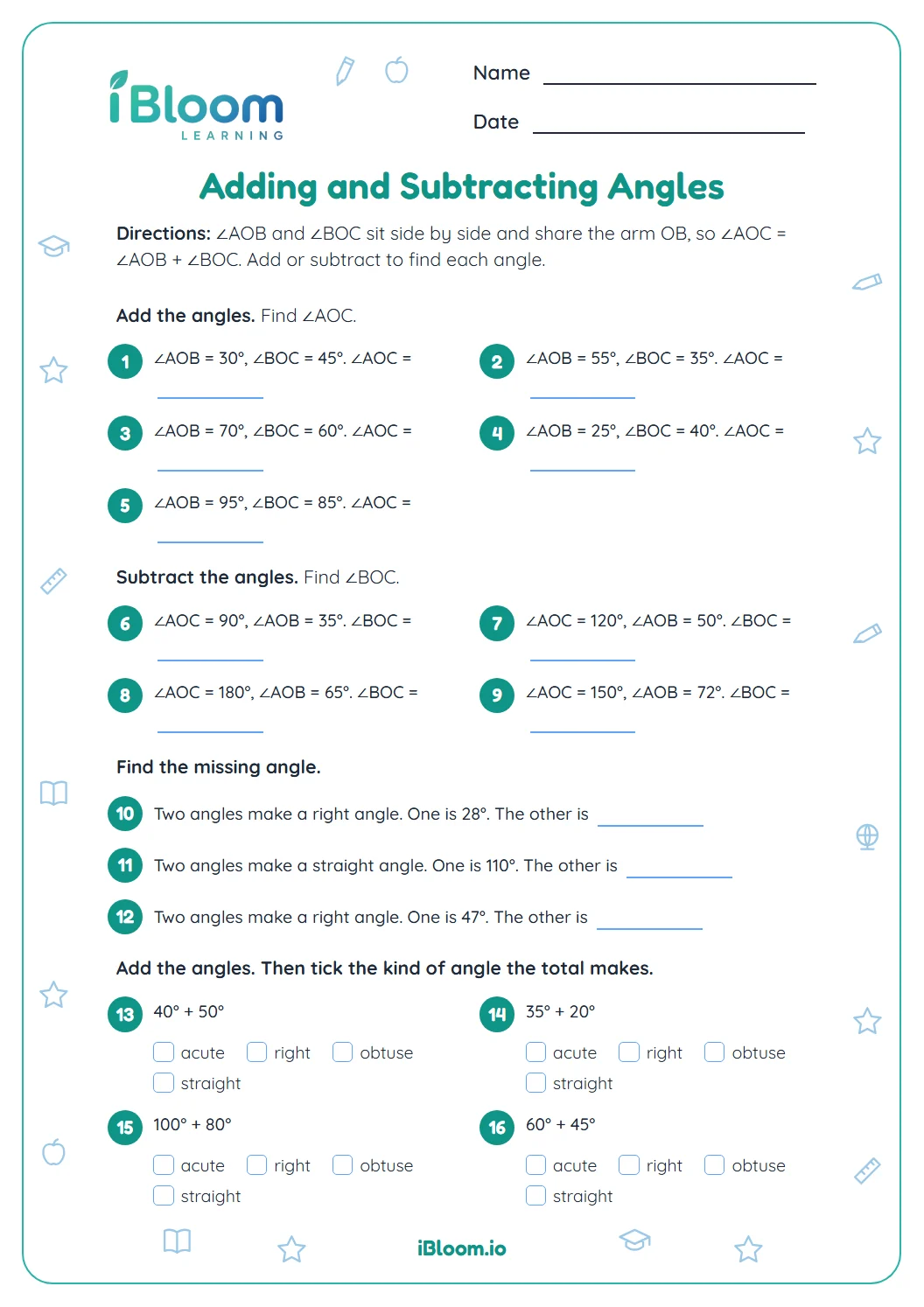
Download the free adding and subtracting angles worksheet PDF
Answer key preview
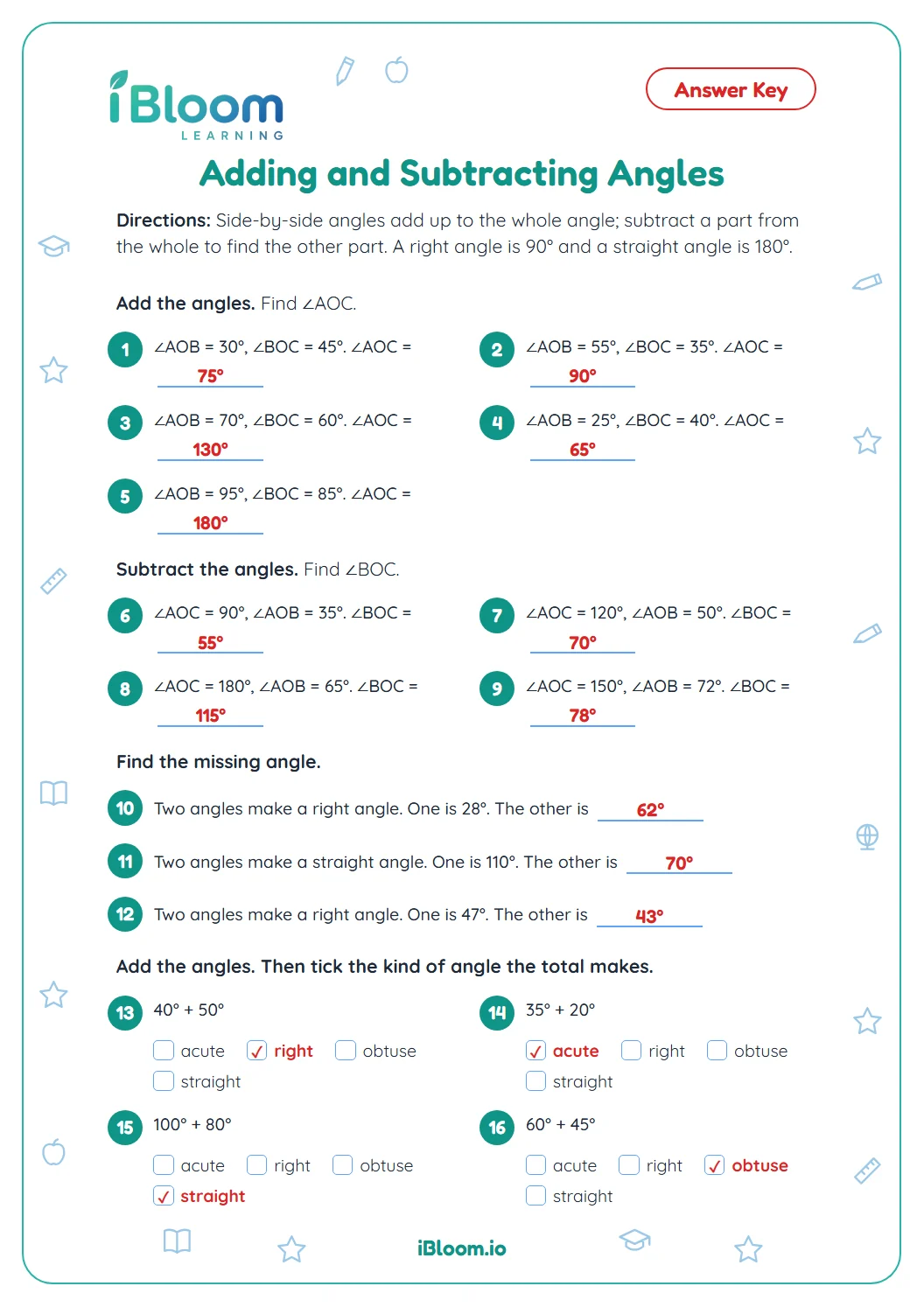
Have your child sketch the two angles side by side before adding, so they can see the whole angle they are finding.
Table of Contents
Introduction
Adding and subtracting angles is a fundamental skill in a child's mathematical journey, crucial for understanding geometry and spatial awareness. Picture a classroom where students eagerly engage with interactive worksheets, each step demystifying the complexities of angles. At iBloom, we aim to transform this learning experience with our innovative AI-powered platform, offering an adding and subtracting angles worksheet that adapts to individual learning needs. Our platform not only addresses these core concepts but also diagnoses learning gaps, ensuring every child progresses with confidence and clarity. Explore our tutorials and discover how iBloom can be your partner in nurturing mathematical brilliance.
Understanding Angles
The Basics of Angle Measurement
Angles are everywhere in our world, from the architecture around us to the paths we walk. Understanding angles begins with recognising their basic units and types—acute, obtuse, right, and straight angles. Grasping these concepts early on lays the groundwork for more advanced mathematical operations. According to a 2024 study by the National Council of Teachers of Mathematics, students who engage with visual and interactive materials show a 30% improvement in spatial reasoning and angle comprehension. By integrating worksheets that focus on these basic principles, children can build a robust foundation in geometry.
Comparing Angles in Everyday Contexts
To help students relate angles to real-world scenarios, teachers can use comparison tables to illustrate different angle types. For instance:
| Angle Type | Measurement Range | Everyday Example | Visual Representation |
|---|---|---|---|
| Acute | 0° - 90° | Slice of pizza |  |
| Right | 90° | Corner of a book |  |
| Obtuse | 90° - 180° | Open door |  |
| Straight | 180° | Flat line | 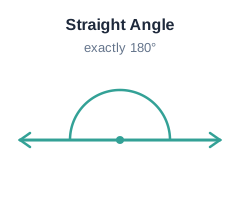 |
This approach not only solidifies understanding but also enhances students' ability to identify angles in their surroundings.
Practical Applications of Angle Worksheets
Engaging Activities for Angle Mastery
Interactive worksheets present angles in a dynamic format, making learning both fun and effective. By incorporating games and challenges, such as constructing angles using everyday objects, children can see the practical applications of their learning. iBloom's SpellBee spelling game exemplifies how gamified learning can enhance engagement and retention.
Step-by-Step Guide to Solving Angle Problems
- Identify the Angle Type: Determine if the angle is acute, right, obtuse, or straight.
- Use Tools: Employ protractors to measure angles accurately.
- Apply Addition/Subtraction: Add or subtract angles using worksheets, referring to the number line for guidance.
- Check Your Work: Verify results with peers or educators to ensure accuracy.
- Reflect and Adjust: Consider different problem-solving approaches for varied angle scenarios.

Strategies for Teaching Angles
Innovative Teaching Techniques
Educators can employ a variety of strategies to teach angles effectively. Hands-on activities, such as creating angles with string or using body movements, can make abstract concepts tangible. A 2025 report by the Educational Development Institute highlights that kinesthetic learning increases student engagement by 40%, underscoring the value of such methods.
Incorporating Technology in Angle Education
Embracing technology in the classroom offers numerous benefits. Digital resources, like iBloom's adaptive lessons, cater to diverse learning styles, providing instant feedback and personalised pathways. This approach not only supports traditional teaching methods but also prepares students for a technology-driven future.
Expert Insight: "Integrating digital tools in mathematics education enhances students' problem-solving skills and adaptability," says Dr. Jane Robertson, Educational Psychologist, 2026.
Common Challenges and Solutions
Overcoming Learning Obstacles
Despite the benefits, some students may struggle with angles due to abstract thinking requirements. Addressing these challenges involves breaking down complex problems into manageable steps, using visual aids and real-world examples. According to a 2026 educational survey, 75% of teachers reported improved student outcomes when employing visual learning strategies.
Tailored Approaches for Diverse Learners
Recognising that each student learns differently, iBloom provides customised resources to meet varied educational needs. Our diagnostic assessments identify specific learning gaps, allowing educators to tailor their instruction accordingly. This personalised approach ensures that all students can succeed in mastering angles.
| Challenge | Solution | Outcome |
|---|---|---|
| Abstract Concepts | Visual Aids, Examples | Improved Understanding |
| Diverse Learning Needs | Customised Resources | Personalised Learning |
| Limited Engagement | Interactive Worksheets | Increased Interest |
| Measuring Difficulties | Step-by-Step Instructions | Greater Accuracy |
Resources and Tools for Angle Learning
Essential Resources for Educators
Teachers seeking to enhance their angle instruction will find a wealth of resources available. From online tutorials to interactive whiteboards, these tools can transform the learning experience. iBloom offers a comprehensive suite of resources, including assessments and diagnostic tools, to support educators in delivering high-quality education.
Building a Supportive Learning Environment
Creating an environment conducive to learning involves more than just providing resources. Encouraging collaboration, fostering curiosity, and promoting problem-solving are key components of a successful classroom. By integrating these elements, educators can inspire students to explore mathematical concepts with enthusiasm and confidence.

Integrating Technology in Angle Education
The Role of Technology in Modern Classrooms
In today's digital age, technology plays a crucial role in education. By leveraging digital tools, such as iBloom's platform, teachers can offer students a rich, interactive learning experience. According to a 2025 study by the International Society for Technology in Education, classrooms that utilise technology see a 50% increase in student engagement and achievement.
Quote: "Technology is not just a tool; it is a catalyst for transforming education," asserts Professor Mark Thompson, Educational Technologist, 2026.
Enhancing Learning Through Digital Platforms
Digital platforms provide students with access to a wide range of resources, enabling them to learn at their own pace. iBloom's adaptive lessons and interactive worksheets offer students the opportunity to engage with material in a way that suits their individual learning styles, leading to improved outcomes and a deeper understanding of angles.
Frequently Asked Questions
How can I help my child understand angles better?
Encourage hands-on activities and use interactive worksheets like those from iBloom to make learning angles engaging. Explore our assessments to identify and address any learning gaps.
What tools can assist in teaching angles?
Protractors, interactive whiteboards, and digital platforms like iBloom provide effective tools for teaching angles, promoting a comprehensive understanding.
How do interactive worksheets benefit students?
They offer personalised learning experiences, instant feedback, and engaging content, which can significantly enhance student understanding and retention.
Can technology replace traditional teaching methods?
Technology complements, rather than replaces, traditional methods by providing additional resources and personalised learning opportunities.
What are the benefits of using iBloom for angle education?
iBloom offers adaptive lessons, interactive worksheets, and diagnostic assessments, providing a comprehensive approach to mastering angles.
Conclusion
Mastering the art of adding and subtracting angles is a crucial step in a child's mathematical development. With the right resources and strategies, parents and educators can make this journey both enjoyable and effective. iBloom stands ready to support this endeavour with its innovative platform, offering everything from interactive worksheets to diagnostic assessments. To explore these tools and start transforming your child's learning experience, start a free trial on iBloom today.
Related practice
Practice this topic
Continue with a lesson, generator, or printable worksheet.