Addition With Regrouping Worksheets Grade 2
Addition with regrouping worksheets for Grade 2 should show why ten ones become one ten, then help children practise the written method carefully.
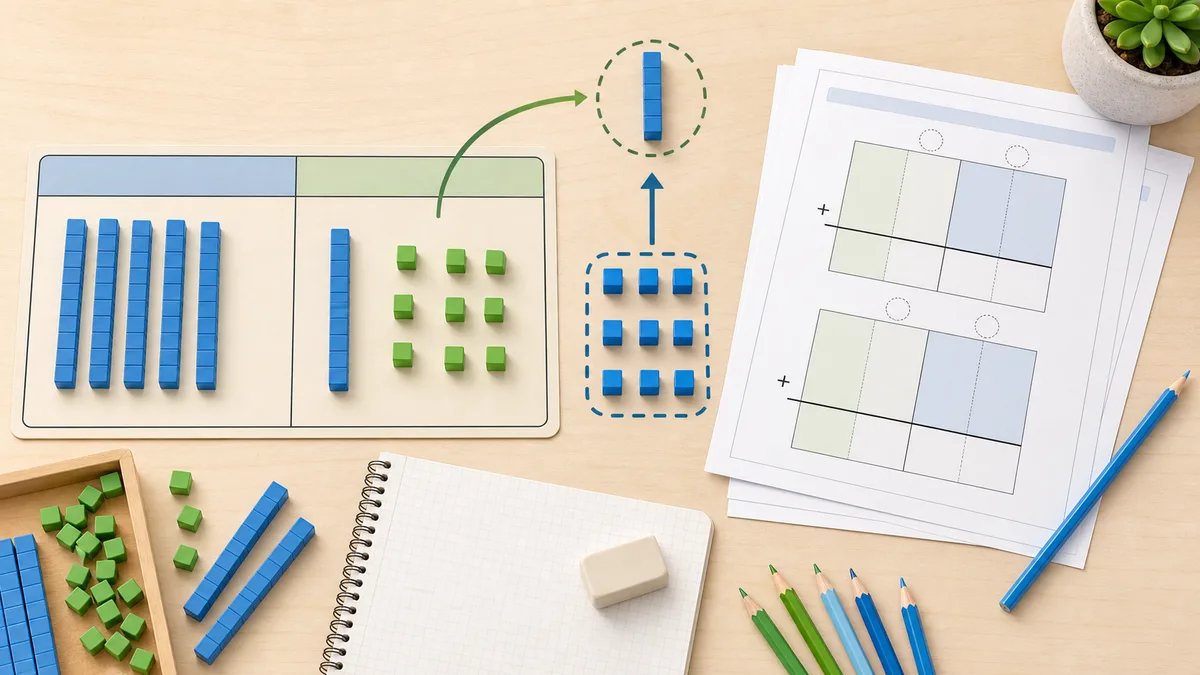
Addition with regrouping worksheets for Grade 2 should show why ten ones become one ten, then help children practise the written method carefully. This guide is written for teachers, parents, tutors, homeschool families, and children who need addition practice that is clear, visible, and connected to real worksheet work. Use it with Addition Worksheets for Grade 2, Place Value Worksheets Grade 2, Building Numbers Worksheets Grade 2, and direct practice such as adding two-digit numbers and one-digit numbers or adding two-digit numbers and multiples of 10.
Start With iBloom Practice
Use one direct iBloom worksheet or lesson before or after reading this guide so the child immediately practises the skill.
Table of Contents
Worksheet And Lesson Previews
Adding Two-Digit Numbers and One-Digit Numbers Worksheets for First Grade Preview
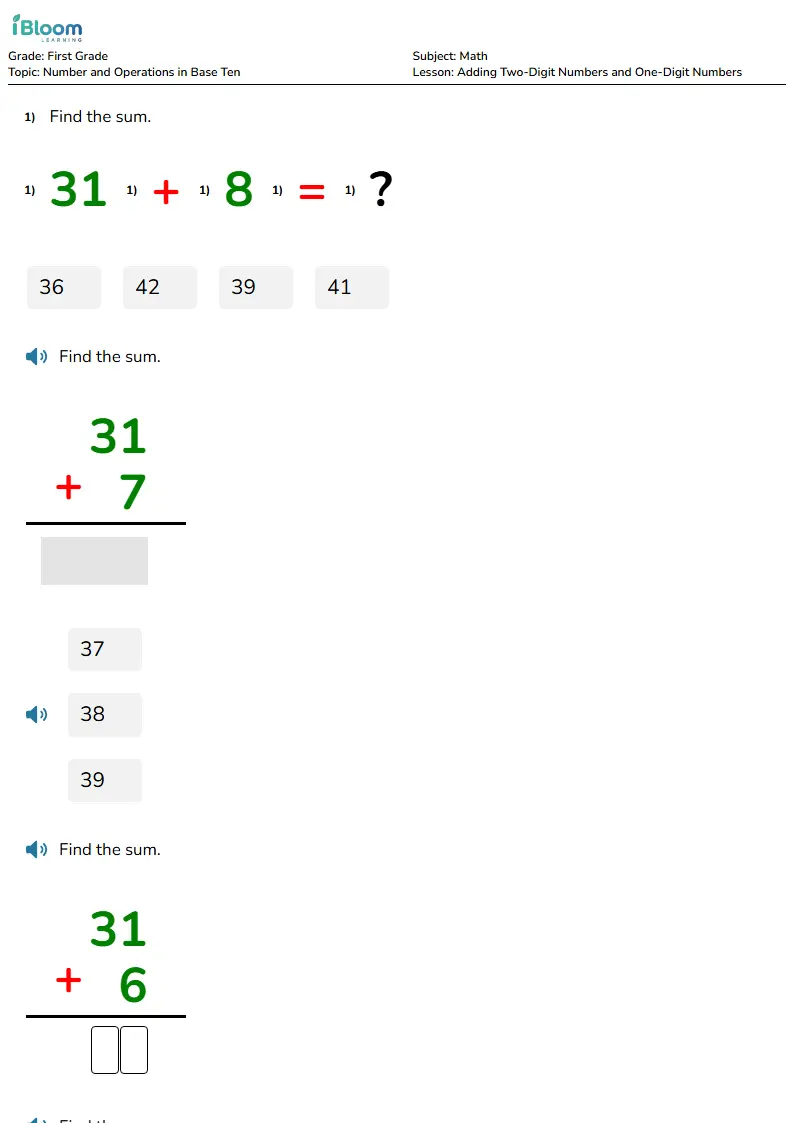
Use this preview to see the kind of practice children will open before you start the routine.
Adding Two-Digit Numbers and Multiples of 10 Worksheets for First Grade Preview
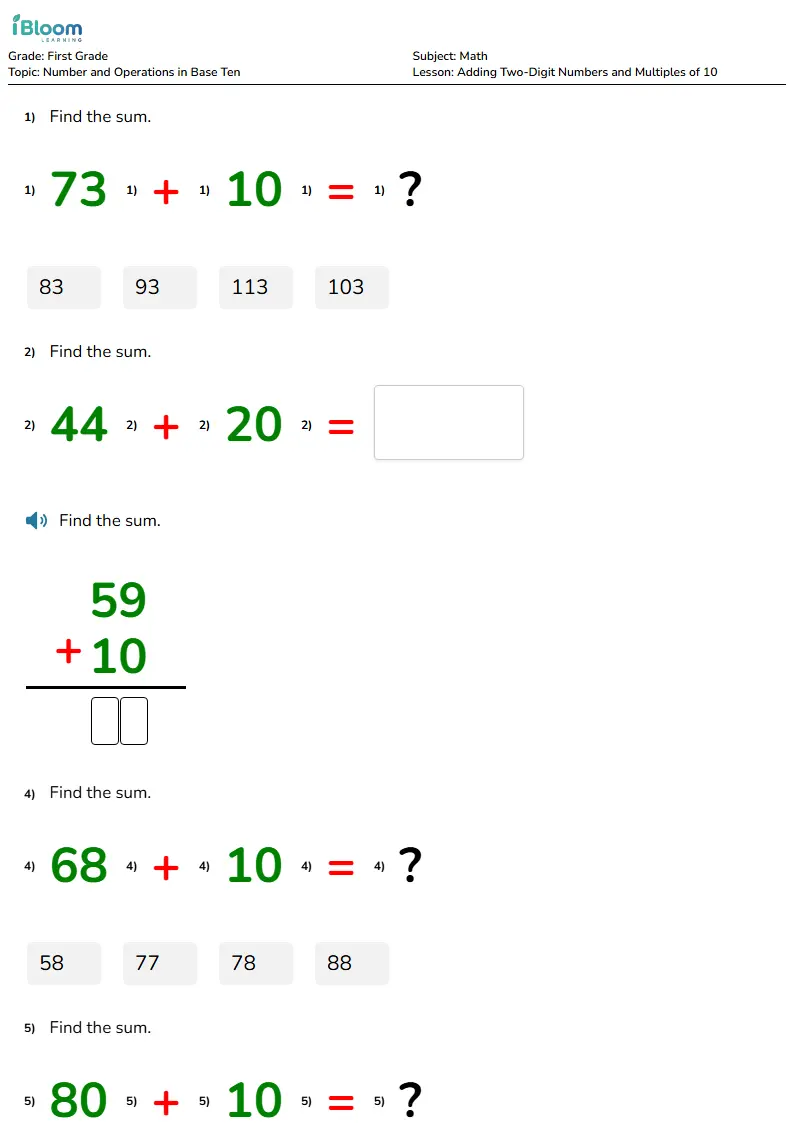
Use this preview to see the kind of practice children will open before you start the routine.
Adding Two-Digit Numbers with Regrouping Worksheets for Second Grade Preview
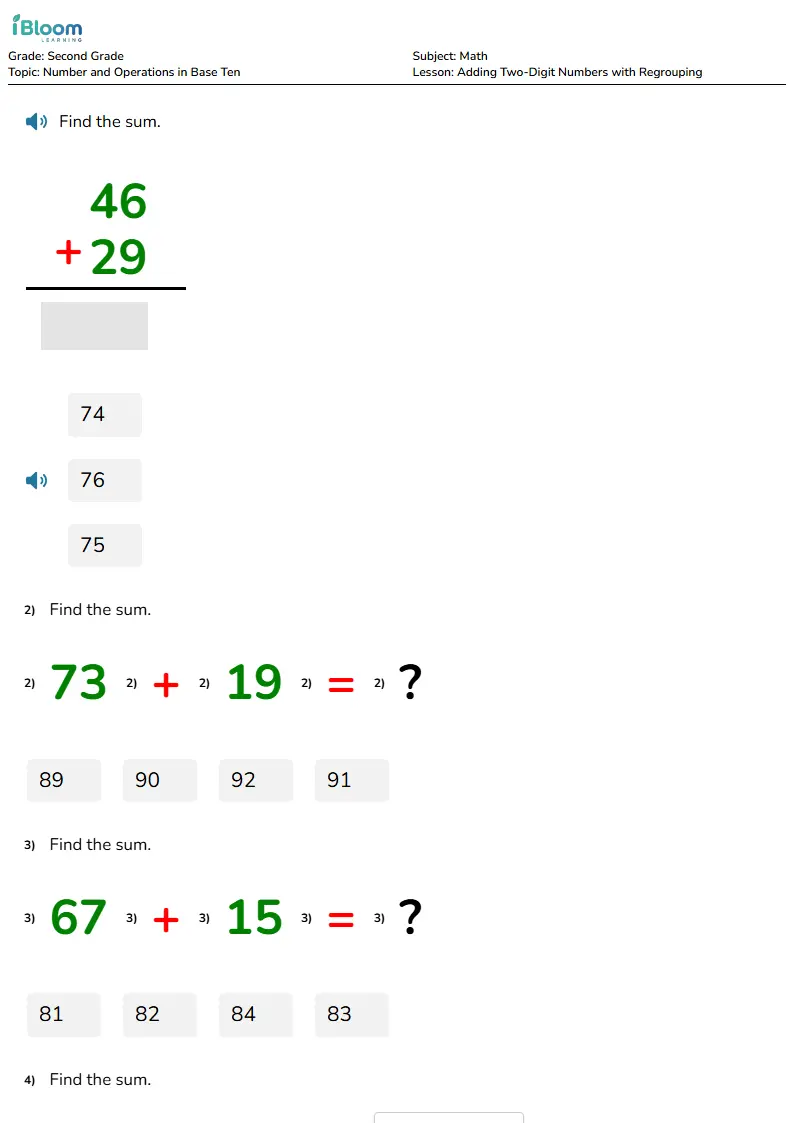
Use this preview to see the kind of practice children will open before you start the routine.
Key Takeaways
- Grade 2 addition should connect tens, ones, models, number lines, equations, and short explanations.
- Children learn more when adults ask, "How did you know?" after one problem.
- Regrouping is easier when children first build ten ones and trade them for one ten.
- Word problems need reading support: find the action, choose the numbers, model the situation, and write the equation.
- Short daily practice is stronger than a long worksheet packet once a week.
Why Grade 2 Addition Needs Place Value
Grade 2 addition is not only about getting larger answers. Children are learning that two-digit numbers are built from tens and ones, and that adding can happen by combining ones, combining tens, using a number line, decomposing numbers, or writing a vertical equation. The IES practice guide for teaching math to young children supports intentional instruction with examples, math language, and repeated practice. The NCTM principles and standards also emphasize representation, reasoning, and communication, while the Common Core Grade 2 number and operations standards show why place value is central to this stage.
For children, this means a worksheet should not feel like a silent stack of sums. A strong page asks the child to build, draw, write, say, and check. If the problem is 36 + 24, ask what happens to the ones first, then what happens to the tens. If the problem is a story, ask what is being joined and what question is being asked.
A Step-by-Step Practice Routine
1. Build the numbers
Use counters, base-ten blocks, sketches, or place-value mats. Ask the child to show tens and ones separately. This helps children see the number before writing the equation.
2. Add ones first when it helps
Children can combine the ones, then decide whether ten ones need to be regrouped. This is especially useful for addition with regrouping practice and for children who forget to carry.
3. Add tens and explain
After the ones are handled, combine the tens. Ask the child to say a sentence such as, "I have five tens and two ones, so the answer is 52." This oral explanation builds number sense.
4. Check with another strategy
Use a number line, mental math, decomposition, or a quick estimate. The child does not need every strategy every time, but one check prevents blind copying.
5. Move to the worksheet
Now complete a few worksheet problems. A short page connected to two-digit addition practice is better than a crowded page that hides mistakes.
Parent Practice Plan
Parents can use this routine for ten minutes at home. Start with two numbers, build them with objects, and ask the child what changed. In India, this can support CBSE, ICSE, state-board, Class 2, Delhi, Mumbai, Bengaluru, Chennai, Hyderabad, Pune, Kolkata, Ahmedabad, Jaipur, Kerala, Tamil Nadu, Karnataka, Maharashtra, Telangana, Gujarat, Rajasthan, and West Bengal. In the United States, it supports Grade 2 classrooms, homeschool, intervention, California, Texas, Florida, New York, Illinois, Pennsylvania, Ohio, Georgia, North Carolina, Michigan, Los Angeles, Houston, Chicago, Dallas, Seattle, Boston, Denver, Atlanta, and Miami. In the UAE, it can support Dubai, Abu Dhabi, Sharjah, Ajman, Al Ain, Ras Al Khaimah, Fujairah, Umm Al Quwain, British, American, IB, and Indian curriculum settings.
If a child resists writing, keep the first round oral. Let the child build and explain. Then ask for only two written problems. The goal is not to fill a page quickly; the goal is to understand what addition does.
Teacher Practice Plan
Teachers can use one page in four ways:
- Morning warm-up: one two-digit addition problem with a quick model.
- Small group: build the numbers and explain the regrouping.
- Math center: pair the worksheet with base-ten blocks or number cards.
- Exit ticket: one problem and one sentence explaining the strategy.
For children who finish quickly, ask them to solve the same problem another way. For children who need support, reduce the numbers and use blocks. A teacher can connect this to Place Value Worksheets Grade 2 before moving into larger addition.
Examples Children Can Try
- Add 34 + 20 and explain what happened to the tens.
- Add 27 + 15 with a drawing and show where regrouping happens.
- Write a story problem for 18 + 26.
- Solve 45 + 19 using a number line.
- Check one answer by estimating before calculating exactly.
For more foundation, use Building Numbers Worksheets Grade 2. For a related Grade 1 bridge, use Ten Frame Addition Worksheets for Grade 1 or Addition on a Number Line for Grade 1.
Common Mistakes
- Adding digits without thinking about tens and ones.
- Forgetting to regroup ten ones as one ten.
- Carrying a ten but not adding it to the tens column.
- Choosing numbers from a word problem without reading the question.
- Writing an answer that is smaller than both addends without checking.
When this happens, do not only mark the answer wrong. Ask the child to build the problem or explain the story. The explanation will usually show whether the difficulty is place value, regrouping, reading, or attention.
Keep Practicing With iBloom
Use a direct practice page next so the child moves from explanation into action.
Frequently Asked Questions
What should Grade 2 children know before two-digit addition?
They should understand tens and ones, count within 100, and explain simple addition with objects, drawings, or number lines.
When should children learn regrouping?
Children can begin regrouping when they understand that ten ones can be traded for one ten. Use blocks or drawings before relying only on vertical notation.
How long should addition practice take?
Ten to fifteen minutes is enough for many children. A short routine with one explanation is often stronger than a long page.
Are word problems harder than number sentences?
They can be, because the child must read the story, choose the numbers, and decide what action is happening. Use drawings and simple number sentences to support this.
What should we practise next?
Use the linked iBloom worksheet or lesson above, then return to place value if the child makes repeated regrouping errors.
Related practice
Practice this topic
Continue with a lesson, generator, or printable worksheet.