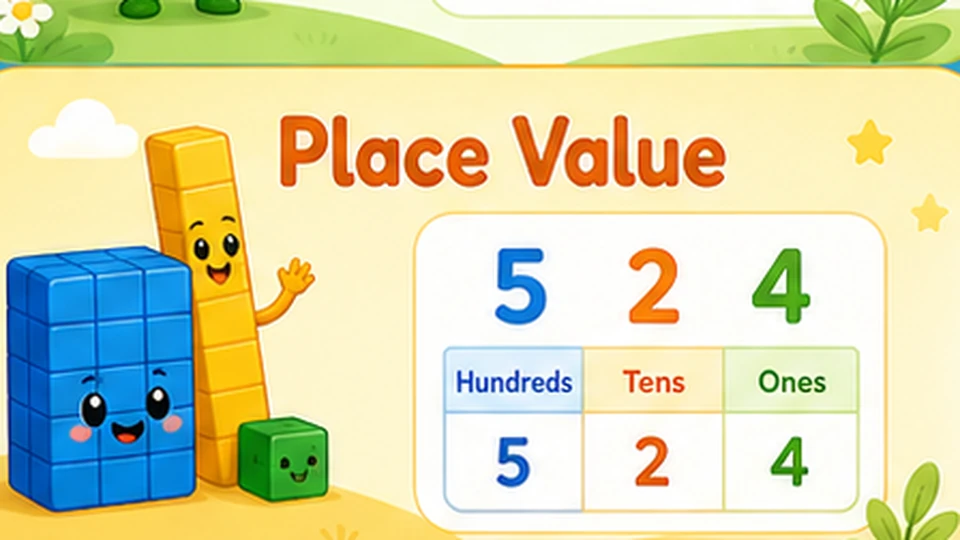
Can Kids Learn Place Value Without Base-Ten Blocks?
A practical U.S.-focused guide to teaching place value with household materials and drawings while preserving base-ten grouping and trading.
Can Kids Learn Place Value Without Base-Ten Blocks?
Yes. Children can learn place value without owning commercial base-ten blocks, but they should not be asked to rely on written digits alone. They need a model that makes three ideas visible: ten ones can be composed into one ten, ten tens can be composed into one hundred, and the value of a digit depends on its position. Bundled straws, craft sticks, connecting cubes, counters in cups, hand-drawn block pictures, place-value charts, and open number lines can all support that reasoning when adults explicitly connect each model to spoken number names and written numerals.
Base-ten blocks are useful because their pieces are proportional: a ten rod is physically ten times a unit, and a hundred flat is ten rods. The important feature is not the plastic. It is the relationship the material represents. A substitute works when the child can build, trade, draw, explain, and finally work without the object. A substitute fails when it becomes a decorative counting aid or an arbitrary color code that hides why ten ones equal one ten.
This guide is for United States parents, homeschoolers, tutors, and elementary teachers, especially those supporting children in Grades 1 and 2. It explains which alternatives preserve the mathematics, how to introduce them, how to diagnose common errors, and how to decide when a learner is ready to move from objects to drawings and symbols.
What Place Value Understanding Actually Looks Like
A child understands place value when a numeral is more than a sequence of digit names. In 47, the 4 represents four tens, or forty, while the 7 represents seven ones. The same digit 4 represents a different amount in 47, 407, and 4. Position matters because our written system is organized in powers of ten.
Place value is visible in several related actions. A child can make 47 as four groups of ten and seven single objects, rename it as forty-seven ones, write 40 + 7, locate it between 40 and 50, explain that adding one ten produces 57, and compare it with 74 without merely saying that 7 is a bigger digit. No single worksheet item proves all of these connections.
The Massachusetts Grade 2 Number and Operations in Base Ten standards map describes three-digit numbers as amounts of hundreds, tens, and ones and includes reading and writing numbers using numerals, number names, and expanded form. It also connects addition and subtraction to concrete models, drawings, and place-value strategies. That range of representations is the key point for families: blocks are one option within a larger representational system.
Before teaching, ask the child to represent 36 in as many ways as possible. Accept objects, bundles, drawings, words, equations, or a number line. Then ask:
- What does the 3 mean in 36?
- Could 36 be made with no tens? How?
- What happens if we add one more ten?
- What happens if we trade one ten for ones?
- Is 36 closer to 30 or 40? How do you know?
The explanations reveal more than the final answers. A child who says “the 3 is three” needs stronger unit language. A child who can build three bundles and six singles but cannot connect them to 30 + 6 needs a bridge from objects to notation.
Why Base-Ten Blocks Help, and What an Alternative Must Preserve
Commercial base-ten blocks offer consistent units, clear trades, and proportional size. Ten individual cubes align with one rod; ten rods cover one flat. That physical match supports the idea that the unit has changed while the total quantity has stayed equal.
The U.S. Department of Education’s elementary mathematics intervention practice guide lists concrete and semi-concrete representations for place value, including base-ten blocks, tiles, connecting cubes, place-value charts, block pictures, and hundreds charts. It also advises using proportional representations when appropriate. This supports a careful answer: alternatives are legitimate, but adults should choose them for the relationship they reveal.
A strong alternative has four properties.
The units are clear
One loose straw represents one. A tied bundle of ten straws represents one ten. The child should know what each object stands for without guessing from color alone.
A trade can be demonstrated
The child can count ten singles, bundle them, and exchange them for one ten while explaining that the quantity did not change. If an object cannot be grouped or traded, pair it with a drawing or chart that makes the exchange visible.
The model connects to symbols
The child places four bundles in a tens column and seven singles in a ones column, then writes 47 and 40 + 7. Objects without this bridge can become a separate game instead of mathematical support.
The support can be faded
After working with objects, the child sketches bundles and singles, uses a place-value chart, and eventually reasons with numerals. The goal is not permanent dependence on one material. The goal is a transferable base-ten idea.
The Best Household Alternatives
Bundled straws or craft sticks
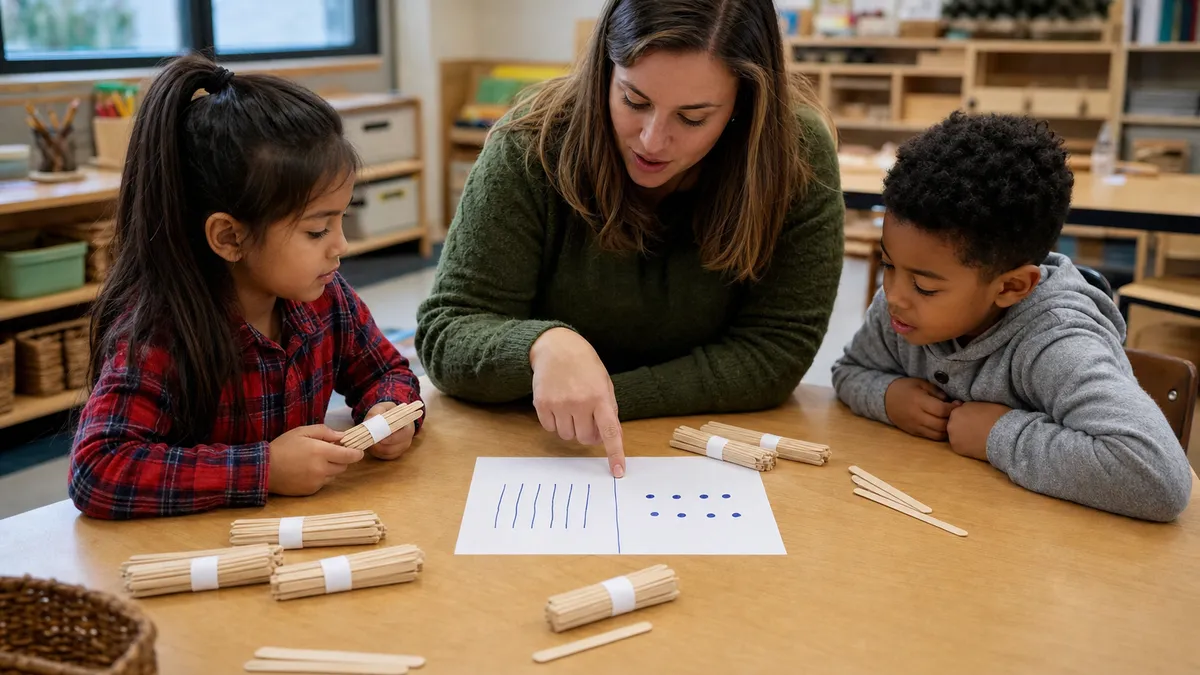
Give the child loose straws and rubber bands. Count ten straws, bind them, and call the result one ten. Build numbers by combining bundles and singles. For 32, use three bundles and two loose straws.
This model is groupable: the child personally performs the trade. It is especially helpful when a learner treats a ten rod as simply “one long block” and forgets that it contains ten ones. Open a bundle to prove the equivalence.
Avoid pre-making every bundle. Let the child create at least some groups of ten. The action is part of the meaning. Later, keep a few bundles ready so the task does not become a test of tying rubber bands.
Counters and small cups
Place ten counters in a cup to make one ten. Keep single counters outside cups. A tray or sheet labeled tens and ones organizes the units. To regroup, empty a cup or fill one.
This option works well when loose objects are available but rods are not. Use identical cups and counters so decorative differences do not suggest mathematical differences. Say “one cup of ten” before shortening the phrase to “one ten.”
Connecting cubes
Join ten cubes into a stick. Keep single cubes loose. Unlike a pregrouped rod, the stick can be taken apart, which makes composing and decomposing explicit. Check that each ten-stick actually contains ten cubes; children sometimes build sticks of nine or eleven and then count sticks as if they were equivalent.
Drawn sticks and dots
After the child has bundled real objects, replace each bundle with a quick line and each one with a dot or small square. Three lines and six dots represent 36. Write the numeral and expanded form beside the drawing.
Drawings are not a lesser version of manipulatives. They are an important bridge between physical action and abstract notation. The child must understand what each mark represents. A line is not automatically ten; it is ten because the class or family has defined and connected it to a bundle.
Ten-frames and place-value charts
A full ten-frame can stand for one ten, while additional counters represent ones. Place-value charts organize tens and ones into columns. These models are useful, but they should not become procedures where children place digits in boxes without understanding the quantities.
Use the iBloom First Grade composing and decomposing tens and ones worksheet after a hands-on trade. Pair it with the matching tens-and-ones lesson when the child needs a modeled connection between groups and numerals.
A Five-Minute Diagnostic Before You Teach
Use the number 24 and ask the child to complete five tasks.
- Build 24 with any available objects.
- Circle or bundle groups of ten.
- Draw what was built.
- Write an equation showing the parts.
- Explain what the 2 means in 24.
Notice where the chain breaks.
If the child counts 24 objects one by one but never groups, work on making and naming tens. If the child makes two bundles and four singles but writes 2 + 4, connect each bundle to ten and write 20 + 4. If the child writes 24 but says the 2 means two, ask “two what?” If the child can explain 24 but not 42, compare the positions directly.
Next, ask for another representation of 24. A strong answer might be one ten and fourteen ones or twenty-four ones. Flexible renaming matters because regrouping later depends on understanding that one ten and ten ones are equal quantities.
Do not begin with three-digit numbers when the tens-and-ones relationship is unstable. A child who memorizes hundreds, tens, and ones column names without understanding a trade may produce correct-looking answers that collapse during addition or subtraction.
A Parent-Friendly Teaching Sequence
Session 1: Make and name a ten
Count ten loose objects. Bundle or contain them. Say, “Ten ones make one ten.” Open the bundle and recount to show equality. Repeat with a different set of ten, then ask the child to teach the trade back to you.
Session 2: Build teen numbers
Build 13, 16, and 19 as one ten and some ones. Match each model to its numeral and spoken name. Ask what remains the same and what changes. Teen number names can obscure the tens-first structure, so consistently say “one ten and six ones; sixteen.”
Session 3: Build two-digit numbers
Use several tens and ones. Build 42, then 24. Place the models side by side and discuss why reversing digit positions changes the value. Write 40 + 2 and 20 + 4.
Session 4: Trade in both directions
Start with two tens and thirteen ones. Ask whether the number can be represented with fewer loose objects. Trade ten ones for one ten and explain why the total remains 33. Reverse the process by opening a ten.
Session 5: Move to drawings
Put the objects away after building one example. Draw lines for tens and dots for ones. Translate the drawing into a numeral and expanded form. If the child becomes uncertain, briefly return to objects and then redraw.
Session 6: Apply the idea
Ask what happens to 46 when ten is added or subtracted. The ones remain six while the tens change. Use an open number line to jump by ten. This shows place value as a tool for reasoning, not only a naming lesson.
Keep sessions focused and stop after a clear explanation. The relevant sign of progress is not how many numbers the child built. It is whether the child can connect quantities, units, words, and symbols.
Move From Objects to Drawings to Symbols
Manipulatives are most useful when adults make the connections explicit. Use a three-column record:
| Object or action | Drawing | Symbols and words |
|---|---|---|
| Four bundles and seven singles | Four lines and seven dots | 47 = 40 + 7; four tens and seven ones |
| Trade ten singles for one bundle | Cross ten dots and draw one line | 10 ones = 1 ten |
| Open one bundle | Cross one line and draw ten dots | 1 ten = 10 ones |
Ask the child to explain how each column represents the same amount. Then cover one column and reconstruct it from the others. This tests transfer rather than copying.
The iBloom Second Grade represent three-digit numbers using place value lesson can extend the sequence to hundreds. Use the matching three-digit place-value worksheet only after the child can explain hundreds, tens, and ones rather than merely count pictured pieces.
For another symbolic bridge, use the Second Grade word, expanded, and standard form lesson and its matching forms worksheet. The pages depict blocks, but the same reasoning can be reproduced with bundles, drawings, or a chart.
How to Know When to Fade the Model
Do not remove objects simply because a calendar says the unit is over. Fade them when the child can explain and reconstruct the relationships.
A learner may be ready for drawings when they can build a requested number, identify each unit, make a valid trade, and connect the model to expanded form. A learner may be ready for mostly symbolic work when they can sketch a model if needed, explain a digit’s value, rename a number flexibly, and detect an unreasonable answer.
Fade one support at a time. Move from bundled straws to drawn bundles, then to a place-value chart, then to expanded notation. Keep models available for new tasks such as regrouping. Returning to a model is not failure; it is a reasoning tool.
Use unexpected representations to test understanding. Show 3 tens and 14 ones and ask for the number. Show 52 as 5 lines and 2 dots, then ask for another drawing. Ask whether 6 tens and 23 ones is possible and how it can be renamed. Children who only learned a canonical picture may need more trading practice.
Common Problems and Specific Fixes
The child counts every object by ones
Ask the child to make groups that can be counted efficiently. Count “ten, twenty, thirty, thirty-one, thirty-two” while touching bundles and singles. Then ask why the bundle can be counted as ten without reopening it.
The child thinks a ten-stick means one
Take it apart or compare it directly with ten singles. Use the full phrase “one group of ten” until the relationship is secure. Avoid asking only “How many rods?” because the answer one can reinforce object-counting rather than value.
The child writes digits in the wrong order
Build the number and place each unit in a labeled column. Say the value before writing the digit: “four tens is forty, so 4 goes in the tens place.” Compare 24 and 42 with models. Do not rely on the spoken number name alone.
The child writes 20 + 4 as 204
Return to the model. Ask how many tens and ones are present, then write the numeral in columns. Explain that 20 already contains a zero in the ones place; adding four ones changes that place to 4 rather than appending another digit.
The child can build but cannot explain
Use sentence frames: “The digit ___ is in the ___ place, so its value is ___.” “I traded ___ ones for ___ ten.” “These models are equal because ___.” Accept pointing and short phrases first, then expand the language.
The child knows place labels but cannot regroup
Perform a physical trade before showing an algorithm. For 28 + 7, combine ones, count fifteen ones, trade ten for one ten, and record what changed. The iBloom Second Grade addition with regrouping lesson can connect the trade to a written method. Follow with the Third Grade two-digit regrouping worksheet as a later check, not as the first explanation.
Classroom Small-Group Plan
Begin with a mystery bag containing loose counters and bundled groups of ten. Ask students to determine the total without opening bundles. Listen for whether they count bundles as objects or units of ten.
Next, give each pair a number card. One student builds the number, one draws it, and one writes standard and expanded form. Students rotate roles. The explainer must use the words ones, tens, value, compose, or decompose as appropriate.
Introduce a nonstandard model after success. Replace blocks with cups of counters or sticks and dots. Ask what mathematical relationship stayed the same despite the new material. This prevents children from associating place value with one brand or color scheme.
Use contrast cases. Show 34, 3 tens and 4 ones, 2 tens and 14 ones, and 34 ones. Ask which are equal and why. Include one incorrect model. Students should prove equality through trades, not visual guessing.
Finish with an exit ticket: “Draw 52 in two different ways and explain what the 5 means.” A child who draws five tens and two ones in both versions has not yet shown flexible decomposition; prompt for four tens and twelve ones or fifty-two ones in the next lesson.
Grade-Level Adjustments
Kindergarten
Focus on making groups of ten and noticing leftovers. Use ten-frames, fingers, egg cartons adjusted to ten spaces, or cups. Do not rush to formal tens-and-ones notation if counting and cardinality are still developing.
Grade 1
Emphasize teen numbers and two-digit numbers as tens and ones. Use groupable materials so children create tens. Connect every model to spoken names and numerals. The Ohio Department of Education’s Grade 1 mathematics model curriculum lists multiple representations, including bundles, linking cubes, beans and cups, ten-frames, and base-ten blocks.
Grade 2
Extend to hundreds, expanded form, comparison, and addition or subtraction within larger numbers. Include zero as a placeholder in numbers such as 406. Ask children to rename quantities flexibly before applying regrouping procedures.
Grade 3 and beyond
Use place value to support rounding, multi-digit operations, multiplication by multiples of ten, and decimals later. Return to models when a new unit relationship appears. Older children do not need babyish materials; use clean diagrams, place-value disks, money analogies with caution, or open number lines.
Accessibility and Home Constraints
Children with fine-motor difficulty may struggle to bundle sticks or handle tiny cubes. Use larger counters, magnetic pieces, digital or printed models, or let an adult bundle while the child directs each trade. The mathematics is choosing and explaining the grouping, not manipulating a rubber band.
For learners with low vision, use high-contrast large objects and tactile groupings. Cups, textured bags, or linked chains can distinguish units. State each action aloud and keep the place-value chart uncluttered.
For multilingual learners, pair precise unit language with action: “ten ones make one ten” while bundling. Allow the child to explain in a familiar language first when possible, then build the English sentence together. Avoid relying on number names alone because language patterns vary.
For children who are distracted by many loose pieces, use a tray with defined tens and ones areas, present one quantity at a time, and store unused materials out of view. A drawn model may be more accessible than a crowded table.
Families do not need to purchase a kit. The Iowa Department of Education provides mathematics supports and resources for families, including place-value resources across elementary grades. Choose simple materials already available and keep the unit meanings consistent.
Misconceptions Adults Should Avoid
“Blocks teach place value automatically” is false. A child can count rods and cubes as separate objects without attending to their values. Adults must ask what each piece represents and how a trade preserves quantity.
“Any colorful object works” is incomplete. Objects work when their grouping and value are defined. Arbitrary colors can become a code the child memorizes. Whenever possible, show or create the ten-to-one relationship.
“Concrete means easy” is also misleading. Materials add actions and visual information. Some children need explicit instruction to connect them to symbols. Use one model consistently before comparing several alternatives.
“Take the blocks away as soon as answers are correct” confuses performance with understanding. Ask for explanation, flexible representation, and transfer. Correct answers may come from counting or a memorized pattern.
“Never use fingers” ignores a natural base-ten resource. Fingers can help children see five and ten, but they do not by themselves represent multiple tens efficiently. Use them as one bridge, then connect to grouped units and notation.
When to Ask the Teacher for Help
Bring specific observations. Say, “She can build 36 as three bundles and six ones but writes 3 + 6,” or “He reads 42 correctly but says the 4 is worth four.” Include the material, prompt, and support that helped.
Ask which representation and vocabulary the class uses so home practice reinforces rather than competes with instruction. Ask whether the difficulty appears with counting, grouping, numeral writing, expanded form, comparison, or regrouping. A shared focus is more useful than trying every worksheet at once.
Seek a broader school conversation when persistent place-value difficulty interferes across tasks despite explicit modeling and practice. One confusing session is not a diagnosis. Patterns across time, settings, and representations provide better information.
Frequently Asked Questions
Are base-ten blocks necessary for teaching place value?
No specific commercial material is necessary. Children do need representations and actions that show grouping by ten, unit value, trades, and connections to symbols. Bundles, cups, cubes, drawings, charts, and number lines can work.
What is the cheapest alternative to base-ten blocks?
Bundled straws or craft sticks are strong low-cost options because children can physically compose and decompose tens. Counters in cups also work. Use materials large enough to handle safely and supervise small objects.
Can I just draw base-ten blocks?
Yes, especially after the child has experienced grouping real objects. Define each mark, connect it to a unit, and include trading tasks. Drawings are a bridge, not merely pictures to count.
What if my child hates manipulatives?
Try a clean drawing, place-value chart, open number line, or verbal trading game. Some children find loose materials distracting. Keep the mathematical relationship but change the representation.
Should every ten be a physically tied bundle?
Not forever. Creating bundles helps establish the unit. Once the child understands, pregrouped or drawn tens make larger tasks efficient. Occasionally reopen a bundle to revisit why it equals ten ones.
When should children work without models?
Fade models when the child can explain digit values, make and reverse trades, connect models to expanded form, and reconstruct a drawing when stuck. Keep representations available for new or difficult tasks.
Do coins teach place value?
Coins can show exchanges, but their sizes are not proportional to value and U.S. coin relationships do not map cleanly onto ones, tens, and hundreds. Use them for money learning, and use clearer grouped models when the goal is base-ten structure.
How can I check understanding quickly?
Ask the child to show one number in two ways, explain one digit’s value, and make one trade without changing the total. A correct numeral alone is not enough evidence.
Why can my child use blocks but not solve written problems?
The connection between representations may be missing. Place the object model, drawing, numeral, expanded form, and spoken explanation side by side. Cover one and ask the child to reconstruct it from the others.
What should we practice next?
Move from composing tens and ones to flexible decomposition, expanded form, comparison, and then regrouping. Advance when the child explains the unit relationships, not simply after completing a set number of questions.
The Practical Next Step
Today, gather twenty-four small objects and two cups or rubber bands. Make one group of ten, then another, leaving four singles. Write 24 and 20 + 4. Open one group and rename the same amount as one ten and fourteen ones. Ask the child why both models equal 24. That short build-trade-draw-explain cycle teaches the relationship that base-ten blocks are designed to show, without requiring the blocks themselves.
Related practice
Practice this topic
Continue with a lesson, generator, or printable worksheet.