Picture Composition for Class 3: Free Worksheet
Teach Class 3 picture composition with an observation method, model paragraph, free printable worksheet, answer key, and direct PDF.
Free printable worksheet
Free Class 3 picture composition worksheet
The student page uses one focused scene called A Windy Day in the Garden. It gives the learner five observation questions, a word bank, three planning boxes, eight writing lines, and a short self-check. The second page shows sample answers, a completed plan, and a model paragraph.
- Free PDF download
- Answer key included
- Ready to print
Free to print and use at home or in class. How to use this worksheet
Picture composition asks a child to study one scene, select useful details, and turn those details into connected sentences. A Class 3 learner does not need to name every object in the picture. The aim is to write a short, clear paragraph that helps another person imagine the scene.
This guide includes an observation method, a planning frame, a model paragraph, and a free two-page worksheet with answers. Parents can use it for a ten-minute home session. Teachers can use the same sequence for whole-class modelling or a writing group.
Free Class 3 picture composition worksheet
The student page uses one focused scene called A Windy Day in the Garden. It gives the learner five observation questions, a word bank, three planning boxes, eight writing lines, and a short self-check. The second page shows sample answers, a completed plan, and a model paragraph.
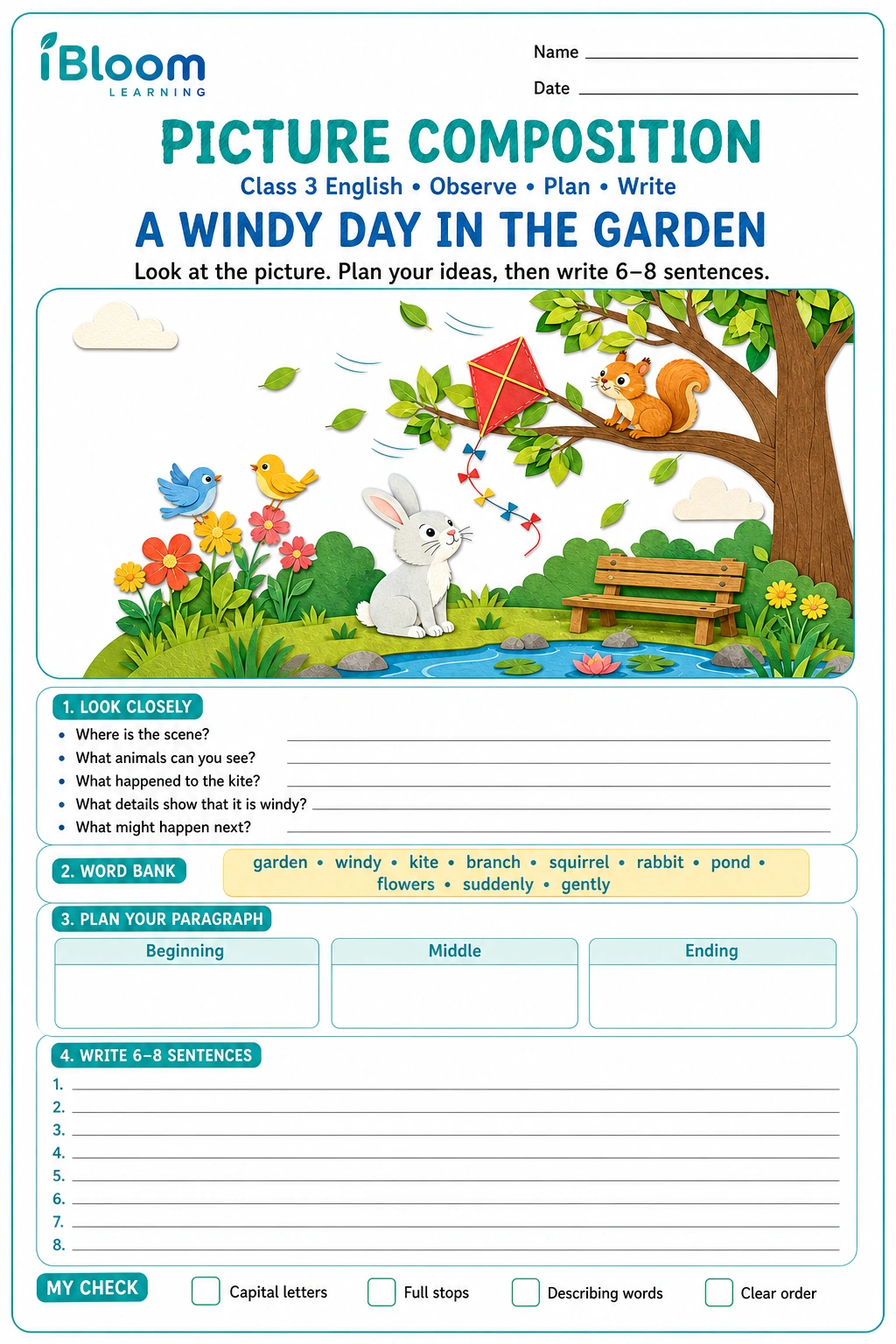
Download the free Class 3 picture composition worksheet PDF
Answer-key preview
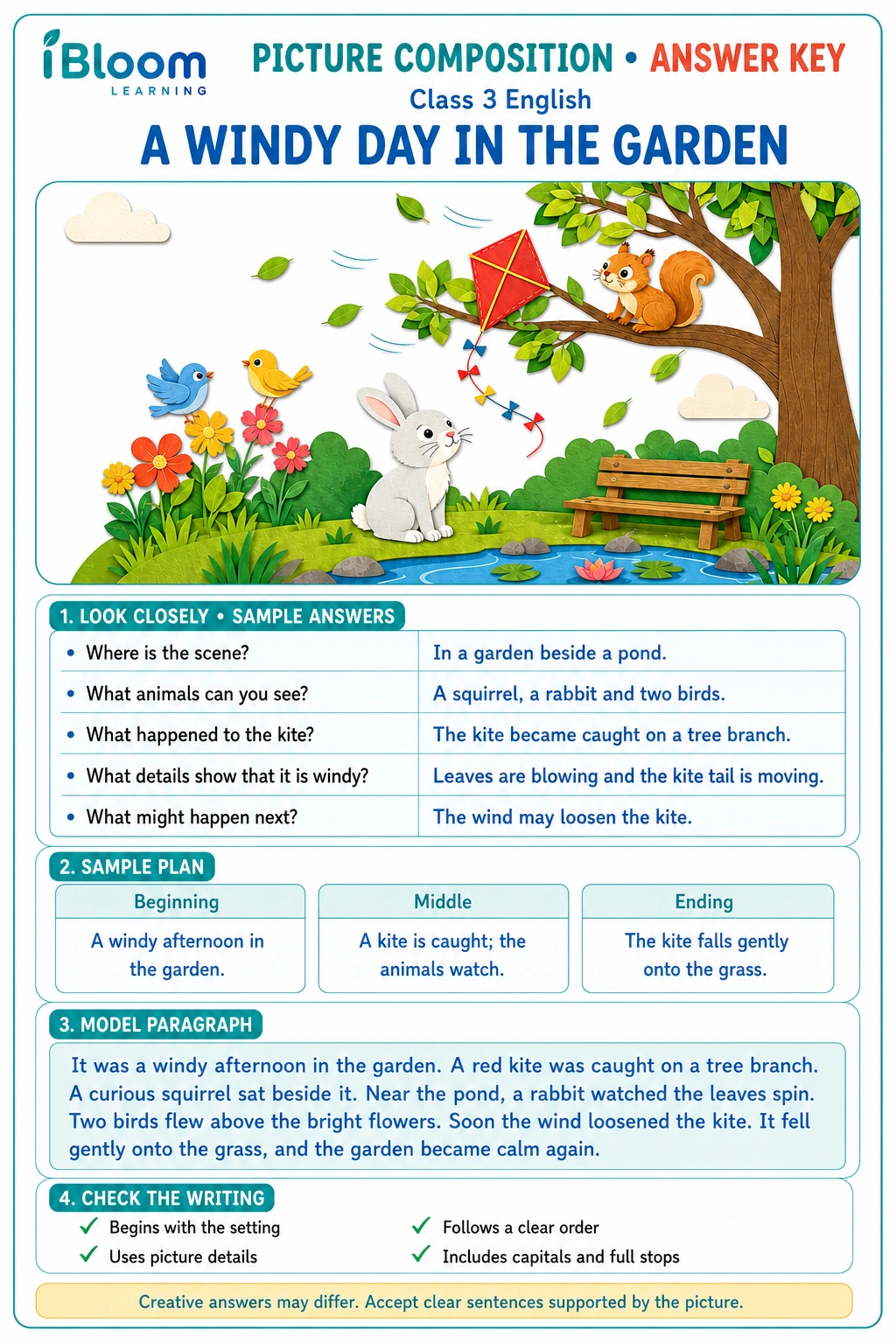
Let the child complete the student page before showing the model. Compare ideas rather than exact wording. Ask which picture detail supports each sentence.
You can also browse English worksheets by grade and skill or choose another activity from the free printable worksheet library.
What is picture composition for Class 3?
In a picture-composition task, the picture supplies the ideas. The learner decides which details belong together and writes them in a sensible order. Most Class 3 tasks ask for five to eight sentences about a familiar place, event, animal, or activity.
A strong response usually does four things:
- names the setting;
- identifies the main subject;
- describes two or three visible actions or details;
- closes with an outcome, feeling, or final observation.
The picture may show far more than a child can fit into one paragraph. Selection is part of the skill. Ask, “Which details help us understand what is happening?” A bench may establish a park setting. A kite caught in a branch may supply the central event. A small stone in the corner may add nothing useful.
Use the Look, Plan, Write method
Class 3 writers often begin before they have chosen an idea. They list objects in random order, repeat I can see, or stop after two sentences. A three-stage routine gives the child enough structure without writing the paragraph for them.
1. Look for the five key details
Study the picture for one minute before picking up a pencil. Find:
- Place: Where does the scene happen?
- Subjects: Which animals, people, or objects matter most?
- Action: What is happening now?
- Clues: What colours, positions, weather details, or expressions add meaning?
- Next event: What could happen after the moment shown?
The last question invites a small inference. The answer must still fit the picture. If a kite hangs from a branch and leaves blow across a garden, “The wind may loosen the kite” makes sense. A sudden trip to the moon does not.
2. Plan a beginning, middle, and ending
Write notes, not full sentences, in three boxes.
| Part | Job | Note for the windy-garden picture |
|---|---|---|
| Beginning | Name the place, time, or weather | windy afternoon in a garden |
| Middle | Describe the main event and supporting details | kite caught; squirrel and rabbit watch |
| Ending | Add a result or final observation | kite falls onto the grass |
The plan protects sentence order. It also shows whether the learner has enough material before drafting.
3. Write and check
Turn each note into a complete sentence. Add describing words only where they help the reader. Read the paragraph aloud after the first draft and check capitals, full stops, spelling, and order.
How to describe a picture without listing objects
An object list sounds like this: “I can see a tree. I can see a kite. I can see a rabbit. I can see flowers.” Every sentence is correct, but the reader learns little about the event.
Connect the details by location and action:
- A red kite is caught on a tree branch.
- A squirrel sits beside the kite.
- A rabbit watches the leaves near the pond.
- Two birds fly above the flowers.
Position words help a writer build the scene: above, below, beside, behind, near, between, in the foreground, and in the background. Action verbs add movement: blows, hangs, watches, circles, rests, and falls.
Teach one or two useful words before the child starts. A long vocabulary list can interrupt the writing. The worksheet word bank contains ten words that match the picture, so the learner can focus on sentence building.
Picture composition example with answer
Study the windy-garden scene in the printable. The main event is the kite caught in the tree. The animals and weather details support that event.
Sample plan
- Beginning: a windy afternoon in the garden
- Middle: red kite caught in a branch; squirrel, rabbit, and birds watch
- Ending: wind loosens the kite; it falls onto the grass
Model paragraph
It was a windy afternoon in the garden. A red kite was caught on a tree branch. A curious squirrel sat beside it. Near the pond, a rabbit watched the leaves spin. Two birds flew above the bright flowers. Soon the wind loosened the kite. It fell gently onto the grass, and the garden became calm again.
This answer uses seven sentences. The first sentence establishes the setting. The next four sentences describe the picture in a connected order. The final two sentences add a possible outcome.
A child may write a different ending. Accept it if the idea fits the scene and the sentences make sense. Picture composition leaves room for choice, so an answer key should serve as a model rather than the only correct response.
For a writing task that starts with supplied words instead of a scene, use Class 3 paragraph writing with hints. The two activities share planning and paragraph structure, but they ask children to gather ideas in different ways.
Five picture-composition prompts for more practice
Use a family photo, a picture book scene, or a simple drawing. Cover any text printed beside the image so the learner must gather ideas from the picture.
A rainy bus stop
Include an umbrella, a puddle, a bus, dark clouds, and a wet road. Ask the child to describe the weather, the waiting area, and what may happen when the bus arrives.
A busy vegetable market
Include baskets, a weighing scale, a shop sign, and several vegetables. Focus on colours, positions, sounds, and one action at the centre of the scene.
Birds at a water bowl
Include two birds, a clay bowl, dry leaves, and a shaded corner. Ask what the birds are doing and why the water may help them.
A lost football in the garden
Place the ball behind a bush near a gate. Add a dog looking towards it and footprints on the path. The learner can infer how the ball reached the bush.
A classroom after an art lesson
Show paintbrushes, paper shapes, crayons, a drying rack, and a tidy-up box. Ask the learner to describe what has finished and what must happen next.
Change one feature when repeating a prompt. A rainy scene can become sunny. A market can become quiet at closing time. The changed detail forces the child to make new choices instead of copying an earlier answer.
A ten-minute picture-writing routine
- One minute: Study the picture without writing.
- Two minutes: Answer the five observation questions aloud.
- Two minutes: Add notes to the beginning, middle, and ending boxes.
- Four minutes: Write five to eight connected sentences.
- One minute: Read the paragraph aloud and complete the self-check.
Stop after one paragraph. A second attempt on another day gives the child a better chance to remember the process.
Common mistakes and useful prompts
| Writing problem | Prompt to use | Next action |
|---|---|---|
| Repeats “I can see” | Where is the object, or what is it doing? | Combine an object with a place or action. |
| Names every small detail | Which three details explain the main event? | Cross out details that do not support the paragraph. |
| Changes tense | Did the paragraph start in the present or past? | Circle verbs and keep one tense. |
| Uses fragments | Who or what does the action? | Add the missing subject or verb. |
| Jumps between ideas | Which detail belongs in the beginning, middle, or ending? | Return to the three-part plan. |
| Copies the model answer | Which detail could you describe in your own way? | Hide the model and say the sentence aloud first. |
| Ends without a final thought | What happens next, or how does the scene finish? | Add one supported outcome. |
Do not correct spelling while the child is trying to find ideas. Mark one repeated spelling pattern after the draft. Keep the first review focused on meaning and order.
Feedback that helps a Class 3 writer
Begin with evidence from the page: “Your first sentence tells me the place and weather.” Then choose one improvement: “Add an action for the rabbit.” A broad comment such as “Write more” gives the learner no decision to make.
Teachers can underline one strong sentence and bracket one place that needs more detail. Parents can ask the child to point to the picture clue behind a sentence. Both responses connect feedback to an observable writing choice.
The NCERT learning outcomes for Class III English include writing five or six sentences from verbal or visual clues, using meaningful short sentences, and applying capitals and full stops. Those outcomes support the length and self-check used in this printable.
The British Council's My favourite picture writing practice models location phrases such as on the left and at the top, plus action forms for describing what a subject is doing. These language tools help children move from naming items to describing a scene.
Frequently asked questions
How many sentences should a Class 3 picture composition have?
Five to eight sentences works well for practice. Follow the school instruction if it gives a set number. The paragraph needs a setting, connected details, and a clear ending more than a fixed length.
Should the paragraph use present or past tense?
Either tense can work. Present tense describes the picture as it appears: “A squirrel sits on the branch.” Past tense can turn the scene into a short event: “A squirrel sat beside the kite.” Choose one and keep it consistent.
Can a child imagine details that are not shown?
Yes, if the added idea fits the visible clues. A possible next event or feeling can make the paragraph complete. The child should not replace the picture with an unrelated story.
How can I help a child who cannot start?
Ask for an oral first sentence. Offer a frame such as “It was a ___ day in the ___.” Remove the frame after the learner has used it once or twice.
Does the free worksheet include answers?
Yes. Page one contains the student worksheet. Page two contains sample observation answers, a completed plan, a seven-sentence model paragraph, and a writing checklist.
Is picture composition the same as paragraph writing with hints?
Both lead to a paragraph. Picture composition asks the learner to find details in an image. Paragraph writing with hints supplies the details as words or phrases. Practising both helps a child plan from different kinds of clues.