Confidence-Building Worksheets for Kids
A practical confidence-building worksheet that helps children choose a small step, use a strategy, and record real evidence of progress.
Free printable worksheet
Free confidence-building worksheet for kids
My Brave Next Step is a one-page printable for one real task. The child rates readiness, chooses a small step, selects a response to difficulty, records evidence, and compares the feeling before and after. The page does not require the child to claim success. “I am still unsure, but I asked a clear question” is useful evidence.
- Free PDF download
- Ready to print
Free to print and use at home or in class. How to use this worksheet
Confidence in learning is not a mood an adult can talk a child into. It grows when the child attempts a specific task, uses a workable strategy, sees evidence of progress, and knows what to try next. A confidence-building worksheet should make that cycle visible.
This guide avoids vague praise and forced positive statements. It gives parents and teachers a practical printable, short routines for reading, maths, writing, and speaking, and language that connects confidence to real actions.
Confidence, self-esteem, and self-efficacy are not the same
Self-esteem is a broad sense of personal worth. Academic confidence is more specific. A learner may feel confident reading familiar stories but unsure about subtraction with regrouping. Self-efficacy is the belief that “I can carry out the actions needed for this task.” That task-level focus makes it teachable.
The Institute of Education Sciences self-efficacy guide distinguishes self-efficacy from self-esteem and growth mindset. For a worksheet, the distinction matters: “I am wonderful” may be kind, but “I used a number line and checked my answer” gives the child evidence that can be repeated.
What a confidence-building worksheet should ask
A useful page follows a real learning task and captures six decisions:
- What am I trying to do?
- How ready do I feel before I start?
- What is one small first step?
- What will I do if I get stuck?
- What evidence shows that I persisted or improved?
- How ready do I feel after the attempt, and what comes next?
These prompts support planning, monitoring, and evaluating—the basic sequence used in metacognition and self-regulation. The Education Endowment Foundation’s evidence summary on metacognition recommends teaching such strategies within ordinary curriculum tasks, not as disconnected “thinking skills.” Use the worksheet before and after a reading passage, maths problem, writing task, spelling list, or short presentation.
Free confidence-building worksheet for kids
My Brave Next Step is a one-page printable for one real task. The child rates readiness, chooses a small step, selects a response to difficulty, records evidence, and compares the feeling before and after. The page does not require the child to claim success. “I am still unsure, but I asked a clear question” is useful evidence.
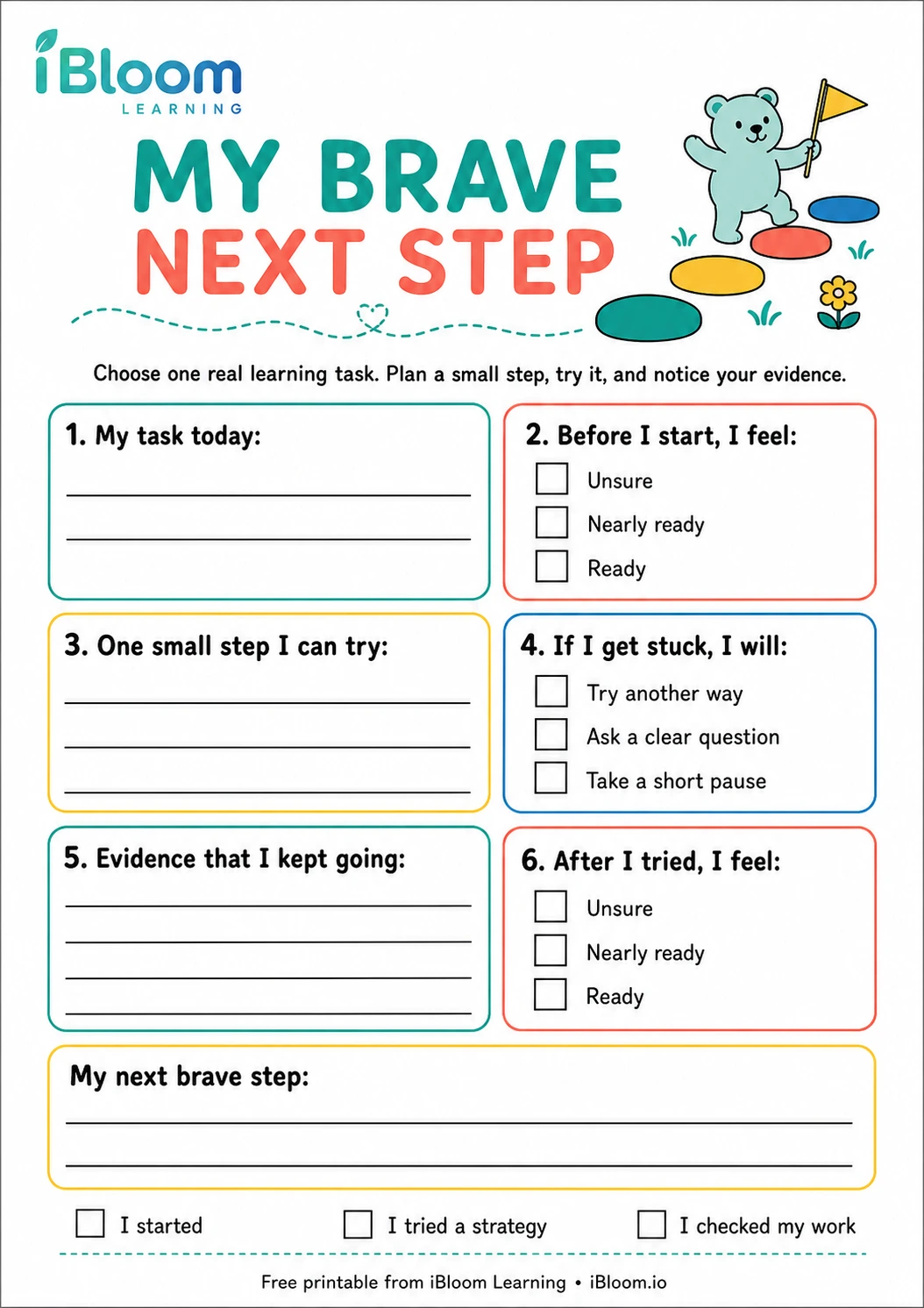
Download the free My Brave Next Step worksheet PDF
There is no answer key because the child is recording a plan and evidence from an authentic task. An adult should check whether the evidence is specific. “I did it” can become “I read the paragraph twice and corrected the word because.”
For more ready-to-print practice, browse the free printable worksheet library or use the guide to choosing worksheets for kids.
How to use the printable in ten minutes
Before the task: name the target
Choose a target small enough to attempt now: read one paragraph aloud, solve four subtraction questions, write a topic sentence, spell five pattern words, or explain one science diagram. Avoid a target such as “get better at maths.” The child cannot tell when that has happened.
Ask for the first readiness rating without correcting it. If the child selects unsure, treat that as information. Reduce the first step or make the support clearer.
During the task: pause at the first obstacle
Do not wait until frustration has taken over. Point to the three options on the printable: try another way, ask a clear question, or take a short pause. The child chooses one and returns to the task.
A clear question identifies the difficult part. “Can you help?” can become “I know how to subtract the ones, but what happens when the top digit is smaller?” That wording makes support more precise and shows the learner what is already understood.
After the task: collect evidence
Ask, “What can we point to, hear, or compare?” Evidence may be a corrected answer, a smoother rereading, a completed first sentence, a labelled diagram, or a second attempt with fewer prompts. Record one example, then take the second readiness rating.
The rating may stay the same. That does not mean the activity failed. A child can understand a task more accurately after trying it and still need more practice.
Four subject-specific confidence routines
Reading: rehearse before performing
If a child avoids reading aloud, begin privately. Read one sentence together, let the child whisper-read it, then read it to one trusted adult. The next step might be two sentences, not the whole page.
Record specific evidence: “I paused at the full stop,” “I worked out the word by reading the next sentence,” or “I read the second attempt without help.” A learner who notices the strategy is more likely to use it again.
Maths: move from model to symbols
When a written question looks intimidating, represent it with counters, a number line, a sketch, or place-value blocks. Then connect the model to the equation. The goal is not to hide the mathematics; it is to create an entry point.
On the worksheet, the small step might be “draw tens and ones for the first number.” Evidence might be “my drawing and equation gave the same answer.” If an error occurs, use the process in mistake-based learning worksheets to analyse it without turning the mistake into a verdict on ability.
Writing: separate ideas from editing
Some children hesitate because they are trying to invent, spell, punctuate, and produce neat handwriting at the same time. Set a first target such as “say three ideas aloud” or “write one complete topic sentence.” Editing comes after the idea exists.
For a concrete writing task, use Class 3 paragraph writing with hints. The planning boxes reduce the number of decisions the learner must hold at once.
Speaking: use a rehearsal ladder
Confidence in speaking grows through predictable exposure, not surprise. A five-rung ladder could be: say the answer to yourself, tell a partner, tell a small group, read one prepared sentence to the class, and answer one follow-up question.
Let the child choose today’s rung within a reasonable range. Do not promise that nervousness will disappear. The evidence is that the child completed a planned step while nervous and knows the next one.
Feedback that builds usable confidence
Feedback should tell the learner what to repeat or change. The EEF’s feedback evidence summary notes that feedback can address the task, the process, or self-regulation, while feedback about the person tends to be least effective.
Try these sentence frames:
- “Your second attempt changed ___, and that improved ___.”
- “You used ___ when you got stuck.”
- “This part meets the goal because ___.”
- “The next small change is ___.”
- “Show me where you checked your work.”
- “Which strategy will you use without a reminder next time?”
Replace broad praise such as “You are a genius” with evidence. “You reread the direction and found the missing step” is more believable and more useful.
A five-day confidence-building plan
Use the same skill for a week so the child can compare like with like.
| Day | Focus | Evidence to save |
|---|---|---|
| Monday | Choose a small target and complete a supported attempt. | First sample and readiness ratings. |
| Tuesday | Repeat the same strategy with a similar item. | One step completed with less prompting. |
| Wednesday | Analyse one mistake and correct it. | The error, correction, and explanation. |
| Thursday | Use the skill in a new format. | A drawing, oral explanation, or transfer example. |
| Friday | Compare Monday and Friday. | One observed improvement and one next step. |
Ten to fifteen focused minutes is enough. Stop after the evidence is recorded. Extra questions added as a reward for finishing can make success feel like a punishment.
Adapt the worksheet without lowering the learning goal
For a younger child, read the prompts aloud and write down the child’s exact words. The learner can circle readiness, choose a strategy, and draw the evidence.
For a child with handwriting difficulty, allow oral recording, speech-to-text, stickers, or a scribe. If writing is not the target, transcription should not block reflection.
For a multilingual learner, discuss the strategy in the strongest language first, then choose one sentence to express in English. Clear thinking can precede new vocabulary.
For an anxious learner, complete the page privately and agree beforehand what may be shared. Never post readiness ratings publicly or compare them across children.
For a learner who rushes, make the confidence target “check one answer and explain why it is reasonable.” Fast completion is not the same as independent control.
What confidence worksheets should not do
Avoid pages that ask children to rank themselves as smart, talented, good, or bad. These labels are broad, public, and difficult to act on. Also avoid:
- requiring cheerful statements the child does not believe;
- colouring a confidence score for display;
- comparing one learner’s rating with another’s;
- removing all difficult work so the child never experiences recovery;
- giving a prize for every attempt;
- treating a worksheet as support for persistent distress.
When worry is intense, frequent, affects sleep or daily functioning, or appears across many settings, a printable is not a substitute for individual support. Speak with the teacher, school counsellor, paediatrician, or another qualified professional.
How adults can tell whether confidence is changing
Review two weeks of attempts and look for behaviour, not slogans:
- Does the child begin with fewer prompts?
- Is the question more specific when help is needed?
- Can the learner name a strategy before starting?
- Does a mistake lead to a second attempt instead of immediate withdrawal?
- Can the child compare two pieces of work accurately?
- Is the skill used in a slightly different context?
One poor day does not erase a pattern. Confidence varies with sleep, task difficulty, relationships, and previous experience. Track the skill and conditions rather than turning the child into a score.
If routines at home are inconsistent, the guide to study habits for kids at home can help create a predictable start and stopping point.
Frequently asked questions
What age is the confidence-building worksheet for?
Adults can read and scribe it for children in the early years. Most learners in Grades or Classes 1 to 5 can circle the options and write short evidence independently, with the task adjusted to their level.
How often should a child complete it?
Use it two or three times a week around genuine learning tasks. Daily use is unnecessary if the reflection becomes automatic or repetitive. The aim is a strategy the child can eventually use without the paper.
What if the child marks “ready” but cannot do the task?
Treat the mismatch as information, not dishonesty. After the attempt, compare the prediction with the evidence and adjust the next step. Accurate self-monitoring develops through repeated, safe comparisons.
What if the child always marks “unsure”?
Make the target smaller, model the first action, and choose support before beginning. After one attempt, ask what changed. Do not argue with the rating or require the child to choose a happier answer.
Should I praise effort even when the strategy was ineffective?
Notice persistence, then help the child evaluate the strategy. “You stayed with it; now let’s compare which method gave clearer evidence” respects the effort without implying that every approach works equally well.
Does a confidence worksheet replace subject practice?
No. It sits around a reading, maths, writing, spelling, or speaking task. Confidence becomes credible when the child can point to growing skill, a successful strategy, or a well-understood next step.