Context Clues for Kids
A parent and teacher guide to context clues for kids, with examples, classroom routines, home practice, regional tips, and iBloom reading links.
Context clues help children work out the meaning of an unfamiliar word by reading the words, sentences, pictures, and ideas around it. A child does not have to stop at every hard word, guess randomly, or wait for an adult to define everything. With the right routine, learners can notice clues, test a possible meaning, reread the sentence, and explain the word in their own voice.
This guide is for parents, teachers, tutors, and homeschool families who want practical context clues activities for elementary reading. It is also designed to support iBloom learners who visit pages such as Using Clues to Find Word Meanings, Understanding New Words, Finding Word Meanings in Stories, and English worksheets for kids.
Start with the Matching Practice
Use this guide with a direct iBloom worksheet or lesson so children can move from reading the explanation into real practice.
Table of Contents
Worksheet And Lesson Previews
Using Clues to Find Word Meanings Lesson for Class 2 Preview
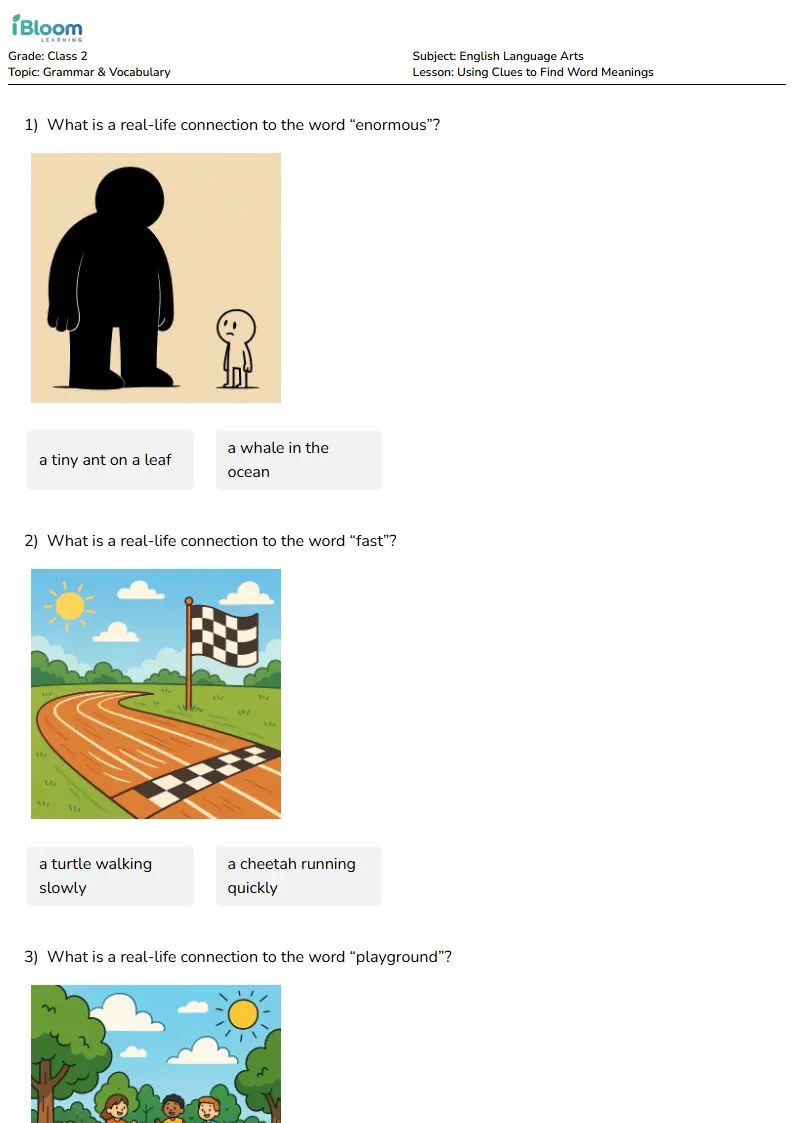
Use this preview to see the kind of practice children will open before you start the routine.
Understanding New Words Lesson for Class 1 Preview
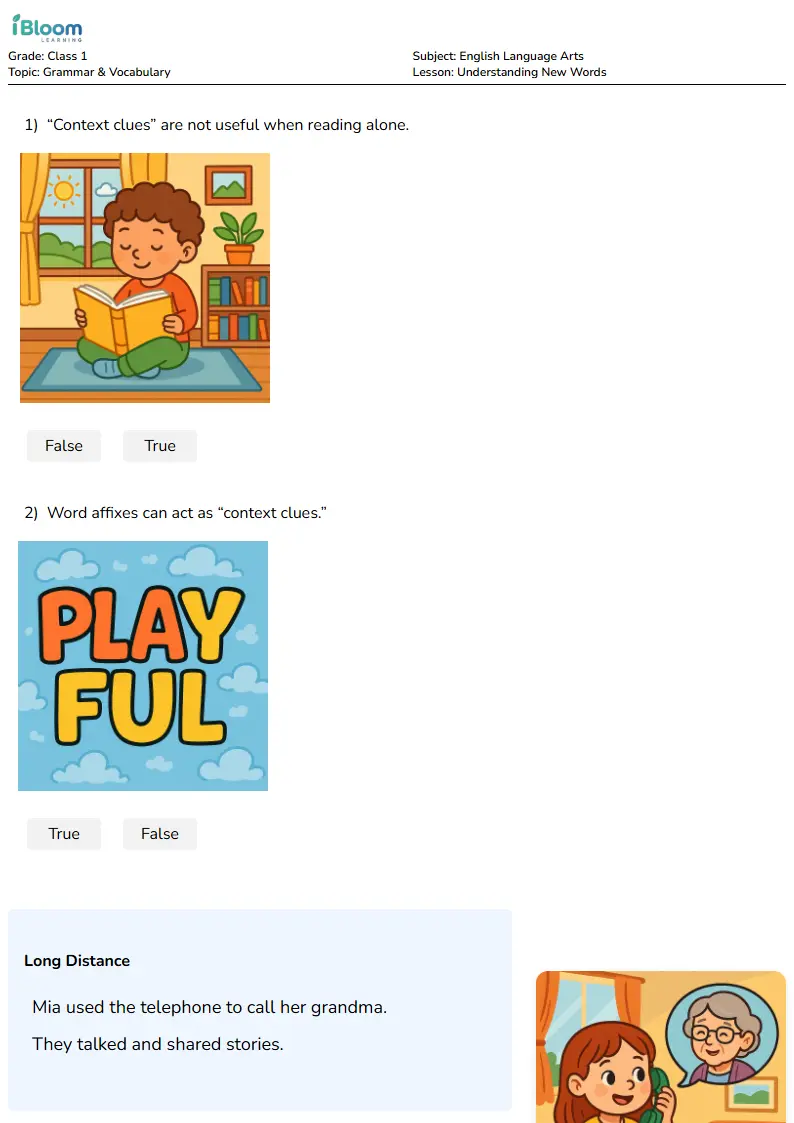
Use this preview to see the kind of practice children will open before you start the routine.
Finding Word Meanings in Stories Worksheets for Class 1 Preview
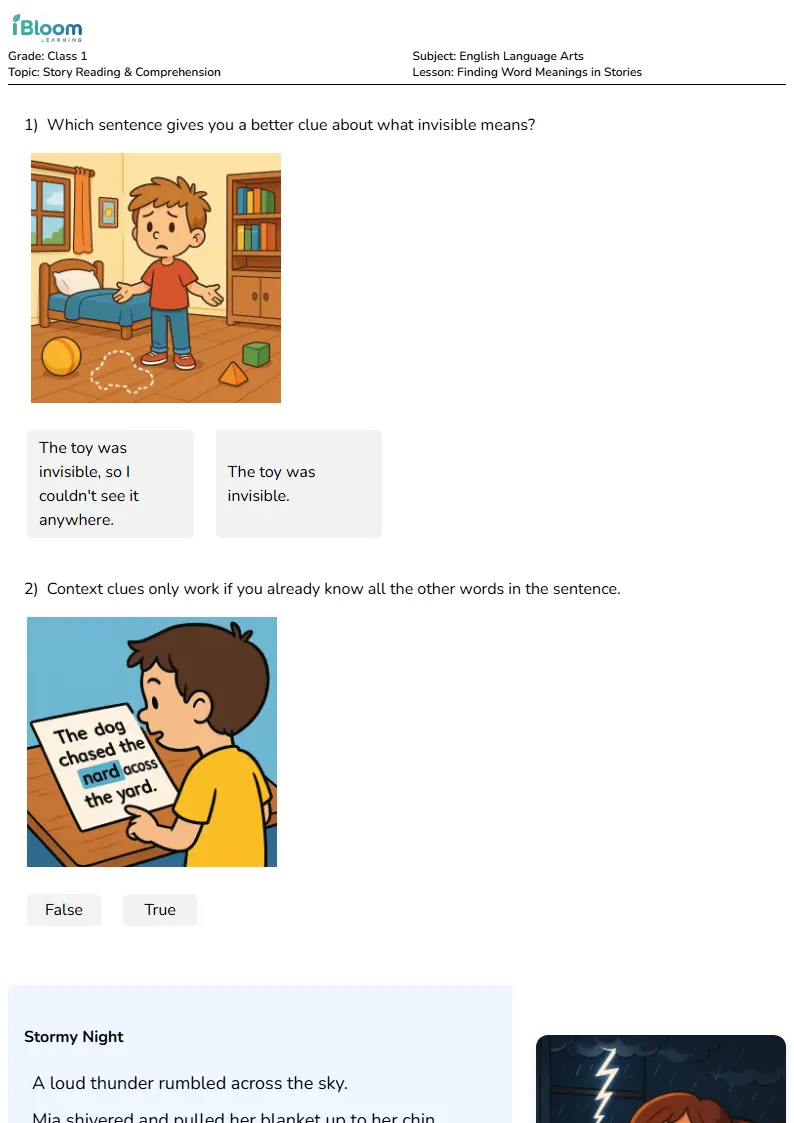
Use this preview to see the kind of practice children will open before you start the routine.
Key Takeaways
- Context clues are hints around an unfamiliar word.
- Children should look before and after the word, not only at the word itself.
- Good practice combines rereading, word parts, sentence meaning, and discussion.
- Parents can use short storybooks, homework passages, menus, notices, and worksheets.
- Teachers can make context clues visible with think-alouds, partner talk, and quick exit tickets.
What Are Context Clues?
Context clues are hints that help a reader understand an unknown word. The clue may be a definition, a synonym, an opposite, an example, a picture, or a sentence that explains what is happening. Reading Rockets explains that students often need direct instruction in the different kinds of clues, especially when the clue is not obvious.
For example, a child may read: "The hallway was silent, so everyone whispered." Even if the child does not know silent, the words "everyone whispered" help them understand that the hallway was very quiet. In iBloom, a learner can practise the same habit on Using Story Clues and then move to a worksheet such as Guessing Word Meanings.
Why Context Clues Matter for Reading
Context clues matter because vocabulary and comprehension grow together. When children pause at every new word, reading feels slow and frustrating. When they guess without checking, they may misunderstand the whole passage. The balanced routine is: notice the word, read around it, try a meaning, reread, and confirm.
The IES reading comprehension practice guide emphasizes explicit comprehension instruction and active discussion. Context clue work fits that guidance because children have to explain how they know, point to evidence, and revise their thinking. The National Center on Improving Literacy also gives families and educators a broad literacy resource base for vocabulary, comprehension, and reading support.
On iBloom, context clues connect naturally with effective reading practice strategies, reading fluency practice, and finding proof in the text. The goal is not just to know one word. The goal is to build a repeatable reading habit.
Six Types of Context Clues
1. Definition Clues
A definition clue explains the word inside the sentence. Example: "A habitat, or the place where an animal lives, gives it food and shelter." The words after the comma explain habitat. Teachers can ask children to underline the signal words "or," "means," "called," and "is."
2. Synonym Clues
A synonym clue gives a similar meaning. Example: "The child was joyful and happy after finishing the story." Happy supports joyful. This kind of clue works well with Understanding New Words because children can say, "Another word that helps me is..."
3. Antonym Clues
An antonym clue gives an opposite. Example: "The first answer was correct, but the second answer was inaccurate." Correct helps a reader understand inaccurate as not correct. Words like but, unlike, however, and instead often introduce this clue.
4. Example Clues
An example clue gives items that show the meaning. Example: "The class collected supplies such as pencils, crayons, glue, and paper." The examples show what supplies are. Parents can use grocery lists, school-bag items, sports equipment, and home objects to make this concrete.
5. Inference Clues
An inference clue asks the reader to combine several hints. Example: "Aarav zipped his jacket, rubbed his hands, and hurried indoors." The sentence does not say cold, but the details support it. Children can practise this skill with What Happened and Why? and Finding Clues About Characters.
6. Picture and Diagram Clues
Young readers often use pictures, captions, labels, and diagrams. A child reading about a seedling may use the picture to understand sprout. This is useful for early grade lessons such as Pictures Help Us Read and Reading Pictures and Diagrams.
A 15-Minute Context Clues Routine
Use this routine at home or in class:
| Minute | Action | What the adult says |
|---|---|---|
| 0-3 | Read a short passage | "Read once for the story, not for perfection." |
| 3-5 | Circle one unfamiliar word | "Choose one word that slowed you down." |
| 5-8 | Read before and after | "Which words around it help?" |
| 8-10 | Try a meaning | "Say the meaning in your own words." |
| 10-12 | Reread and check | "Does your meaning fit the sentence?" |
| 12-15 | Use the word | "Make a new sentence that shows the meaning." |
For a classroom, the same routine can become a quick station. One group reads, one group marks clues, one group explains, and one group writes a new sentence. For home practice, a parent can use a school reader, iBloom worksheet, library book, or short informational paragraph.
Examples for Grades 1 to 5
Grade 1 and Class 1
Use picture-supported sentences and familiar words. Example: "The puppy was tiny, so it fit in Maya's hand." Ask: "Which word helps tiny?" Children in Class 1, Grade 1, or early primary programs in India, the United States, and the UAE can answer with gestures before writing.
Good iBloom next steps include Finding Word Meanings in Stories, Using Story Clues, and How Words Are Related.
Grade 2 and Class 2
Move to synonym, antonym, and inference clues. Example: "The path was narrow, but the playground was wide." Ask children to identify the opposite clue. A learner can continue with Using Clues to Find Word Meanings, Unlocking New Words, and Understanding Phrases.
Grades 3 to 5
Older elementary learners should connect context clues with morphology, author purpose, and evidence. Example: "The scientist observed the plant daily and recorded each tiny change." Children can infer that observed means looked carefully over time. They can then use What Does the Author Think? or Identify and Analyze Key Details to explain how word meaning affects comprehension.
Parent Practice at Home
Parents do not need special materials. Choose one short paragraph from a story, homework sheet, email from school, recipe, simple news article, or library book. Ask your child:
- "Which word is new or tricky?"
- "What sentence part helps?"
- "What do you think it means?"
- "Read it again with your meaning. Does it fit?"
- "Can you use the word about our own day?"
In Delhi, Mumbai, Bengaluru, Chennai, Hyderabad, Pune, Kolkata, Jaipur, Ahmedabad, and Kochi, families can use school circulars, festival stories, science chapters, and English readers. In the United States, families in California, Texas, Florida, New York, Illinois, Georgia, and Washington can use library books, classroom newsletters, science readers, and state ELA practice passages. In the UAE, families in Dubai, Abu Dhabi, Sharjah, Ajman, and Al Ain can use British, American, IB, and Indian curriculum readers plus multilingual home examples.
Teacher Classroom Activities
Think-Aloud Reading
Read one sentence aloud and show the thinking. Say: "I do not know this word yet. I am reading the next sentence. I see an example. I think the word means..." This is especially helpful for children who assume strong readers know every word automatically.
Clue Type Sorting
Give pairs of students sentence strips. Ask them to sort the clues into definition, synonym, antonym, example, inference, and picture/diagram. This supports students who need language for explaining their thinking. Link the activity to Checking My Reading so children learn to verify answers.
Vocabulary Discussion
Reading Rockets' vocabulary guidance supports direct teaching, review, and meaningful word use. After students identify a clue, ask them to use the word in a new sentence about school, home, a story character, or a science topic. A crossword can also help with review; use Crossword Puzzles for Teachers when students already understand the target words.
Exit Ticket
Ask each child to complete one sentence: "I think ___ means ___ because the text says ___." This keeps context clues connected to evidence instead of guessing.
Common Mistakes and Fixes
Mistake: Guessing From One Word
Some children see one familiar word and guess too quickly. Fix it by requiring two checks: one clue before the word and one clue after the word.
Mistake: Looking Only at Pictures
Pictures help, but they are not enough. Ask children to combine picture clues with sentence clues. Use Pictures and Words Together for this blend.
Mistake: Copying Dictionary Definitions
A dictionary can help, but young learners also need to explain the word in the sentence. Ask: "Which definition fits this passage?" This avoids definitions that are technically correct but wrong for the paragraph.
Mistake: Not Rereading
The child may find a possible meaning and move on. Train the reread step: replace the word with the meaning and check if the sentence still makes sense.
Regional Learning Notes
Context clues fit different school systems because the reading behavior is universal. In Indian CBSE, ICSE, and state-board classrooms, it supports comprehension questions, unseen passages, and vocabulary-in-context tasks. In US elementary classrooms, it supports close reading, academic vocabulary, and evidence-based responses. In UAE international schools, it helps multilingual learners handle British, American, IB, and Indian curriculum readers while building English confidence.
The examples should feel local without becoming narrow. A teacher in Dubai can use a school bus notice, a parent in Austin can use a library book, and a tutor in Bengaluru can use a science paragraph. The routine stays the same: find the word, read around it, test the meaning, reread, and explain.
Frequently Asked Questions
What are context clues for kids?
Context clues are hints around a new word. The hint may be in the same sentence, nearby sentences, pictures, examples, or opposite words.
What are the main types of context clues?
Common types include definition, synonym, antonym, example, inference, and picture or diagram clues.
How do I teach context clues at home?
Use a short paragraph. Ask your child to circle one tricky word, read before and after it, guess a meaning, reread, and explain the clue.
Are context clues enough for vocabulary learning?
No. Context clues are one tool. Children also need direct vocabulary teaching, word parts, reading aloud, discussion, writing, and repeated word use.
Which iBloom pages help with context clues?
Start with Using Clues to Find Word Meanings, Understanding New Words, and Finding Word Meanings in Stories.
Practice Path for context clues worksheets
Use this section when a child needs a direct next step after reading the guide. Start with the explanation in this article, then move into a connected iBloom practice path so the child sees the idea in a lesson, a worksheet, and a short review routine.
- context clues worksheets for grade 2
- use context clues to understand stories worksheet
- infer word meanings from context worksheet
For parents, the simplest routine is: read one example aloud, let the child try two items, ask for the reason, then revisit the article section that explains the skill. For teachers and tutors, the same path can become a small-group rotation or a homework support set. The goal is steady improvement on the exact skill, not just more pages.
Practice This Skill Next
After reading this guide, children can practise the same skill on iBloom. Start with Using Clues to Find Word Meanings or Understanding New Words, then ask the child to explain one answer before moving on.