Full and Empty Worksheet for LKG
A full and empty worksheet for LKG helps young children connect real containers, picture choices, spoken math words, and simple explanations.
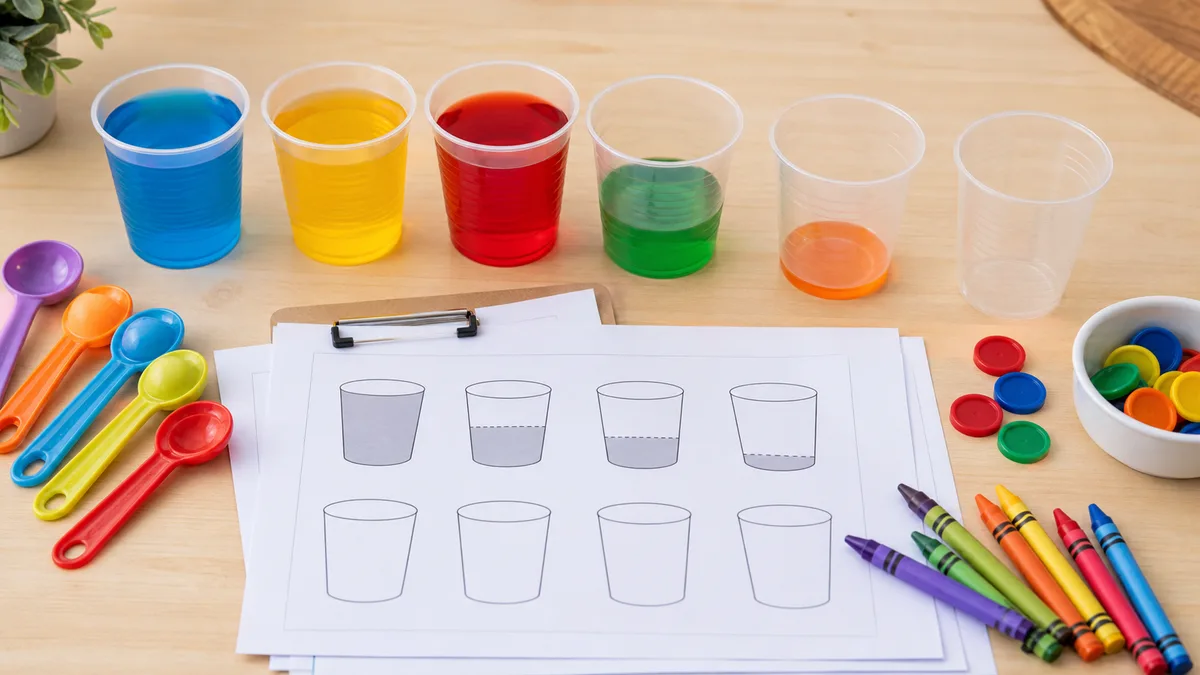
A full and empty worksheet for LKG helps young children connect real containers, picture choices, spoken math words, and simple explanations. This guide is for parents, teachers, tutors, homeschool families, and children who need early math practice that feels concrete, calm, and useful. It connects LKG worksheet routine to iBloom pages such as Full and Empty Worksheets for LKG, Full and Empty Concept Lesson, Identifying Full and Empty Containers, and related support from Full and Empty Worksheets for Kindergarten and Empty and Full Concept Activities.
Start With iBloom Practice
Use this guide with direct iBloom practice so children move from real objects into worksheet and lesson practice.
Table of Contents
Worksheet And Lesson Previews
Full and Empty Worksheets for LKG Preview
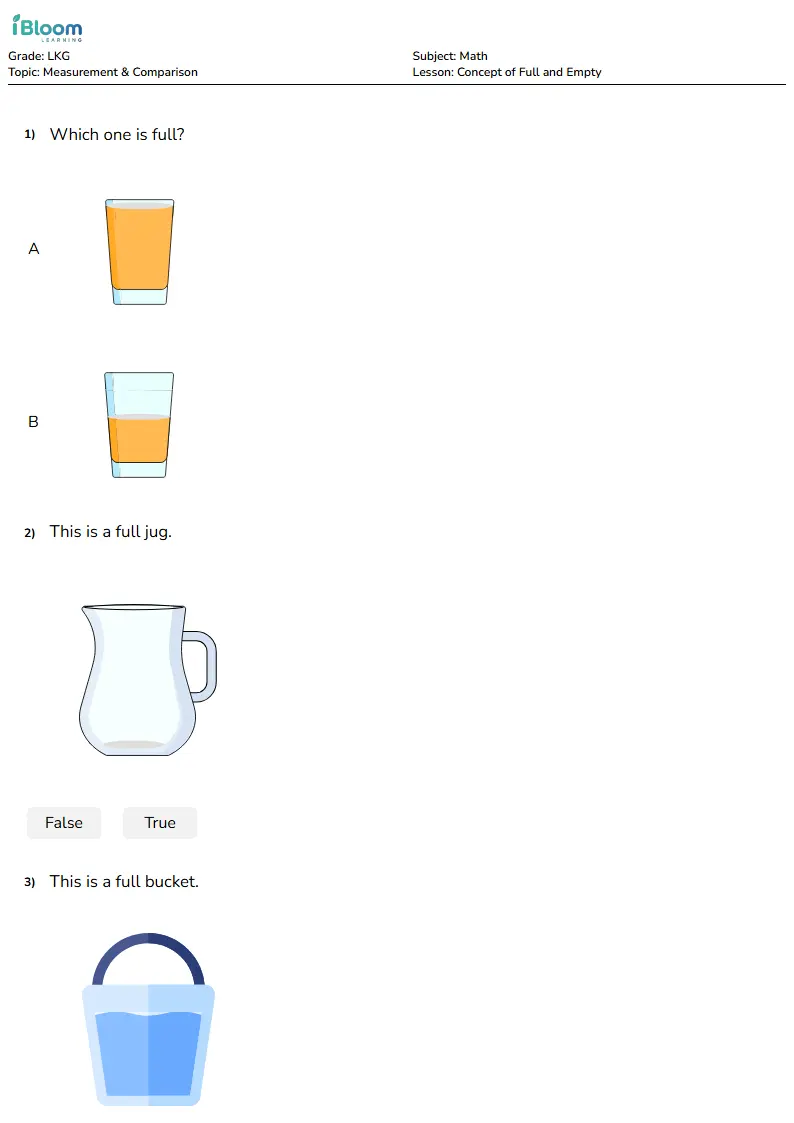
Use this preview to see the kind of practice children will open before you start the routine.
- Open the worksheet: Full and Empty Worksheets for LKG
- Open the lesson: Full and Empty Concept Lesson for LKG
Identifying Full and Empty Containers Worksheets for Pre Kindergarten Preview
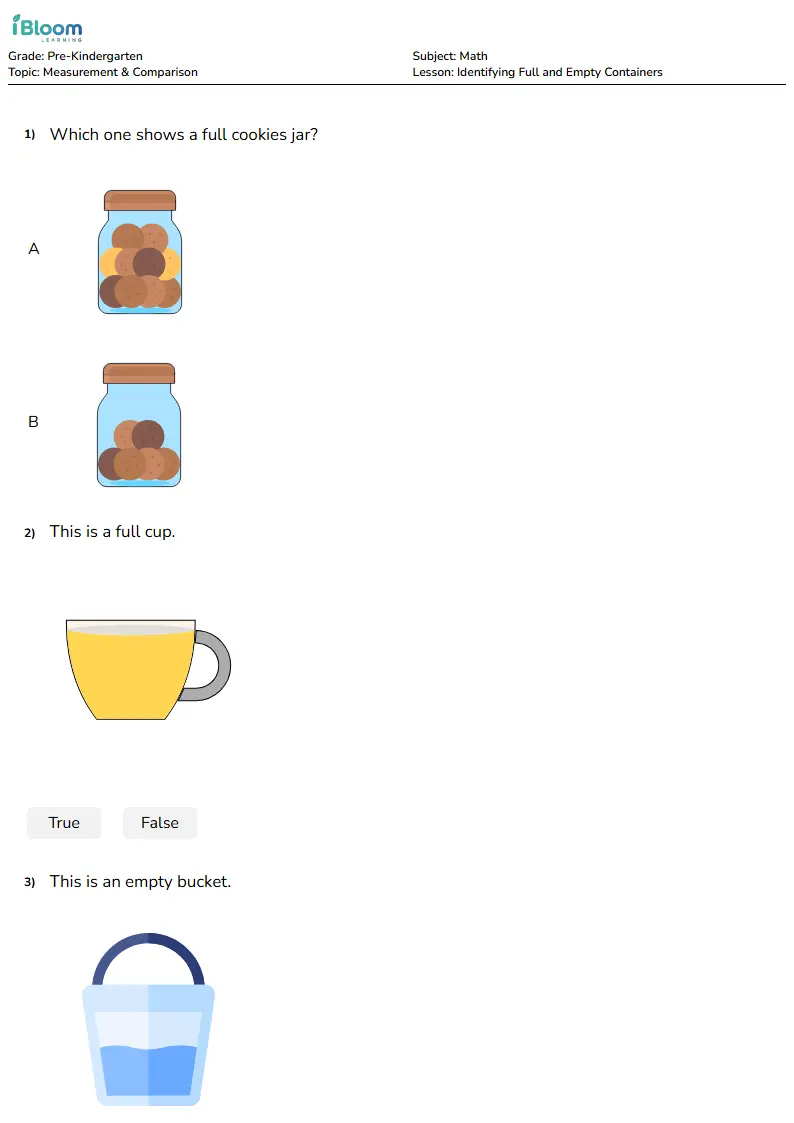
Use this preview to see the kind of practice children will open before you start the routine.
- Open the worksheet: Identifying Full and Empty Containers Worksheets for Pre Kindergarten
- Open the lesson: Identifying Full and Empty Containers Lesson for Pre Kindergarten
Identifying the Full Container Worksheets for Pre Kindergarten Preview
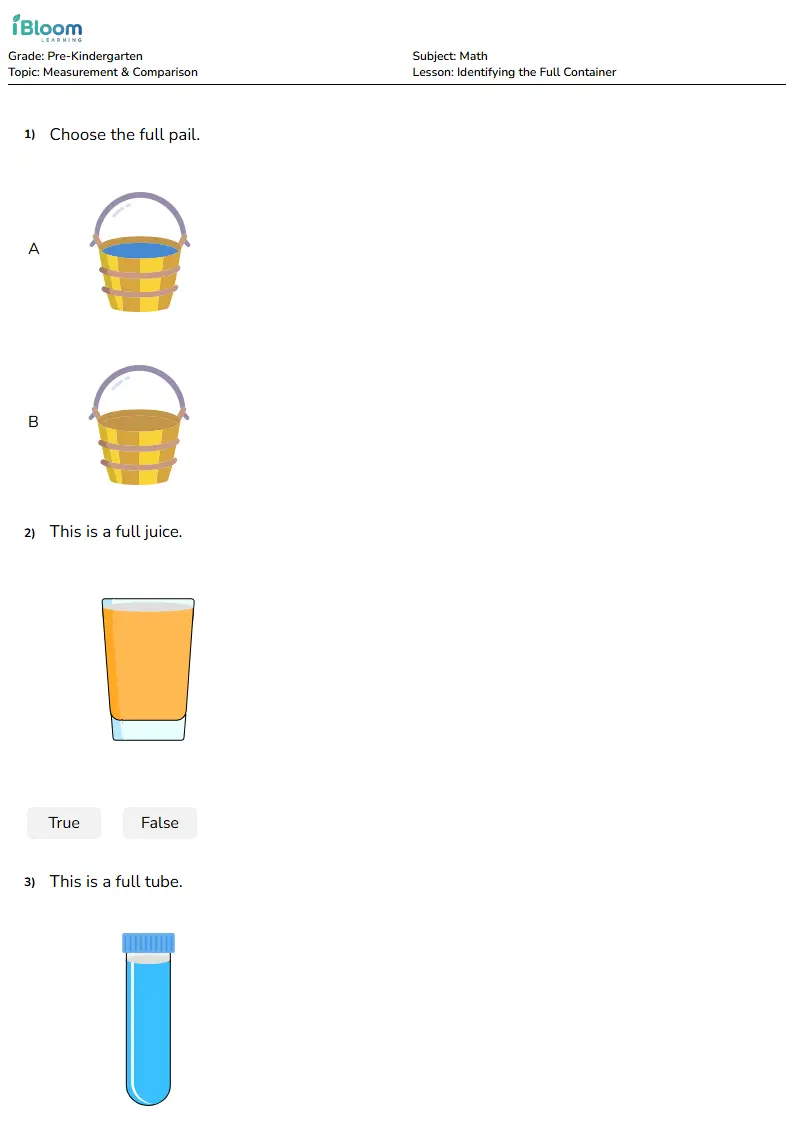
Use this preview to see the kind of practice children will open before you start the routine.
Key Takeaways
- Children understand full and empty best when they compare real containers before worksheets.
- The strongest routine is touch, look, say, choose, and explain.
- Full, empty, nearly full, nearly empty, and half full are useful math words when children can see the difference.
- Parents can practise with cups, boxes, bowls, bottles, pencil cases, toy baskets, and lunch containers.
- Teachers can use the same idea in a math center, oral language activity, worksheet station, or quick exit check.
Why Full and Empty Practice Matters
Full and empty are early capacity words. They prepare children for comparing, measuring, describing, sorting, and explaining. A child who can say "this cup is full" and "this box is empty" is also learning to observe carefully and use math language with evidence.
The IES practice guide for teaching math to young children recommends intentional early math instruction with clear examples, language, and repeated opportunities to practise. The NCTM principles and standards support mathematical communication, representation, and reasoning from the earliest years. For classrooms using US standards, Common Core math standards also emphasize describing, comparing, and reasoning with measurable attributes in the early grades.
That means a worksheet should not be only a page to finish. Use real objects first, then pictures, then a short explanation. When children use Identifying Full and Empty Containers or Full and Empty Worksheets for LKG, ask them to tell why an object is full or empty instead of only circling a picture.
How to Teach the Concept
Start with two containers. Fill one and leave one empty. Ask the child to touch or point to each container and say the word. Then change the amount: a little water, half a cup, many blocks in a box, or no crayons in a tray. Children learn faster when the adult changes one thing at a time.
Move through this sequence:
- Real object comparison: one full, one empty.
- Picture comparison: circle the full object or empty object.
- Vocabulary extension: nearly full, nearly empty, half full.
- Explanation: "I know it is full because there is no more space."
- Worksheet practice: complete one iBloom page and explain one answer.
Use Practice Identifying the Full Container when the child needs only full examples. Use Practice Identifying the Empty Container when empty examples need more attention. Use Full and Empty Worksheets Black and White when the child benefits from simple printable-style visual contrast.
Parent Routine
Parents can practise in five minutes. Pick three safe objects: a cup, a bowl, and a box. Ask the child to make one full, one empty, and one partly full. Then open the matching iBloom page and ask the child to choose the picture that matches the word.
A parent might say:
- "Show me the empty cup."
- "Make the bowl full of blocks."
- "Which one is half full?"
- "How do you know this one is empty?"
- "Can you find a full object in the kitchen or classroom?"
In India, families can use this with LKG, UKG, CBSE, ICSE, and state-board early math routines in Delhi, Mumbai, Bengaluru, Chennai, Hyderabad, Pune, Kolkata, Ahmedabad, Jaipur, Lucknow, Kerala, Tamil Nadu, Karnataka, Maharashtra, Telangana, Gujarat, Rajasthan, and West Bengal. In the United States, it supports preschool, pre-K, kindergarten, homeschool, and intervention practice in California, Texas, Florida, New York, Illinois, Pennsylvania, Ohio, Georgia, North Carolina, Michigan, Los Angeles, Houston, Chicago, Phoenix, Philadelphia, Dallas, Austin, Seattle, Boston, Denver, Atlanta, and Miami. In the UAE, it supports Dubai, Abu Dhabi, Sharjah, Ajman, Ras Al Khaimah, Fujairah, Umm Al Quwain, Al Ain, and British, American, IB, and Indian curriculum families.
Teacher Routine
Teachers can turn full and empty into a math-and-language center. Put safe containers, counters, picture cards, and a small worksheet station on the table. Children compare real objects first, then move to the page. This keeps the worksheet connected to observation.
A classroom plan can be simple:
- Warm-up: show two containers and ask children to name full or empty.
- Small group: children fill, empty, and describe containers.
- Worksheet station: children complete one iBloom page.
- Partner talk: children explain one answer to a friend.
- Exit check: the teacher asks one child to find a full, empty, or half full example.
For children who need support, use only full and empty first. For children ready for more, add half full, almost full, almost empty, more, less, same, capacity, container, and compare. Pair this with Counting Numbers Up to 5 when children need a short counting reset between comparison tasks.
India, US, and UAE Notes
The names of grade levels may change, but the child task is similar. LKG, UKG, preschool, pre-kindergarten, kindergarten, KG1, KG2, reception, nursery, homeschool, and early primary classrooms all need concrete capacity language. Children should see, touch, compare, and explain.
For multilingual learners, let the child say the word in the home language first if needed, then connect it to English math vocabulary. A child in Dubai, Abu Dhabi, Delhi, Mumbai, Bengaluru, Houston, Chicago, Dallas, New York, or Los Angeles can follow the same routine: look at the object, say the word, explain the amount, and match the picture.
Examples Children Can Try
- Find one full cup and one empty cup.
- Fill a box with blocks, then empty it and describe the change.
- Circle the full container on a worksheet.
- Draw an empty basket and a full basket.
- Sort picture cards into full, empty, and half full.
- Explain one answer using the sentence: "I know it is ___ because ___."
For a printable-style review, use Full and Empty Worksheets Black and White. For hands-on practice ideas, use Empty and Full Concept Activities. For the main kindergarten worksheet path, use Full and Empty Worksheets for Kindergarten.
Common Mistakes
- Choosing the bigger container even when it is empty.
- Calling a half-full container full because it has something inside.
- Guessing from color or picture size instead of looking at the amount.
- Finishing the worksheet without saying why.
- Moving to measurement vocabulary before full and empty are clear.
When this happens, return to real objects. Empty the container completely, fill it again, and ask the child to describe what changed. One clear comparison is better than a crowded worksheet page.
Keep Practicing With iBloom
Use this guide with direct iBloom practice so children move from real objects into worksheet and lesson practice.
Frequently Asked Questions
What age is full and empty practice best for?
It is useful for preschool, LKG, UKG, pre-kindergarten, kindergarten, KG1, and KG2 learners who are beginning capacity and comparison language.
Should children use real objects before worksheets?
Yes. Real objects make the words full and empty concrete. Worksheets work better after the child has touched, filled, emptied, and described containers.
How do I teach half full?
Show full and empty first. Then fill a similar container halfway and ask the child to compare all three: full, half full, and empty.
What should I do if my child guesses?
Ask the child to point to the amount inside the container and explain the answer. If guessing continues, return to two real objects only.
Which iBloom page should we start with?
For India LKG practice, start with Full and Empty Worksheets for LKG. For US pre-K practice, start with Identifying Full and Empty Containers.