Full and Empty Worksheet for LKG & UKG + Answers
A hands-on full-and-empty concept guide for LKG, UKG, and kindergarten, followed by clear worksheet questions and answer checks.
Free printable worksheet
Free full and empty worksheet for kindergarten
This two-page printable has 12 picture questions and an answer key. Children decide whether glasses, jars, baskets and bowls are full or empty, then compare pairs of pictures.
- Free PDF download
- Answer key included
- Ready to print
Free to print and use at home or in class. How to use this worksheet
A full and empty worksheet makes more sense after children have handled real containers. For LKG, UKG, and kindergarten learners, begin with visible examples: an empty basket, a box filled with blocks, and a jar with only some counters. Then move from objects to pictures and words.
The concept develops observation, comparison, and early measurement vocabulary. Children learn that full and empty describe how much is inside a container—not the container's overall size.
Use the matching iBloom full-and-empty interactive lesson before or after the questions below.
Free full and empty worksheet for kindergarten
This two-page printable has 12 picture questions and an answer key. Children decide whether glasses, jars, baskets and bowls are full or empty, then compare pairs of pictures.
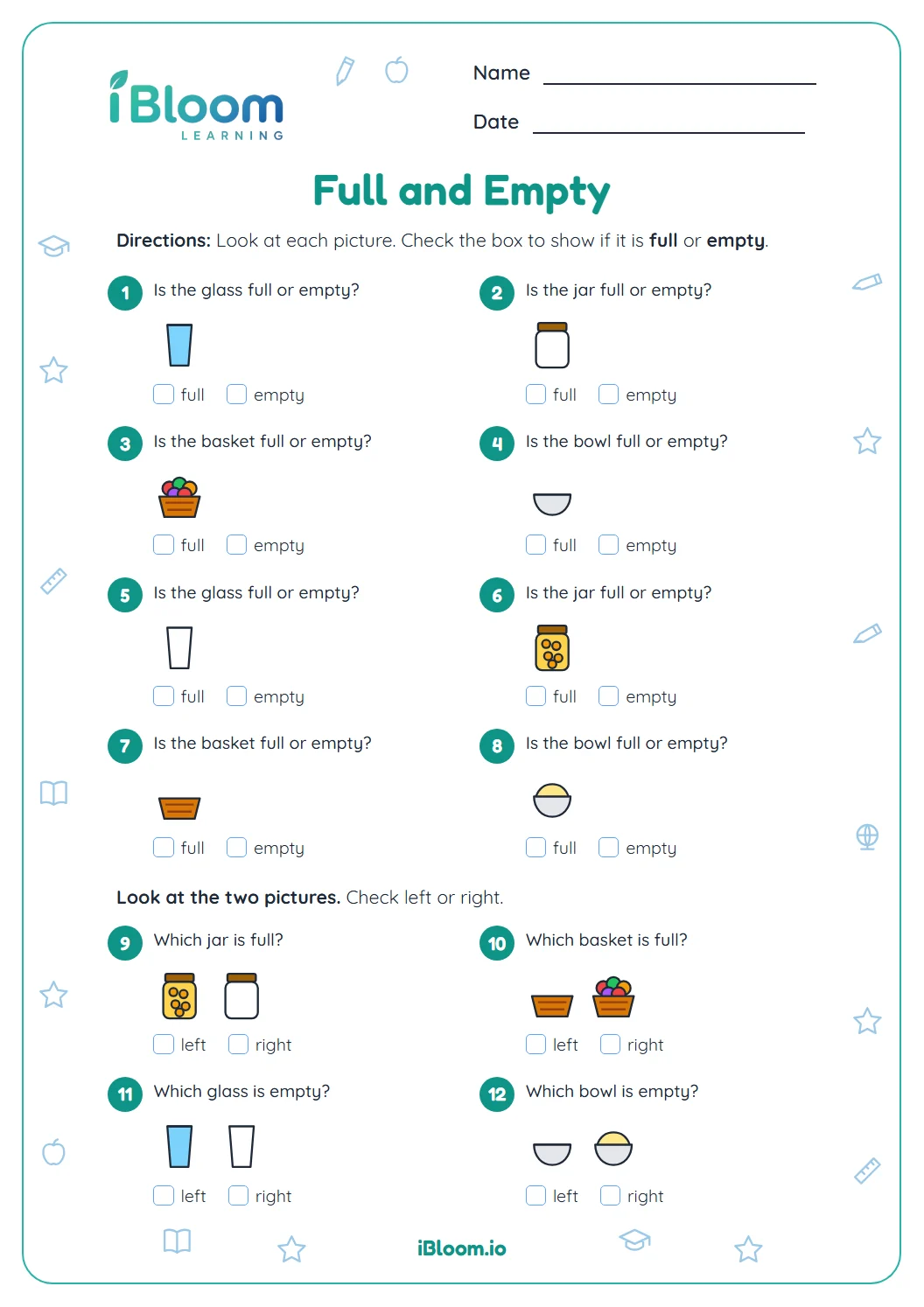
Download the free full and empty worksheet PDF
Answer key preview
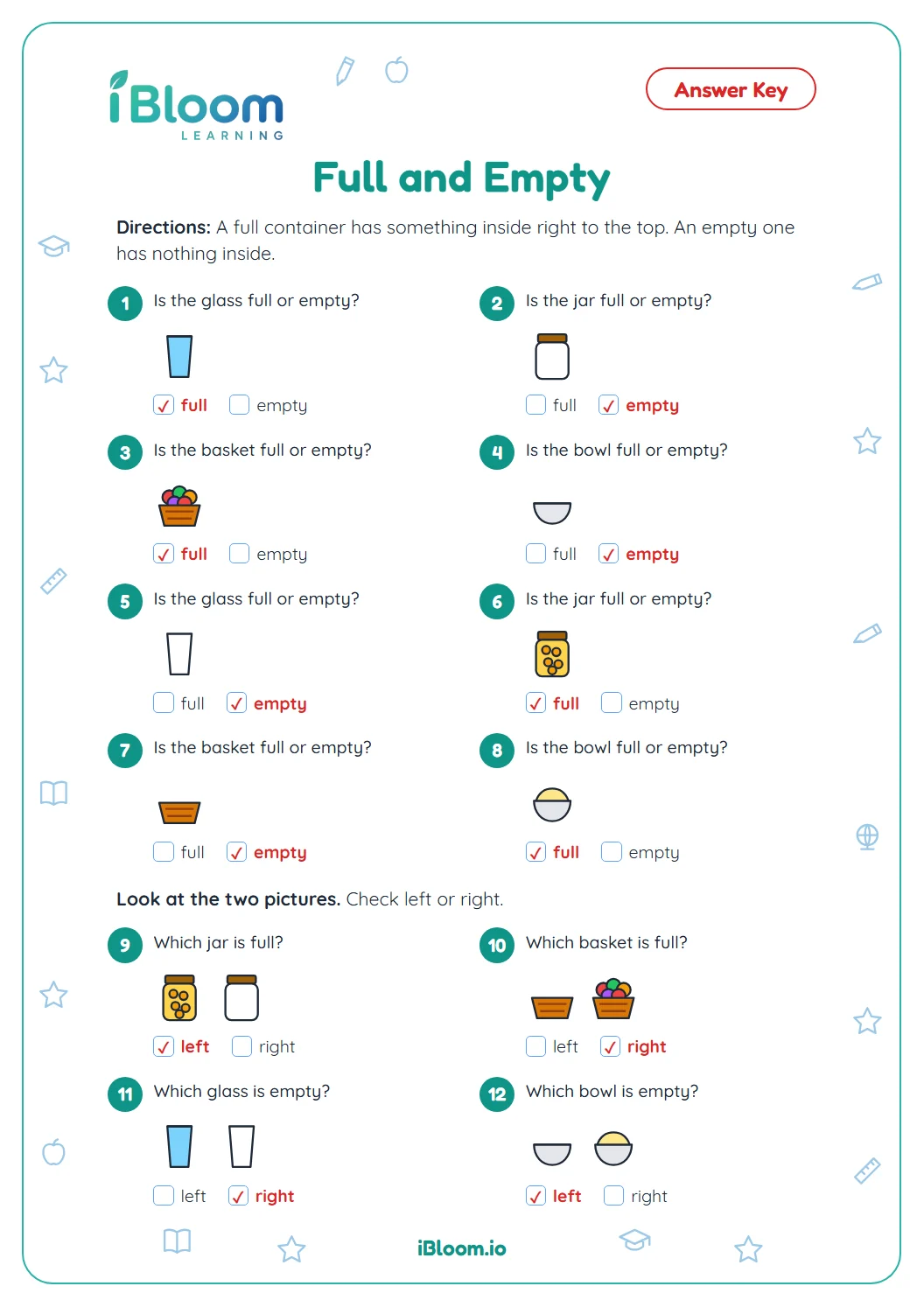
Fill and empty a real cup of water together before the worksheet, and let your child say full or empty each time.
Teach the concept with three containers
Choose three safe, transparent containers of the same size. Leave one empty, fill one halfway with large classroom objects, and fill the last one to a clearly visible level near the top.
Ask:
- Which container has nothing inside?
- Which container has the most objects?
- Is the middle container empty or full?
- What could we add to make it full?
- What could we remove to make it empty?
Introduce empty, nearly empty, half-full, nearly full, and full gradually. Young learners may first use only the opposite pair. Add the middle words after the contrast is secure.
Worksheet questions with answers
1. Choose full or empty
- A cup with no pencils is empty.
- A toy box packed with toys is full.
- A plate with no food is empty.
- A basket filled to the top with clothes is full.
2. Complete the sentence
- There is nothing in the jar. The jar is empty.
- The bottle has reached the top line. The bottle is full.
- The bucket has some space and some blocks. It is partly full.
3. Think and explain
A large empty bucket and a small full cup are on the table. Which has more inside?
Answer: The small cup has more inside at that moment because the large bucket is empty. This question checks whether children confuse container size with how full it is.
4. Put the pictures in order
Arrange three pictures from least to most: empty glass, half-full glass, full glass.
Answer: empty → half-full → full.
A 15-minute activity plan
Minutes 1–4: Explore. Children fill and empty safe containers using large blocks, scarves, or beanbags.
Minutes 5–7: Compare. Place two containers side by side and ask children to use a complete sentence: “The blue basket is full.”
Minutes 8–12: Complete a worksheet. Use six to eight clear pictures. Ask children to explain two choices orally.
Minutes 13–15: Apply. Find one full and one empty object in the classroom or home. Check that the object is truly a container.
For related early maths practice, explore iBloom's interactive learning library and math worksheets.
Common misunderstandings
“Big means full.” Compare a big empty box with a small full basket.
“Not empty means full.” Show a half-filled container and discuss the space that remains.
Judging from a closed object. If children cannot see inside, explain that they need evidence—looking, lifting safely, or being told.
Changing both size and amount at once. Begin with identical containers so only the filling level changes. Introduce different sizes later.
Parent and teacher prompts
- “What do you notice inside?”
- “How do you know it is empty?”
- “Is there space for more?”
- “What would change your answer?”
- “Can a small container be full while a large one is empty?”
These prompts ask children to justify a description instead of guessing a label.
Extra printable practice with answers
Use real containers before pictures. Place an empty cup, a cup filled to the top, and a cup with only a little water on a tray. Ask the child to point, compare, and explain. This makes the words full and empty describe an amount rather than a particular type of object.
For a paper activity, read each prompt aloud and let the child circle the answer.
- A glass has water up to the top. Is it full or empty?
- A lunch box has nothing inside. Is it full or empty?
- A basket is holding many apples and has no space for another. Is it full or empty?
- A bucket has no water in it. Is it full or empty?
- Draw three balls inside the empty box.
- Cross out the objects in a full bowl so the bowl becomes empty.
- Which can hold more: a full spoon or a full bottle?
- Can a large bucket be empty? Explain with one sentence.
Answer key: 1. full; 2. empty; 3. full; 4. empty; 5–6. check the drawing; 7. a full bottle; 8. yes—a container’s size and whether it is empty are different ideas.
Questions 7 and 8 check understanding rather than picture matching. A child who answers them correctly can usually separate capacity, size, and amount.
A simple learning progression
Teach the idea in this order:
- Real objects: fill and empty cups, boxes, and baskets.
- Action words: ask the child to fill a container and then empty it.
- Photographs: compare familiar containers shown from the side.
- Simple drawings: circle the full object and cross the empty one.
- Language: complete “The ___ is full” or “The ___ is empty.”
- Reasoning: explain how an object could change from one state to the other.
Do not introduce full, nearly full, half-full, nearly empty, and empty on the same first worksheet. Once full and empty are secure, add one middle amount and ask the child to place three pictures in order.
Use the Full and Empty Concept lesson, then practise Which One Is Full? and Which One Is Empty?.
How to check the worksheet fairly
Avoid pictures with hidden contents, opaque containers, or objects spilling over the rim. Ask the child, “What can you see that proves your answer?” Accept pointing or a home-language response before requiring a full English sentence.
If the child labels every container with something inside as full, show one cup with a single block and another packed with blocks. Say, “Both have something inside. Which one has no more space?” Then repeat with different objects. If the child thinks a large container must be full, compare a large empty bucket with a small full cup.
A quick exit check needs only three items: identify one full object, identify one empty object, and describe how to change one into the other. Save longer worksheets for later practice.
Frequently Asked Questions
What does full and empty mean for LKG?
Empty means a container has nothing inside. Full means it contains as much as the activity defines, usually with little or no usable space left.
Should I teach half-full at the same time?
Start with the strong full/empty contrast. Add half-full and partly full when the child can identify the opposites consistently.
Can I teach this without a printed worksheet?
Yes. Real containers and safe household or classroom objects are an excellent starting point. Pictures and worksheets help children transfer the concept to representations.
Why does my child call every container with something inside full?
They may understand only “empty” versus “not empty.” Show an empty, partly filled, and full container together and compare the space remaining.
What objects are safe for the activity?
Use large, age-appropriate objects that are not choking hazards, sharp, breakable, or messy. Supervise the activity and avoid containers that held unsafe substances.