Grade 4 Angle Measurement Worksheets
Grade 4 Angle Measurement Worksheets with direct iBloom worksheet and lesson links, parent routines, teacher routines, examples, and FAQs.
Use this guide when a fourth grader needs angle measurement practice with protractors, unknown angles, and angle addition. Start with the iBloom worksheet or lesson below, then use the routines here to help the child measure carefully and explain the angle relationship.
Start Here: Worksheets And Lessons
Open one iBloom page first. Use the article below when you need a parent script, classroom routine, worked example, or FAQ help.
Worksheets
Lessons
How To Use These Links
Choose a worksheet when the child is ready to practise after one clear model. Choose a lesson when the skill is new, when a child is guessing, or when an adult needs teaching language for the first example. A reliable order is: open the lesson, model one item, move to the worksheet, and finish with one explanation.
For home practice, stop after a short accurate round. For classroom practice, listen to a few explanations before assigning more items. For tutoring or intervention, write down the exact mistake pattern you heard, then choose the next iBloom page from that need.
Table of Contents
Worksheet And Lesson Previews
Finding Unknown Angle Measures Worksheets for Fourth Grade Preview
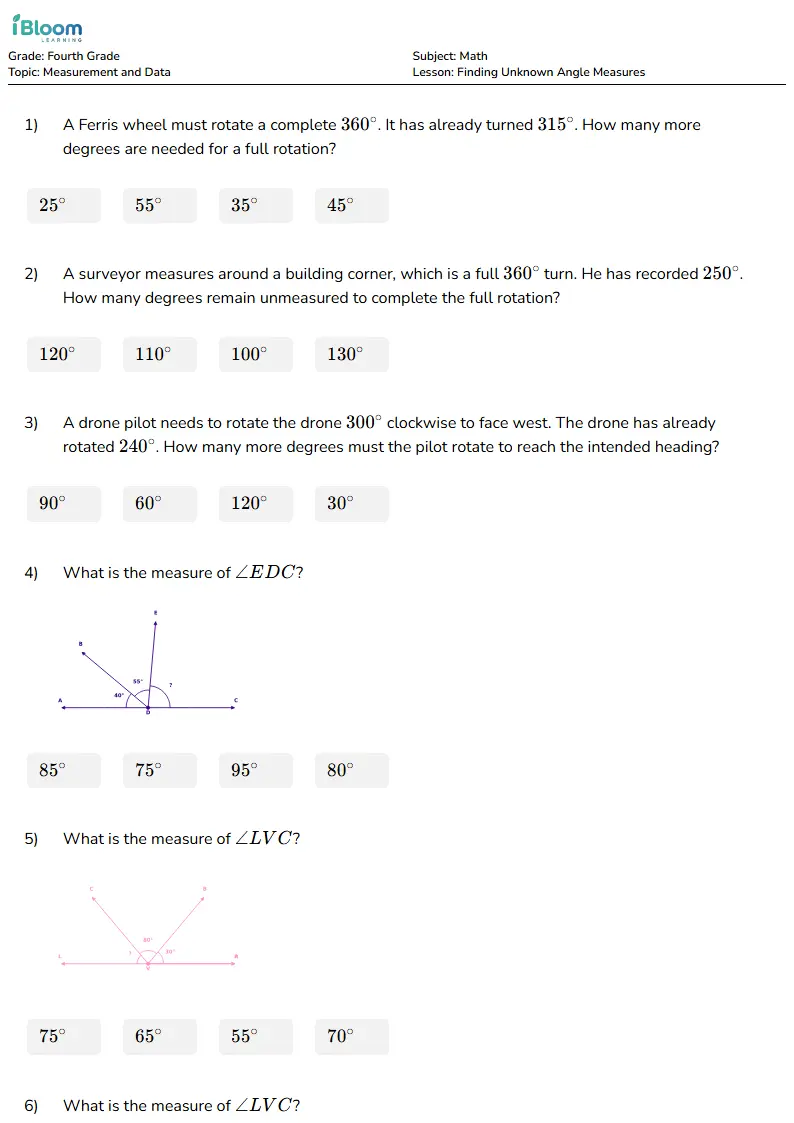
Use this preview to see the kind of practice children will open before you start the routine.
Key Takeaways
- Start with one direct iBloom worksheet or lesson before assigning more practice.
- Keep the first practice round short enough for the child to finish accurately.
- Ask the child to explain the clue, model, sentence, operation, or evidence behind the answer.
- Use Common Core Math grade 4 measurement and geometry language for planning, but keep the child-facing instruction simple.
- Return to one missed item and reteach the thinking pattern before moving on.
Why This Skill Matters
Grade 4 Angle Measurement Worksheets help children turn a school skill into something they can actually use. A child may know the answer on one page but struggle when the same idea appears in a story, paragraph, word problem, or classroom discussion. The adult's job is to make the thinking visible, then give the child enough practice to repeat it independently.
This topic is especially useful for US families, teachers, homeschool groups, tutoring sessions, and intervention blocks because it connects a grade-level skill to a practical routine. The worksheet gives the child a task. The lesson gives the adult a teaching path. Together, they reduce guessing and make practice easier to repeat across the week.
The safest routine is not a long packet. It is a short cycle: model, guided try, independent item, explanation, correction. That cycle works for grade 4 angle measurement because it keeps attention on the strategy rather than on finishing as many items as possible.
US Curriculum Fit
This guide is written for Common Core Math grade 4 measurement and geometry. Teachers can connect the page to standards language during planning, while parents can use the simpler child-facing wording in the practice sections. A standard describes the destination; the worksheet routine shows the child how to get there.
In US classrooms, this page can support whole-class review, small-group reteaching, RTI-style intervention, homeschool lessons, tutoring, homework support, and short summer practice. It can also help adults in states such as California, Texas, Florida, New York, Illinois, Georgia, North Carolina, Michigan, and Washington who are looking for grade-level practice with clear directions.
Use standards as a guide, not as a script for the child. A child needs to know what to notice, what to do first, how to check the answer, and how to explain the thinking.
Teaching Routine
- Name the skill. Say the exact action the child will practise.
- Model one item. Think aloud slowly and show the clue, model, sentence, or number relationship.
- Guide one attempt. Let the child try while you watch the strategy.
- Ask for proof. The child should point, draw, say, or write why the answer works.
- Assign a small set. Keep the first independent round short.
- Review one error. Correct the thinking pattern, not only the final answer.
- Return later. A second short session is better than one long session.
Worked Examples
| Situation | Adult prompt | What the child should do |
|---|---|---|
| The child guesses quickly | "Show me what helped you decide." | Point to the clue, number model, sentence, or evidence. |
| The child waits for help | "What is the first thing we notice?" | Start with one visible feature rather than the whole page. |
| The answer is correct but unexplained | "Can you prove it?" | Give a short explanation in words, drawing, or numbers. |
| The answer is wrong | "Let's fix the thinking, not just the answer." | Rework one item with a simpler model. |
Try this child-friendly script: "First we look, then we think, then we answer, then we prove it." That sentence works across reading and math because it slows the task down without making it complicated.
Parent Routine
Parents can use this page in five to ten minutes. Open one iBloom worksheet or lesson, read the direction aloud, model the first item, and ask the child to complete two or three items. Stop after the child explains one answer clearly.
If the child struggles, do not add more items. Return to the lesson, model again, and make the task smaller. If the child succeeds easily, ask the child to create a similar item for you to solve. That turns practice into explanation, which is often where real understanding appears.
Teacher Routine
Teachers can use this topic as a warm-up, small-group station, intervention check, homework support page, exit ticket, or reteaching block. The key is to connect the worksheet to a visible strategy. Students should know whether they are measuring, proving, finding evidence, identifying a main idea, editing a sentence, or solving a fact relationship.
For a small group, model one item and ask students to complete one item independently. Listen to two explanations before moving to a larger set. Those explanations reveal more than silent completion does.
Differentiation
For students who need support, reduce the number of choices and add a concrete model. For students who are ready for more, ask them to explain a mistake, write a new item, or connect the skill to a word problem, paragraph, or classroom example.
For multilingual learners, pre-teach the key words in the direction. For students with attention challenges, cover part of the page and reveal only the current item. For advanced students, ask for a second strategy or a written explanation.
Common Mistakes
- The child completes the page but cannot explain the thinking.
- The adult assigns too many items before modelling the first one.
- The worksheet is used without the matching lesson or strategy language.
- The child guesses from a familiar-looking answer.
- The child practises after fatigue begins, which creates avoidable errors.
When one of these happens, pause and reteach one item. A short correction is usually more useful than a longer assignment.
Helpful Planning Sources
Frequently Asked Questions
Who should use these worksheets?
Use them with a child who is learning grade 4 angle measurement in a US elementary classroom, homeschool setting, tutoring session, or intervention group.
Should we start with the worksheet or lesson?
Start with the lesson if the skill is new or confusing. Start with the worksheet if the child has already seen the skill and only needs practice.
How long should practice take?
Five to ten minutes is enough for most home sessions. In class, the same routine can work as a short station or exit check.
What if the child gets most answers wrong?
Reduce the set, model one item again, and ask the child to explain only one corrected answer. Accuracy with explanation matters more than page completion.
What should we do next?
Open one iBloom practice link at the top, complete a short round, and ask the child to explain one answer.
Three-Day Practice Plan
Day one is for modelling. Open the lesson, show one item, and say the thinking aloud. Day two is for short independent practice. Open the worksheet and ask the child to complete a small set. Day three is for review and transfer. Return to one missed item, correct it, and ask the child to make a similar example.
This three-day plan works because children need spaced practice. They also need adults to notice the type of mistake. A child who is rushing needs a slower proof step. A child who is confused needs a clearer model. A child who is accurate but quiet needs a simple explanation sentence.
What To Listen For
A strong explanation usually includes the clue, the action, and the reason. In reading, that might sound like, "I chose this answer because this sentence tells me." In math, it might sound like, "I used the groups to check the fact." In writing, it might sound like, "This sentence needs a question mark because it asks something." The exact words can vary, but the child should be able to connect the answer to evidence, a model, or a rule.
When To Move On
Move on when the child can complete a small set accurately and explain at least one answer without copying your words. Stay with the skill when the child is guessing, waiting for hints, or giving answers without proof. Progress is not measured by how many pages the child finishes. It is measured by whether the child can use the skill again in a new item.