Horizontal Sums: When Should Children Use Mental Math?
A practical guide to horizontal addition, mental strategies, vertical rewriting, worked examples, and error-based teaching decisions.
Free printable worksheet
Free horizontal sums mental math worksheet
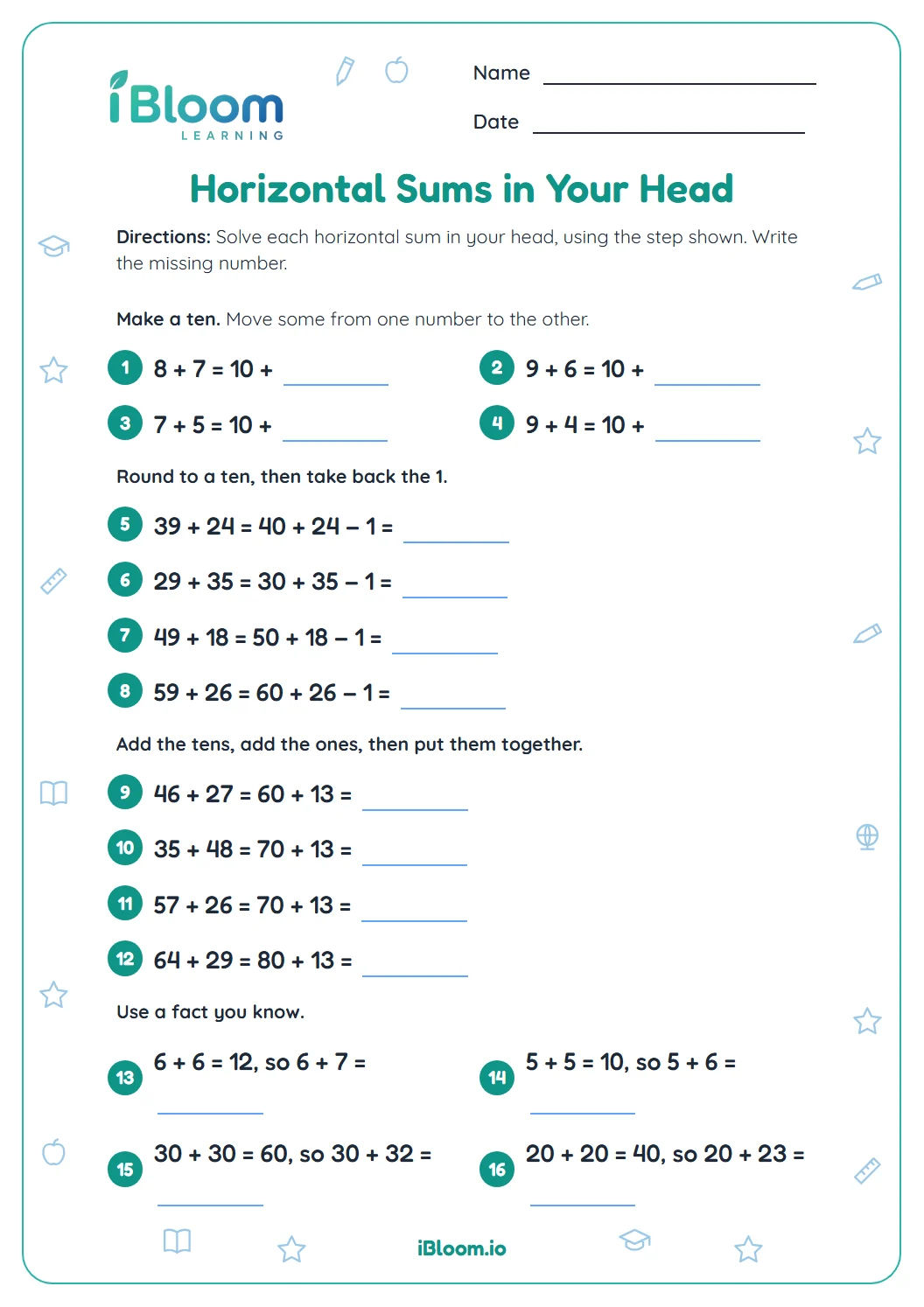
This two-page printable has 16 horizontal sums to solve mentally: four by making a ten, four by rounding to a ten and taking back 1, four by adding tens and ones, and four from a known fact. Page 2 is the answer key.
- Free PDF download
- Answer key included
- Ready to print
Free to print and use at home or in class. How to use this worksheet
Horizontal sums are addition or subtraction expressions written across a line, such as 28 + 17 = 45. The term describes the layout, not a required method. A child may solve a horizontal sum mentally, record partial steps, use objects, draw a model, or rewrite it vertically. The best choice is the one that keeps quantities and place values clear.
A horizontal sum is not automatically a mental-math test. It can invite mental calculation, but a learner should rewrite it vertically when the written layout will reduce errors or make the reasoning easier to check.
Free horizontal sums mental math worksheet
This two-page printable has 16 horizontal sums to solve mentally: four by making a ten, four by rounding to a ten and taking back 1, four by adding tens and ones, and four from a known fact. Page 2 is the answer key.
Download the free horizontal sums mental math worksheet PDF
Answer key preview
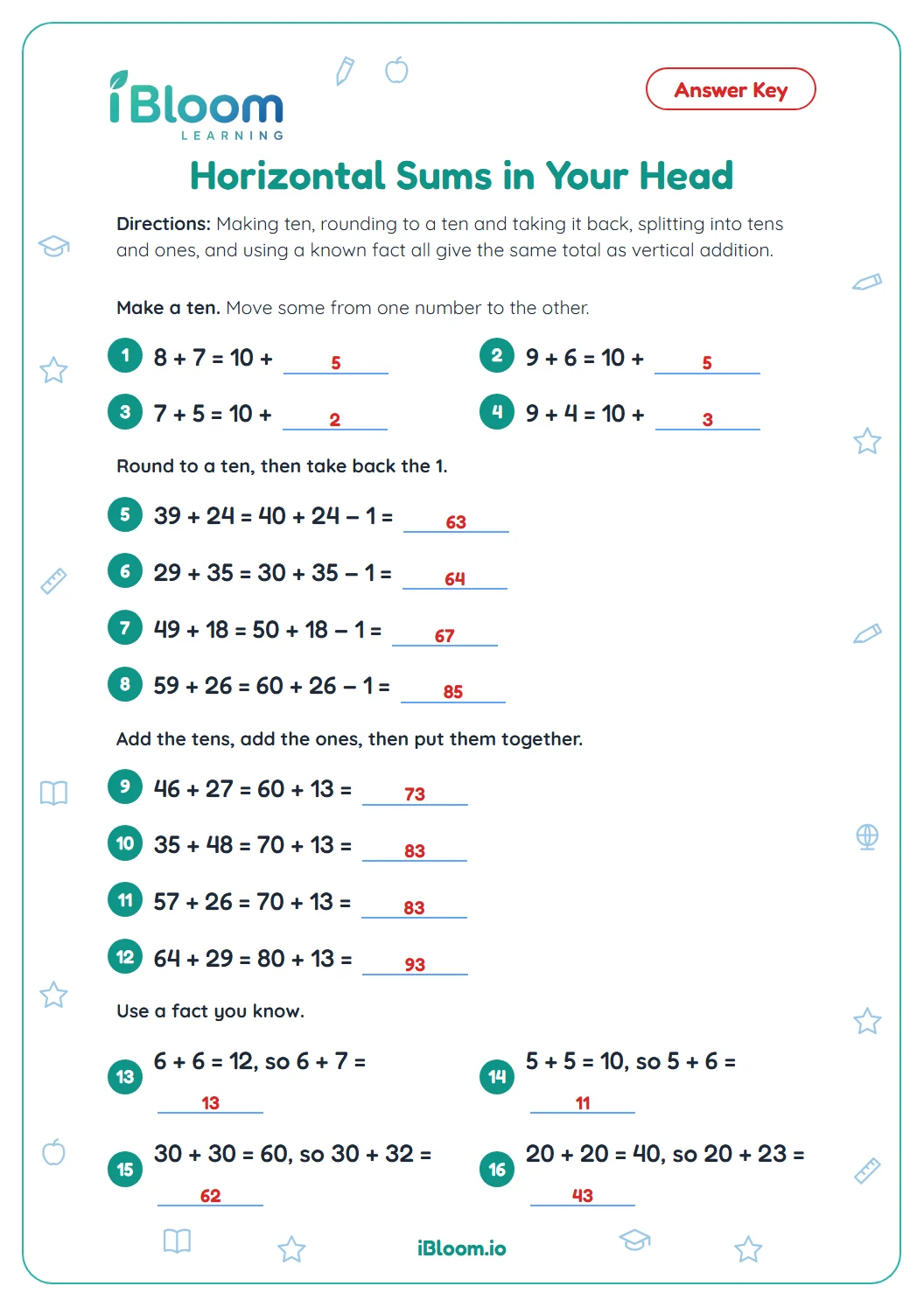
After each row, ask your child to check one answer by writing the sum vertically, so they see both layouts give the same total.
What Does Horizontal Sum Mean?
In a horizontal sum, numbers and the operation sign appear from left to right: 46 + 27 = ___. In vertical addition, the same numbers are stacked by place value. Both notations represent the same calculation. Neither changes the value of 46, 27, or their total.
The practical difference is what each layout makes easy to see. Horizontal notation keeps an expression compact and encourages a child to inspect number relationships. Vertical notation makes ones and tens columns explicit. Adults should therefore avoid saying, “You must do horizontal sums in your head.” Ask, “Which method will help you keep track of the numbers, and why?”
When Is Mental Math a Good Choice?
Mental math is a strong choice when a child can hold the numbers in mind, select a reliable strategy, and explain or check the result. The numbers often contain a helpful relationship.
Make a friendly ten
For 8 + 7, move 2 from 7 to 8: 8 + 7 = 10 + 5 = 15. Making ten is among the strategies identified in the Achieve the Core coherence map. The written steps are short because the relationship is easy to track.
Compensate near a multiple of ten
For 39 + 24, calculate 40 + 24 - 1 = 63. The child changed 39 to 40, so the extra 1 must be removed. Ask, “What did you change, and how did you balance it?” Compensation is reliable only when both changes are understood.
Decompose tens and ones
For 46 + 27, calculate 40 + 20 = 60, 6 + 7 = 13, then 60 + 13 = 73. It can be recorded as 46 + 27 = 40 + 20 + 6 + 7 = 73.
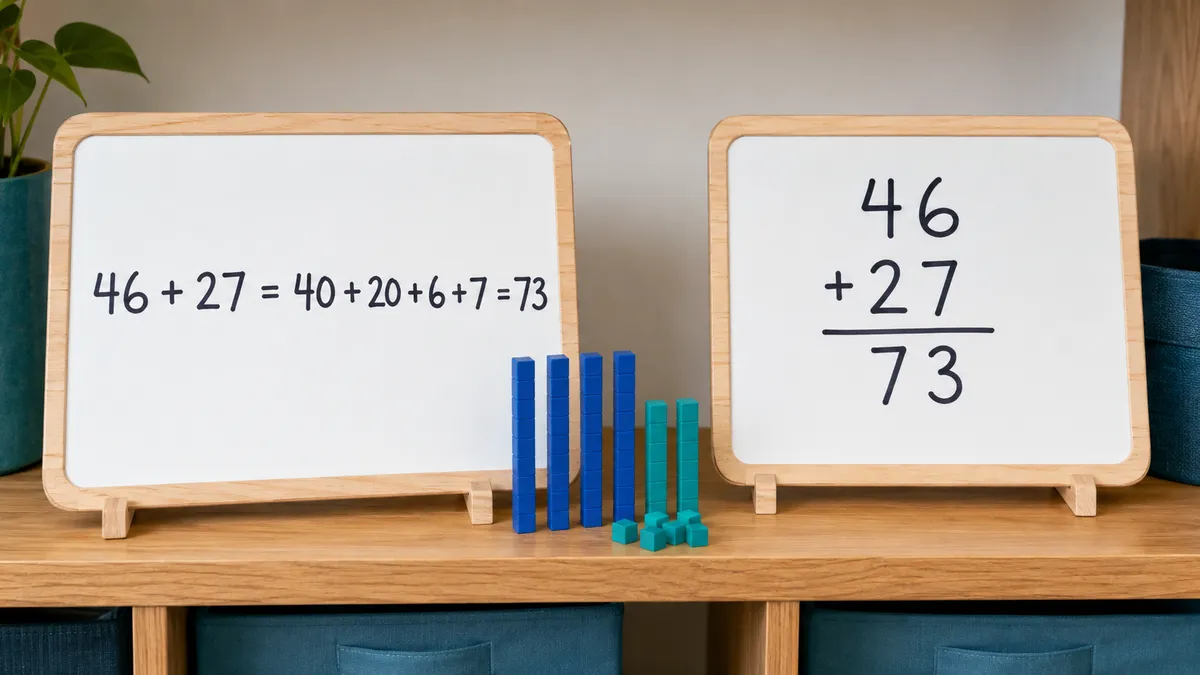
The numbers stay the same; only the layout changes.
The expression is still horizontal, but it shows enough thinking to review. A child who loses track should not be required to retain every intermediate result.
Use a known fact
If a learner knows 6 + 6 = 12, then 6 + 7 is one more: 13. Likewise, 30 + 30 = 60 supports 30 + 32 = 62. The known relationship matters more than speed.
Short discussions in which children compare methods are often called number talks. Achieve the Core's Number Talks resource describes routines where students solve mentally and share strategies. At home, use one expression and ask for two methods rather than assigning many nearly identical calculations.
When Should a Child Rewrite Vertically?
Rewrite a horizontal sum vertically when the layout reduces memory demand or makes place value safer. This is a tool choice, not evidence that the child has failed.
Several place values must stay aligned
For 368 + 457, ones, tens, and hundreds must remain coordinated. A vertical layout makes those columns visible. If digits drift out of alignment, use graph paper or draw place-value columns before calculating.
Regrouping steps are getting lost
A learner may understand that 8 ones plus 7 ones makes 15 ones but forget the new ten. Vertical notation provides a stable place to record regrouping. The written mark should represent a quantity the child understands, not an unexplained ritual.
There are multiple addends
An expression such as 126 + 58 + 247 can be solved in several ways, but stacking may simplify checking. A confident child might first combine a friendly pair mentally. The point is to choose deliberately rather than treat one layout as universally superior.
Accuracy matters more than mental efficiency
In a multi-step problem, a small arithmetic error can obscure whether the learner understood the situation. Writing the calculation preserves attention for interpreting the problem and evaluating the answer.
The mental path cannot be explained
A correct answer without a repeatable method may be a guess. Ask the child to jot one intermediate step. If that step is difficult to retain, rewrite vertically or use a model.
A Four-Question Decision Routine
- What operation is shown? Read signs and numbers accurately.
- Do I see a useful relationship? Look for ten, doubles, place-value parts, or compensation.
- Can I track the steps? If not, write an intermediate step or stack the numbers.
- How will I check? Estimate, use the inverse operation, or solve another way.
The routine prevents mental math from becoming a demand for invisible work. It also prevents vertical notation from becoming automatic digit manipulation. Children inspect the numbers first, then select a representation.
Four Worked Horizontal Strategies
Count on
For 34 + 3, start at 34 and count three more: 35, 36, 37. This is efficient because the second addend is small. Counting from 1 ignores the structure.
Make ten
For 27 + 6, move 3 from 6 to 27: 27 + 6 = 30 + 3 = 33. Check by estimating: 27 is close to 30, so an answer in the low thirties is reasonable.
Add tens, then ones
For 52 + 36, calculate 52 + 30 = 82, then 82 + 6 = 88. A child may instead combine 50 + 30 and 2 + 6. Both routes preserve the addends.
Compensate
For 48 + 25, calculate 50 + 25 = 75, then 75 - 2 = 73. Ask the learner to point to both changes. If only the first appears, the compensation is incomplete.
For focused place-value practice, see iBloom's Class 2 mental addition without carrying. Learners working with early facts can use these Class 1 addition questions.
Diagnose the Error Before Giving More Problems
Different wrong answers need different responses. Matching instruction to the error is more useful than repeating the same problem format.
A number changes without compensation
Example: 39 + 24 = 40 + 24 = 64. The learner recognizes a friendly number but changes the total. Use counters or a number line to show that adding 1 to an addend adds 1 to the sum. Compare 29 + 15 with 30 + 15.
Digits are combined instead of place values
Example: treating 46 + 27 as 4 + 2 and 6 + 7, then writing 613. Build both numbers with base-ten blocks, combine ones, and rename 10 ones as 1 ten. The issue is place-value meaning, not merely a missing procedure.
An intermediate total is lost
Example: the learner says 46 + 20 = 66 but then adds 7 to 46. Have the child record 66 + 7 before continuing. This small written bridge may be enough; a full vertical rewrite is optional.
Stacked numbers are misaligned
If the ones digit of one addend sits under the tens digit of another, draw labeled tens and ones columns. Read each number by value before adding. Squared paper can provide a boundary.
An unreasonable answer goes unchecked
Before exact calculation, estimate. For 48 + 25, think “about 50 + 25, so about 75.” An exact answer of 713 should trigger a review.
What Changes by Grade Level?
Young learners begin with objects, drawings, counting, and relationships among small facts. They should not be rushed into multi-digit algorithms before digits represent meaningful tens and ones. By the end of Grade 2, the fluency expectation includes knowing sums of two one-digit numbers from memory, as summarized by Illustrative Mathematics for 2.OA.B.2. That does not mean every larger expression must be solved without writing.
As numbers grow, students should expand their choices. They may use decomposition for one problem, compensation for another, and a written method when it is clearest. The Grade 2 ten-more, ten-less guide provides a related place-value progression. For discussion instead of drill, use this parent guide to short number talks.
A Five-Minute Home or Classroom Routine
Write one horizontal expression. Give quiet thinking time without demanding speed. Ask, “What relationship do you notice?” Record two methods exactly as learners describe them. Compare where the methods use the same place-value idea. End with an estimate or inverse-operation check.
Use only one or two expressions. The goal is to make reasoning visible. If a child needs objects or a vertical rewrite, treat that representation as useful evidence about current understanding.
On another day, present two expressions, such as 25 + 25 and 25 + 26. Ask how the first can help with the second. On a third day, compare 48 + 25 with 50 + 23. These pairs expose relationships without requiring a long worksheet.
How Adults Can Respond Productively
If an answer is correct, ask for the method rather than immediately moving on. If it is wrong, avoid naming a preferred procedure before understanding the error. Say, “Show me what each number became,” or “Where are the tens in your work?” Those prompts locate reasoning.
When a child selects a vertical method for an easy expression, ask whether another relationship is visible, but do not ban the written method. When a child insists on mental work and repeatedly loses steps, require a brief record. Strategy flexibility grows through comparison, not through declaring one representation superior.
Use precise language. “Regroup 10 ones as 1 ten” communicates place value more clearly than “carry the one.” “Add 30” is clearer than “add the 3” when the digit represents three tens. Language should preserve quantity.
Common Misconceptions
“Horizontal means mental.” Horizontal only names the arrangement.
“Vertical addition is always easier.” It supports alignment but may hide useful relationships if applied without thought.
“Fast answers prove fluency.” A dependable strategy, accurate result, and ability to check are more informative than speed alone.
“Every child should use the same strategy.” Different combinations favor different methods. Require consistency, not identical routes.
“Writing a step is cheating.” Recording a useful intermediate result is mathematical communication. It can reveal understanding and prevent a memory slip.
Frequently Asked Questions
Are horizontal sums and number sentences the same?
A horizontal sum is a calculation written across a line. “Number sentence” is broader and can include any arithmetic operation or comparison.
Should children show work for horizontal sums?
Ask for enough work to make the method reliable and reviewable. A known fact may need no intermediate writing; compensation may need one or two lines.
Can a child rewrite every horizontal sum vertically?
Yes, if the rewrite is accurate. Still ask the child to inspect the numbers first because a mental relationship may be simpler for some expressions.
What if school expects a particular method?
Help the child understand and use it, then compare it with another valid representation. The comparison reveals why a method works instead of turning it into unexplained steps.
How can I tell whether mental math is too difficult?
Watch for lost intermediate totals, guessing, place-value confusion, or inability to explain a correction. Let the child record a bridge step, use a model, or stack the numbers. Reduce the memory demand without reducing the mathematical idea.
Is horizontal subtraction handled the same way?
The same choice principle applies, although subtraction strategies differ. A child may count up, decompose by place value, compensate, or rewrite vertically. The chosen method must preserve the difference.
The Practical Rule
Use mental math for a horizontal sum when the child sees a useful relationship and can track and check the steps. Rewrite vertically when place-value alignment, regrouping, multiple addends, or working memory makes the horizontal route fragile. The goal is not loyalty to a layout. It is an accurate, explainable calculation built on the value of the numbers.
Related practice
Practice this topic
Continue with a lesson, generator, or printable worksheet.