Picture Reading Worksheets for Kids
Use picture reading worksheets to build observation, oral language, early comprehension, and confident reading practice.
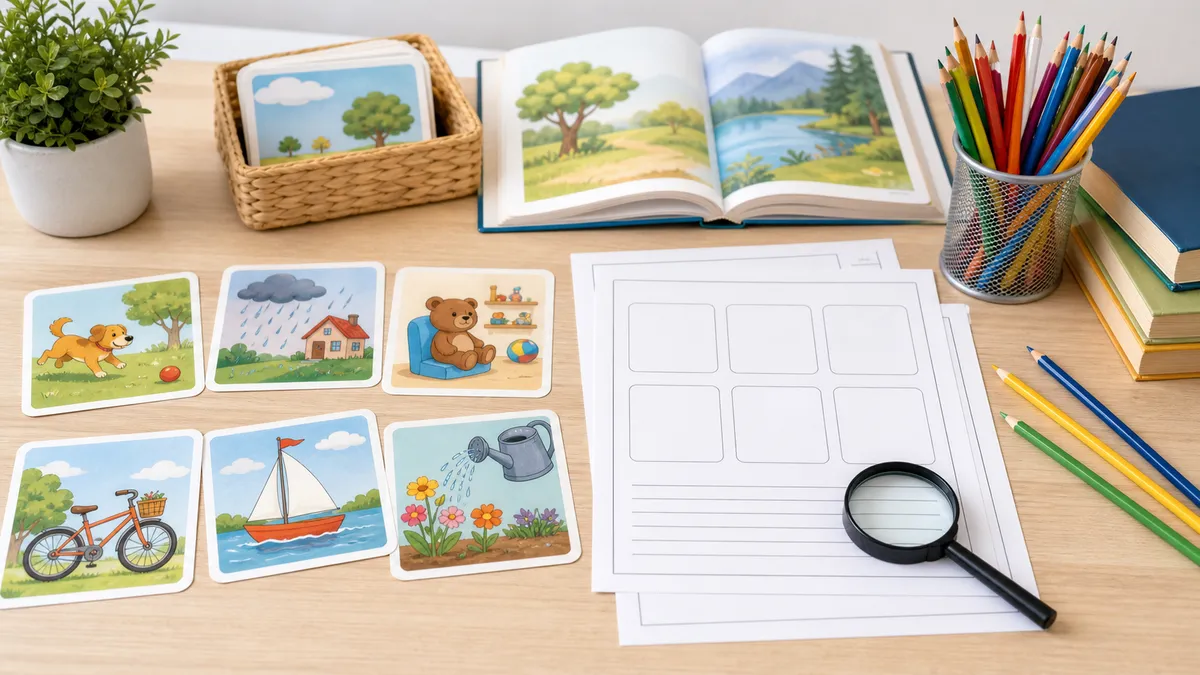
Picture Reading Worksheets for Kids help children move from quick guessing to careful reading. This guide is for parents, teachers, tutors, and children who want worksheet practice that feels simple at the table but still builds real comprehension. It connects picture clues, oral language, observation, and short answer practice before a child carries the same skill into longer passages, then links children to iBloom practice such as English Worksheets, Pictures Help Us Read worksheet, and Finding Facts lesson.
Start with the Matching Practice
Use this guide with a direct iBloom worksheet or lesson so children can move from reading the explanation into real practice.
Table of Contents
Worksheet And Lesson Previews
Pictures Help Us Read Worksheets for Class 1 Preview
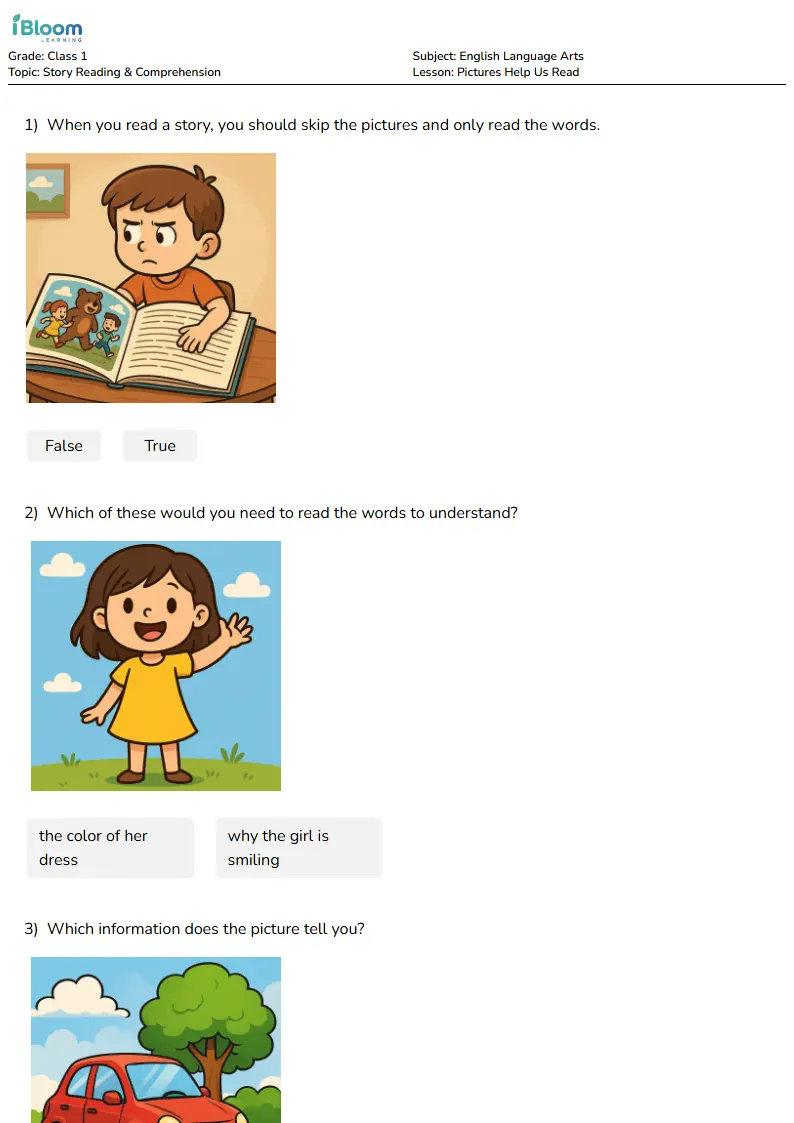
Use this preview to see the kind of practice children will open before you start the routine.
Finding Facts Lesson for Ukg Preview
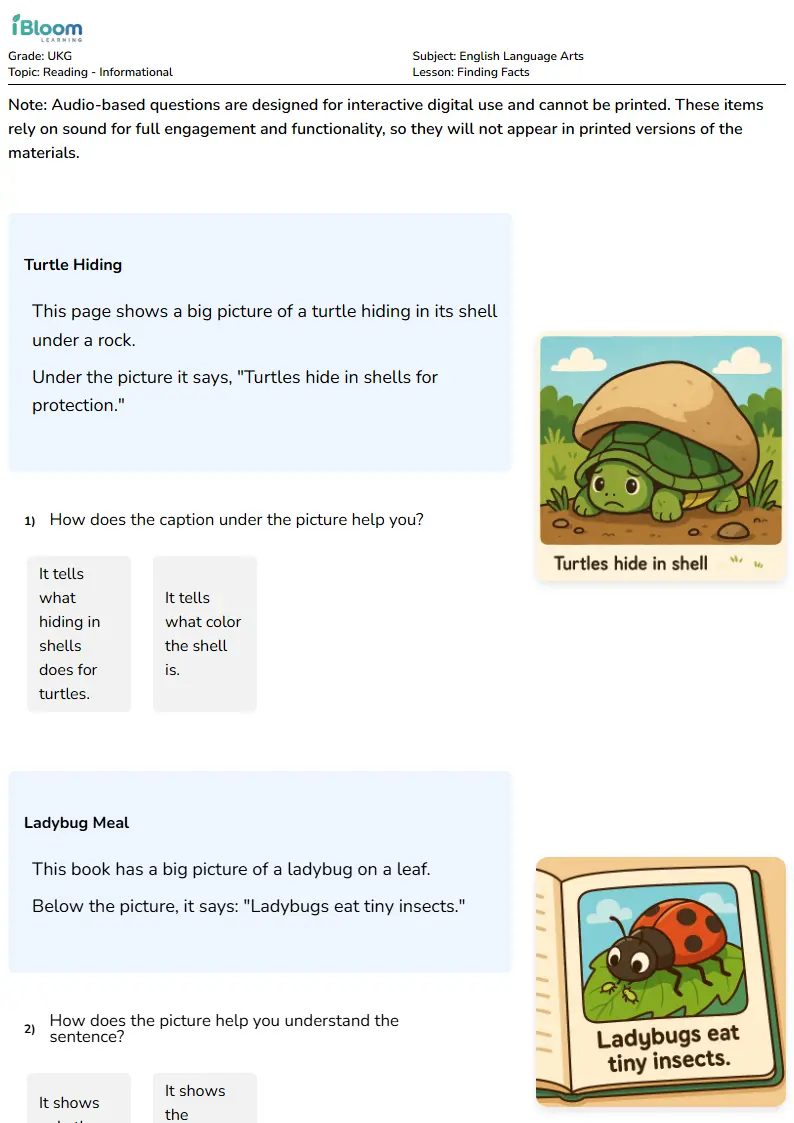
Use this preview to see the kind of practice children will open before you start the routine.
Key Takeaways
- The best picture reading worksheets ask children to slow down, notice clues, and explain answers.
- Short routines work better than long worksheet piles.
- Parents can support comprehension with talk, rereading, and one clear question at a time.
- Teachers can use the same page for mini-lessons, small groups, centers, and homework.
- iBloom links should guide children from one skill to the next: English Worksheets, Pictures Help Us Read worksheet, Finding Facts lesson, Kindergarten Reading Assessment Checklist, and How to Improve Reading Skills at Home.
Why This Worksheet Skill Matters
Children often look like they are reading when they can say words aloud, but comprehension grows when they can explain what the words and pictures mean. Reading Rockets describes comprehension strategies as conscious steps readers use to make sense of text, including monitoring understanding, asking questions, making inferences, and summarizing. The IES reading-comprehension practice guide also supports explicit instruction in comprehension strategies, vocabulary, and purposeful discussion.
That matters for picture reading worksheets for kids because a worksheet can either become a quick-answer page or a thinking page. The difference is the routine. A strong adult prompt sounds like, "What clue helped you know?" or "Where did the page show that?" A child-friendly response sounds like, "I know because the picture shows..." or "The sentence says..." This turns practice into reading, speaking, writing, and reasoning at the same time.
Use English Worksheets when you want the closest iBloom practice page. Use How to Improve Reading Skills at Home when the child needs a broader reading routine. Keep Kindergarten Reading Assessment Checklist nearby for families who want a longer reading support article after the worksheet is done.
A Simple Teaching Routine
Show the picture, ask what is happening, ask what clue proves it, then read the sentence or question. The adult should model one example, let the child try one example, and then ask for a reason. A reason is more valuable than a fast answer because it shows whether the child used the page.
- Preview the worksheet title and say what kind of thinking it needs.
- Read or observe the first item together.
- Ask the child to point to the clue.
- Let the child answer in a short phrase first.
- Ask the child to extend the answer with because.
- Move to Pictures Help Us Read worksheet or Finding Facts lesson for another page when the first page feels secure.
Examples Children Can Try
Try a one-minute clue hunt. Ask the child to find one picture clue, one word clue, and one detail that does not belong. Then ask the child to explain the best clue. For example, if a picture shows a child holding an umbrella under gray clouds, the child can say, "It may rain because I see an umbrella and clouds." If a short passage says a character packed lunch, water, and a map, the child can say, "The main idea is that the character is getting ready for a trip."
For older elementary learners, add a written answer frame: "I think ___ because ___." Another helpful frame is, "The detail that proves my answer is ___." These frames are especially useful before students work on Finding Facts lesson or How to Improve Reading Skills at Home.
Parent Practice Plan
At home, keep the session short. Ten minutes is enough when the child is focused. Start with one warm-up question, complete three to five worksheet items, then end with one oral retell. If the child gets stuck, do not jump to the answer. Ask, "Should we look at the picture, the first sentence, or the question again?" That teaches repair strategies.
Parents in busy homes can also use a two-day pattern. On day one, complete the page orally. On day two, ask the child to write two answers. This helps children in Delhi, Mumbai, Bengaluru, Chennai, Hyderabad, Pune, Kolkata, Ahmedabad, Jaipur, Lucknow, California, Texas, Florida, New York, Illinois, Dubai, Abu Dhabi, Sharjah, and Al Ain build the same careful reading habit across different school systems.
Teacher Practice Plan
Teachers can use picture reading worksheets for kids as a mini-lesson, a partner task, a literacy center, or a quick exit ticket. Start by naming the skill. Then model the exact language students should use: "My clue is..." "The main idea is..." "The detail that supports it is..." This is especially useful in multilingual classrooms where students understand the idea but need sentence frames to explain it clearly.
Small groups work well when each child has a role. One child reads, one child points to the clue, one child explains, and one child checks whether the answer matches the question. After that, send students to English Worksheets or Pictures Help Us Read worksheet so the practice continues on a focused iBloom page.
How to Choose the Right Worksheet
Choose a page that has one clear skill. If a child is practicing picture clues, avoid pages that also demand long written answers, difficult vocabulary, and unfamiliar background knowledge. If the child is practicing text evidence, use short passages first. If the child is practicing main idea, pick a passage where the details all point to one clear topic.
The Common Core English Language Arts standards emphasize reading, language, speaking, listening, and writing across grades. Families do not need to use standards language at the table, but teachers can connect these worksheets to standards-aligned comprehension, vocabulary, and evidence-based response goals.
Common Mistakes
The first mistake is using too many worksheets in one sitting. Children may finish pages but stop thinking carefully. The second mistake is accepting an answer without asking for the clue. The third mistake is making every correction feel like failure. A better correction is, "Let's find the clue together." The fourth mistake is using the same type of question every day; children need pictures, short passages, oral retell, written answers, and discussion.
Regional Learning Notes
In India, picture reading worksheets for kids fit CBSE, ICSE, and state-board English practice because children often need clear reading routines before exams, oral assessments, and homework. In the United States, the same worksheets fit classroom comprehension centers, intervention groups, homeschool reading, and after-school practice. In the UAE, they support British, American, IB, and Indian curriculum classrooms where children may speak more than one language at home.
Use location context as a way to choose examples. A child in Mumbai might describe a rainy-day picture. A child in Houston might read a short school-bus passage. A child in Dubai might explain a market, park, library, or classroom scene. The skill stays the same: observe, read, find the clue, and explain.
How iBloom Fits
iBloom works best when the adult treats each page as a thinking conversation. Start with English Worksheets, move to Pictures Help Us Read worksheet for a closely related skill, and use Finding Facts lesson when the child needs another route into the same reading behavior. For broader support, connect this article with Kindergarten Reading Assessment Checklist and How to Improve Reading Skills at Home.
Frequently Asked Questions
What age are picture reading worksheets for kids best for?
They work for early and elementary readers when the adult chooses the right difficulty. Younger children need picture clues, oral answers, and short sentences. Older children need written explanations, evidence, and multi-sentence passages.
Should parents correct every mistake?
Correct the thinking routine, not every tiny wording issue. Ask the child to find the clue, reread the sentence, or explain the picture. Then help the child improve the answer.
How many worksheet questions should a child do each day?
Three to eight thoughtful questions can be enough. A short session with explanation is usually better than a long page completed silently.
Can teachers use these worksheets for small groups?
Yes. Give each child a role and ask the group to prove each answer. Then rotate roles so every child reads, points to evidence, explains, and checks.
What should I do when a child guesses?
Pause and ask, "What clue helped you?" If the child cannot answer, return to the picture, sentence, title, or question. Guessing usually means the child needs a clearer routine.
Practice This Skill Next
After reading this guide, children can practise the same skill on iBloom. Start with Pictures Help Us Read worksheet or Finding Facts lesson, then ask the child to explain one answer before moving on.