Supporting Details Worksheets for Kids
Teach supporting details with worksheets, examples, text evidence, parent routines, and teacher reading activities.
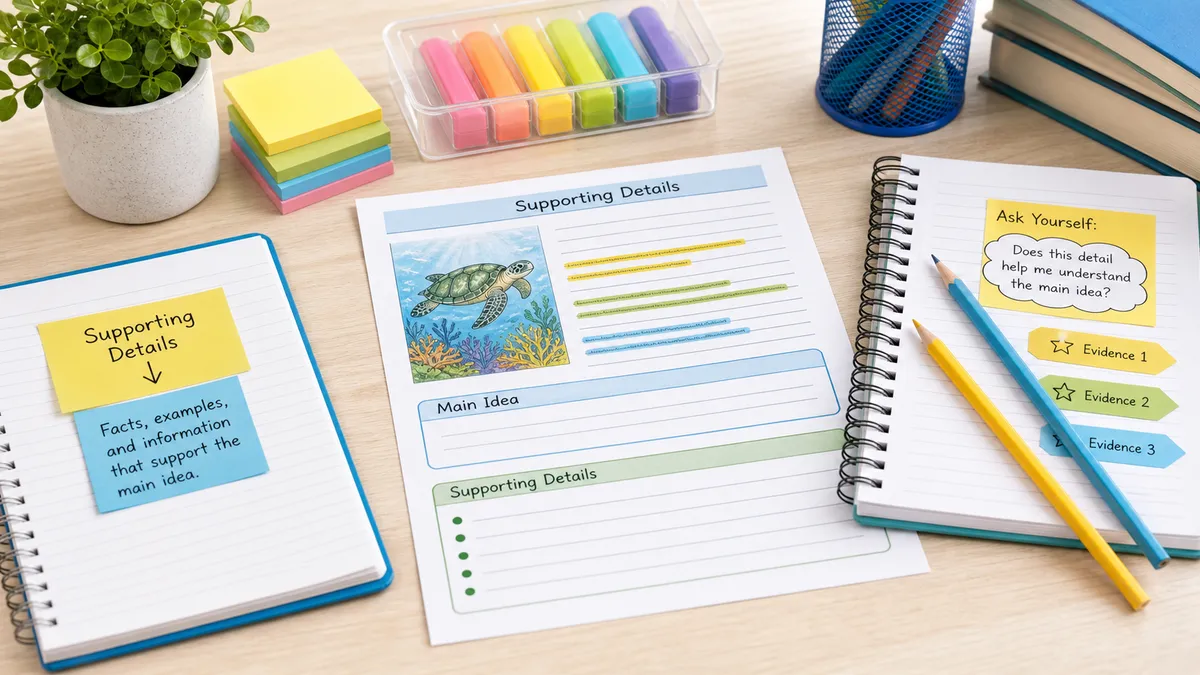
Supporting Details Worksheets for Kids is a practical guide for parents, teachers, tutors, and children who need helping children prove a main idea with exact details rather than guessing from one sentence. It supports iBloom's existing reading-comprehension hubs without repeating them. Use it with Main Idea Worksheets for Kids, Text Evidence Worksheets for Elementary Students, and the exact lesson or worksheet links throughout this article.
Start with the Matching Practice
Use this guide with a direct iBloom worksheet or lesson so children can move from reading the explanation into real practice.
Table of Contents
Key Takeaways
- Children understand reading better when they can point to the words that prove an answer.
- A good worksheet should ask for thinking, not only a circled choice.
- Parents can help by asking, "Where did the text show that?"
- Teachers can improve answers with sentence frames, partner talk, and short evidence checks.
- Reading, writing, vocabulary, and comprehension grow together when children explain their thinking.
Why This Skill Matters
Many children can read the words in a passage but still guess when a question asks for the main idea, detail, reason, or evidence. Supporting Details Worksheets for Kids gives them a repeatable routine: read the question, reread the text, find the clue, explain the answer, and check whether the detail fits.
Literacy resources from Reading Rockets comprehension guidance, Reading Rockets writing guidance, and IES practice guides support explicit modeling and repeated practice. Children need to hear adults think aloud before they can write strong reading responses by themselves.
How to Teach It
Start with one short passage and one clear question. Model the answer aloud. Then say which sentence helped. Next, ask the child to try a second question with a partner, parent, or tutor. Finally, ask the child to write one complete response.
Use simple language. Instead of saying, "Cite textual evidence," say, "Show me the words that helped." Instead of saying, "Develop an inference," say, "What clue made you think that?" The academic language can come later. The reasoning habit must come first.
Examples and Mini-Lessons
| Example | What Children Do | Why It Helps |
|---|---|---|
| The main idea is that the class solved a problem together. | Find the idea or point | It keeps the answer focused |
| One detail is that each student had a job. | Choose a detail or reason | It proves the answer |
| This proves the answer because teamwork is shown in actions. | Explain with a sentence frame | It turns reading into writing |
If a child answers too quickly, cover the choices and ask for the clue first. If a child copies a whole paragraph, ask for the shortest useful detail. If a child gives a true detail that does not answer the question, reread the question together.
Home Practice Routine
Parents can use this routine in ten minutes:
- Read one short passage or paragraph.
- Ask one question.
- Find one clue sentence.
- Say one complete answer.
- Write one sentence using the clue.
This works after school in Delhi, Mumbai, Bengaluru, Chennai, Hyderabad, Pune, Kolkata, Ahmedabad, Los Angeles, Houston, Chicago, Dallas, Seattle, Boston, Dubai, Abu Dhabi, Sharjah, Ajman, and Al Ain. The curriculum label may change, but children everywhere benefit from a calm evidence routine.
Classroom Routine
Teachers can model one response, let partners find one clue, and then move students to independent iBloom practice. During review, ask students to explain why one answer choice is better than another. That comparison often reveals whether they understood the passage or guessed.
For struggling readers, use shorter passages and oral answers first. For advanced readers, ask for two pieces of evidence, a counterexample, or a written explanation that includes the author's reason. Connect the activity to Identify and Analyze Key Details lesson when students need direct practice.
Regional Practice Notes
In India, this supports CBSE, ICSE, state-board English, and tuition review. In the United States, it fits ELA centers, comprehension standards, intervention, and homework. In the UAE, it helps multilingual learners in British, American, IB, and Indian curriculum schools keep a consistent reading-response habit.
iBloom Practice Path
- Start with Main Idea Worksheets for Kids for the closest hub.
- Use Text Evidence Worksheets for Elementary Students when the child needs evidence practice.
- Use Identify and Analyze Key Details lesson for exact lesson or worksheet practice.
- Add Reading Comprehension Grade 4 for broader grade-level comprehension.
- Keep English Worksheets as the wider iBloom pathway.
Frequently Asked Questions
How often should children practise reading responses?
Short daily practice works best. One passage, one question, and one explanation can build the habit without tiring the child.
What should parents do if a child guesses?
Ask for the clue before discussing whether the answer is right. The goal is to train the process.
Should every answer include a quote?
No. Younger children can point to or paraphrase evidence. Older children can quote short evidence when the question asks for it.
How does this support writing?
Children learn to make a point, give a reason, and support it with evidence. That is the same foundation they need for clear paragraphs.
Detailed Practice Sets for Supporting Details
Use these practice sets when a child can find the main idea but still chooses details that are too small, too broad, or only partly related. Start with a one-paragraph passage about a familiar topic such as a classroom garden, a science project, a school trip, or a family reading routine. Ask the child to write the main idea in one sentence. Then ask for three supporting details: one fact, one action, and one explanation. This keeps the child from copying random sentences.
A teacher can turn the same routine into a small-group activity. Give each student a detail card and ask the group to decide whether the card strongly supports the main idea, weakly supports it, or does not belong. Children in Class 3, Grade 4, and Grade 5 often learn more from defending their choice than from simply circling an answer. Parents can use the same method at home with sticky notes. Write the main idea on one note, write details on three others, and ask the child to arrange them from strongest to weakest.
Differentiation for Mixed Reading Levels
For emerging readers, use short passages and oral answers first. The child can point to the detail before writing it. For stronger readers, require two details from different parts of the passage. For advanced readers, ask which detail is most important and why. In India, this helps children prepare for English comprehension questions in CBSE, ICSE, and state-board classrooms. In the US and UAE, it supports ELA reading-response expectations where children must connect claims and evidence clearly.
Teacher Checklist
- The child can state the main idea without copying the title.
- The child can choose a detail that directly proves the main idea.
- The child can ignore an interesting sentence that does not answer the question.
- The child can explain the link using because.
- The child can revise an answer after rereading.
Parent Conversation Prompts
Ask, What is the whole passage mostly about? Which sentence helped you most? Is this detail important or just interesting? Could another child understand your answer without reading your mind? These questions make supporting details feel like a conversation, not a test.
Practice This Skill Next
After reading this guide, children can practise the same skill on iBloom. Start with Identify and Analyze Key Details lesson, then ask the child to explain one answer before moving on.