Pangram Solver Guide: Find More Words Without Spoilers
A spoiler-light pangram method that helps children search letter patterns, build vocabulary, and use solver tools as feedback rather than shortcuts.
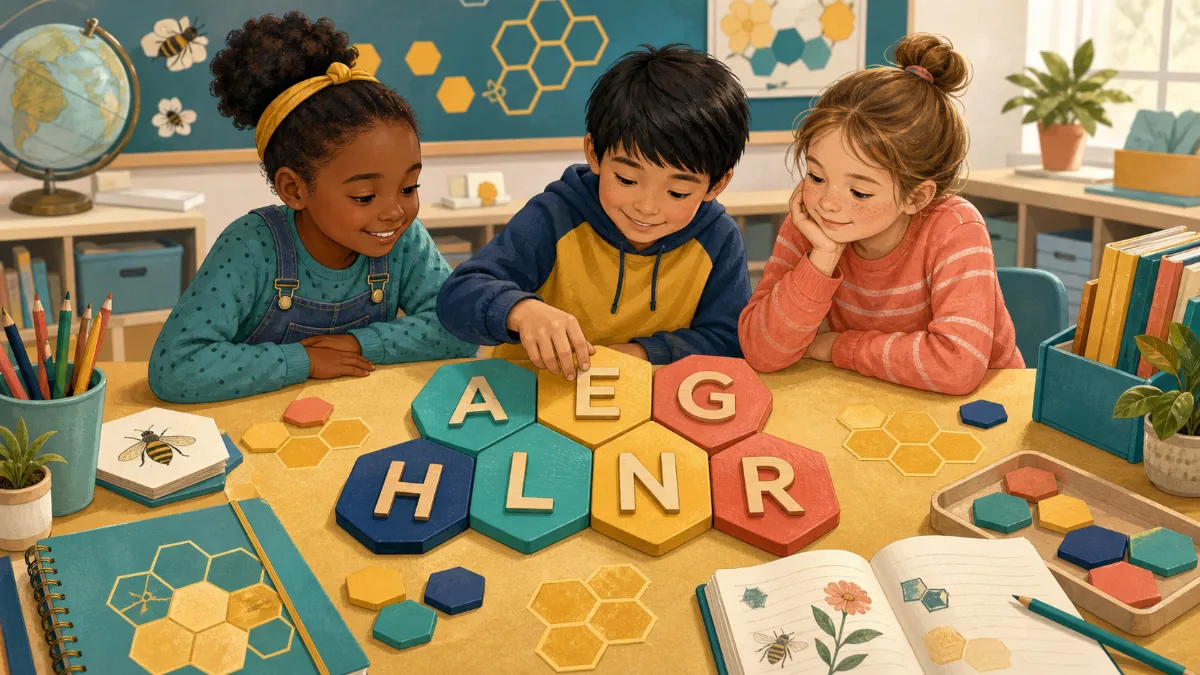
A pangram solver can reveal a word quickly, but the best learning happens in the few minutes before the reveal. Children build spelling knowledge when they search for chunks, test possibilities, reject impossible combinations, and explain why a word works.
In a seven-letter honeycomb-style puzzle, a pangram is a word that uses every available letter at least once while following the puzzle's centre-letter rule. That is different from an alphabet pangram such as “The quick brown fox…,” which uses all 26 letters. Knowing which kind of pangram the puzzle expects prevents a lot of confusion.
A seven-step pangram method
Use this sequence before opening a full-answer solver.
- Mark the required letter. Every candidate must include it.
- Group vowels and consonants. Notice whether common openings or endings are possible.
- Build familiar chunks. Try patterns such as re-, un-, -ing, -er, or -tion only when the available letters support them.
- Reuse letters. Most word puzzles allow a letter to appear more than once. Children often miss pangrams because they assume each tile can be used once.
- Start from a known long word. Add, remove, or rearrange one chunk instead of testing random strings.
- Say the candidate aloud. Pronunciation can reveal a missing syllable or an unlikely letter order.
- Check meaning and spelling. A letter pattern is not enough; it must form an accepted word.
Keep a scratch area with three columns: possible start, word family, and checked word. This makes the reasoning visible and stops children from retrying the same combinations.
Use hints before answers
Solver tools are most useful when they offer levels of help. Try this order:
- Ask only how many pangrams exist.
- Reveal the number of letters in one pangram.
- Reveal the first letter or a useful word chunk.
- Request a definition without the word.
- Reveal the answer only after recording the strategies already tried.
This turns a solver into feedback. The child can compare the final word with their search and identify the missing pattern. If the answer is shown immediately, there is little to retrieve or remember next time.
A worked practice routine
Create a seven-letter set with one required centre letter. Give the learner three minutes to list short valid words first. Those words become raw material for longer ones.
Next, circle repeated chunks. If several words share a base, test prefixes and suffixes. Encourage the child to narrate: “I need the centre letter, I have used six of the seven letters, and this ending is possible.” That sentence is more valuable than a lucky guess because it can be reused on a new puzzle.
Finish by choosing three unfamiliar words to define and use in sentences. Pangram practice should expand vocabulary, not just increase a score. Children who enjoy word challenges can continue with iBloom's SpellBee practice or use a short interactive English activity.
Classroom and family variations
Hint ladder: Teams earn fewer points as they request stronger hints. This rewards persistence without making help feel like failure.
Pattern detective: Give one correct word and ask learners to create a list of related starts, endings, or syllables from the same letter set.
Explain the rejection: Present a near-word and ask why it fails: missing centre letter, unavailable letter, spelling error, or not a standard word.
Vocabulary finish: After solving, sort found words into familiar, partly known, and new. Look up only the new words and write one useful sentence for each.
Common mistakes
- Treating the puzzle like an anagram where each letter can be used only once.
- Forgetting the required centre letter.
- Searching only for seven-letter words; a pangram may be longer because letters can repeat.
- Entering proper nouns, abbreviations, or invented forms that the puzzle does not accept.
- Using a full solver before the child has tried patterns and word families.
A worked pangram-solving example
Spelling-game rules vary, so confirm the allowed letters, minimum word length, and whether one letter is mandatory. In this practice set, the allowed letters are A, C, E, H, R, T, the required letter is A, letters may repeat, and a pangram must use every allowed letter at least once.
Start with short families: at, cat, car, care, race, and trace. Then list useful chunks such as teach, each, -er, and re-. Combining teach + er produces teacher. It contains A, C, E, H, R, and T, so it is a pangram for this practice set.
The point of the example is the method:
- Mark letters that are still unused.
- Search for a common base word containing several of them.
- Test a prefix or suffix that may add the remaining letter.
- Check that the required letter is present.
- Verify the final word in an accepted dictionary.
A solver may reveal “teacher” instantly, but working through the chunks teaches a reusable spelling strategy.
Use a hint ladder before a solver
When a child is stuck, give the smallest helpful hint.
- Hint 1: Name the two least-used letters.
- Hint 2: Suggest a word family or common letter pair.
- Hint 3: Reveal the length of one possible pangram.
- Hint 4: Reveal the beginning or ending chunk.
- Hint 5: Show the answer and ask the child to rebuild it.
After revealing an answer, cover it and ask the child to explain where every allowed letter appears. Then create two smaller words from the same base. This turns answer checking into word study.
Try the Class 2 spelling-puzzles lesson or Build Words with Phonics Patterns before opening a full solver.
Keep a pangram strategy log
A one-line log helps players recognise what unlocks a puzzle.
| Puzzle clue | What I tried | What helped |
|---|---|---|
| Rare C and H remained | searched for ch words | found teach, then teacher |
| Many short words, no pangram | grouped by endings | added -er to a base |
| Required letter forgotten | circled it on the page | checked every candidate |
Record strategies, not a large copied answer list. Over time, look for patterns: missing common endings, overlooking repeated letters, or abandoning a productive word family too early.
When a solver is appropriate
A solver is useful for checking whether a suspected word fits the rules, finding one final pangram after a genuine attempt, or reviewing a completed puzzle. It is less useful when it replaces all retrieval. For child accounts, avoid tools that request unnecessary personal information or require public posting.
For classroom use, set a “hint budget”: for example, two child-generated strategies, one peer hint, and then one solver check. Award credit for explaining the word structure, not only for finding the answer.
Frequently Asked Questions
What does pangram mean in a spelling puzzle?
It usually means a valid word that uses every letter in the puzzle at least once and includes the required centre letter.
Is a pangram always seven letters long?
No. It must use all seven available letters, but one or more letters may repeat, so the word can be longer.
Is using a pangram solver cheating?
It depends on the goal. Revealing every answer ends the puzzle, while using graded hints after an independent attempt can support learning and strategy reflection.
How can children get better at finding pangrams?
Practise common prefixes, suffixes, syllables, and word families. Say possible words aloud, reuse letters, and review the pattern that was missed after each puzzle.
Do alphabet pangrams and spelling-game pangrams mean the same thing?
No. An alphabet pangram uses every letter of an alphabet in a sentence or phrase. A spelling-game pangram uses all letters supplied by that particular puzzle.