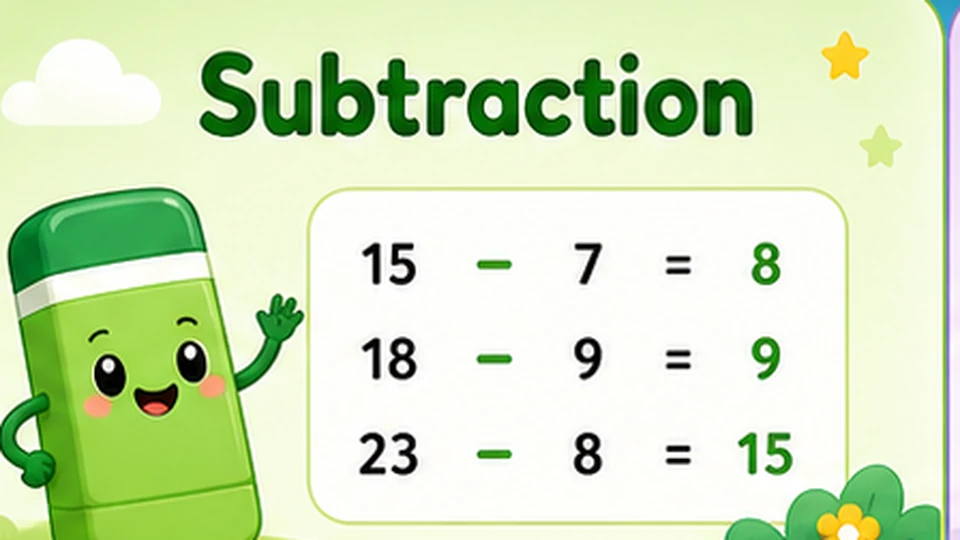
UKG Subtraction Worksheets: Free Practice for Numbers 1 to 10
A practical UKG subtraction worksheet guide for parents and teachers, with picture subtraction, one digit sums, number line practice, common mistakes, and links to interactive iBloom worksheets.
Free printable worksheet
Free UKG subtraction worksheet
This two-page printable has eight picture subtraction sums within 10, four missing-number sums and an answer key. Children cross out the pictures that go away, count what is left and write the number sentence.
- Free PDF download
- Answer key included
- Ready to print
Free to print and use at home or in class. How to use this worksheet
Subtraction is one of the first big math steps in UKG. Children move from counting objects to understanding that a number can become smaller when some objects are taken away. The best UKG subtraction worksheets make that idea visible: cross out fruits, count the toys that are left, move backward on a number line, and then write the matching subtraction sentence.
This guide gives parents and teachers a simple sequence for subtraction practice, plus worksheet ideas that match how young children actually learn. If your child is ready to practise online, start with iBloom's interactive worksheet for understanding subtraction with pictures.
Free UKG subtraction worksheet
This two-page printable has eight picture subtraction sums within 10, four missing-number sums and an answer key. Children cross out the pictures that go away, count what is left and write the number sentence.
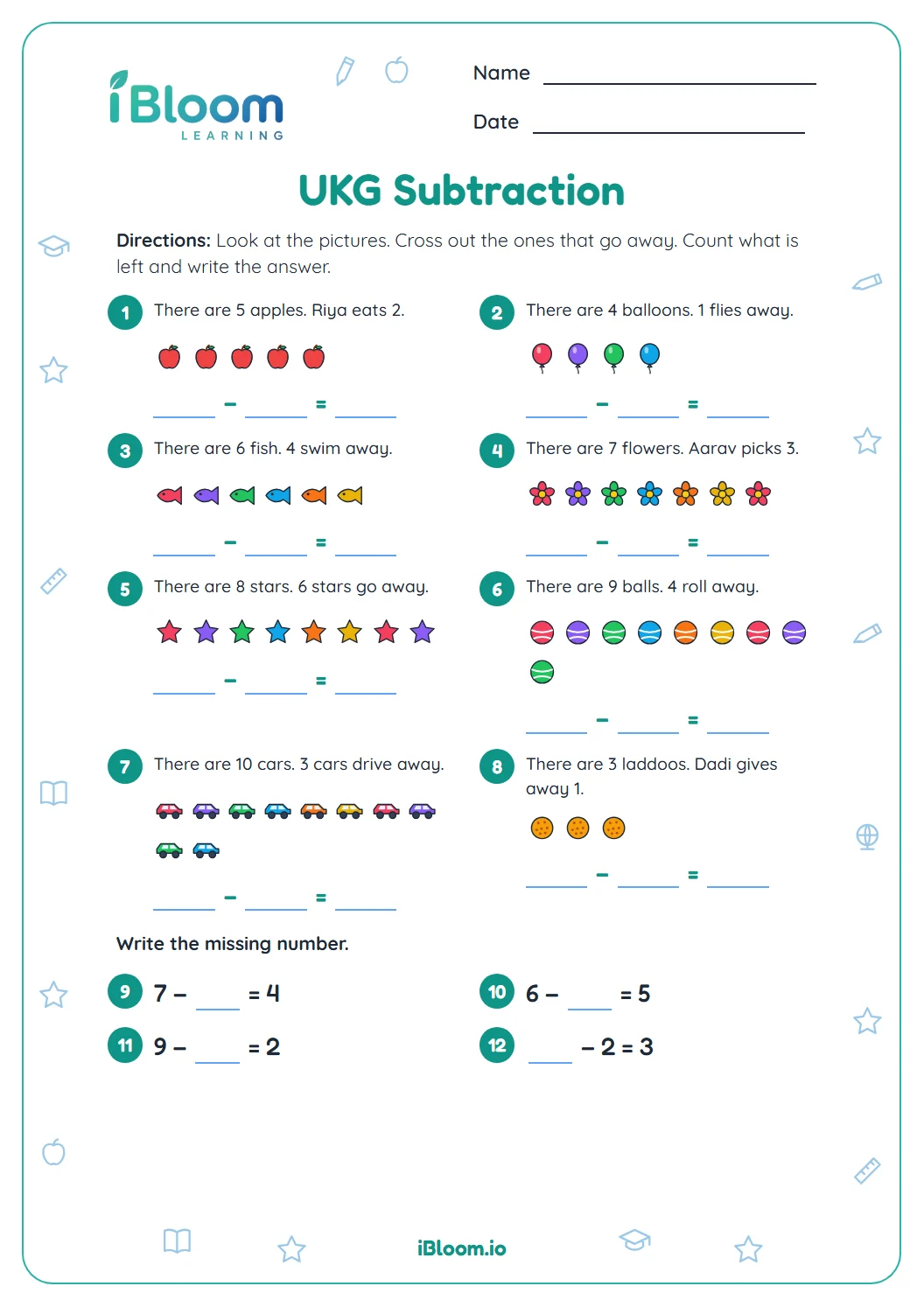
Download the free UKG subtraction worksheet PDF
Answer key preview
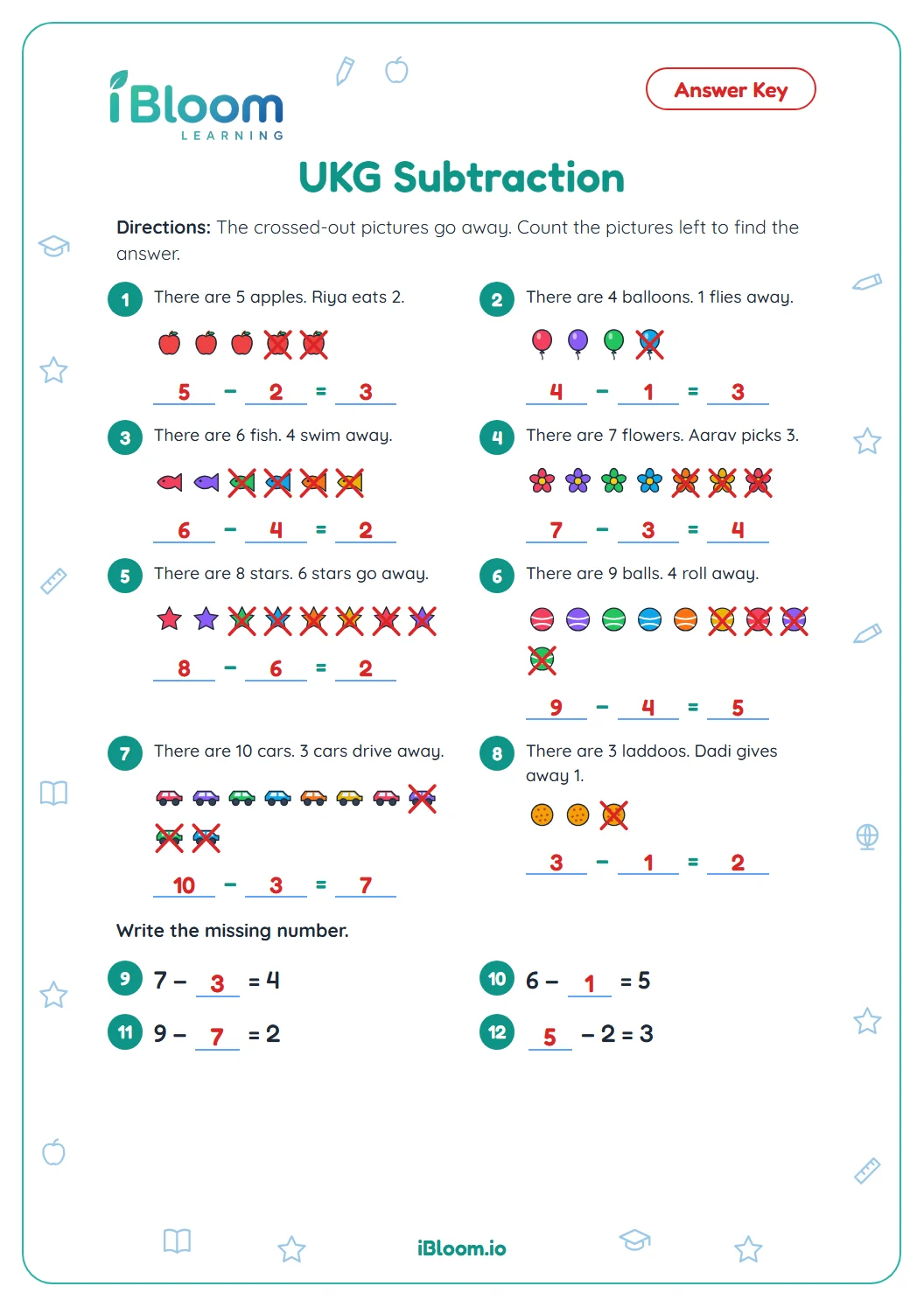
Let your child touch and count each picture that is left. Saying the number sentence aloud helps them link the pictures to the symbols.
Start with the Matching Practice
Use this guide with a direct iBloom worksheet or lesson so children can move from reading the explanation into real practice.
What should a UKG subtraction worksheet include?
A strong subtraction worksheet for UKG should focus on small numbers, clear pictures, and one skill at a time. At this stage, most children are still building number sense, so the worksheet should not jump too quickly into abstract sums.
Use worksheets that include:
- Picture subtraction from 1 to 10
- Crossing out objects and counting what remains
- One digit subtraction without borrowing
- Number line subtraction
- Missing number subtraction, such as 7 - __ = 4
- Simple subtraction word problems
- Short mixed revision with addition and subtraction
For UKG learners, the goal is not speed. The goal is understanding the meaning of taking away.
Best order to teach subtraction in UKG
1. Start with real objects
Before a printable worksheet, use pencils, blocks, beads, spoons, or buttons. Put 6 objects on the table. Take away 2. Ask, "How many are left?" Let the child touch and count the remaining objects.
Then say the full sentence: "6 take away 2 is 4." This language prepares the child for writing 6 - 2 = 4 later.
2. Move to picture subtraction
Picture subtraction is the easiest worksheet format for UKG. Children see 8 apples, cross out 3 apples, and count 5 apples left. It connects the written sum to a visible action.
Good picture subtraction questions look like this:
- 5 balloons, cross out 2, how many are left?
- 7 mangoes, cross out 4, how many are left?
- 9 stars, cross out 1, how many are left?
Keep the pictures large and uncluttered. Too many small objects can make the task a counting challenge instead of a subtraction lesson.
3. Use number lines
Once picture subtraction feels comfortable, introduce a number line from 0 to 10. Show that subtraction means moving backward.
Example: For 8 - 3, start at 8 and jump back three times: 7, 6, 5. The answer is 5.
Number lines help children understand why the answer is smaller. They are especially useful for children who memorize answers without understanding the operation.
4. Practise one digit subtraction facts
After objects, pictures, and number lines, children can practise simple written sums:
- 4 - 1 = __
- 6 - 2 = __
- 9 - 5 = __
- 10 - 3 = __
For UKG, keep subtraction within 10 until the child is confident. Avoid borrowing or regrouping at this stage unless the school has already introduced it.
Free UKG subtraction practice set
Use this sequence for a balanced worksheet pack.
Worksheet 1: Take away with pictures
Ask children to cross out objects and write the answer.
- 5 flowers - 2 flowers = __
- 6 balls - 1 ball = __
- 7 kites - 3 kites = __
- 8 stars - 4 stars = __
- 10 apples - 5 apples = __
Worksheet 2: Count what is left
This activity strengthens counting after subtraction.
- There are 9 crayons. 2 are taken away. How many are left?
- There are 6 cups. 3 are taken away. How many are left?
- There are 10 leaves. 1 is taken away. How many are left?
- There are 7 ducks. 5 go away. How many are left?
- There are 8 beads. 2 are taken away. How many are left?
Worksheet 3: Number line subtraction
Let children draw backward jumps.
- 5 - 1 = __
- 6 - 3 = __
- 8 - 2 = __
- 9 - 4 = __
- 10 - 6 = __
Worksheet 4: Missing number subtraction
Use this only after basic subtraction is comfortable.
- 6 - __ = 4
- 8 - __ = 5
- 10 - __ = 7
- 5 - __ = 2
- 9 - __ = 6
Worksheet 5: Simple word problems
Word problems help children apply subtraction in real situations.
- Riya had 6 stickers. She gave 2 stickers to her friend. How many stickers are left?
- Aarav saw 8 birds on a tree. 3 birds flew away. How many birds are still on the tree?
- There were 10 laddoos on a plate. 4 were eaten. How many laddoos are left?
- A basket had 7 oranges. 1 orange fell out. How many oranges remain?
- Meera had 5 pencils. She lost 2 pencils. How many pencils does she have now?
Common mistakes children make in subtraction
Counting the crossed out objects instead of the remaining objects
Many children cross out 3 objects and write 3 as the answer. Remind them that subtraction asks what is left, not what was removed.
Starting from the wrong number on the number line
For 8 - 3, some children start at 3. Show them that the first number is the starting point.
Treating subtraction like addition
If a child answers 6 - 2 as 8, go back to objects and act out the story. Young learners need repeated visual practice before symbols feel natural.
Rushing into borrowing
Borrowing is not a UKG priority for most children. Build confidence with one digit subtraction first. Borrowing becomes easier later when the child understands place value.
How parents can practise subtraction at home
Short daily practice is better than one long worksheet session. Try 5 to 10 minutes at a time.
Use everyday moments:
- "You had 5 biscuits and ate 2. How many are left?"
- "There are 8 toys on the floor. Put away 3. How many are still there?"
- "We have 6 spoons. I used 1. How many are unused?"
After the child answers, ask, "How did you know?" The explanation matters more than the speed.
Printable vs interactive subtraction worksheets
Printable worksheets are useful for pencil control, handwriting, and school-style practice. Interactive worksheets are useful when children need instant feedback, visual movement, and repeated attempts.
For UKG subtraction, a mix works best:
- Use printable worksheets for writing numbers and showing work.
- Use interactive worksheets for picture-based practice and quick review.
- Use real objects when a child is confused.
You can use iBloom's interactive subtraction worksheet for UKG when your child is ready to practise picture subtraction independently.
UKG subtraction worksheet checklist
Before choosing a worksheet, check whether it is age-appropriate.
A good UKG subtraction worksheet should:
- Use numbers mostly from 1 to 10
- Include pictures before plain equations
- Have enough white space for writing
- Avoid long mixed drills in the beginning
- Build from easy to slightly challenging
- Include answer checking or teacher guidance
Avoid worksheets that use two digit subtraction, borrowing, or crowded pages too early. Those can make subtraction feel harder than it is.
FAQ
What is the best subtraction worksheet for UKG?
The best subtraction worksheet for UKG starts with picture subtraction from 1 to 10. Children should cross out objects, count what remains, and then write the subtraction sentence.
Should UKG children learn subtraction with borrowing?
Most UKG children should first master one digit subtraction without borrowing. Borrowing can wait until the child has stronger place value understanding.
How can I teach subtraction to a UKG child at home?
Start with real objects, then use pictures, then number lines, and finally written sums. Keep practice short and ask the child to explain what is left after taking away.
Are interactive subtraction worksheets useful for UKG?
Yes. Interactive worksheets are useful because children can practise picture subtraction, get quick feedback, and repeat questions without waiting for manual correction.
How many subtraction sums should a UKG child practise daily?
Five to ten carefully chosen questions are enough for most UKG children. Quality matters more than the number of sums.
Next step
If your child is learning subtraction now, begin with picture-based practice. Open iBloom's UKG worksheet on understanding subtraction with pictures, then use the printable-style question sets above for revision.
Practice This Skill Next
After reading this guide, children can practise the same skill on iBloom. Start with understanding subtraction with pictures, then ask the child to explain one answer before moving on.
Related practice
Practice this topic
Continue with a lesson, generator, or printable worksheet.