Vowel Worksheet for Class 1: A E I O U Practice
A clear Class 1 vowel practice guide with picture-word activities, short-vowel questions, answer checks, and a simple teaching sequence.
Free printable worksheet
Free A E I O U vowel worksheet for Class 1
This two-page printable has 18 vowel questions and an answer key. Children write the missing vowel from a clue, tick the vowel sound they hear, and write short-vowel words of their own.
- Free PDF download
- Answer key included
- Ready to print
Free to print and use at home or in class. How to use this worksheet
A useful vowel worksheet for Class 1 does more than ask children to circle A, E, I, O, and U. It helps them hear the vowel sound inside a word, connect that sound to a letter, read the word, and then use the pattern again.
Start with short, familiar picture words. Say each word naturally, stretch the middle sound once, and let the child choose the vowel. After oral practice, move to writing. This order reduces guessing based only on the picture.
Try the matching iBloom Class 1 short-vowel lesson alongside this guide.
Free A E I O U vowel worksheet for Class 1
This two-page printable has 18 vowel questions and an answer key. Children write the missing vowel from a clue, tick the vowel sound they hear, and write short-vowel words of their own.
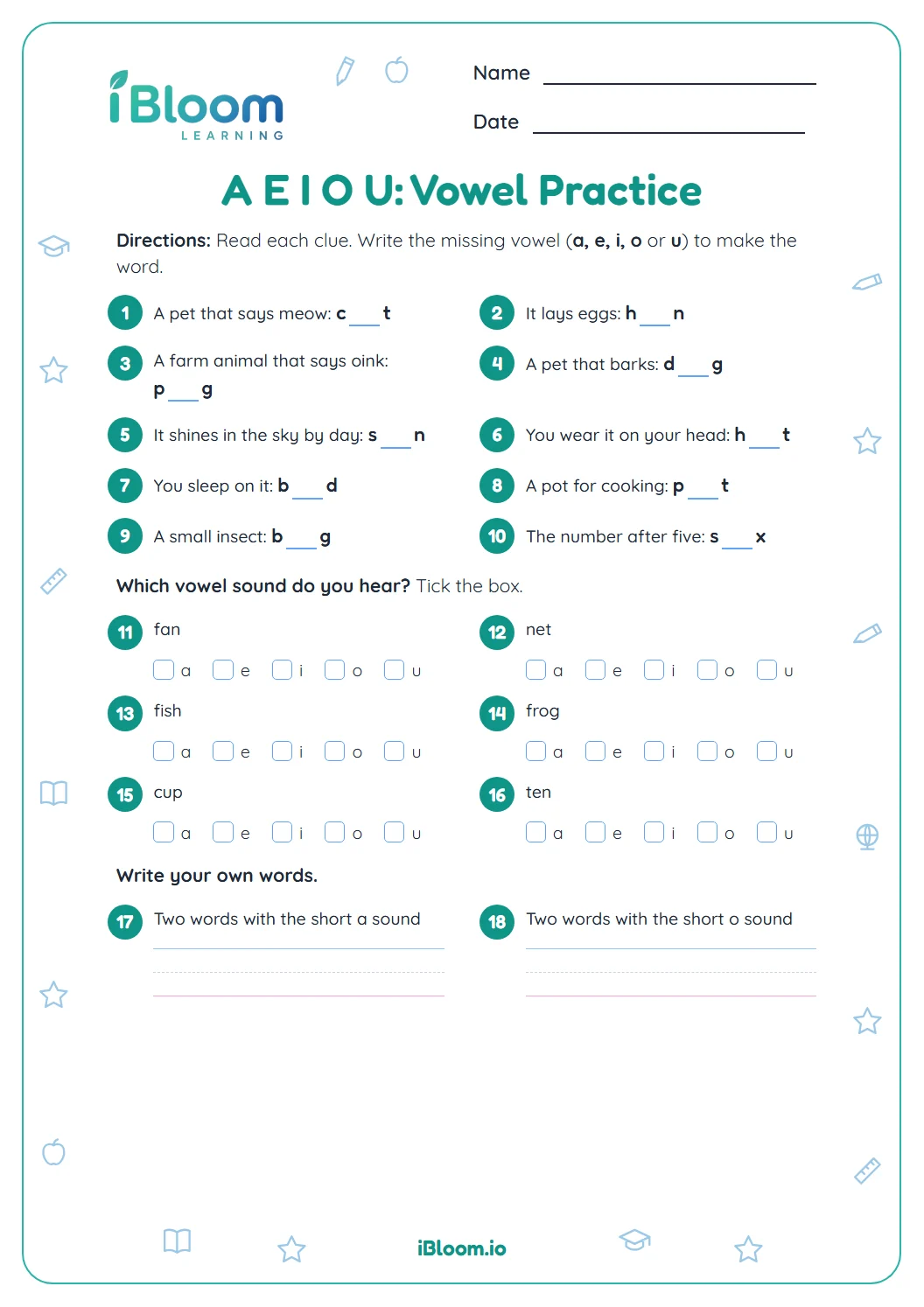
Download the free A E I O U vowel worksheet PDF
Answer key preview
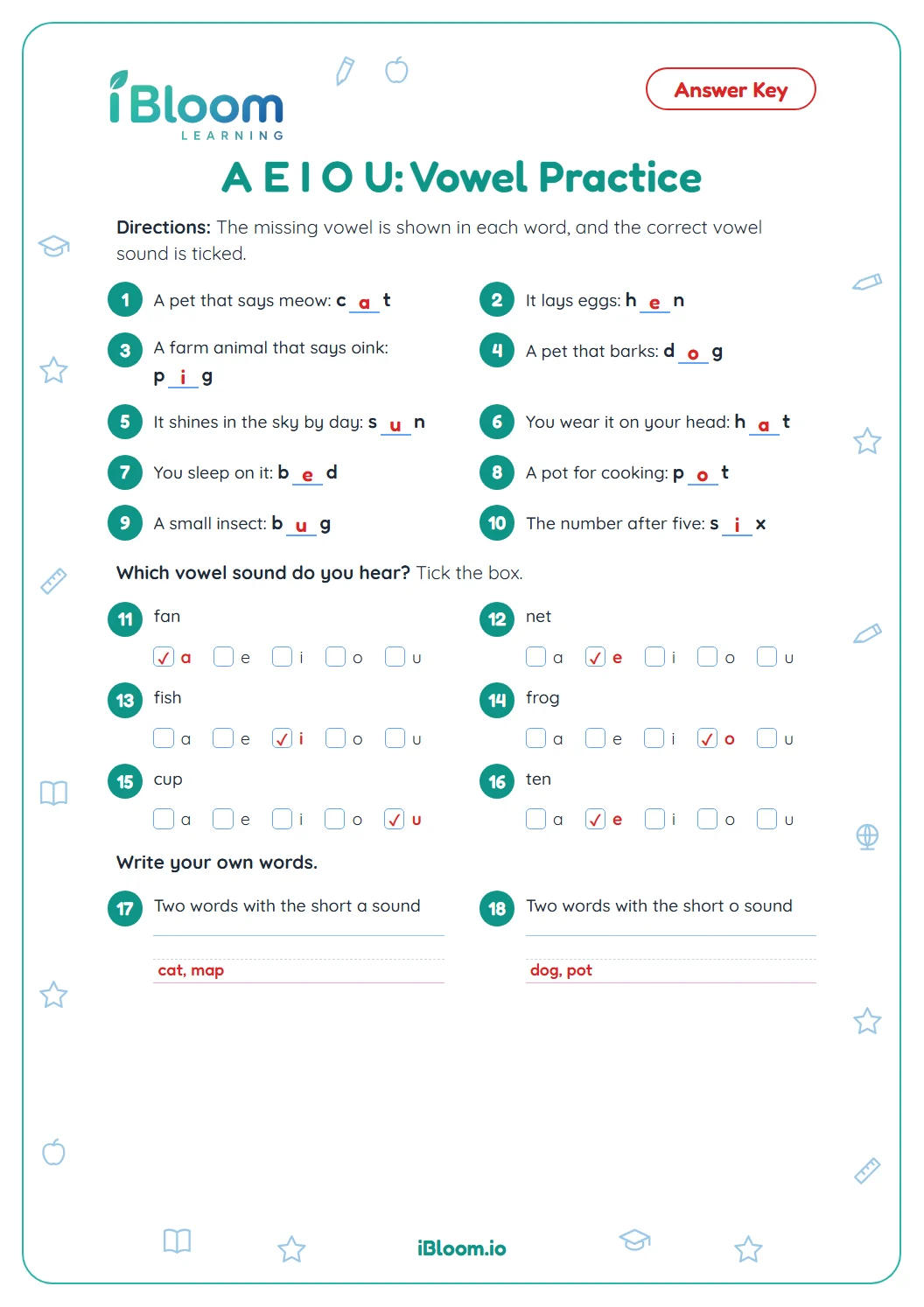
Say each word slowly and stretch the middle sound. If your child is unsure, say the word with each vowel and listen together.
Quick A E I O U review
The five vowel letters are A, E, I, O, U. In early phonics practice, children often begin with these short sounds:
| Vowel | Example words | Sound focus |
|---|---|---|
| A | cat, bag, map | middle sound in cat |
| E | hen, bed, net | middle sound in hen |
| I | pin, sit, fish | middle sound in pin |
| O | pot, log, fox | middle sound in pot |
| U | sun, cup, bus | middle sound in sun |
English vowel spelling is not perfectly regular, so keep the first activity to a consistent set of short-vowel words. Introduce long vowels and alternative spellings only after the child can hear and identify the basic contrasts.
Class 1 vowel questions
1. Fill in the missing vowel
- c_t → cat
- h_n → hen
- p_g → pig
- d_g → dog
- s_n → sun
Ask the child to say the completed word, not just write the letter.
2. Sort by middle sound
Sort these words under A, E, I, O, or U:
map, red, fin, top, mug, jam, ten, lip, box, run
Answer check:
- A: map, jam
- E: red, ten
- I: fin, lip
- O: top, box
- U: mug, run
3. Find the word that does not belong
- cat, bag, sun → sun has a different middle vowel.
- hen, net, fox → fox has a different middle vowel.
- sit, pin, cup → cup has a different middle vowel.
Ask: “What do the other two words have in common?” This checks whether the child is listening to the vowel rather than choosing randomly.
A 15-minute teaching routine
Minutes 1–3: Hear it. Say five words without showing them. The child holds up the matching vowel card.
Minutes 4–7: Build it. Use letter tiles to build two or three CVC words. Change only the vowel—cat, cot, cut—and notice how the word changes.
Minutes 8–12: Read and write. Complete a small group of worksheet questions. Five careful answers are more useful than a full page of guesses.
Minutes 13–15: Explain. The child chooses one answer and says: “I wrote O because I hear /o/ in dog.”
For extra practice, browse iBloom's English worksheets or the interactive learning library.
Common vowel mistakes
Naming the letter instead of hearing the sound. A child may know the letter E but not hear /e/ in hen. Return to oral sorting.
Adding an extra sound. Say consonant sounds cleanly. An exaggerated “buh” can make blending harder than /b/.
Mixing short and long patterns too early. Keep cap and cape in separate lessons until short-vowel identification is secure.
Using pictures as the only clue. Cover the picture occasionally and ask the child to read the letters. Then use a picture to confirm meaning.
Make a reusable vowel worksheet at home
Fold a sheet into five columns and write A, E, I, O, and U across the top. Say or draw ten simple CVC words, then let the child place each one in a column. On the next day, shuffle the same words and ask for a faster sort followed by one spoken sentence per column. Reusing the set adds retrieval practice while keeping the reading demand familiar. Add only two or three new words when the child can explain the earlier choices accurately.
Mini vowel worksheet with answers
Read the clue, fill in the missing middle vowel, and say the complete word.
- c_t — an animal that says meow
- h_n — a female chicken
- p_g — a farm animal
- l_g — a short piece of wood
- s_n — it shines in the sky
Answers: 1. cat (A); 2. hen (E); 3. pig (I); 4. log (O); 5. sun (U).
Now ask the child to underline the vowel and read each word slowly. The clue matters: a pattern such as c_t can form more than one English word, so a picture or sentence prevents guessing.
For a second round, sort these words by their middle vowel: map, red, fish, top, cup, bed, sit, hot, run, cap.
Answer key:
- A: map, cap
- E: red, bed
- I: fish, sit
- O: top, hot
- U: cup, run
Check the skill in three different ways
A child may know vowel names but still need practice hearing vowel sounds. Use three checks:
- Recognition: Circle A, E, I, O, and U in a mixed row of letters.
- Listening: Say three simple words and ask which middle vowel sound each contains.
- Application: Give a picture and ask the child to complete its three-letter word.
If recognition is secure but listening is difficult, return to oral sorting with two contrasting sounds, such as A and O. If the child hears the sound but writes the wrong letter, add a small keyword cue: A–apple, E–egg, I–ink, O–octopus, U–umbrella.
India’s National Curriculum Framework for the Foundational Stage describes decoding as connecting speech sounds with letters and letter combinations. That is why saying, hearing, reading, and writing belong in the same short routine.
Differentiate the worksheet
For children beginning the skill, offer two vowel choices under each picture. Next, remove the choices. Then ask the child to write the full word from a picture. For children ready for more, compare short and long sounds in pairs such as cap/cape and kit/kite, but keep this separate from the first short-vowel lesson.
Try Finding Vowels and Letter Pairs for Class 1, followed by Finding Vowel Sounds and Long and Short Vowel Sounds.
A quick parent or teacher check
End with one unseen example, not a copied word. Say “jam,” “net,” “lip,” “fox,” or “bus” and ask the child to write only the middle vowel. Record which contrasts are confusing and use those in the next session. Five accurate, explained answers are more useful than a page completed by guessing.
Frequently Asked Questions
What are the vowels for Class 1?
The vowel letters are A, E, I, O, and U. Class 1 learners commonly practise hearing short vowel sounds in simple words before studying more complex vowel spellings.
How do I teach vowels without making children memorise lists?
Use listening, picture sorting, letter tiles, reading, and short writing tasks. Ask the child to explain the sound-letter choice.
Should Class 1 children learn long vowels too?
Yes, but usually after they can identify short vowels reliably. Teach one contrast at a time and use familiar examples.
Why does my child confuse E and I?
The sounds can be difficult to distinguish in some accents or when words are spoken too quickly. Use clear contrasting pairs, say them naturally, and let the child watch and repeat.
How many worksheet questions should we do at once?
Use a small set that the child can complete thoughtfully, often five to ten questions. Stop to correct the sound pattern before practising more.