Why Does My Child Forget Math Facts They Knew Yesterday?
A practical U.S. family and teacher guide to separating understanding, strategy use, and recall, then strengthening each with short practice.
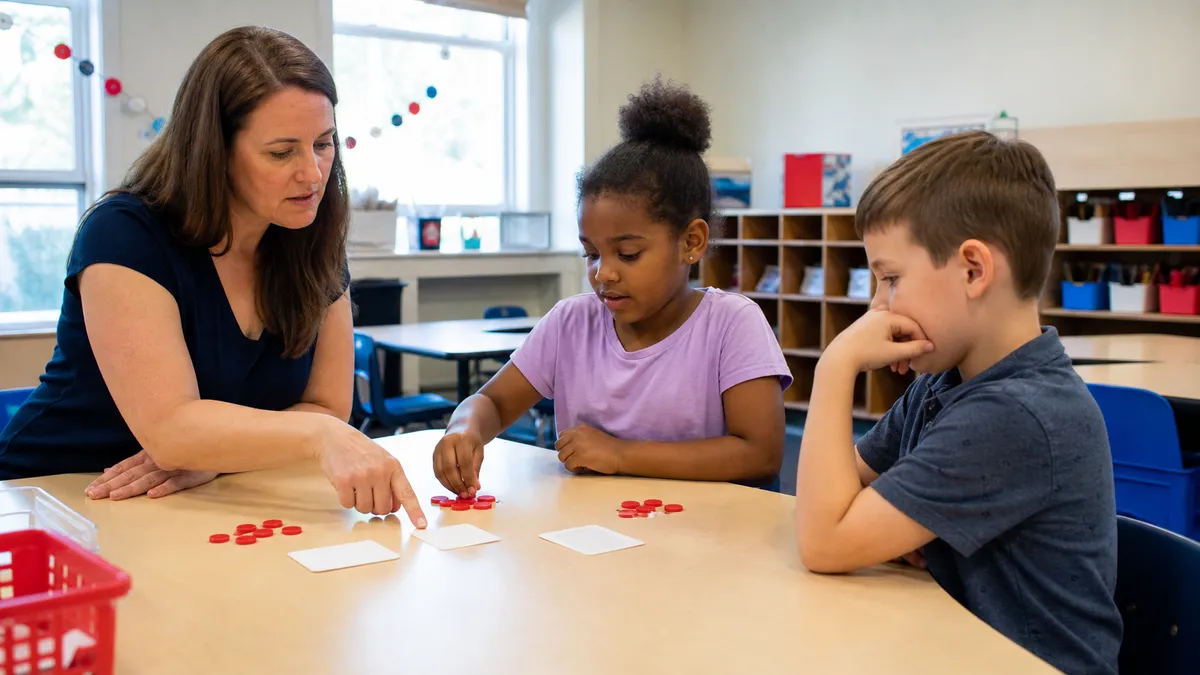
Why Does My Child Forget Math Facts They Knew Yesterday?
Slug: why-child-forgets-math-facts-they-knew-yesterday Meta title: Why Does My Child Forget Math Facts? | iBloom Meta description: Learn why math facts seem to disappear, how to identify the real barrier, and how to build durable recall without stressful drills. Excerpt: A practical U.S. family and teacher guide to separating understanding, strategy use, and recall, then strengthening each with short, useful practice. Primary keyword: child forgets math facts Tags: Math Facts, Addition, Subtraction, Fluency, Parent Guide
A child may answer a math fact correctly today and hesitate tomorrow because one successful answer does not yet prove durable, flexible recall. The child may have reconstructed the answer with counting, copied a recent pattern, remembered it only in one format, or retrieved it while the strategy was still fresh. That is not laziness, and it does not automatically mean the child lacks mathematical understanding. The useful response is to identify how the answer was produced, keep meaning and strategies available, and use brief, spaced opportunities to retrieve the fact in varied contexts.
This guide is for U.S. parents, homeschoolers, tutors, and elementary teachers, especially in Grades 1 through 3. It focuses on addition and subtraction facts, but the diagnostic process also applies when multiplication facts begin. The goal is not instant speed at any cost. It is dependable access to facts while preserving reasoning, accuracy, and confidence.
First, Find Out What “Knew It” Meant
Adults often see a correct answer and conclude that a fact has been memorized. A correct answer can come from several different processes. A child solving 8 + 7 might count every object, count on from 8, use 8 + 2 + 5, recall 7 + 7 and add 1, or retrieve 15 immediately. Every route can produce the same answer, but each tells you something different about what the child can do tomorrow.
Ask the child, “How did you know?” Do this with curiosity, not as a demand for a polished explanation. If the child says, “I counted,” the fact was solved successfully but may not yet be readily recalled. If the child says, “Seven and seven is fourteen, so one more is fifteen,” a useful relationship is developing. If the answer arrives quickly but disappears when the fact is written vertically, retrieval may be tied to presentation rather than absent altogether.
Use four small checks instead of a long test:
- Show the fact horizontally: 8 + 7.
- Ask it orally without showing symbols.
- Put it in a short story: eight markers are on the table and seven more arrive.
- Reverse the addends: 7 + 8.
Record whether the child retrieves, uses a strategy, counts, guesses, or becomes stuck. This gives you a better starting point than a percentage score. It also prevents you from reteaching what the child already understands.
For an accessible first-grade meaning check, use the live iBloom composing tens and ones lesson. Its grouping context can help reveal whether a child sees number relationships or is relying only on a remembered answer. The matching tens-and-ones worksheet practice gives another format for checking transfer.
Why Correct Answers Can Disappear
The child used a temporary procedure
A child can look fluent immediately after a lesson because the demonstrated steps are still active. For example, after practicing “make ten,” the child may solve 9 + 6 as 10 + 5. The next day, the child may not independently notice that 9 needs 1. The relationship was used with support but has not become a self-selected strategy.
The solution is not to abandon the strategy. Make the cue visible, then gradually remove it. Ask, “Which number is close to ten?” Later ask only, “What do you notice?” Finally present the fact without a cue. This fading sequence shows whether the child can choose the strategy rather than merely follow it.
The fact is remembered in only one form
Some children recognize 6 + 8 on a flashcard but hesitate when it appears as 8 + 6, in a story, or inside a longer computation. This is a transfer issue. Practice should include oral, written, visual, and applied forms, but not all at once. Change one feature while keeping the numbers stable so the child can notice that the underlying relationship remains the same.
Counting is accurate but demanding
Counting can be a valid way to establish meaning. It becomes inefficient when a child recounts every quantity for every familiar fact. If 7 + 5 requires building seven counters, adding five, and recounting all twelve, the child has little attention left for noticing five-and-five, making ten, or relating addition to subtraction.
Do not ban fingers or counters abruptly. Compress the count. Move from counting all to counting on, then to a known relationship. For 7 + 5, a child might progress from counting twelve objects, to saying “seven, eight, nine, ten, eleven, twelve,” to moving three from the five to make ten and seeing two more. The concrete model remains available as proof while the strategy becomes shorter.
Practice has been blocked instead of mixed
Twenty nearly identical facts can create an illusion of mastery. A child may infer the operation or pattern from the page rather than decide what relationship applies. Later, a mixed page removes that cue and performance drops.
Use small mixed sets after the child understands each strategy separately. A six-fact set might include a double, a near double, a make-ten fact, a fact with zero, and two subtraction facts. Ask the child to sort the facts by strategy before solving. Selection is part of fluency.
Speed pressure is hiding what the child knows
When a child expects correction after every pause, the task can shift from reasoning to guessing or freezing. A timer may tell you how many responses occurred in a minute, but it does not explain why an answer was unavailable. Begin diagnosis without a timer. Watch the method, accuracy, self-correction, and ability to explain. Speed can be observed later and used carefully, without turning it into the only definition of success.
The U.S. Institute of Education Sciences recommends systematic instruction and regular practice for students who need additional elementary mathematics support; its elementary mathematics intervention practice guide also emphasizes representations, mathematical language, and opportunities to build fluency. That combination matters: facts should become easier to access while remaining connected to quantities and relationships.
Use a Five-Minute Diagnostic Before More Practice
Choose three facts from the child’s current range. For a first grader, examples might be 6 + 4, 7 + 5, and 9 + 3. For a second grader, include related subtraction such as 12 - 5. Avoid selecting only the hardest facts.
Step 1: Ask for an answer and a method
Say, “Solve it in any way that makes sense. Then show me what you did.” Give paper, counters, or a number line if requested. Do not suggest a strategy yet.
Step 2: Change the representation
Turn 7 + 5 into seven counters and five counters, then into a story. If the child succeeds only with objects, the next teaching step is connecting objects to drawings and equations. If the child succeeds orally but misreads the written symbols, the barrier is not fact memory alone.
Step 3: Ask a nearby fact
After 7 + 5, ask 7 + 6. A child who says “one more than twelve” is using a relationship. A child who restarts counting may know the first answer but not yet use it as an anchor.
Step 4: Return after a delay
Work on something else for several minutes, then ask one fact again in a different form. Retrieval after a delay provides more useful information than repeating the same card immediately.
Step 5: Classify the next need
Choose one label for planning, not for defining the child:
- Meaning: The child does not reliably connect the symbols to quantities.
- Strategy: The child understands quantities but lacks an efficient route.
- Selection: The child knows several strategies but cannot choose one independently.
- Retrieval: The child explains relationships and answers accurately, but recall is inconsistent.
- Transfer: The fact is available in one format but not another.
This classification keeps practice targeted. Giving more flashcards to a child who does not understand the equation is unlikely to address the real problem.
Build Facts From Relationships, Not Isolated Cards
Start with facts that organize other facts
Useful anchors include adding zero, adding one, doubles, combinations that make ten, and facts already known securely. The point is not that every child must follow one fixed order. The point is to connect a less familiar fact to something the child can justify.
For 6 + 7, a child might use 6 + 6 and one more. For 9 + 4, the child can move one from four to make 10 + 3. For 13 - 6, the child might ask what must be added to six to reach thirteen. Write both the original fact and the relationship so the reasoning does not disappear when the objects are removed.
Connect addition and subtraction
If a child knows 8 + 5 = 13, write the related equations 5 + 8 = 13, 13 - 8 = 5, and 13 - 5 = 8. Use a covered-part model: show thirteen objects, cover five, and ask how many remain visible. Then uncover to verify.
This does not mean drilling four equations at once before the first is understood. Introduce the family after the child can explain the whole and parts. The second-grade subtraction without regrouping lesson can extend the same part-whole reasoning into larger numbers, while the corresponding subtraction worksheet provides a different context for checking whether the relationship transfers.
Keep a proof available
When the child retrieves 8 + 7 = 15, ask for proof occasionally, not after every answer. The child might draw ten dots and five dots, decompose seven, or use a known double. Proof protects meaning. It also gives the child a recovery route when retrieval fails.
A Home Routine That Builds Durable Access
Use five to eight minutes, three or four times across a week, rather than one exhausting session. Stop while the child can still think productively.
Families do not need to reproduce a full classroom lesson at home. The Iowa Department of Education mathematics resources for families organize grade-level support for family use; the routine below follows the same practical principle of connecting brief home activity to the mathematics children encounter in school.
Minute 1: Reconnect to meaning
Build or draw one target fact. Ask the child to identify the whole, parts, and operation. If working on 8 + 6, arrange eight counters and six counters, then invite the child to reorganize them.
Minutes 2 and 3: Compare two strategies
Solve the same fact in two ways. For 8 + 6, make ten by moving two, then solve as a near double using 7 + 7. Ask which route feels clearer and why. Accept either efficient, accurate route.
Minute 4: Retrieve a tiny set
Ask four to six facts. Mix secure facts with one or two developing facts. If the child pauses, say, “Use a relationship,” rather than immediately supplying the answer. If the child still cannot begin, return to a model.
Minute 5: Apply one fact
Use a story, missing-number equation, or larger problem. For example: “There are eight red pencils and six blue pencils. How many altogether?” Another day ask, “Fourteen pencils are split into groups of eight and some more. How many are in the other group?”
End with a specific reflection
Ask, “Which fact became easier because of another fact?” Record one sentence, such as “I used 10 + 4 to solve 9 + 5.” This creates a strategy record without producing a long worksheet.
For larger-number application, the live iBloom two-digit addition without regrouping lesson lets families observe whether basic facts remain available inside place-value work. Its interactive worksheet counterpart can be used as a transfer check, not as a substitute for targeted instruction.
How Teachers Can Use the Same Diagnosis
Run a strategy interview with a small group
Give every student the same fact and invite multiple methods. Record methods in columns: count all, count on, make ten, doubles, known fact, or retrieval. The chart is for instructional planning, not public ranking.
Select one relationship for the next mini-lesson. If several students count 8 + 6, compare a counting route with making ten. Use counters first, draw the movement, then write 8 + 6 = 10 + 4 = 14. Ask students to explain what stayed equal.
Separate accuracy, strategy, and retrieval records
A single score hides important differences. One student may answer accurately through counting; another may retrieve quickly but make occasional careless errors; another may know facts orally but struggle to record them. Use three brief notes:
- Was the answer accurate?
- What method was used?
- Was the method chosen independently?
Review these notes weekly. Progress might appear first as shorter counting, then independent strategy selection, then more reliable retrieval.
Use exit tickets that reveal thinking
Instead of ten facts, use three prompts: solve one fact, show a relationship, and explain a choice. An example is “Solve 9 + 7. Show how a fact you know helped. Circle the step where you made ten.” This is quicker to interpret than a page of answers.
Plan cumulative review
Do not abandon a fact family as soon as a unit ends. Include a few earlier facts beside current work. Keep the amount small enough that students still analyze rather than rush. The Massachusetts Grade 2 base-ten standards map places fluent addition and subtraction within broader number-and-operations work, supporting the practical need to connect fact use with larger computations rather than isolating it indefinitely.
When students begin regrouping, use the iBloom two-digit addition with regrouping lesson to see whether a basic fact or the regrouping process is causing the delay. The two-digit regrouping worksheet provides additional examples for that distinction.
What to Do When Practice Is Not Working
The child guesses faster
Reduce the set and remove the timer. Ask for a model before an answer. Practice two related facts, such as 6 + 6 and 6 + 7, until the child can explain the connection. Random guessing usually means the task is not giving the child an accessible route.
The child counts from one every time
Do not hide the counters. Arrange them so structure is visible: rows of five, a ten-frame pattern, or two clear groups. Ask the child to start with the larger amount and count on. Then compare that method with making ten. Celebrate a shorter, explainable method before expecting immediate recall.
The child knows addition but not subtraction
Use missing-addend language. Replace 13 - 5 with “five and what make thirteen?” Build thirteen, separate five, and identify the unknown part. Write both equations. Avoid teaching subtraction only as a disconnected countdown.
The child succeeds at home but not at school
Compare conditions. Is the school task timed, visually crowded, mixed with unfamiliar directions, or presented vertically? Share specific observations with the teacher: the facts, formats, prompts, and strategies that worked. Ask the teacher what they observe before, during, and after an error.
The child succeeds with a model but not symbols
Add a drawing between objects and equations. Build 7 + 6, sketch circles grouped as ten and three, then write the equation. On the next problem, show the drawing first and keep objects nearby. Later ask the child to choose whether a drawing is needed. Removing support should be gradual and based on performance.
The child is accurate but very slow
Look at the method. A long but correct count suggests strategy compression is the next step. A long pause followed by a correct retrieval may improve through small, spaced review. Slow writing or symbol formation may make a written page look like a fact problem when oral responses are stronger. Do not assume one cause from speed alone.
Grade and Age Variations
Kindergarten and early Grade 1
Prioritize quantity, composition, and language. Ask children to make five in different ways, compare groups, and explain what changed when one object was added. Written facts should remain connected to objects and drawings. The Ohio kindergarten mathematics model curriculum describes representing and comparing whole numbers with objects as a central early focus.
Grade 1
Develop counting-on, doubles, near doubles, and making-ten relationships within the range taught by the child’s school. Use short mixed practice only after strategies make sense. Ask for oral explanations and drawings as well as equations.
Grade 2
Connect addition and subtraction facts to place value and two-digit computation. If 36 + 27 is difficult, check 6 + 7 separately. If that fact is available, the barrier may be regrouping or recording. If it is not, support the fact while teaching the larger procedure rather than treating every error as a place-value error.
Grade 3 and beyond
When multiplication begins, use arrays, equal groups, known products, and distributive relationships. A student who forgets 6 x 7 can reason from 5 x 7 plus another seven. Continue cumulative practice, but preserve a strategy route so a missed retrieval does not stop all problem solving.
Accessibility and Learning Differences
Use large, uncluttered print for a child who loses their place. Present one problem at a time if a full page overwhelms attention. Allow oral answers when handwriting masks mathematical thinking. Use manipulatives with clear color contrast and consistent spacing. Describe visual models aloud for children who need language support, and let the child touch or move objects when that improves access.
For multilingual learners, teach concise recurring phrases such as “whole,” “part,” “make ten,” “one more,” and “difference.” Pair each phrase with the same visual action before expecting a detailed explanation in English.
Persistent difficulty deserves specific documentation, not a quick label. Record which facts, formats, supports, and prompts help; whether difficulties appear across settings; and whether the child understands quantities when recall fails. Bring those observations to the teacher or school support team. A blog cannot diagnose a learning disability, and inconsistent recall by itself does not establish one.
A Two-Week Reset Plan
Days 1 through 3: Diagnose and select
Choose six to eight target facts, not an entire table. Identify each child’s method and select two relationships to teach. Build, draw, and write each relationship. End with one delayed retrieval.
Days 4 through 7: Retrieve and vary
Practice a tiny mixed set for five minutes. Change one feature each day: oral facts, cards, stories, or missing numbers. Keep the strategy model available. Note which facts become independent.
Days 8 through 10: Connect operations
Build fact families and compare addition with subtraction. Use one unknown-part story and one larger-number application. Return to any fact that has slipped, but begin with its relationship rather than starting a long drill.
Days 11 through 14: Check durability
Ask the facts after a delay and in a new order. Include a few secure facts to reduce pressure. Check whether the child can explain or prove an answer even when recall is not immediate. Choose the next small set based on evidence.
At the end, improvement may mean fewer count-all responses, faster selection of make-ten or doubles, better transfer to stories, or more reliable retrieval. Those are all meaningful forms of progress.
Frequently Asked Questions
Should my child memorize math facts?
Children benefit from increasingly efficient and reliable access to basic facts, but memorization should not replace understanding. Connect facts to quantities and relationships, then provide brief retrieval opportunities. A child should also retain a way to reason when an answer does not come immediately.
Are flashcards bad?
Flashcards are a format, not a complete teaching method. They can support retrieval of a small, understood set. They are less useful when a child is guessing, practicing too many unknown facts, or receiving no help connecting facts. Sort cards by strategy, keep the set small, and pause to model a relationship after repeated errors.
Should I time math-fact practice?
Do not begin diagnosis with a timer. First establish accuracy, strategy use, and independent selection. If timing is later used, compare the child with their own earlier performance and avoid making speed the only goal.
Is finger counting causing the problem?
Finger counting can show quantities and support accurate early work. The next step is to make counting more efficient, not to remove fingers suddenly. Help the child count on, see groups, make ten, and connect a counted answer to a reusable relationship.
How many facts should we practice at once?
Use a small set that permits thought and success. Six to eight facts can be enough for a focused cycle, with only one or two genuinely developing facts in a retrieval round. Expand after the child shows understanding and increasing independence.
When should I talk to the teacher?
Talk with the teacher whenever the pattern is persistent, stressful, or affecting broader work. Share concrete examples: facts attempted, methods used, formats that help, and what happens after a delay. Ask whether the same pattern appears at school and what instructional strategies are already in use.
What if my child remembers facts orally but misses them on worksheets?
Check symbol reading, visual spacing, writing demands, and page complexity. Present one equation at a time and compare oral and written responses. This difference suggests that retrieval may be available while another part of the task needs support.
What is the most important change to make tonight?
Replace a long drill with a five-minute investigation of three facts. Ask how the child solved each one, connect one difficult fact to a known relationship, retrieve it after a short delay, and finish with a simple application. That gives you evidence for tomorrow instead of another frustrating score.