Free printable practice
Hey Diddle Diddle Practice Activities
Printable cursive passage worksheets using “Hey Diddle Diddle” to help children practise smooth joins, spacing, rhythm and neat copying.
Free printable worksheet PDFs
Preview every available page, then download the free worksheet PDF for home, homeschool, tutoring, or classroom practice.
Preview the exact activity before downloading it.
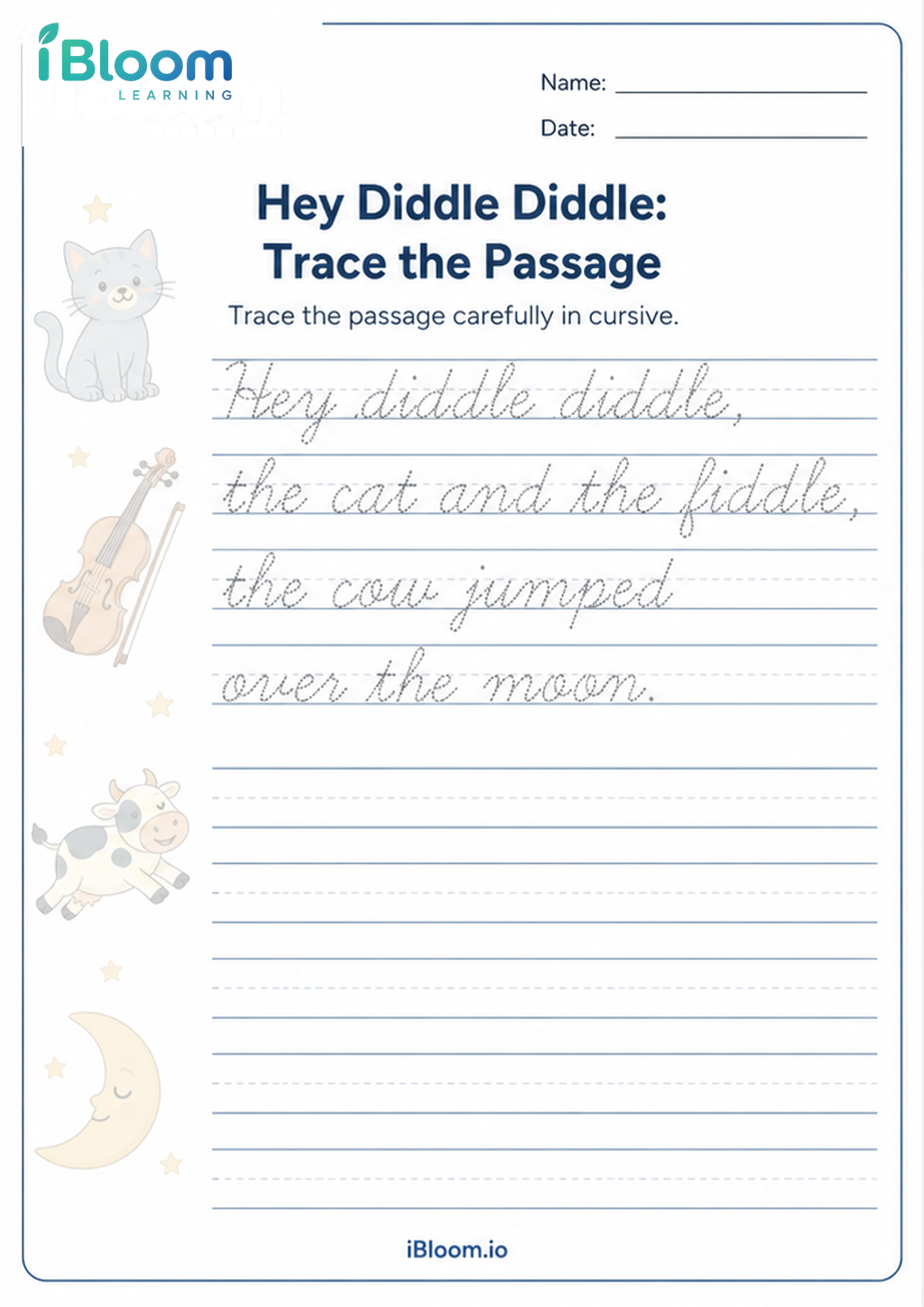 Hey Diddle Diddle: Trace the PassageClass 2 printable practice for Hey Diddle Diddle Passage.Class 2Free PDF preview
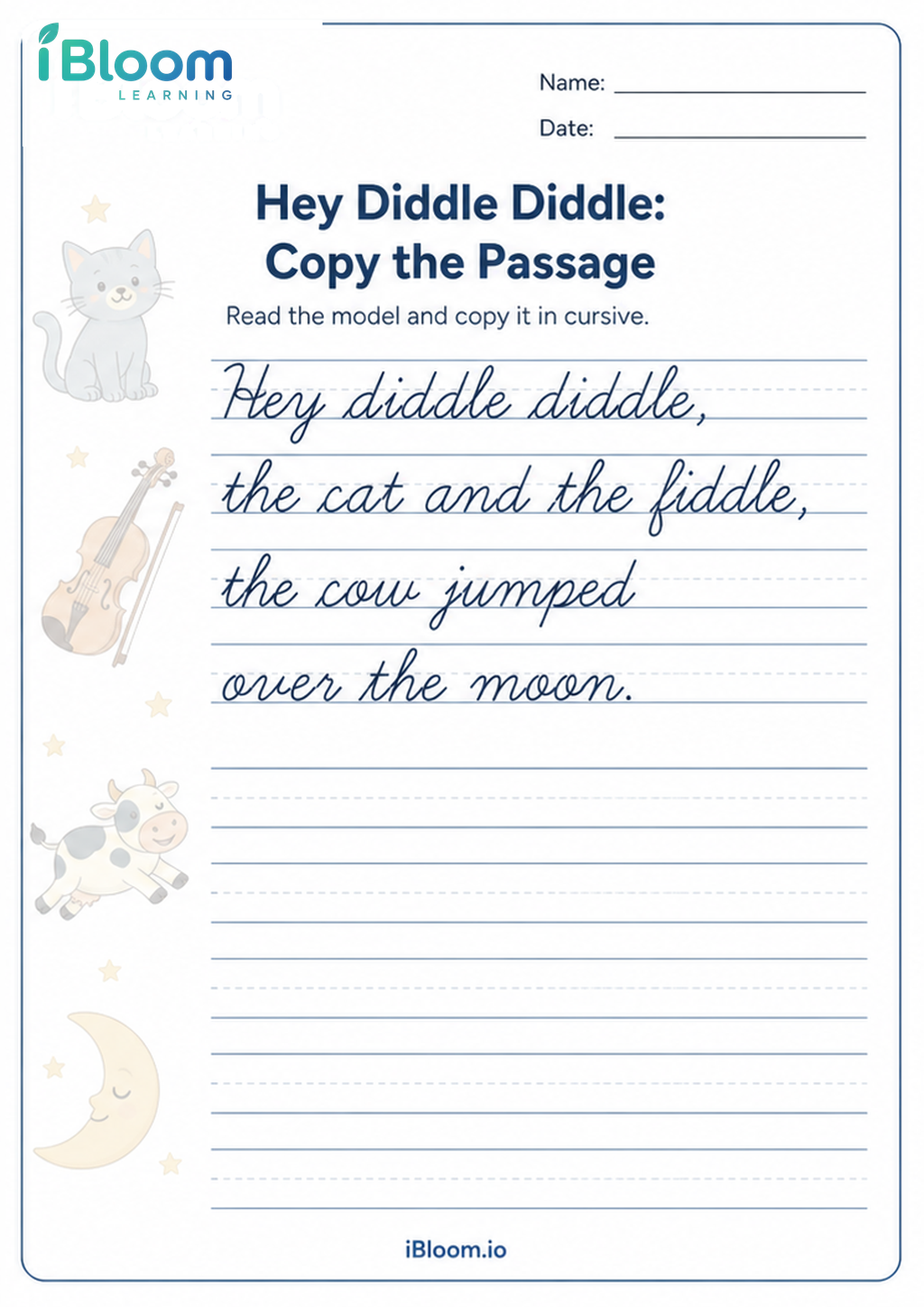 Hey Diddle Diddle: Copy the PassageClass 2 printable practice for Hey Diddle Diddle Passage.Class 2Free PDF preview
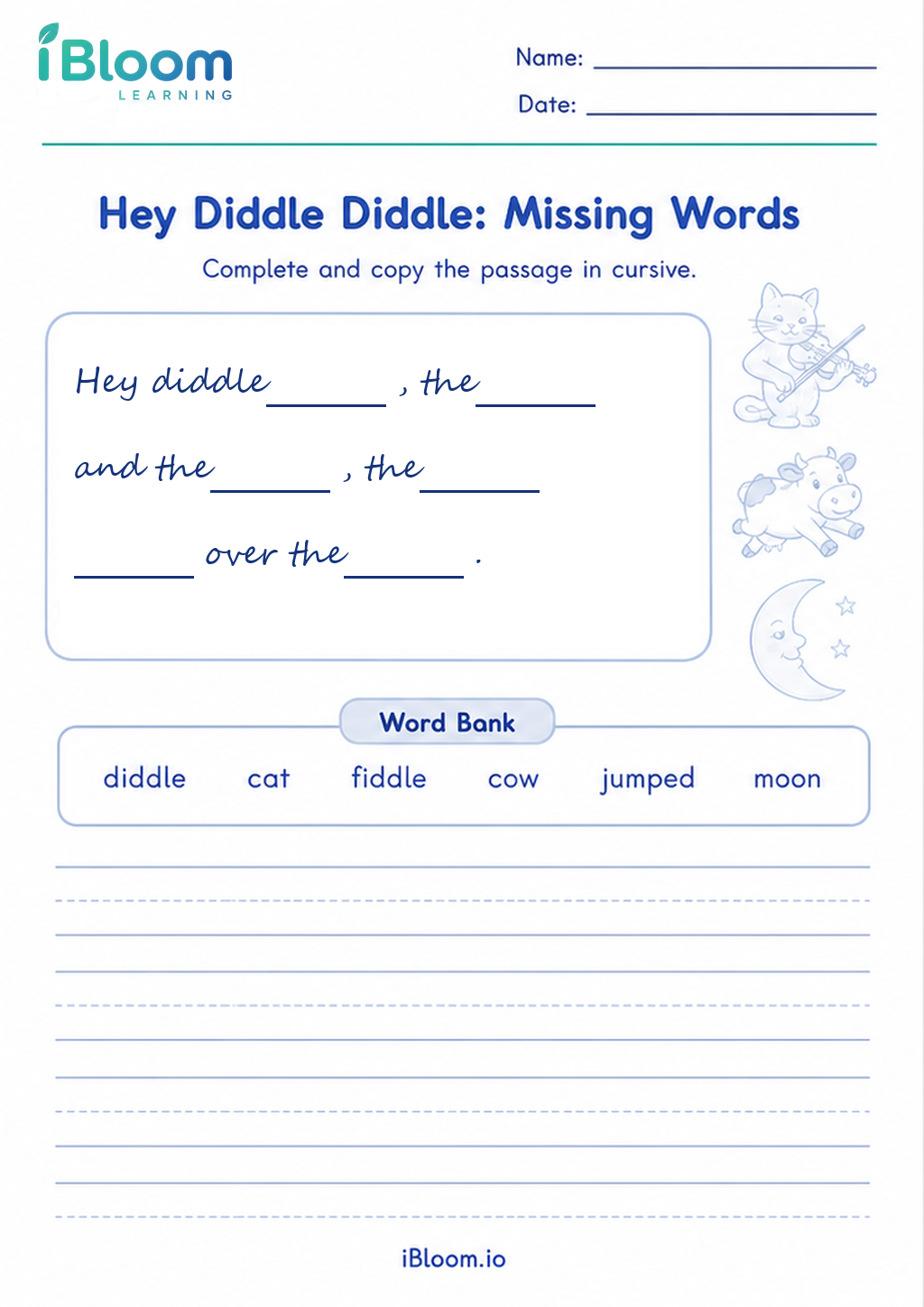 Hey Diddle Diddle: Missing WordsClass 2 printable practice for Hey Diddle Diddle Passage.Class 2Free PDF preview
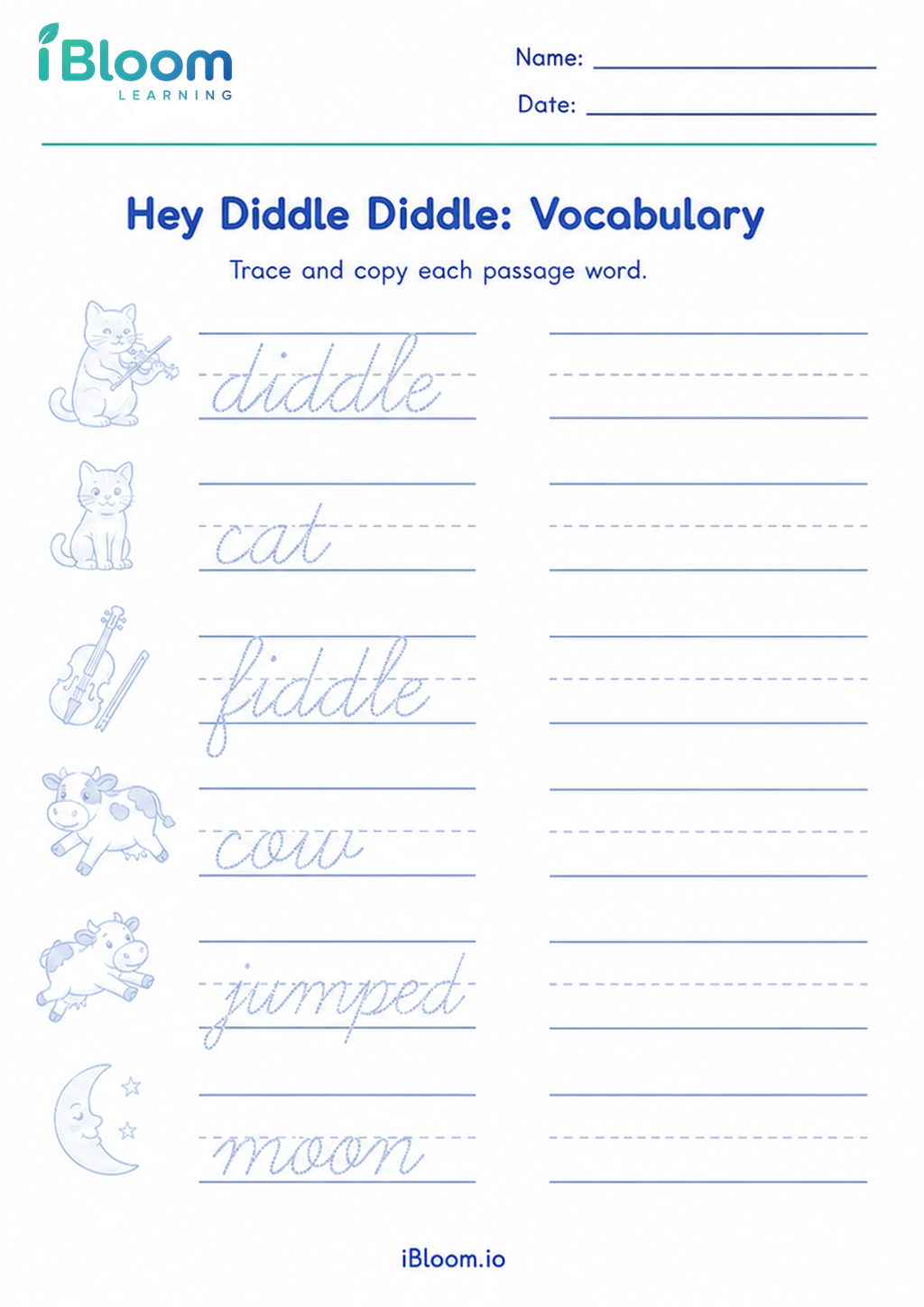 Hey Diddle Diddle: VocabularyClass 2 printable practice for Hey Diddle Diddle Passage.Class 2Free PDF preview
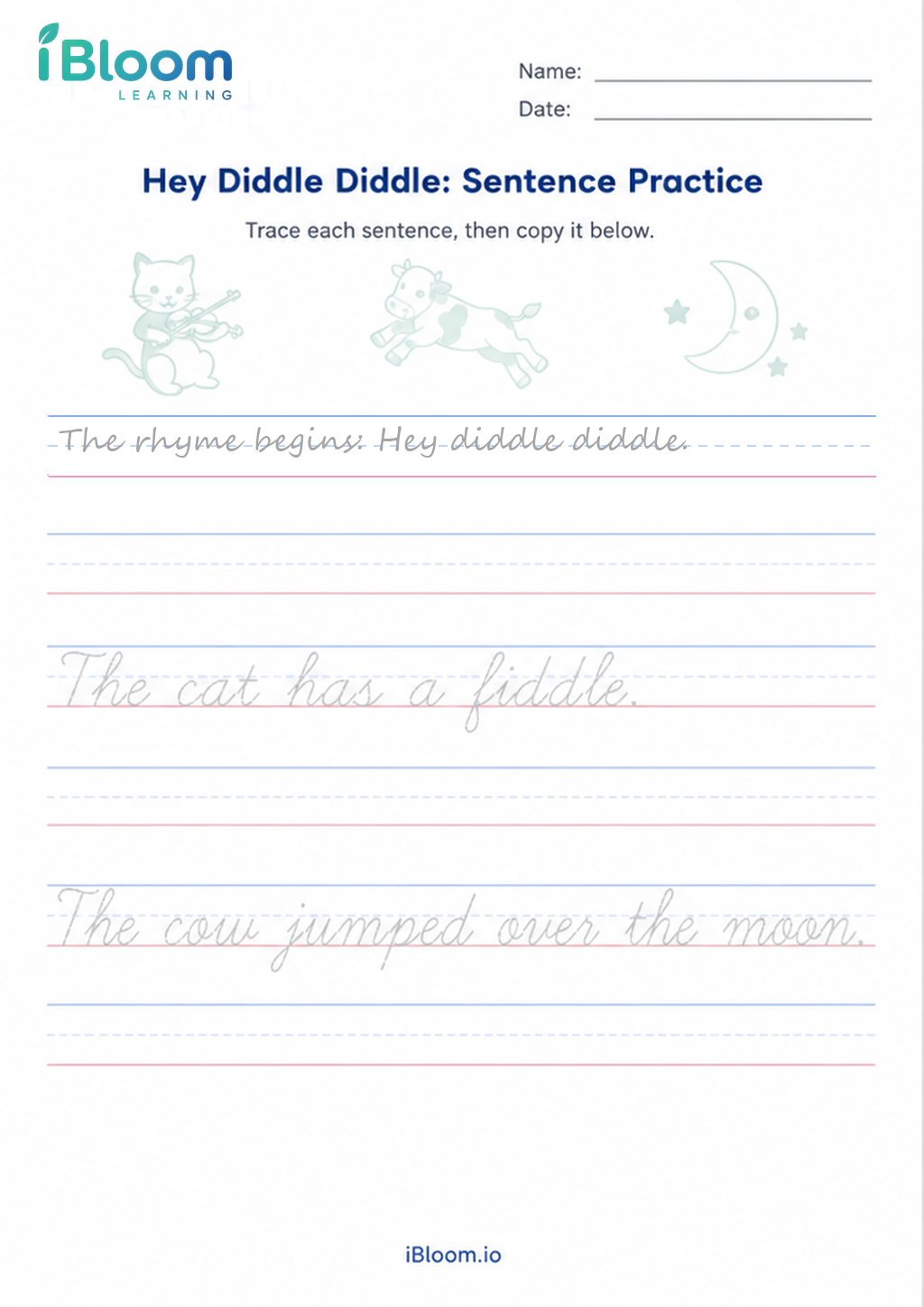 Hey Diddle Diddle: Sentence PracticeClass 2 printable practice for Hey Diddle Diddle Passage.Class 2Free PDF preview
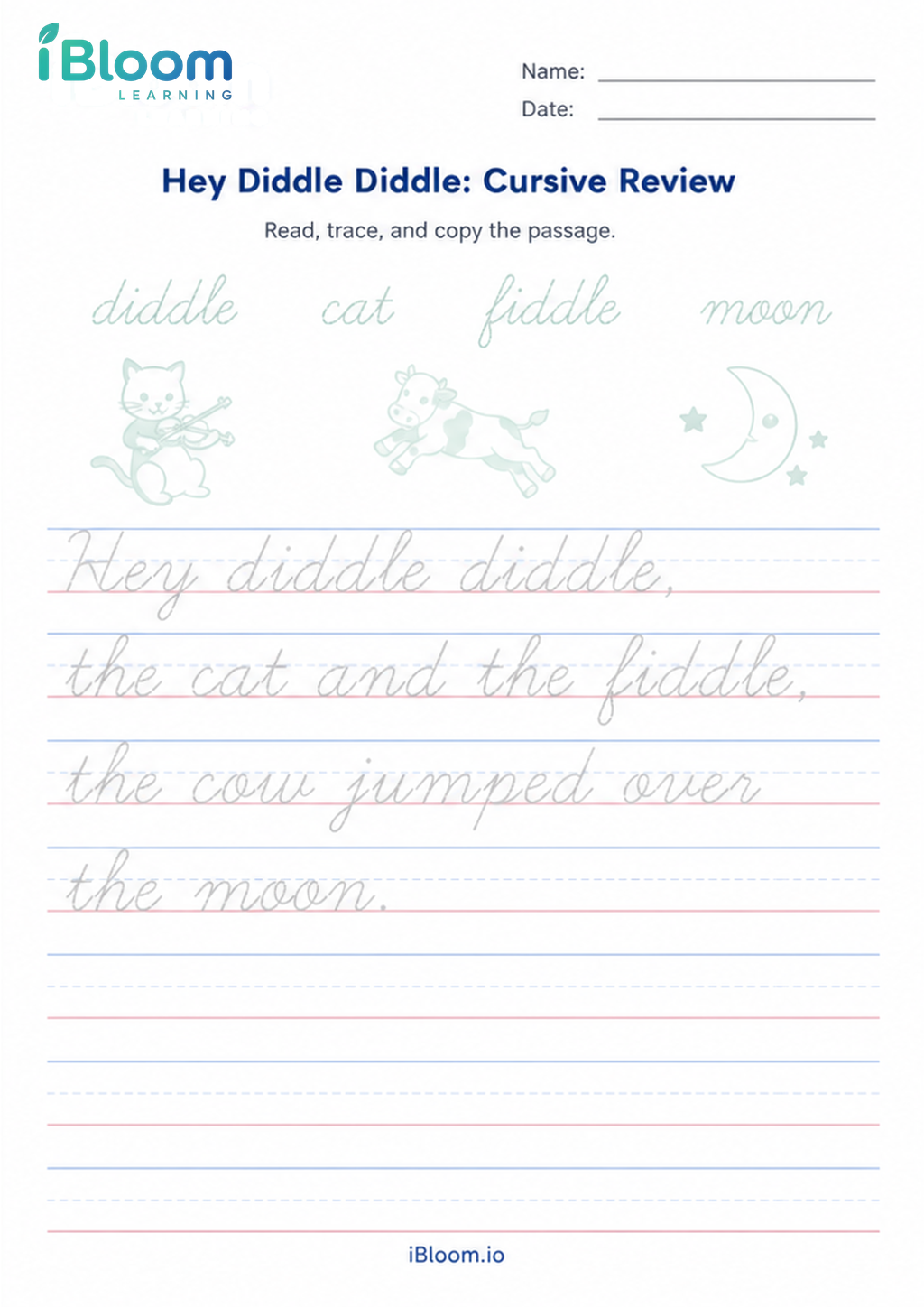 Hey Diddle Diddle: Cursive ReviewClass 2 printable practice for Hey Diddle Diddle Passage.Class 2Free PDF preview
Practice that builds confidence
Cursive practice with a familiar rhyme
These cursive writing worksheets help children practise copying the nursery rhyme “Hey Diddle Diddle” as a complete passage. The familiar lines give learners a meaningful text for improving letter joins, word spacing, line control and handwriting flow.
The printable activities focus on careful cursive passage practice rather than isolated letters. Children read, trace or copy the rhyme, notice punctuation and capital letters, and build confidence writing a short, memorable piece neatly.
“Hey Diddle Diddle” is useful for cursive passage work because the words are short, rhythmic and easy for children to remember. Instead of thinking only about spelling, learners can pay attention to handwriting skills: starting letters correctly, joining smoothly, keeping words on the line and leaving clear spaces between words.

What children learn as they copy
This page sits under Cursive Writing > Cursive Passages, so the main skill is writing connected text neatly. Children practise capitals at the start of lines, lower-case joins in words such as “diddle,” “fiddle” and “moon,” and punctuation such as commas and full stops where they appear. The passage also encourages even letter size, steady slant and controlled descenders in letters like g and y.
A simple parent routine
At home, first read the rhyme aloud together so the child hears the rhythm. Ask them to point to each word, then trace or copy one line at a time. After each line, have them check three things: Are the words easy to read? Are the letters sitting on the line? Is there a finger space between words? Praise one specific improvement before moving to the next line.

Classroom uses for teachers
Teachers can use these printables during handwriting practice, morning work, language centres or quiet independent writing. The same passage can be revisited across the week: one day for tracing, another for copying, and another for best handwriting. It also works well as a display piece after children have corrected spacing and line placement.

Common errors to watch for
Some children may lift the pencil too often, crowd words together, make tall letters too short, or let letters float above the baseline. In “Hey Diddle Diddle,” watch repeated d letters, the double consonants, and descenders in “dog” and “laughed.” Encourage slow, smooth movement rather than rushing to finish the rhyme.
Free printable PDF download
Use this Hey Diddle Diddle cursive writing worksheet page to preview the activity, print it, or download it as a PDF for quick practice. It works well for homework, homeschool lessons, tutoring, morning work, revision, and classroom centers.
Answers and answer key support
After the child completes the worksheet independently, parents and teachers can use the answer support or answer key information to check the work, review mistakes, and choose the next practice step.
Why iBloom worksheets help
iBloom worksheets give children a focused passage with enough repetition to build fluency without becoming confusing. A child-friendly strategy is: read the line, trace the word shape in the air, write slowly, then check spacing. This keeps cursive practice calm, purposeful and easier to self-correct.
Helpful answers
Frequently asked questions
What does my child practise in the Hey Diddle Diddle cursive worksheets?
Children practise copying a complete cursive passage, with attention to smooth joins, clear word spacing, correct line placement, capitals and punctuation.
Is this worksheet for tracing or independent cursive writing?
It is designed for cursive passage practice and may include tracing or copying formats depending on the printable. Children can first trace, then copy the rhyme independently.
Why use a nursery rhyme for cursive handwriting?
A familiar rhyme reduces reading difficulty and lets children focus on handwriting control. The rhythm also helps them copy line by line with better confidence.
Which words in the passage need extra care?
Words such as “Diddle,” “fiddle,” “laughed,” “dog” and “moon” are useful for checking repeated letters, descenders, joins and spacing.
How can I help if my child rushes through the passage?
Ask your child to read one line, write it slowly, and check spacing before continuing. A simple self-check after each line is better than rewriting the whole passage.
Is this Hey Diddle Diddle cursive writing worksheet free?
Yes. You can preview it for free and use the printable worksheet for home or classroom practice.
Can I download this Hey Diddle Diddle cursive writing worksheet as a PDF?
Yes. Use the worksheet download option to save a printable PDF, or print the worksheet directly from the page.
Does this Hey Diddle Diddle cursive writing worksheet include answers or an answer key?
When the activity has fixed answers, iBloom includes answer support so parents and teachers can check the completed worksheet.