Free printable practice
Identify Adverbs Verbs Practice Activities
Class 3 worksheets for identifying verbs and the adverbs that describe how, when, or where an action happens in a sentence.
Free printable worksheet PDFs
Preview every available page, then download the free worksheet PDF for home, homeschool, tutoring, or classroom practice.
Preview the exact activity before downloading it.
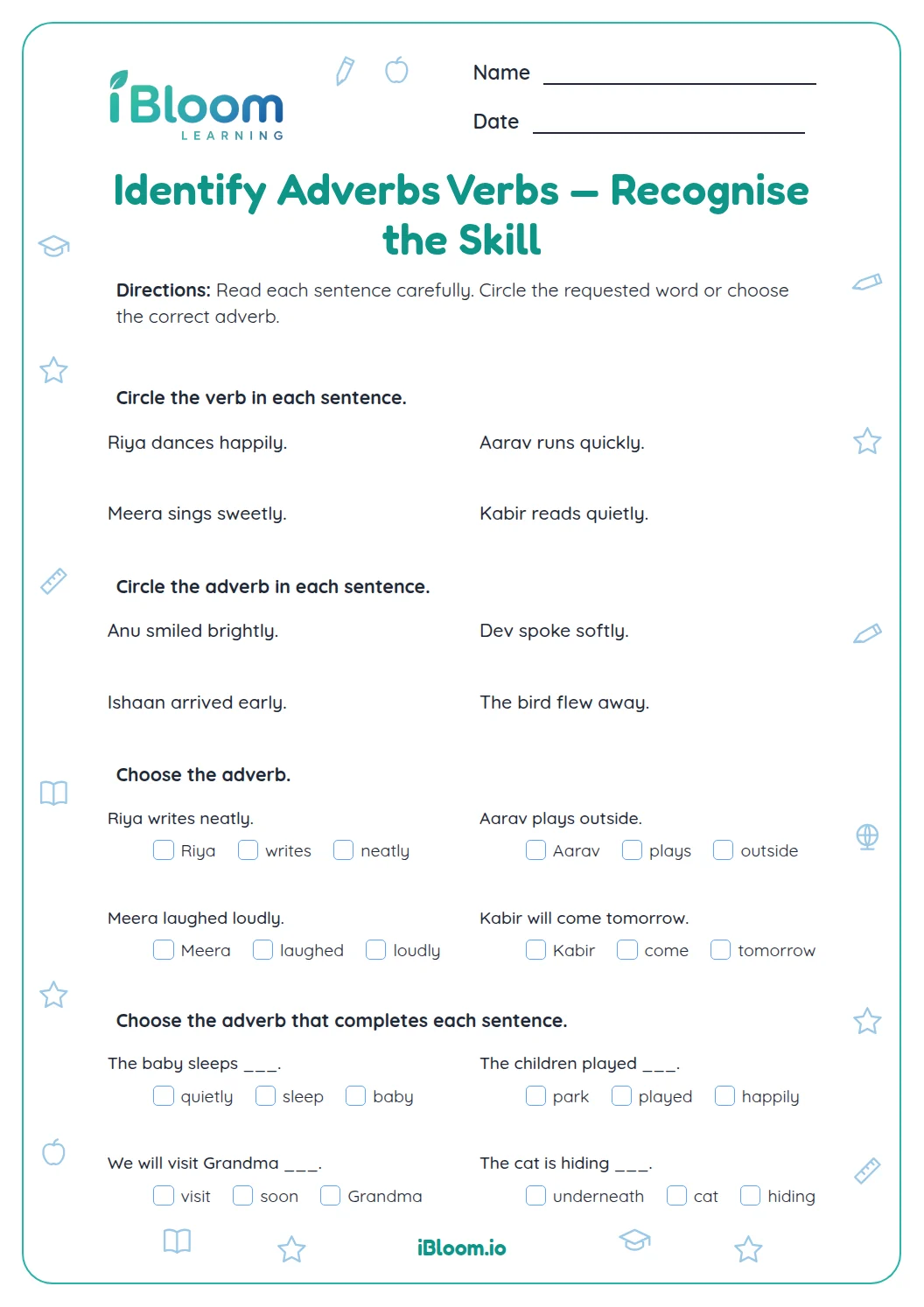 Identify Adverbs Verbs — Recognise the SkillRecognise the Skill for identify adverbs verbs in Class 3. Circle verbs and adverbs, then choose the adverb that tells how, when, or where an action happens.Class 3Free PDF preview
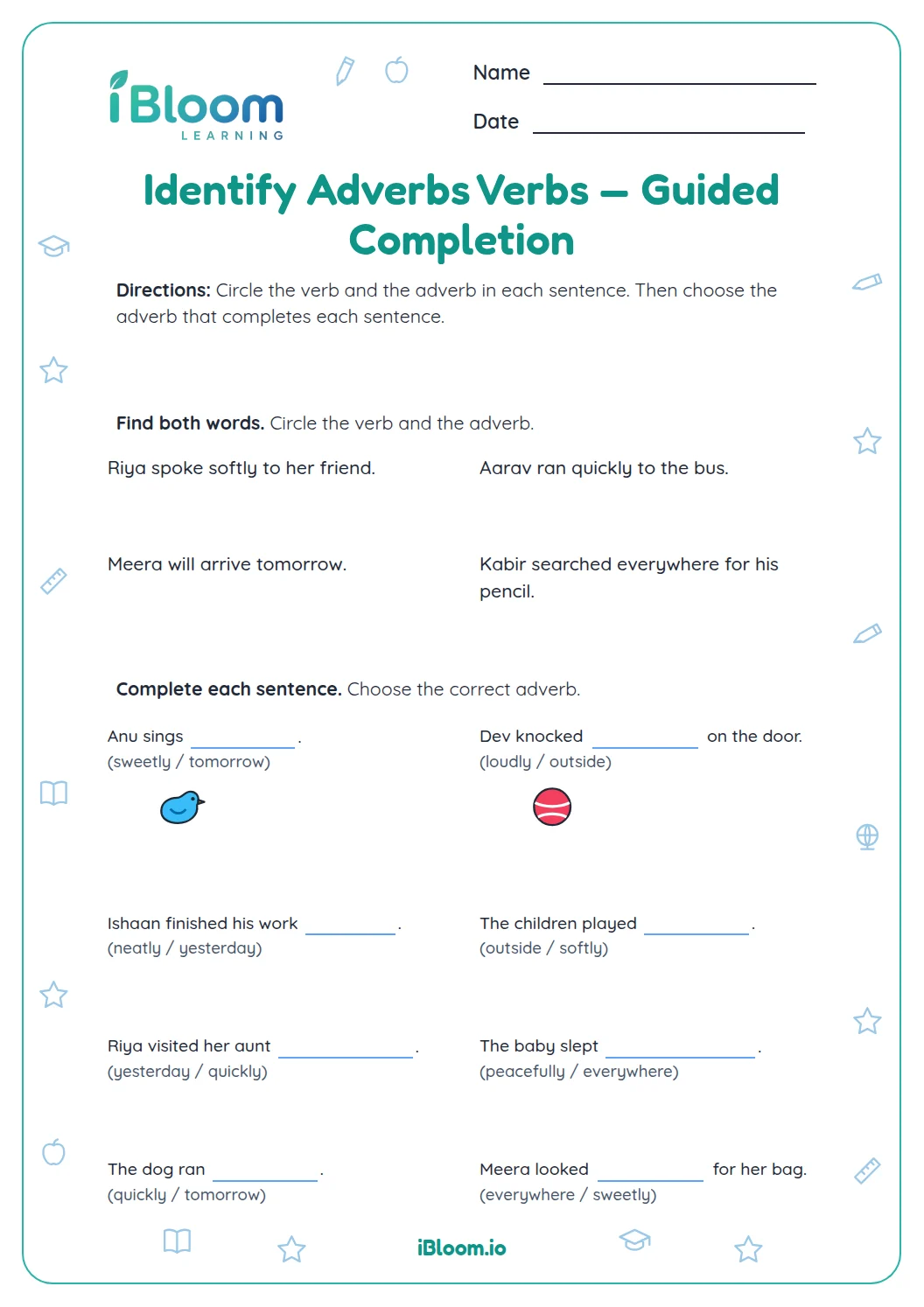 Identify Adverbs Verbs — Guided CompletionGuided Completion for identify adverbs verbs in Class 3. First circle the verb and adverb, then complete sentences with the correct adverb from the choices.Class 3Free PDF preview
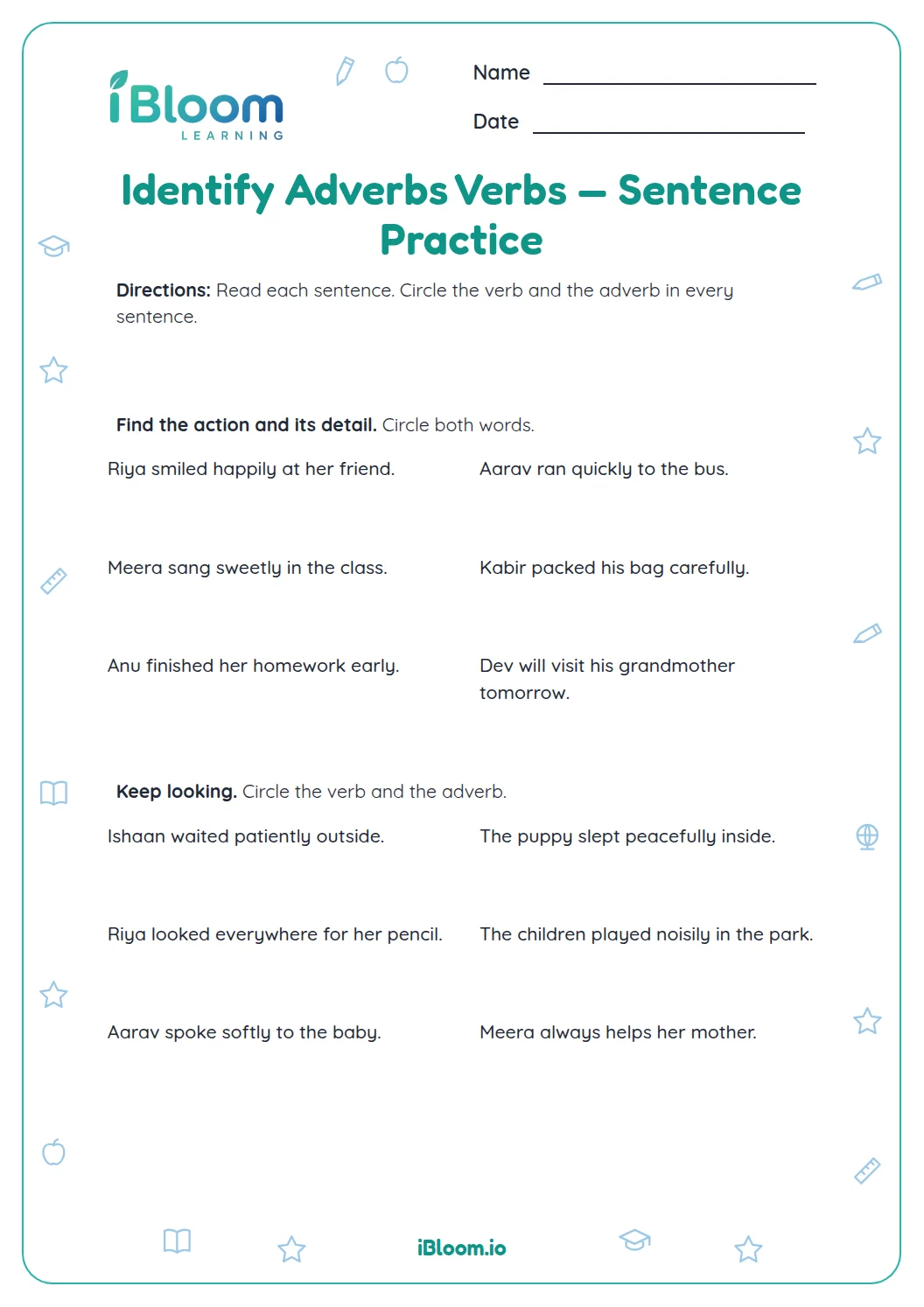 Identify Adverbs Verbs — Sentence PracticeSentence Practice for identify adverbs verbs in Class 3. Read each sentence and circle the verb and the adverb that tells how, when, or where the action happens.Class 3Free PDF preview
 Identify Adverbs Verbs — Write and ApplyWrite and Apply for identify adverbs verbs in Class 3. Find the verb and the adverb in each sentence, then choose or write the adverb that tells how, when, or where the action happens.Class 3Free PDF preview
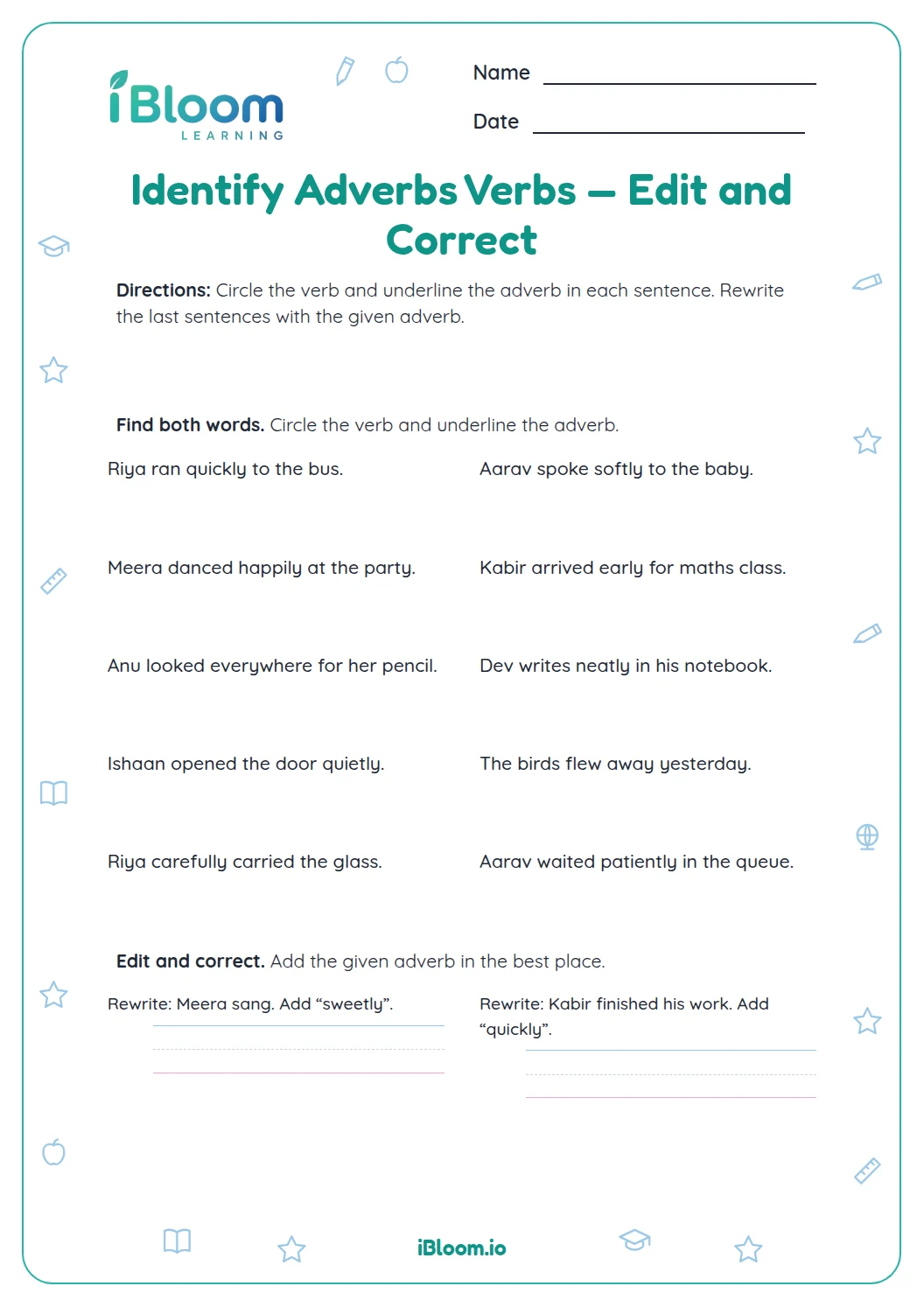 Identify Adverbs Verbs — Edit and CorrectEdit and Correct for identify adverbs verbs in Class 3. Circle the verb and adverb in each sentence, then edit sentences by adding the given adverb correctly.Class 3Free PDF preview
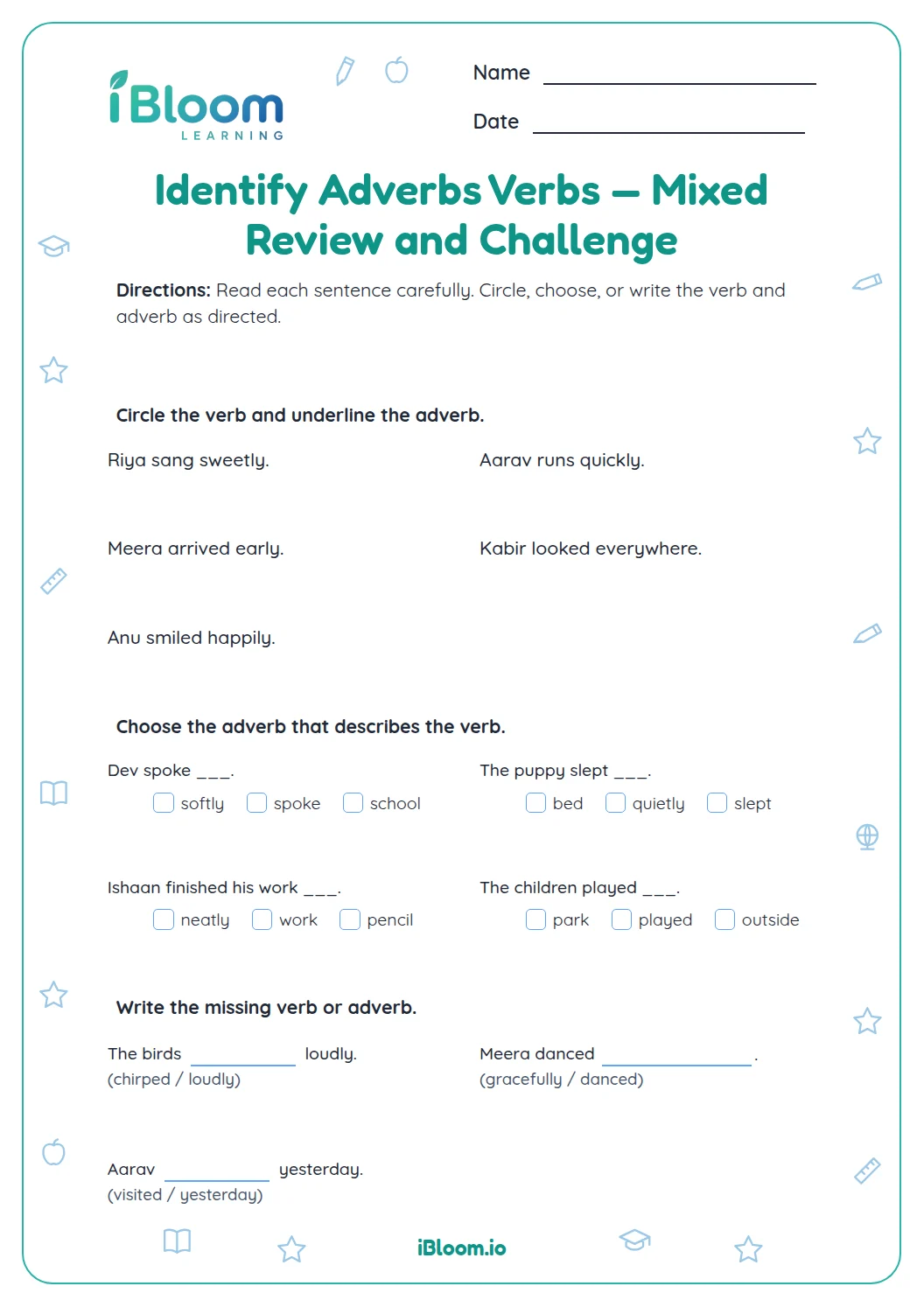 Identify Adverbs Verbs — Mixed Review and ChallengeMixed Review and Challenge for identify adverbs verbs in Class 3. Read each sentence, identify the verb and adverb, and choose or write the correct words.Class 3Free PDF preview
Practice that builds confidence
Understanding the verb-adverb link
These Class 3 grammar and writing worksheets help children spot the verb in a sentence and identify the adverb that tells more about it. They practise noticing how words such as quickly, carefully, loudly, slowly and yesterday add meaning to an action.
Printable activities include circling verbs, underlining adverbs, matching adverbs to suitable verbs, completing sentences, and sorting adverbs by the question they answer. The focus stays on reading the whole sentence, not just looking for words ending in -ly.
Children first learn that a verb names the action or state in a sentence, while an adverb gives extra information about that verb. In a sentence like “Riya writes neatly,” writes is the verb and neatly tells how she writes. This connection is the centre of the practice.

How the worksheets build the skill
The activities move from simple identification to sentence-level thinking. Children may underline the verb, circle the adverb, choose the adverb that best fits a verb, or decide whether an adverb tells how, when, or where. Examples include action words such as ran, spoke, sang, walked, and worked, with adverbs such as softly, yesterday, outside, fast, and carefully.
A simple parent routine
At home, ask your child to read one sentence aloud, act out the verb, and then ask, “How, when, or where did it happen?” For “The dog barked loudly,” the action is barked and loudly answers how. Let your child explain the pair before writing the answer, because speaking the reason helps prevent guessing.

Classroom uses for teachers
Teachers can use these printables during grammar practice, revision, small-group support, or language centres. A useful class activity is to display one sentence and have pupils hold up two colours: one for the verb and one for the adverb. The same sheets can also support sentence writing, where children add an adverb to make a plain action more precise.

Common errors to watch for
Some children mark every word ending in -ly as an adverb, even when it is not working with a verb in that sentence. Others confuse adjectives and adverbs, such as calling “happy” an adverb in “She is happy.” Encourage them to find the verb first, then test whether the other word tells more about that action. Also remind them that not all adverbs end in -ly; words like soon, here, there, and often can also be adverbs.
Free printable PDF download
Use this Class 3 identify adverbs and verbs worksheet page to preview the activity, print it, or download it as a PDF for quick practice. It works well for homework, homeschool lessons, tutoring, morning work, revision, and classroom centers.
Answers and answer key support
After the child completes the worksheet independently, parents and teachers can use the answer support or answer key information to check the work, review mistakes, and choose the next practice step.
Why iBloom worksheets help
iBloom worksheets give repeated, clear practice without making the task mechanical. Children see adverbs beside real verbs, compare choices, and explain meaning in context. A child-friendly strategy is: “Find the action, ask the clue question, then choose the describing word.” This keeps grammar practical and helps Class 3 learners use adverbs more confidently in their own writing.
Helpful answers
Frequently asked questions
What does my child practise in these worksheets?
Your child practises finding the verb in a sentence and identifying the adverb that gives more information about that verb, such as how, when, or where the action happens.
Should children identify the verb before the adverb?
Yes. Finding the verb first helps children understand what the adverb is describing. This reduces guessing and makes the sentence meaning clearer.
Do all adverbs in these worksheets end in -ly?
No. Many common adverbs end in -ly, such as slowly or neatly, but children also meet adverbs like soon, here, there, often, and yesterday.
How can I help if my child confuses adjectives and adverbs?
Ask whether the word describes a noun or tells more about a verb. In “The boy ran fast,” fast tells about ran, so it is an adverb. In “The fast boy ran,” fast describes boy, so it is an adjective.
Are these worksheets useful for writing practice too?
Yes. After identifying adverbs, children can improve their own sentences by adding suitable adverbs to verbs, such as changing “She spoke” to “She spoke politely.”
Is this Class 3 identify adverbs and verbs worksheet free?
Yes. You can preview it for free and use the printable worksheet for home or classroom practice.
Can I download this Class 3 identify adverbs and verbs worksheet as a PDF?
Yes. Use the worksheet download option to save a printable PDF, or print the worksheet directly from the page.
Does this Class 3 identify adverbs and verbs worksheet include answers or an answer key?
When the activity has fixed answers, iBloom includes answer support so parents and teachers can check the completed worksheet.