Free printable practice
Rules Practice Activities
Class 5 pupils write opinion pieces about rules, giving clear reasons, examples, and organised arguments.
Free printable worksheet PDFs
Preview every available page, then download the free worksheet PDF for home, homeschool, tutoring, or classroom practice.
Preview the exact activity before downloading it.
 Prompts: Rules — Recognise the SkillRecognise the Skill for prompts: rules in Class 5. Read each writing prompt and recognise whether it asks for an opinion about rules.Class 5Free PDF preview
 Prompts: Rules — Guided CompletionGuided Completion for prompts: rules in Class 5. Complete guided opinion sentences about school rules using the best word or phrase from each set of choices.Class 5Free PDF preview
 Prompts: Rules — Sentence PracticeSentence Practice for prompts: rules in Class 5. Complete and choose sentences about school rules using clear opinions, reasons, examples, and linking words.Class 5Free PDF preview
 Prompts: Rules — Write and ApplyWrite and Apply for prompts: rules in Class 5. Choose strong rule ideas, complete opinion sentences, and write short organised arguments with reasons and examples.Class 5Free PDF preview
 Prompts: Rules — Edit and CorrectEdit and Correct for prompts: rules in Class 5. Choose corrections for rule-related sentences, then rewrite two sentences accurately.Class 5Free PDF preview
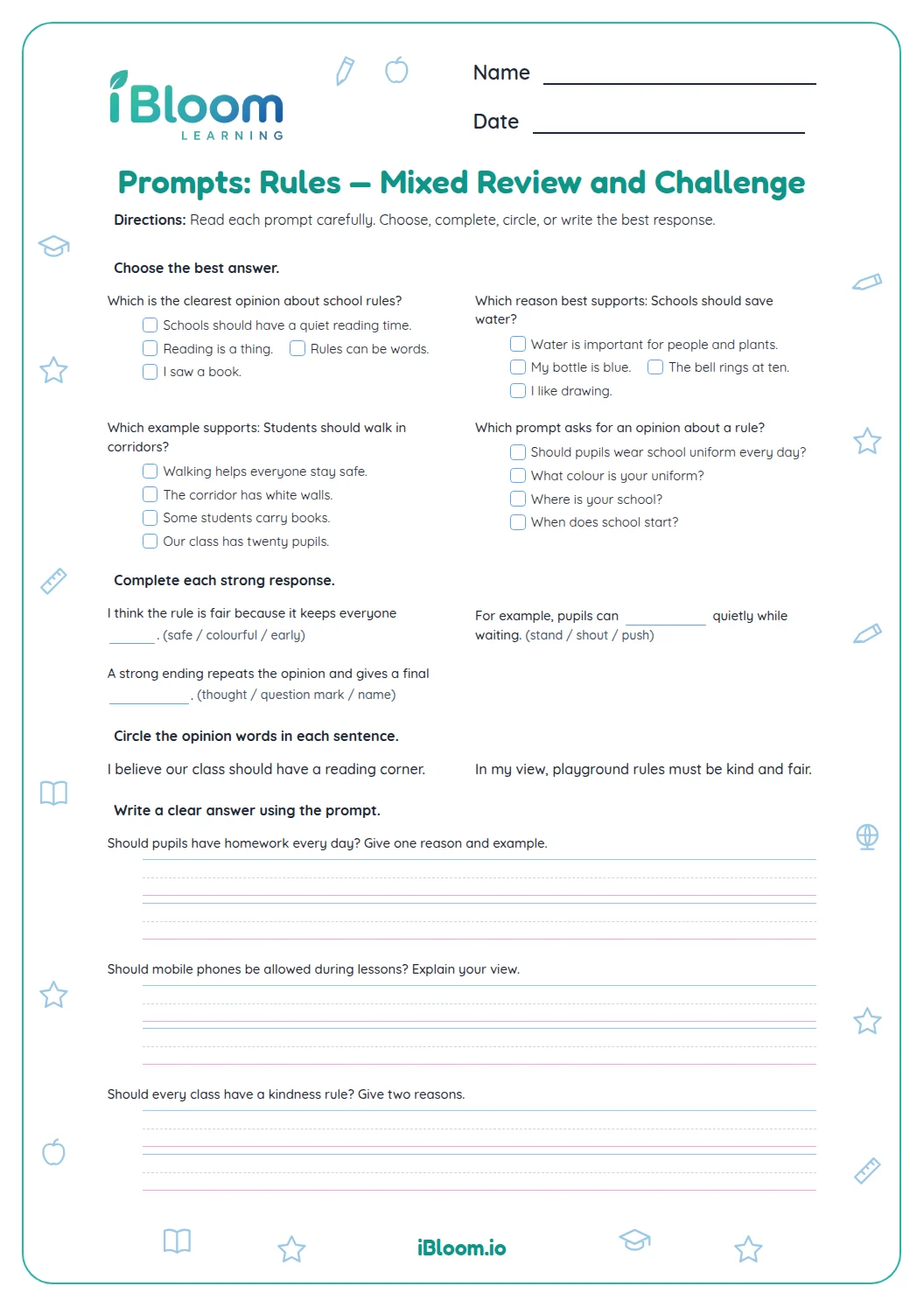 Prompts: Rules — Mixed Review and ChallengeMixed Review and Challenge for prompts: rules in Class 5. Read rule-related prompts, identify strong reasons and examples, organise ideas, and write clear opinion responses.Class 5Free PDF preview
Practice that builds confidence
Thinking about rules as opinion prompts
These Class 5 opinion writing worksheets use rules as the prompt focus, helping pupils think about school, home, classroom, playground, safety, and community expectations. Children practise stating an opinion clearly and supporting it with sensible reasons.
The printable activities guide pupils to plan, write, and improve opinion paragraphs or short essays about whether a rule is fair, useful, too strict, or needs changing. They learn to use examples, linking words, and a respectful writing voice.
Rules are familiar to Class 5 pupils, which makes them a strong topic for opinion writing. A child may write about uniforms, homework rules, library rules, traffic rules, classroom silence, or screen-time limits. The aim is not just to agree or disagree, but to explain why the opinion makes sense.

Skills pupils practise
These worksheets develop a clear opinion statement, relevant reasons, examples, and a concluding sentence. Pupils practise using opinion vocabulary such as I believe, in my view, should, must, fair, unfair, responsible, safe, freedom, and consequence. They also learn to organise ideas so each reason supports the main view.
A parent routine for home
At home, choose one everyday rule, such as “No phones during dinner.” Ask your child to say whether they support it, then give two reasons and one example. Before writing, have them plan in three lines: my opinion, my best reason, my example. After writing, ask, “Will a reader understand why you think this?”

Classroom uses for teachers
Teachers can use these prompts for pre-writing discussions, debate corners, paragraph writing, peer review, or assessment of persuasive structure. Pupils can compare two sides of a rule before choosing their position. This helps them avoid one-sided complaining and instead write with fairness and evidence.

Common errors to watch for
Some pupils list rules without giving an opinion. Others write emotional statements such as “This rule is bad” but give no reason. Watch for repeated reasons, weak examples, and endings that simply stop. Encourage pupils to use linking words like firstly, another reason, for example, however, and therefore.
Free printable PDF download
Use this class 5 opinion writing rules worksheet page to preview the activity, print it, or download it as a PDF for quick practice. It works well for homework, homeschool lessons, tutoring, morning work, revision, and classroom centers.
Answers and answer key support
After the child completes the worksheet independently, parents and teachers can use the answer support or answer key information to check the work, review mistakes, and choose the next practice step.
Why iBloom worksheets help
The iBloom rules prompts give children a concrete topic while still requiring independent thought. A child-friendly strategy is: choose, reason, example, end. Choose your side, give a reason, prove it with an example, and end by reminding the reader of your opinion in a calm, confident way.
Helpful answers
Frequently asked questions
What kinds of rules can pupils write about?
Pupils may write about familiar rules from school, home, public places, playgrounds, safety routines, classroom behaviour, or community life.
What should a Class 5 opinion answer include?
It should include a clear opinion, at least a few relevant reasons, examples that support the view, linking words, and a suitable conclusion.
How can I help a child who only writes one sentence?
Ask the child to add one reason and one real-life example. A simple frame is: I believe __ because __. For example, __.
Can pupils disagree with a rule in their writing?
Yes. They can disagree, but they should explain respectfully, give practical reasons, and suggest a better alternative if possible.
How are these prompts useful before essay writing?
They help pupils practise the building blocks of an essay: position, reasons, examples, transitions, and a closing statement.
Is this class 5 opinion writing rules worksheet free?
Yes. You can preview it for free and use the printable worksheet for home or classroom practice.
Can I download this class 5 opinion writing rules worksheet as a PDF?
Yes. Use the worksheet download option to save a printable PDF, or print the worksheet directly from the page.
Does this class 5 opinion writing rules worksheet include answers or an answer key?
When the activity has fixed answers, iBloom includes answer support so parents and teachers can check the completed worksheet.