Free printable practice
Punctuation Practice Activities
Class 5 punctuation worksheets for commas, quotation marks, titles, colons, semicolons, dialogue, direct address, introductory phrases and question tags.
Explore Punctuation
Free printable worksheet PDFs
Preview every available page, then download the free worksheet PDF for home, homeschool, tutoring, or classroom practice.
Preview the exact activity before downloading it.
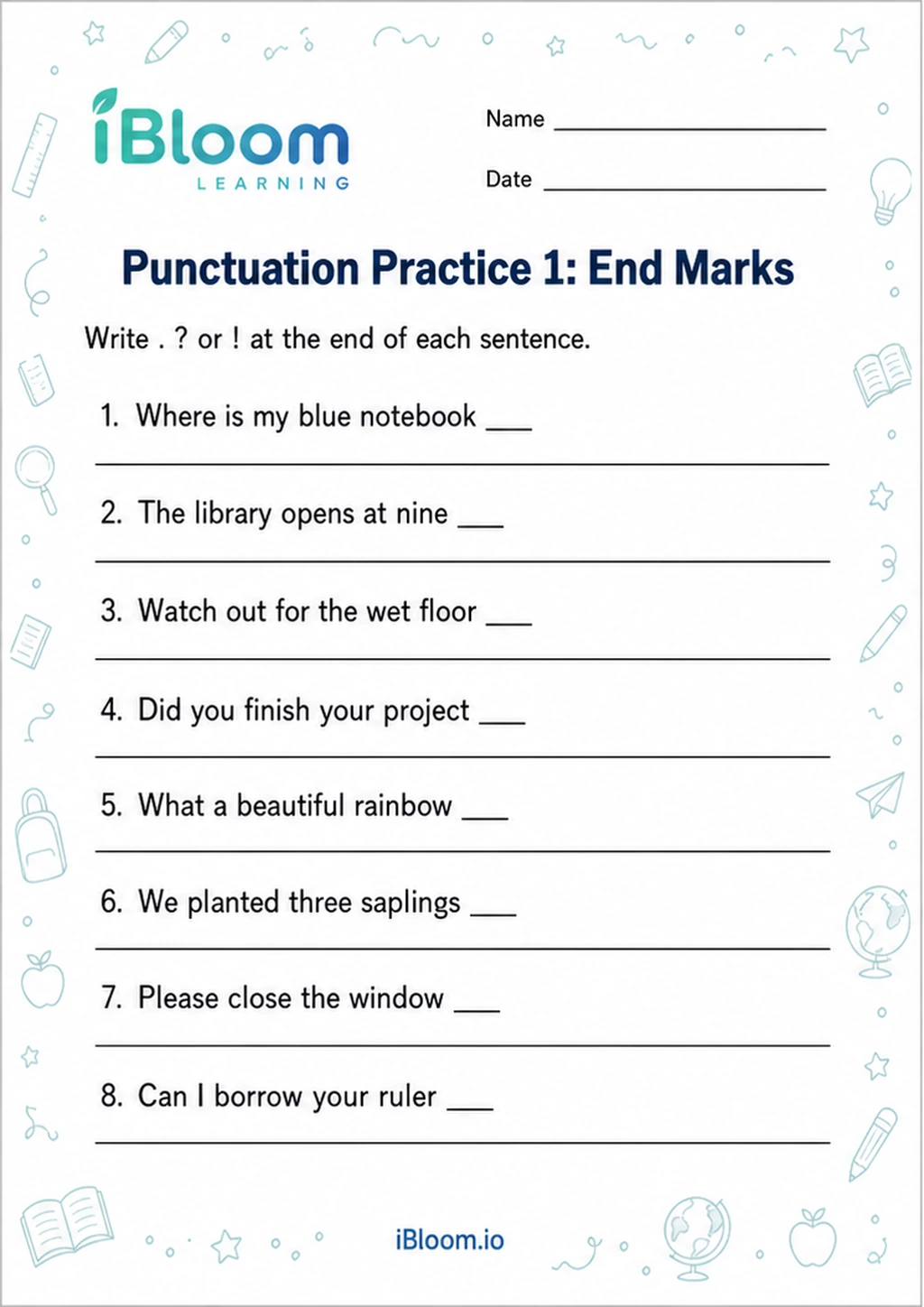 Punctuation Practice 1: End MarksClass 5 printable practice for punctuation practice using a clear, age-appropriate learning task.Class 5Free PDF preview
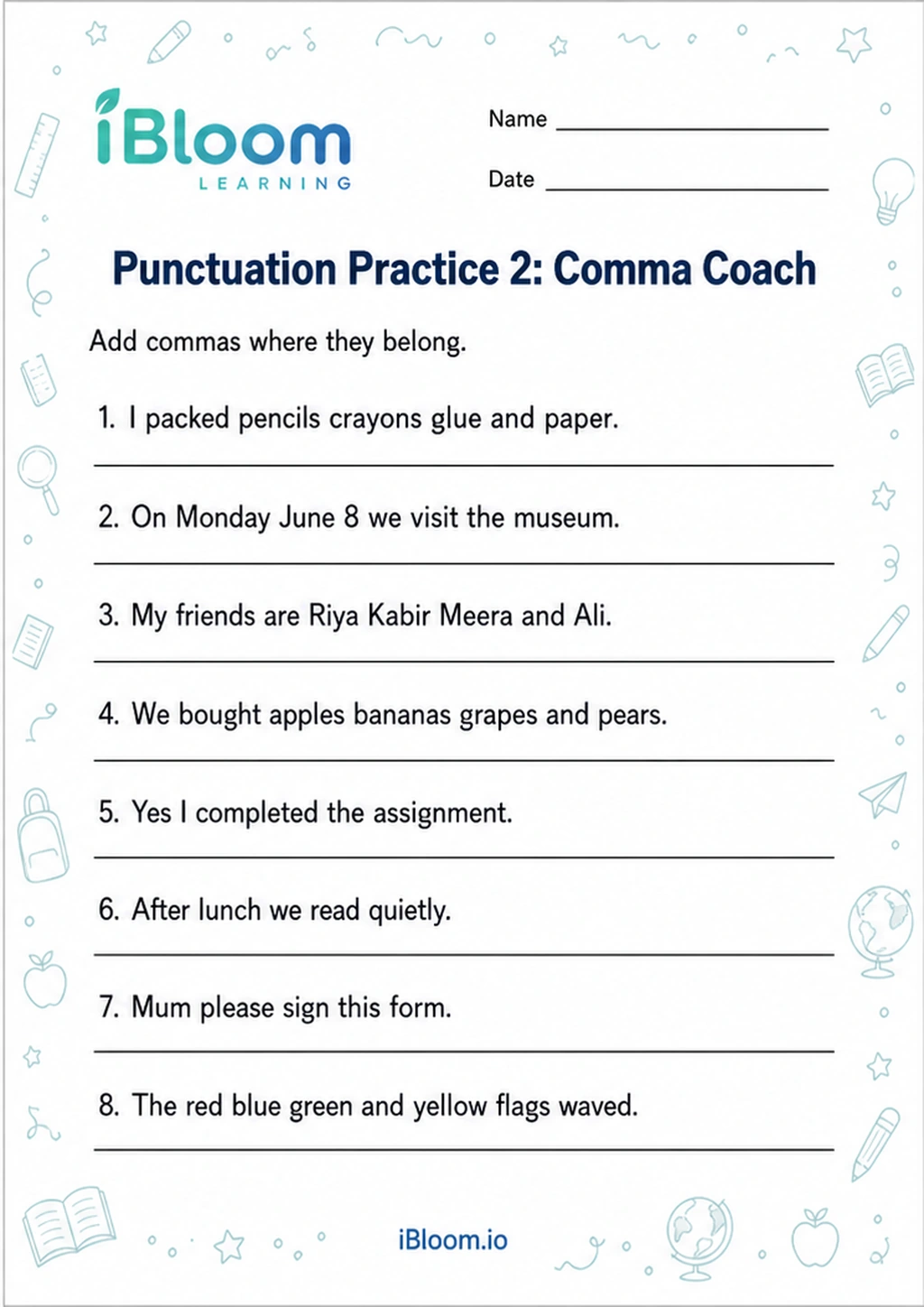 Punctuation Practice 2: Comma CoachClass 5 printable practice for punctuation practice using a clear, age-appropriate learning task.Class 5Free PDF preview
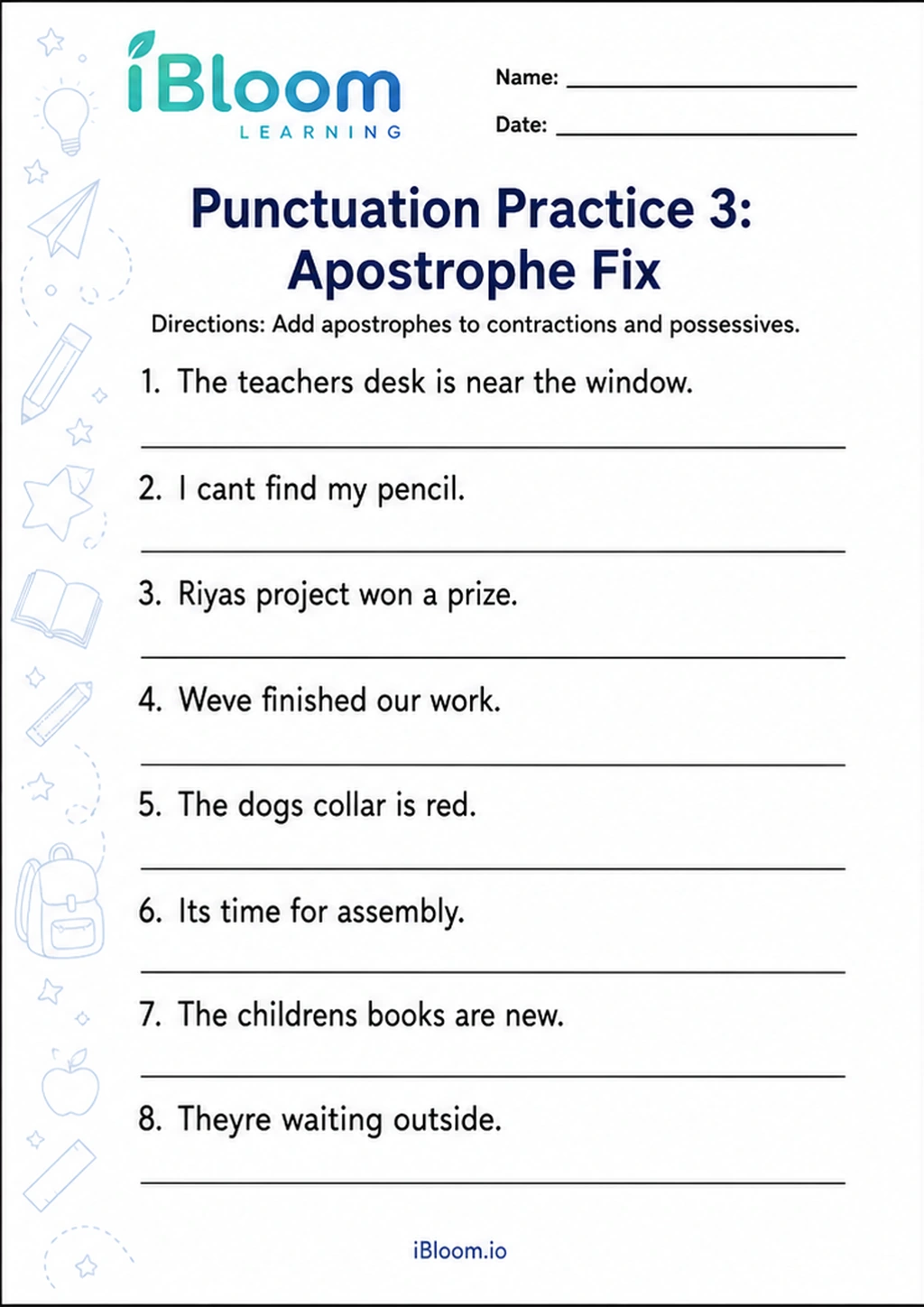 Punctuation Practice 3: Apostrophe FixClass 5 printable practice for punctuation practice using a clear, age-appropriate learning task.Class 5Free PDF preview
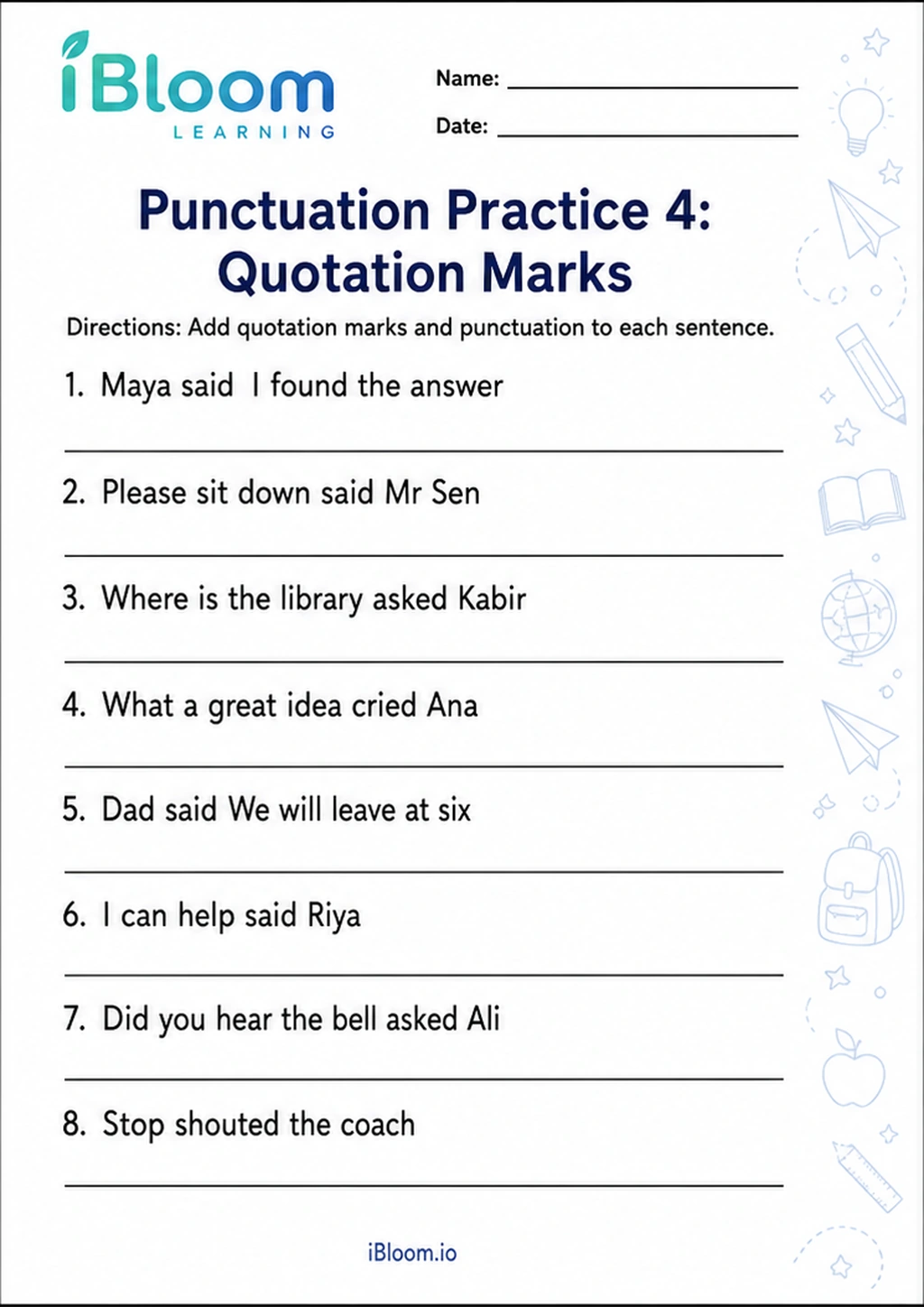 Punctuation Practice 4: Quotation MarksClass 5 printable practice for punctuation practice using a clear, age-appropriate learning task.Class 5Free PDF preview
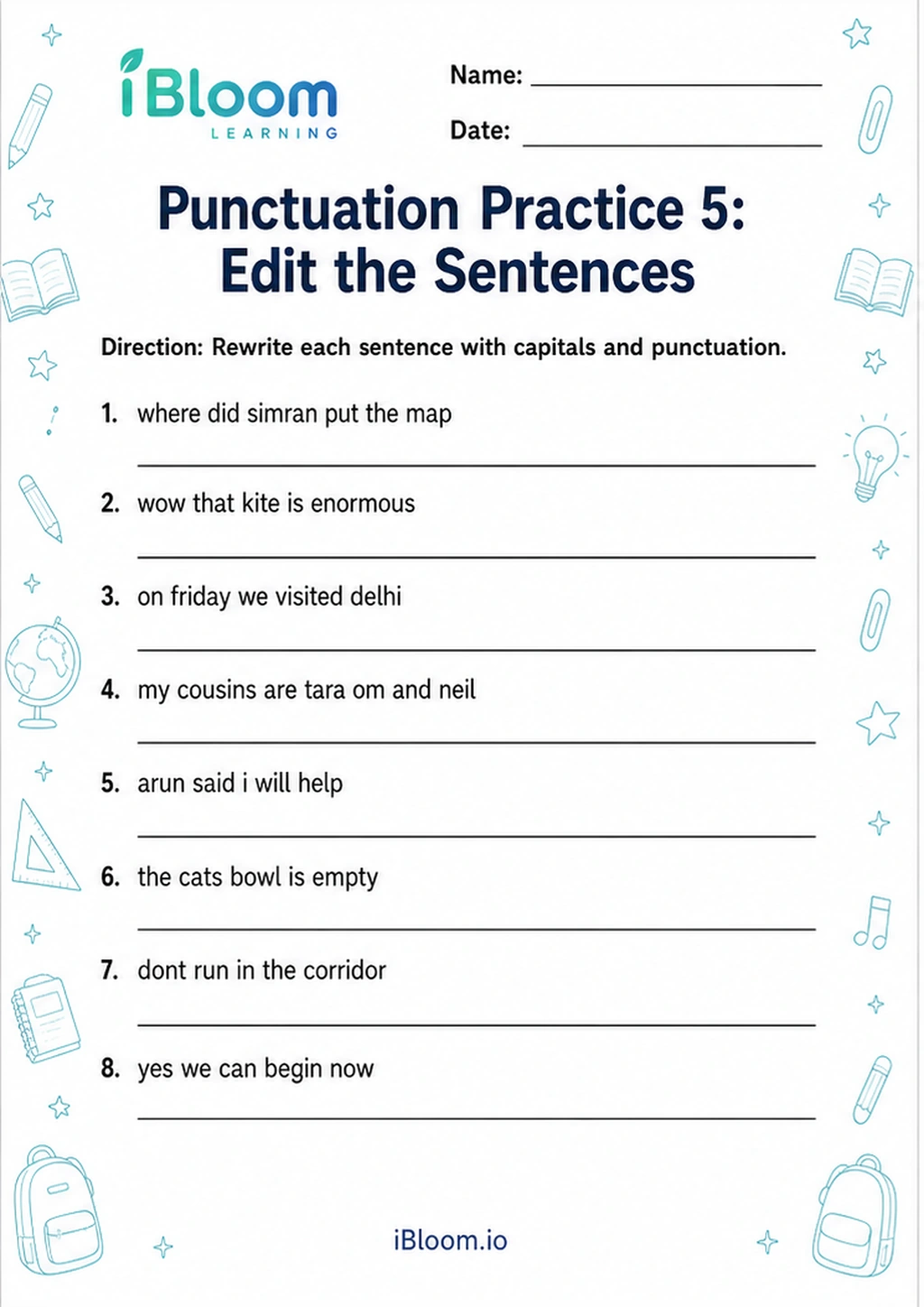 Punctuation Practice 5: Edit the SentencesClass 5 printable practice for punctuation practice using a clear, age-appropriate learning task.Class 5Free PDF preview
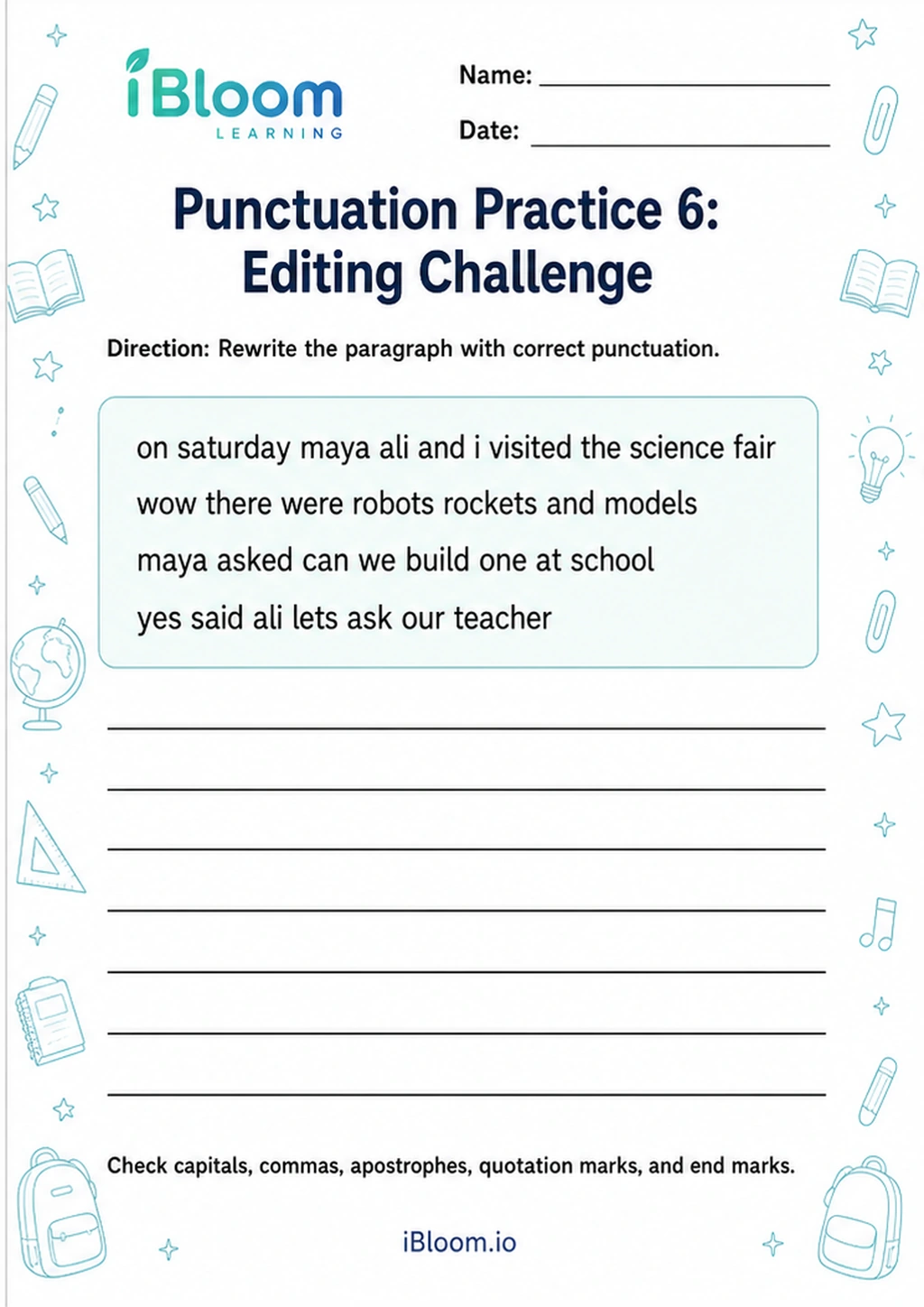 Punctuation Practice 6: Editing ChallengeClass 5 printable practice for punctuation practice using a clear, age-appropriate learning task.Class 5Free PDF preview
Practice that builds confidence
What children practise
These Class 5 Grammar and Writing worksheets help children use punctuation with purpose, not just add marks at the end of sentences. They practise commas in lists, series, direct address and introductory elements, along with quotation marks, dialogue, colons, semicolons and question tags.
The printable activities include focused drills, sentence editing, title formatting, capitalisation of titles, yes/no comma use, and short writing tasks. Children move from spotting punctuation clues to writing clearer sentences and dialogue of their own.
This Punctuation collection sits under Grammar and Writing > Class 5 > Punctuation and brings together the marks children often meet in longer reading and writing. Worksheets cover commas after introductory words and phrases, commas in lists and series, commas for direct address, yes/no responses, quotation marks, writing dialogue, colons, semicolons, question tags, and the correct formatting and capitalisation of titles.

Building from simple marks to sentence control
The progression begins with recognising where punctuation changes meaning: Yes, I can come is different from Yes I can come. Children then apply comma rules in series such as apples, oranges and bananas, use commas when speaking to someone by name, and add punctuation after introductory phrases. Later tasks ask them to combine or separate ideas with colons and semicolons and to punctuate dialogue, including speaker words and quotation marks.
A practical routine for parents
Choose one small focus per sitting. First, ask your child to read a sentence aloud and pause where a comma or punctuation mark appears. Next, let them explain why the mark is needed. Then have them correct two or three similar sentences and write one original sentence, such as After lunch, Meera packed her bag. For title work, ask them to check a book or chapter name and decide which important words need capital letters.

Classroom uses for teachers
Teachers can use these printables for grammar warm-ups, writing centers, peer editing, homework, or revision before composition work. A dialogue worksheet can lead into story writing, while comma and introductory phrase sheets can support paragraph improvement. Short practice pages also work well for small-group reteaching when children know the rule but forget to apply it while writing.

Common errors and a child-friendly strategy
Watch for missing commas after introductory words, commas placed between a subject and verb, quotation marks that do not enclose the exact spoken words, and title words left in lower case. Children may also overuse semicolons where a full stop is better. A useful strategy is Read, Pause, Ask: read the sentence aloud, listen for a natural pause or speaker change, then ask which punctuation rule explains it.
Free printable PDF download
Use this class 5 punctuation worksheet page to preview the activity, print it, or download it as a PDF for quick practice. It works well for homework, homeschool lessons, tutoring, morning work, revision, and classroom centers.
Answers and answer key support
After the child completes the worksheet independently, parents and teachers can use the answer support or answer key information to check the work, review mistakes, and choose the next practice step.
Why iBloom worksheets help
iBloom worksheets separate closely related skills so children can practise one decision at a time before mixing them in editing and writing tasks. Clear examples, varied sentence patterns and independent writing prompts help Class 5 learners connect punctuation rules to real communication, making their stories, answers and paragraphs easier to read.
Helpful answers
Frequently asked questions
What punctuation skills are included in these Class 5 worksheets?
They include commas in lists, series, direct address, yes/no answers and introductory phrases, plus quotation marks, dialogue, titles, colons, semicolons and question tags.
Do the worksheets teach how to punctuate dialogue?
Yes. Children practise placing quotation marks around spoken words, adding commas with speaker tags, and writing short dialogue lines with correct punctuation.
How can my child remember when to use a comma after an introductory phrase?
Ask your child to read the sentence aloud. If the sentence begins with a starter such as After school or In the morning, they should check whether a comma helps separate that opening phrase from the main idea.
Are colons and semicolons suitable for Class 5 learners?
Yes, when taught in simple contexts. These worksheets introduce them through clear sentence patterns, such as using a colon before an explanation or list and a semicolon between closely related complete ideas.
Can these worksheets be used for revision before writing assignments?
Yes. Teachers and parents can use them before story writing, paragraph writing or editing tasks so children apply punctuation rules while composing their own sentences.
Is this class 5 punctuation worksheet free?
Yes. You can preview it for free and use the printable worksheet for home or classroom practice.
Can I download this class 5 punctuation worksheet as a PDF?
Yes. Use the worksheet download option to save a printable PDF, or print the worksheet directly from the page.
Does this class 5 punctuation worksheet include answers or an answer key?
When the activity has fixed answers, iBloom includes answer support so parents and teachers can check the completed worksheet.