Free printable practice
Identify Aus Dollar Coins Practice Activities
Grade 1 printable math activities for recognizing Australian dollar coins by value, symbol, color, size, shape, and common coin features.
Free printable worksheet PDFs
Preview every available page, then download the free worksheet PDF for home, homeschool, tutoring, or classroom practice.
Preview the exact activity before downloading it.
Practice that builds confidence
What children learn first
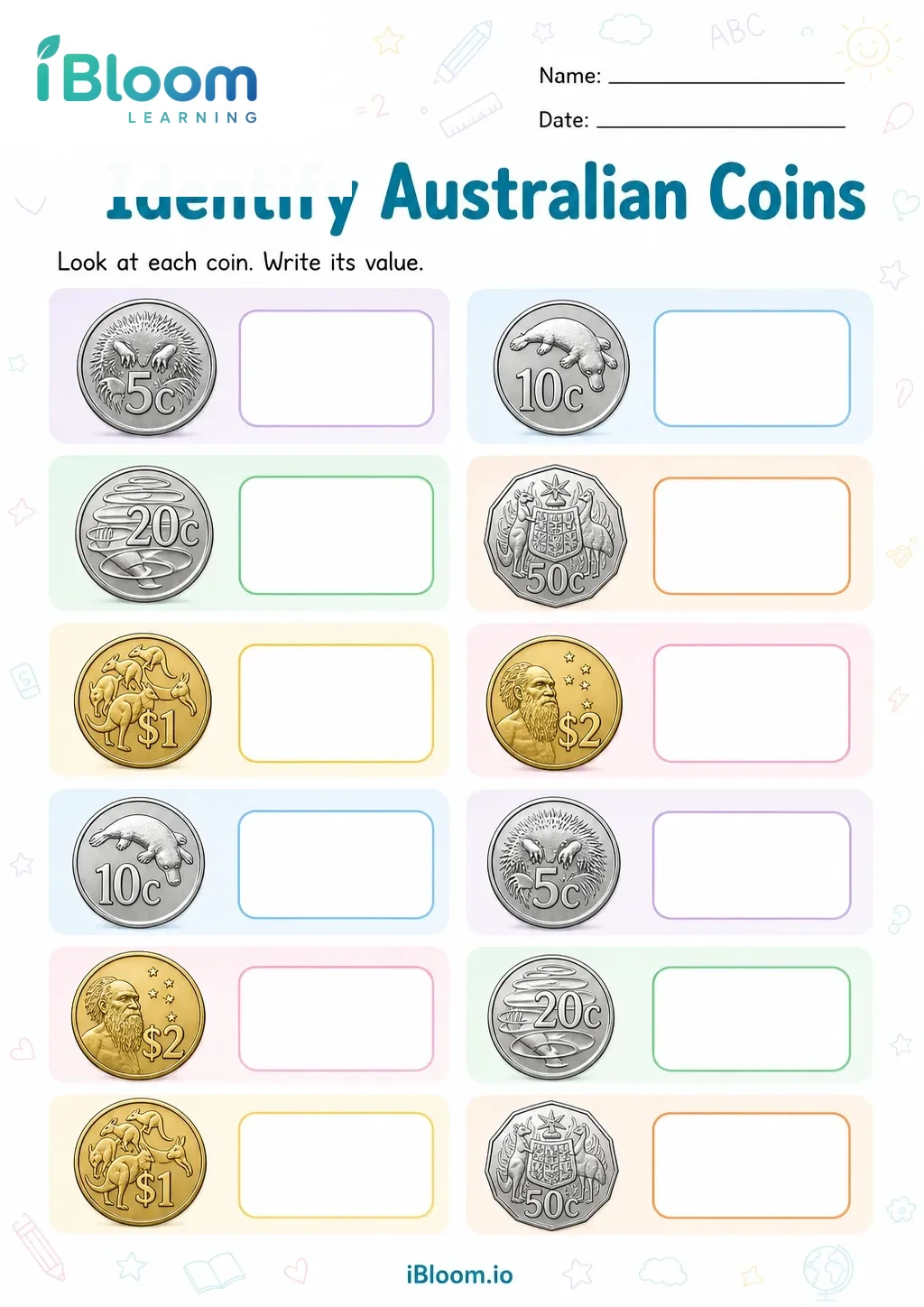
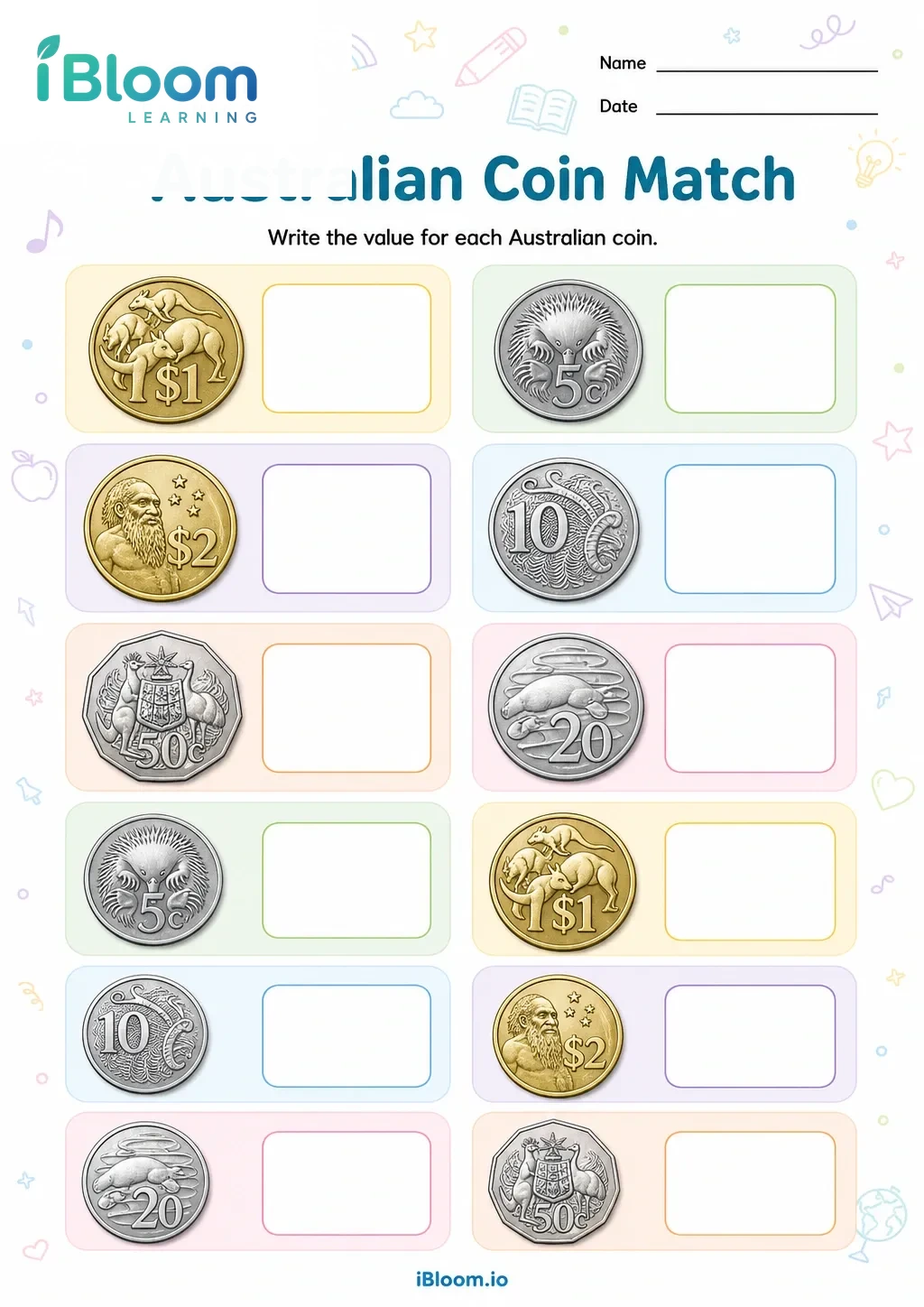
These Grade 1 math worksheets help children identify Australian dollar coins and cents coins, including 5c, 10c, 20c, 50c, $1, and $2. Students practise matching coin pictures to values, reading the c and $ symbols, and noticing visual clues such as color, size, and shape.
The printable activities include coin recognition, value labeling, sorting, matching, and simple comparison tasks. They fit the Math > Grade 1 > Counting Money path by building the recognition skills children need before they begin adding coin amounts.
Children begin by naming each Australian coin and connecting the written value to the coin image. They learn that cent coins use c, while dollar coins use $. A 50c coin is easy to spot because it has 12 sides, while the $1 and $2 coins are gold-colored. The worksheets also help students notice that coin size does not always match value, since the $2 coin is smaller than the $1 coin.

Skill progression in the printables
The practice moves from direct recognition to mixed review. Early pages may ask students to circle all the 10c coins or match a coin picture to “20c.” Later pages ask them to sort several coins, choose the correct label, or identify coins shown in different positions. This keeps the focus on recognition rather than counting totals too soon.
A simple parent routine
At home, place a few real or play Australian coins on the table. Ask, “Which one is worth 5 cents?” or “Find the gold coin that says $2.” Then use one worksheet page to reinforce the same idea with printed coins. End by asking your child to explain one clue they used, such as “the 50c coin has many sides” or “this one has a dollar sign.”

Classroom uses
Teachers can use these sheets for a money center, small-group review, morning work, or quick assessment before lessons on counting collections of coins. Students can cut out coin cards, sort them by cents and dollars, or pair a coin image with its written value. The pages also support vocabulary practice: coin, cents, dollar, value, label, match, sort, silver-colored, and gold-colored.

Common errors to watch for
Many Grade 1 students confuse $1 and $2 because both are gold-colored. Others assume the largest coin is always worth the most, which can lead to mistakes with 50c, $1, and $2. Some children also mix up 5c and 10c when they rely only on color. Encourage them to check more than one clue: number, symbol, color, and shape.
Free printable PDF download
Use this identify Australian dollar coins worksheet page to preview the activity, print it, or download it as a PDF for quick practice. It works well for homework, homeschool lessons, tutoring, morning work, revision, and classroom centers.
Answers and answer key support
After the child completes the worksheet independently, parents and teachers can use the answer support or answer key information to check the work, review mistakes, and choose the next practice step.
Why iBloom worksheets help
iBloom worksheets give children repeated, varied exposure to the same Australian coins without rushing into multi-step money sums. A child-friendly strategy is: “Look, read, check.” Look at the coin, read the number and symbol, then check a visual clue such as shape or color before choosing the answer.
Helpful answers
Frequently asked questions
Which Australian coins are included in these worksheets?
The worksheets focus on identifying 5c, 10c, 20c, 50c, $1, and $2 Australian coins by their printed value, symbol, color, size, and shape.
Are these worksheets about adding coin amounts?
No. This page focuses on recognizing and naming coins. That foundation helps students later when they begin counting mixed coin collections.
Why do children often mix up the $1 and $2 coins?
Both coins are gold-colored, so children may rely on color alone. Encourage them to read the value on the coin and notice that the $2 coin is smaller than the $1 coin.
How can I use real coins with these printables?
Show one real coin, ask your child to name it, then have them find the matching coin or label on the worksheet. This connects hands-on money practice with printed images.
What vocabulary should Grade 1 students practise on this topic?
Useful words include coin, cents, dollar, value, symbol, match, sort, label, 5c, 10c, 20c, 50c, $1, and $2.
Is this identify Australian dollar coins worksheet free?
Yes. You can preview it for free and use the printable worksheet for home or classroom practice.
Can I download this identify Australian dollar coins worksheet as a PDF?
Yes. Use the worksheet download option to save a printable PDF, or print the worksheet directly from the page.
Does this identify Australian dollar coins worksheet include answers or an answer key?
When the activity has fixed answers, iBloom includes answer support so parents and teachers can check the completed worksheet.