Free printable practice
Length Non Standard Units Practice Activities
Grade 1 worksheets for measuring length with non-standard units such as cubes, clips, tiles, and everyday objects.
Free printable worksheet PDFs
Preview every available page, then download the free worksheet PDF for home, homeschool, tutoring, or classroom practice.
Preview the exact activity before downloading it.
Practice that builds confidence
Building the idea of length
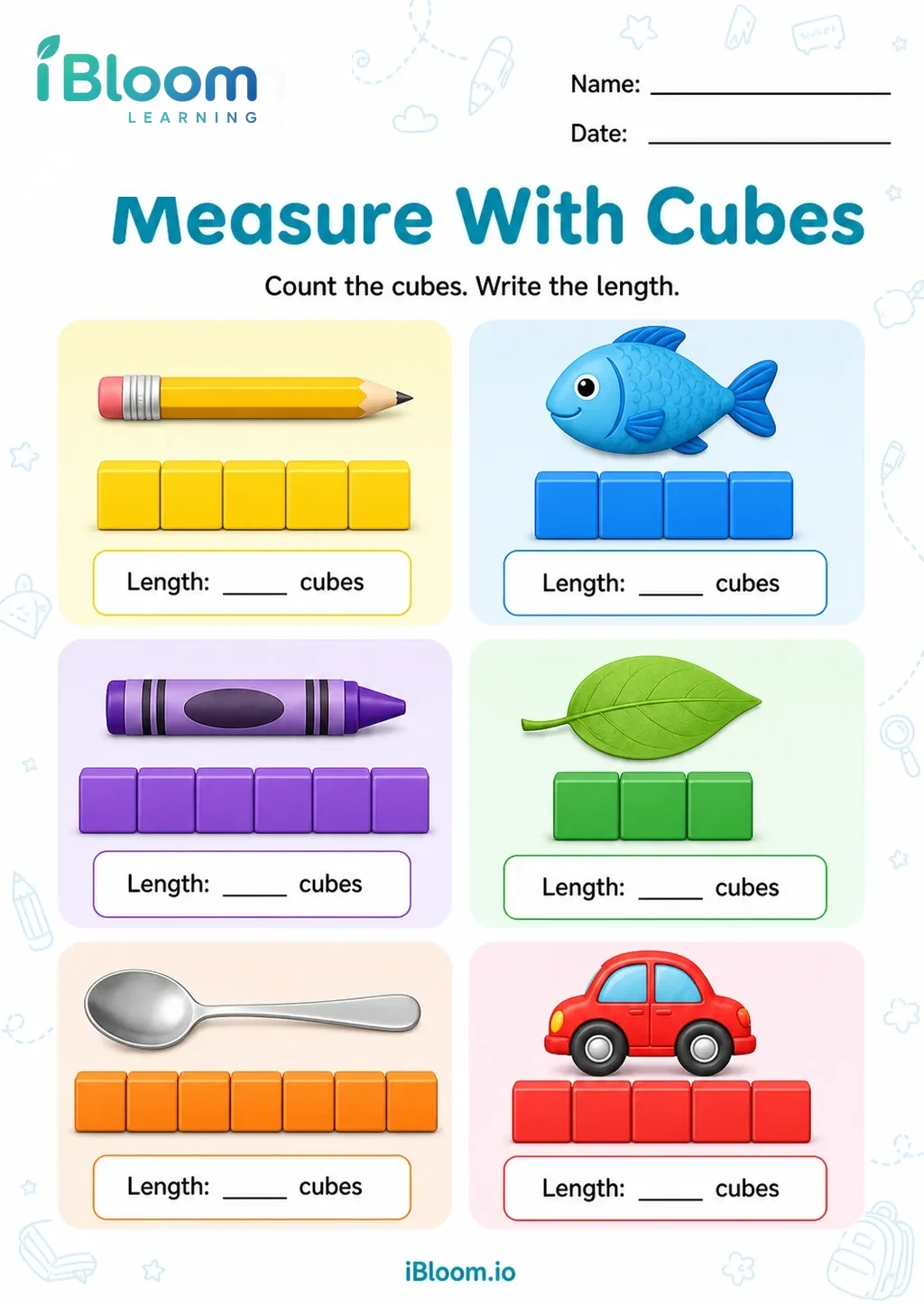
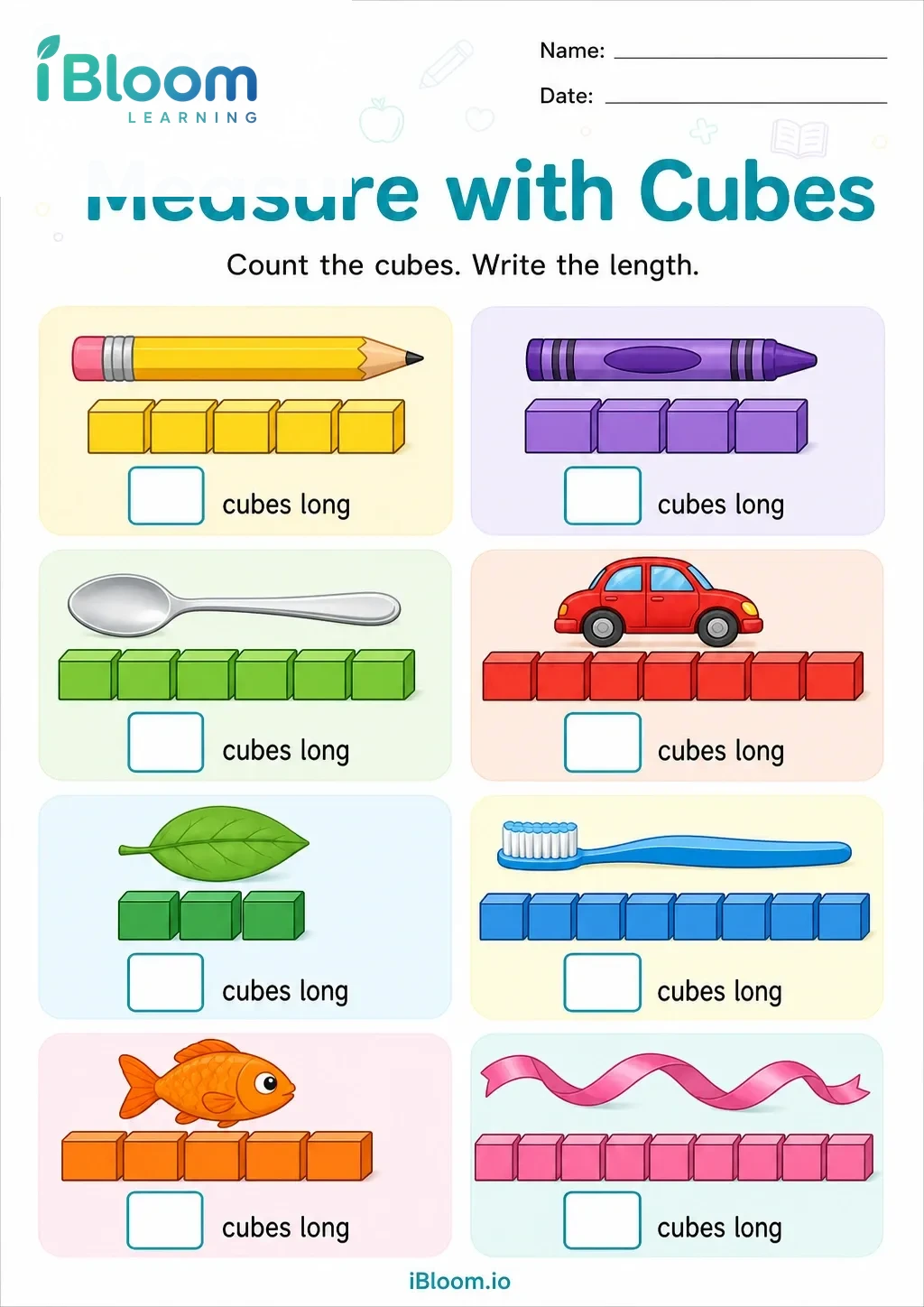
These Grade 1 measurement worksheets help children understand length before they use rulers. Students practise measuring objects with non-standard units, comparing lengths, and explaining which object is longer or shorter.
The printable activities use familiar representations such as cubes, paper clips, blocks, and classroom items. Children count equal units, notice gaps and overlaps, and build the habit of measuring carefully from one end to the other.
Length measurement begins with the question, “How long is it?” These worksheets guide Grade 1 learners to see length as the distance from one endpoint to another. Instead of inches or centimeters, children use non-standard units such as cubes, clips, counters, tiles, or drawn blocks. This keeps the focus on the measurement process: line up equal units, count them, and compare the total.

From direct comparison to counting units
Activities move from looking at two objects and deciding which is longer to counting how many same-size units match an object’s length. A pencil might be 6 cubes long, while an eraser might be 3 cubes long. Children also practise reading pictures where units are already placed beside an object, then choosing or writing the correct length.
A simple parent routine
At home, pick one unit for the day, such as paper clips. Ask your child to measure a spoon, a book, and a crayon using the same kind of clip each time. Have them say the full sentence: “The book is about 8 paper clips long.” Then ask, “How do you know it is longer than the spoon?” This routine builds counting, comparison, and measurement vocabulary in a natural way.

Classroom uses for teachers
Teachers can use these printables after a hands-on measuring center, as small-group practice, or as a quick check for understanding. They also pair well with math talk: students can explain why two answers differ, point to the starting end, or show where a missing unit would go. The pages support independent practice while still encouraging discussion about fair measuring.

Common mistakes to watch for
Children may leave spaces between units, overlap units, start measuring away from the object’s endpoint, or mix different-sized units in one measurement. Another common error is counting the object instead of the units. Encourage students to touch and count each unit in order, then check that all units are the same size and arranged in a straight line.
Free printable PDF download
Use this grade 1 length non standard units worksheet page to preview the activity, print it, or download it as a PDF for quick practice. It works well for homework, homeschool lessons, tutoring, morning work, revision, and classroom centers.
Answers and answer key support
After the child completes the worksheet independently, parents and teachers can use the answer support or answer key information to check the work, review mistakes, and choose the next practice step.
Why iBloom worksheets help
The worksheets give repeated practice with clear visual models and child-friendly measurement situations. A useful strategy for children is: “Start at the end, line them up, no gaps, no overlaps, then count.” This short routine helps them measure with care and prepares them for standard units later.
Helpful answers
Frequently asked questions
What are non-standard units of length?
Non-standard units are everyday objects used for measuring, such as cubes, paper clips, blocks, counters, or tiles. They help children understand how measurement works before using rulers.
Why should Grade 1 children measure without a ruler first?
Measuring with non-standard units helps children focus on the key ideas: start at one endpoint, use equal units, place them in a line, avoid gaps or overlaps, and count the units.
Can my child use different objects to measure the same item?
Yes, but compare results carefully. A book may be 8 paper clips long but only 4 large blocks long because the units are different sizes. For fair comparison, use the same unit.
What vocabulary should children practise with these worksheets?
Useful words include length, measure, unit, longer, shorter, longest, shortest, same length, endpoint, compare, and about. Encourage children to answer in full sentences.
How can I tell if my child understands the skill?
Your child should be able to line up equal units from one end of an object to the other, count the units accurately, and explain which object is longer or shorter using the measurement.
Is this grade 1 length non standard units worksheet free?
Yes. You can preview it for free and use the printable worksheet for home or classroom practice.
Can I download this grade 1 length non standard units worksheet as a PDF?
Yes. Use the worksheet download option to save a printable PDF, or print the worksheet directly from the page.
Does this grade 1 length non standard units worksheet include answers or an answer key?
When the activity has fixed answers, iBloom includes answer support so parents and teachers can check the completed worksheet.