






About this worksheet
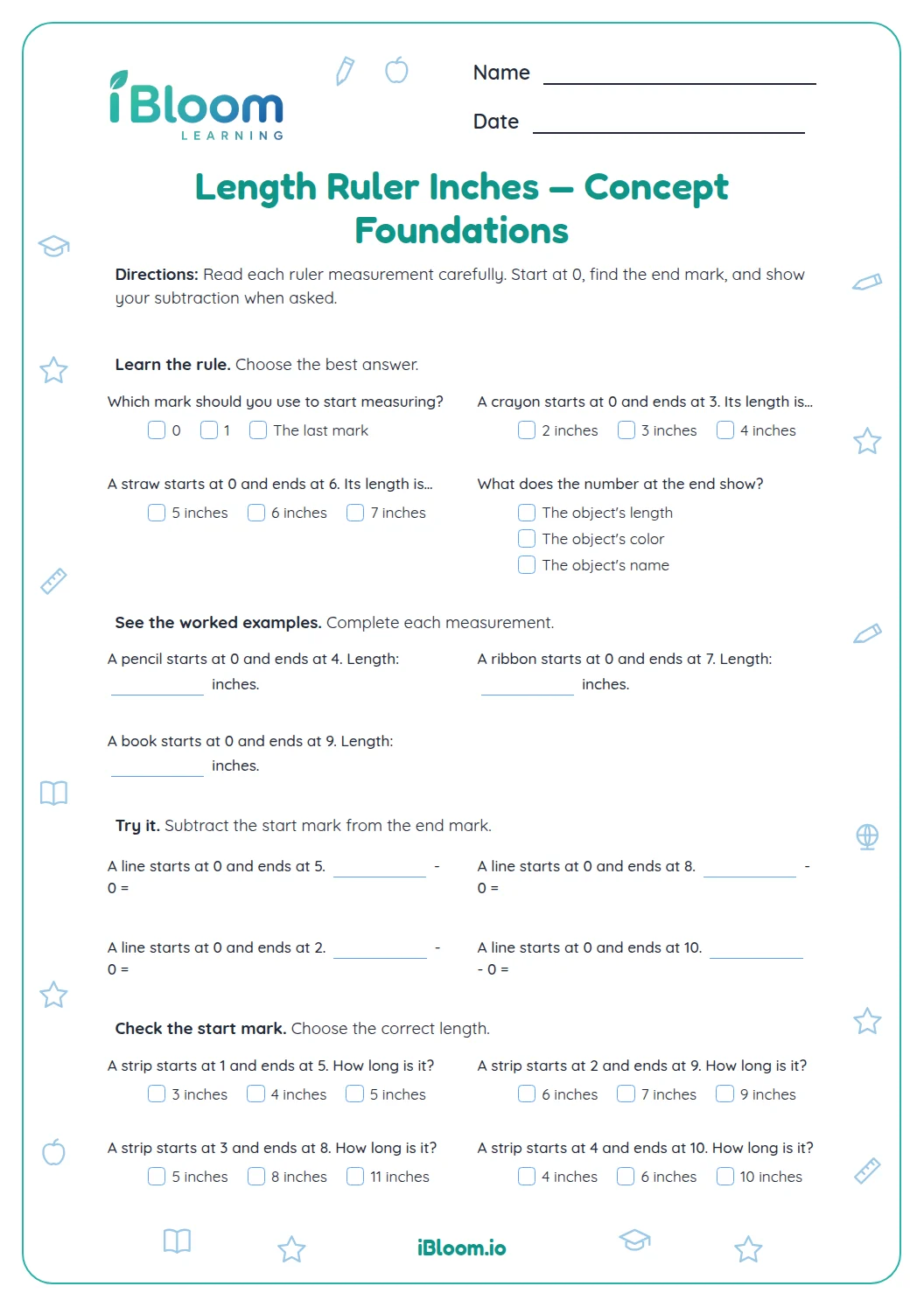
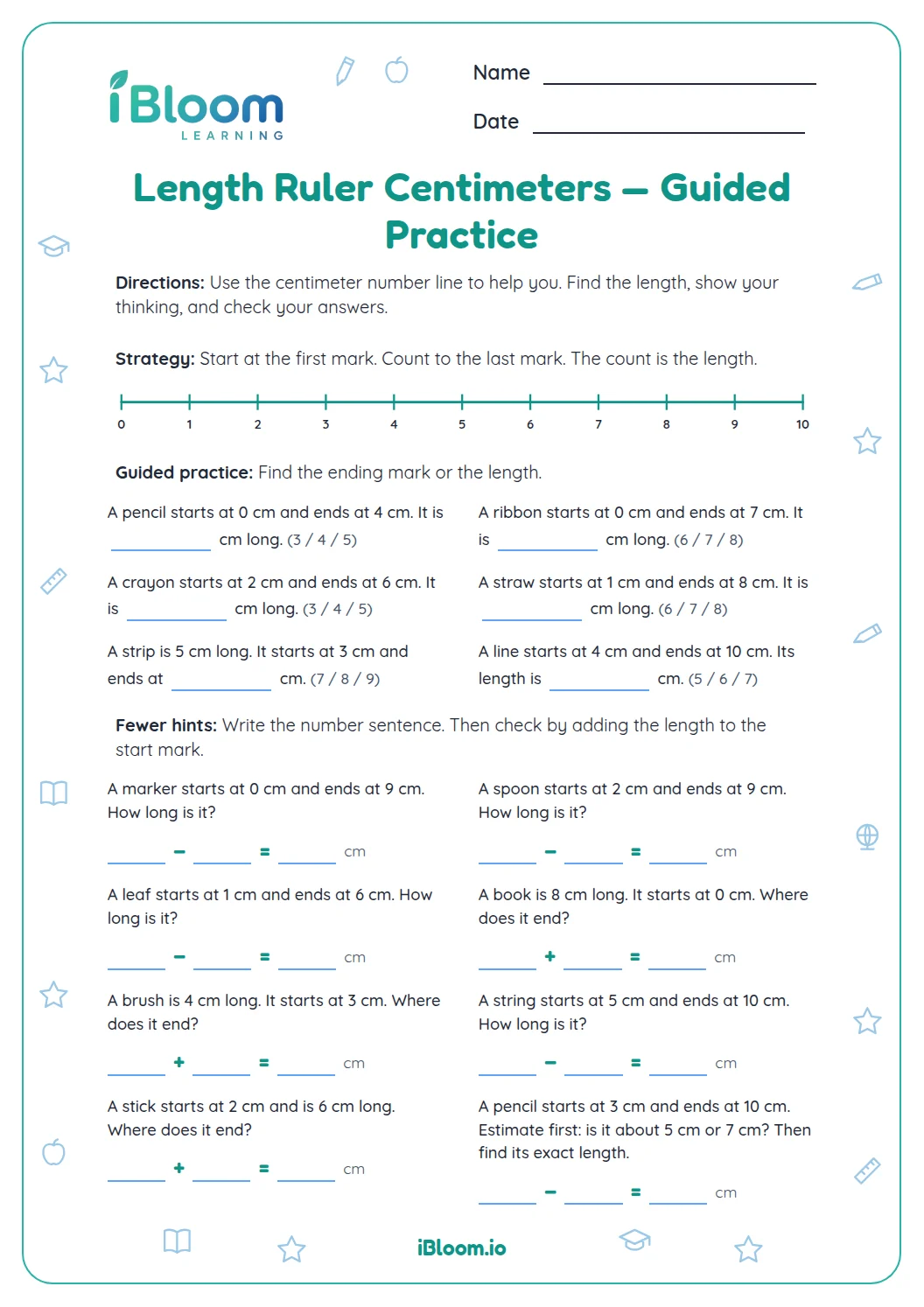
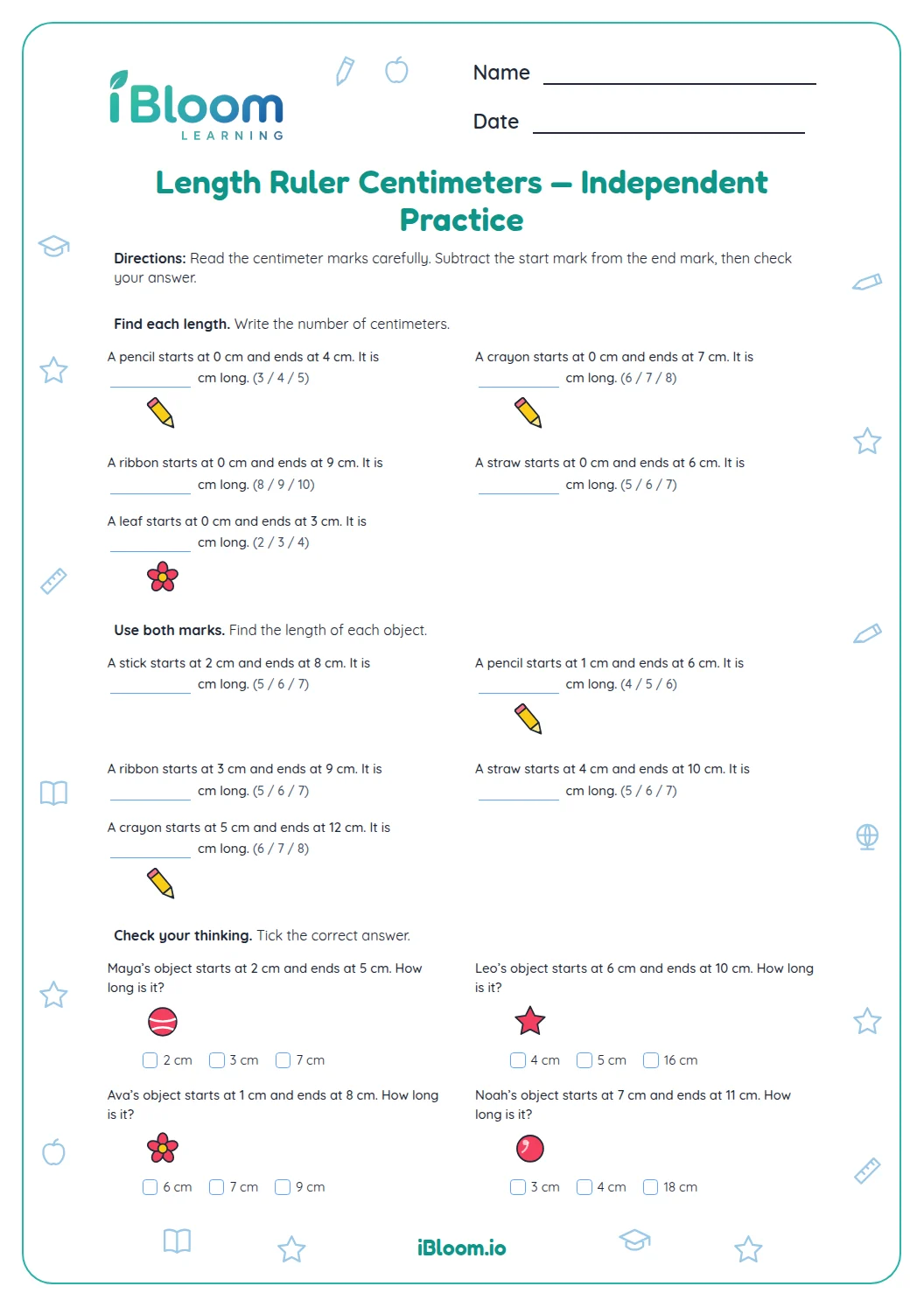
This Grade 1 worksheet starts with four illustrated inch rulers, then gives ten compact addition and subtraction items using inch lengths. Learners read from zero to the endpoint and solve within 20. A separate answer key supports checking; the ruler practice connects to CCSS 1.MD.A.2.
Aligned to 1.MD.A.2
How do you work through measuring objects in inches?
Start at 0 and read the whole-inch mark where each object ends. Read the units and quantities in each prompt, choose the operation or pattern that fits, and check that the answer responds to the question.
- 1The pencil starts at 0 and ends at the 2-inch mark.
- 2Its length is 2 inches.
- Part A: read whole-inch ruler endpoints
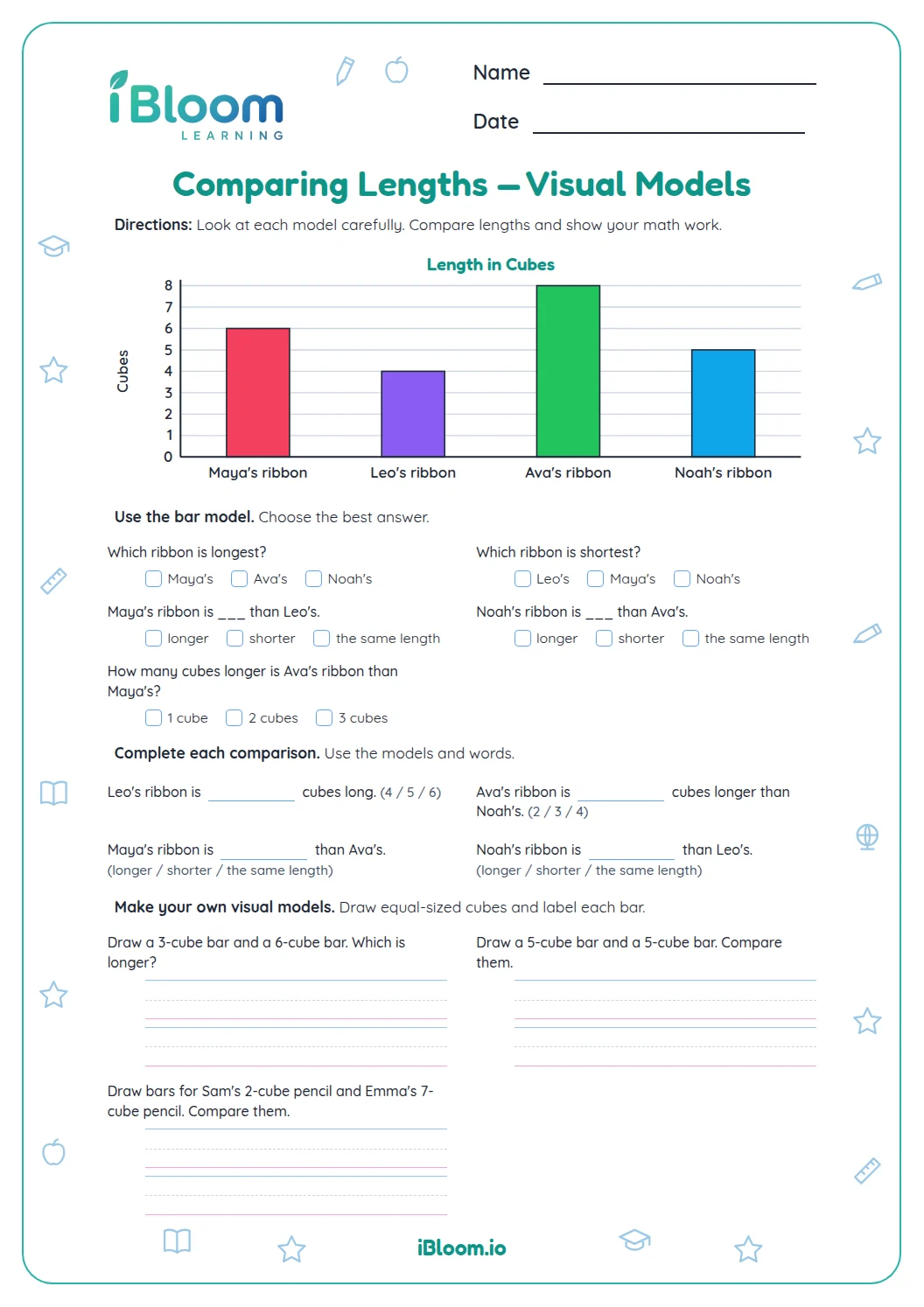
- Part B: compare and combine stated lengths
- Part C: solve short length stories
What does each part practice?
The 15 items move from a direct look at the skill to its use in short situations. Each question has space suited to its response, and the separate key follows the same order.
- Reading the number at the object’s starting point: Line up the ruler’s zero mark with the object start.
- Counting every tick after zero, then adding one: Read the number printed at the endpoint; zero is the starting mark.
- Recording a number without its unit: Write inches as the prompt requests.
How can I use the answer key?
Have the learner finish a part before checking it. For any mismatch, return to the prompt, name the information used, and solve it again with the answer key nearby.
How to use this worksheet
- 1Read the one-sentence direction and the first item together.
- 2Complete Part A and check that each response follows its direction.
- 3Use the same method independently in Part B.
- 4Finish Part C, rereading each prompt before answering.
- 5Check with the key and correct any missed item by showing the step.
Common mistakes and quick fixes
Common Core alignment
This worksheet supports focused practice with a Grade-level Common Core skill.
Start at 0 and read the whole-inch mark where each object ends.
On this sheet: Children read ruler endpoints and reason about whole-inch lengths and combinations.
Show the official wordingHide the official wording
Express the length of an object as a whole number of length units, by laying multiple copies of a shorter object (the length unit) end to end; understand that the length measurement of an object is the number of same-size length units that span it with no gaps or overlaps.
What to practice next
Make more practice
Further reading
Questions parents and teachers ask
How many ruler questions are on the page?
There are 15 questions: five ruler drawings and ten short length situations. Children read whole-inch endpoints, compare lengths, combine lengths, and find what remains after a change. The separate key gives the answer to every item. Five ruler drawings give direct endpoint practice before the length situations.
How should a child read the ruler?
Look for the object’s starting point at zero, then find the inch mark at its other end. The number at that endpoint gives the length. This worksheet uses whole-inch lengths so learners can focus on matching the object to the ruler marks.
Does the worksheet include an answer key?
Yes. The answer key is separate and lists each object’s length in inches. Have the learner finish a group of questions first, then compare the recorded measurements with the key. This gives the learner a concrete way to practice the skill before checking the answer key.
What if the object does not start at zero?
For this worksheet, each object is drawn with its start at zero. That lets a Grade 1 learner read the endpoint directly. On a ruler where an object starts later, compare the two marks and find how far apart they are.
How long will it take?
Plan for about 20 minutes for all 15 ruler readings. You can pause after each group and ask the learner to point to the starting mark and endpoint before writing the length. This gives the learner a concrete way to practice the skill before checking the answer key.