
About this worksheet
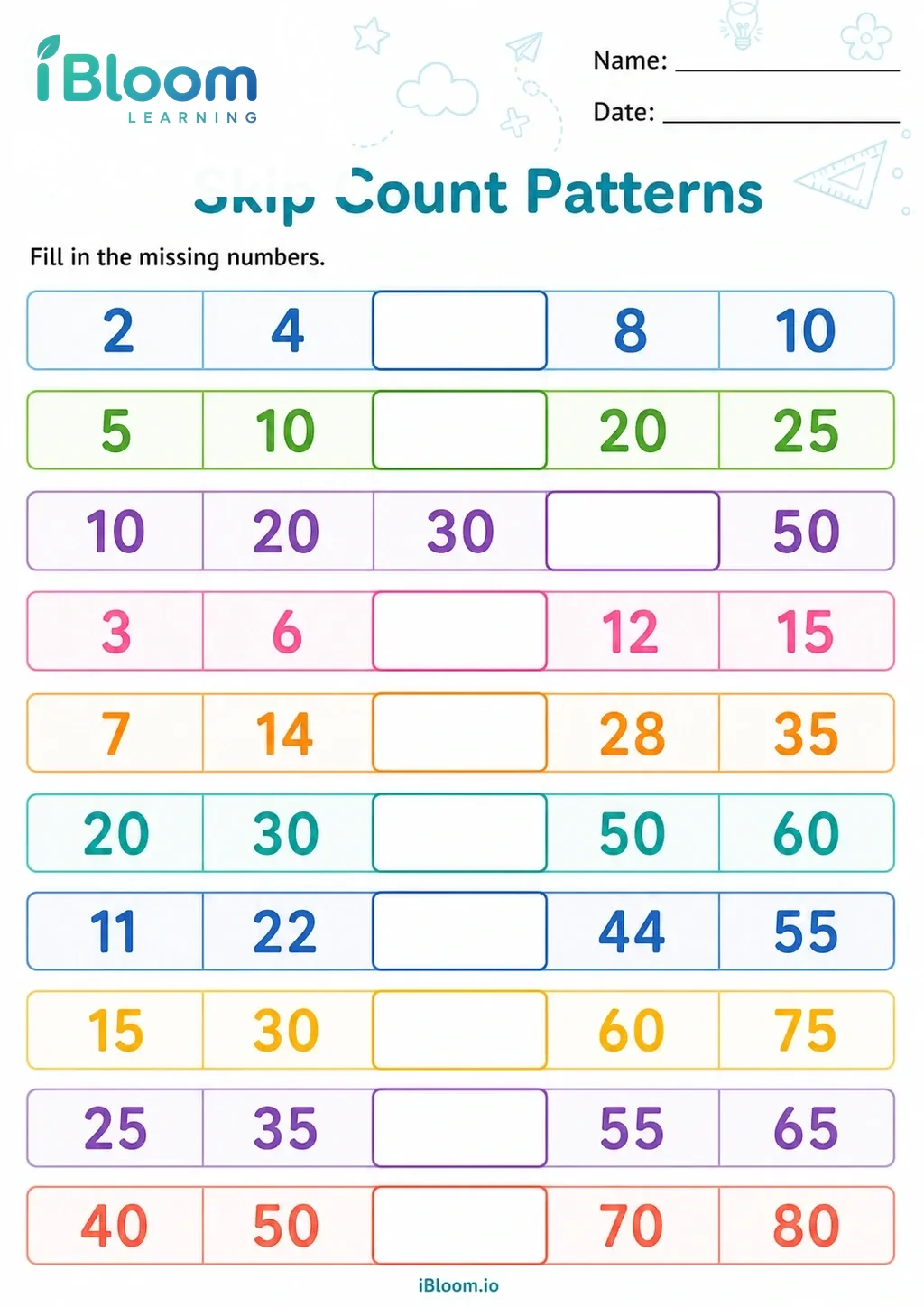
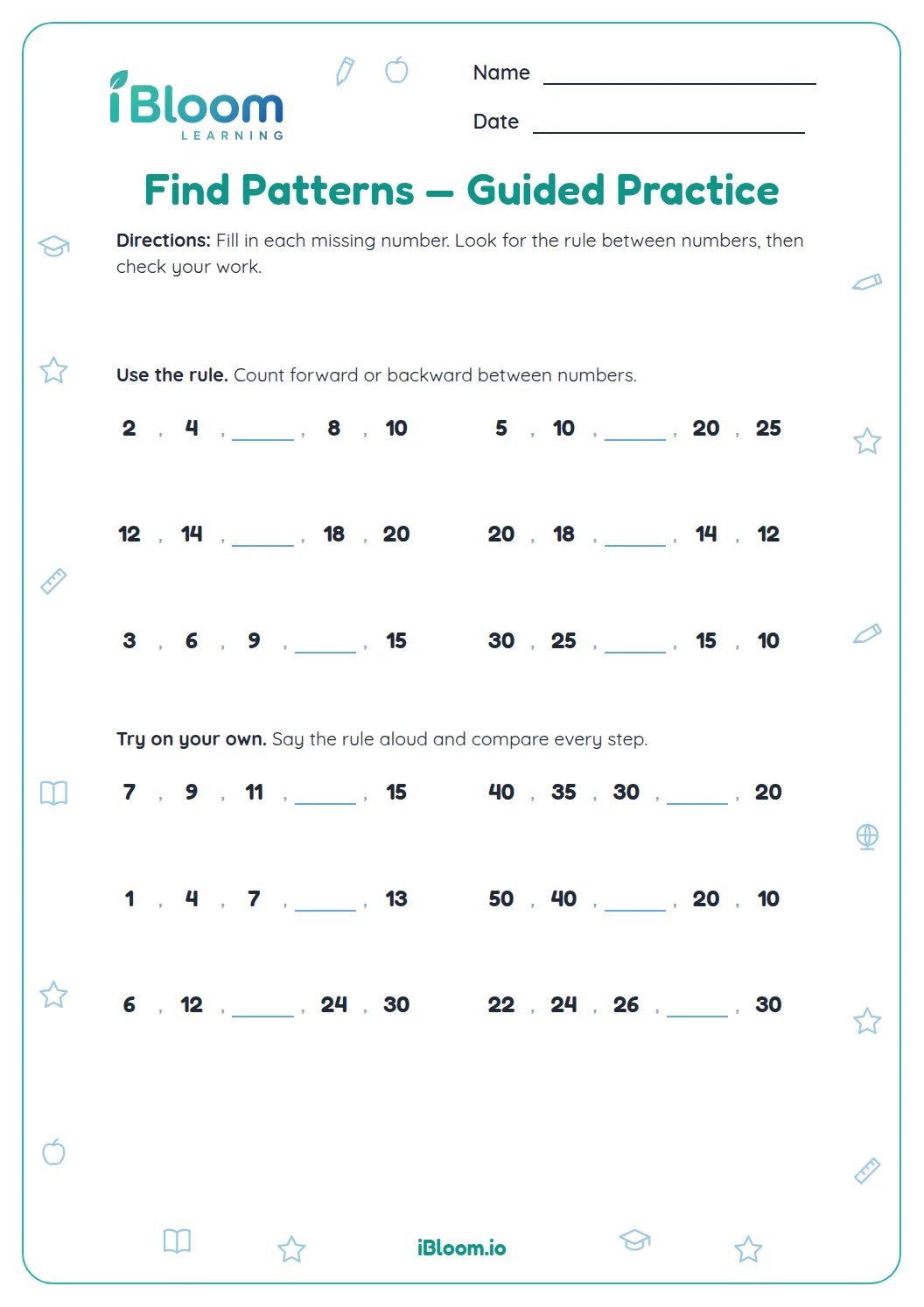
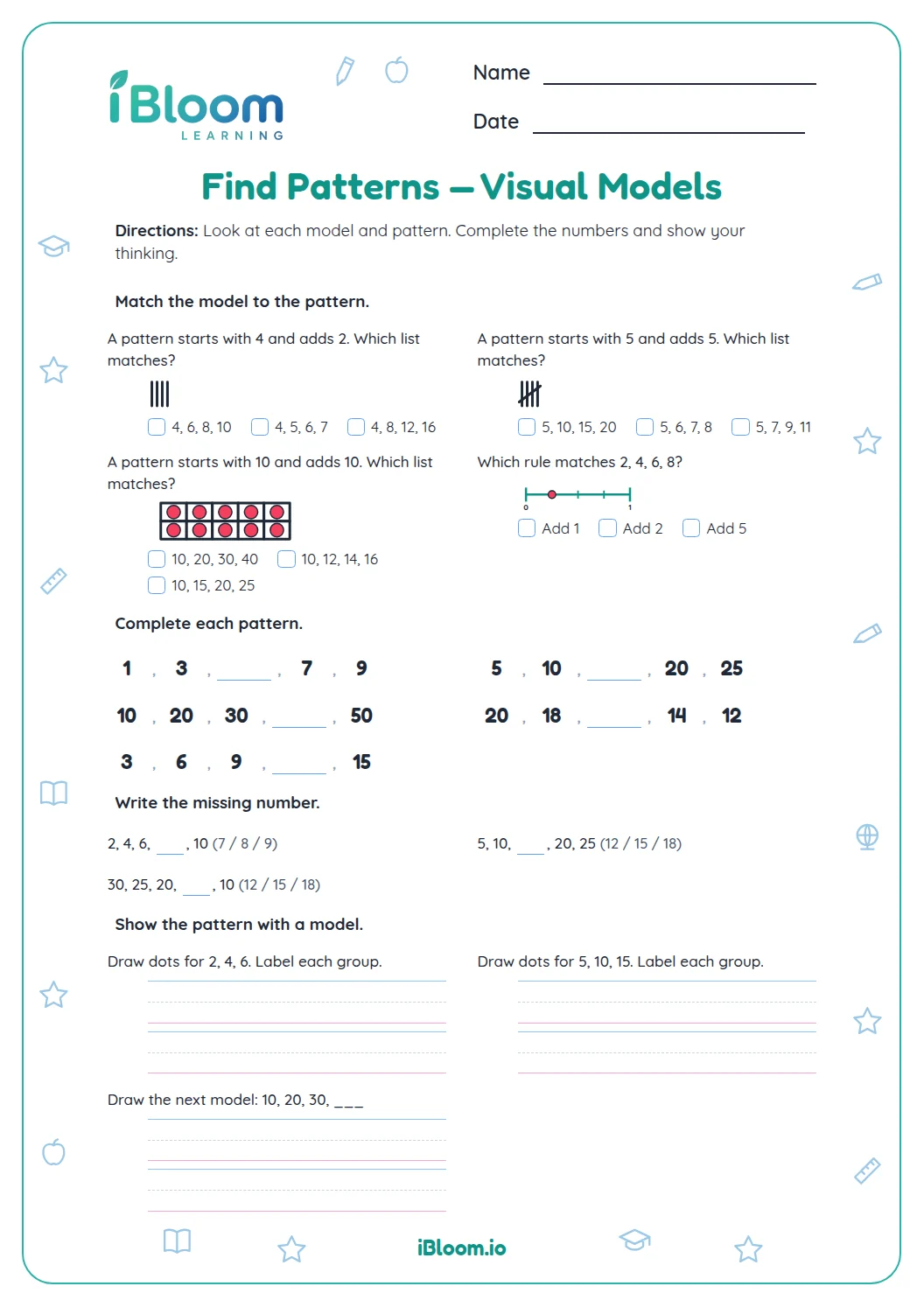
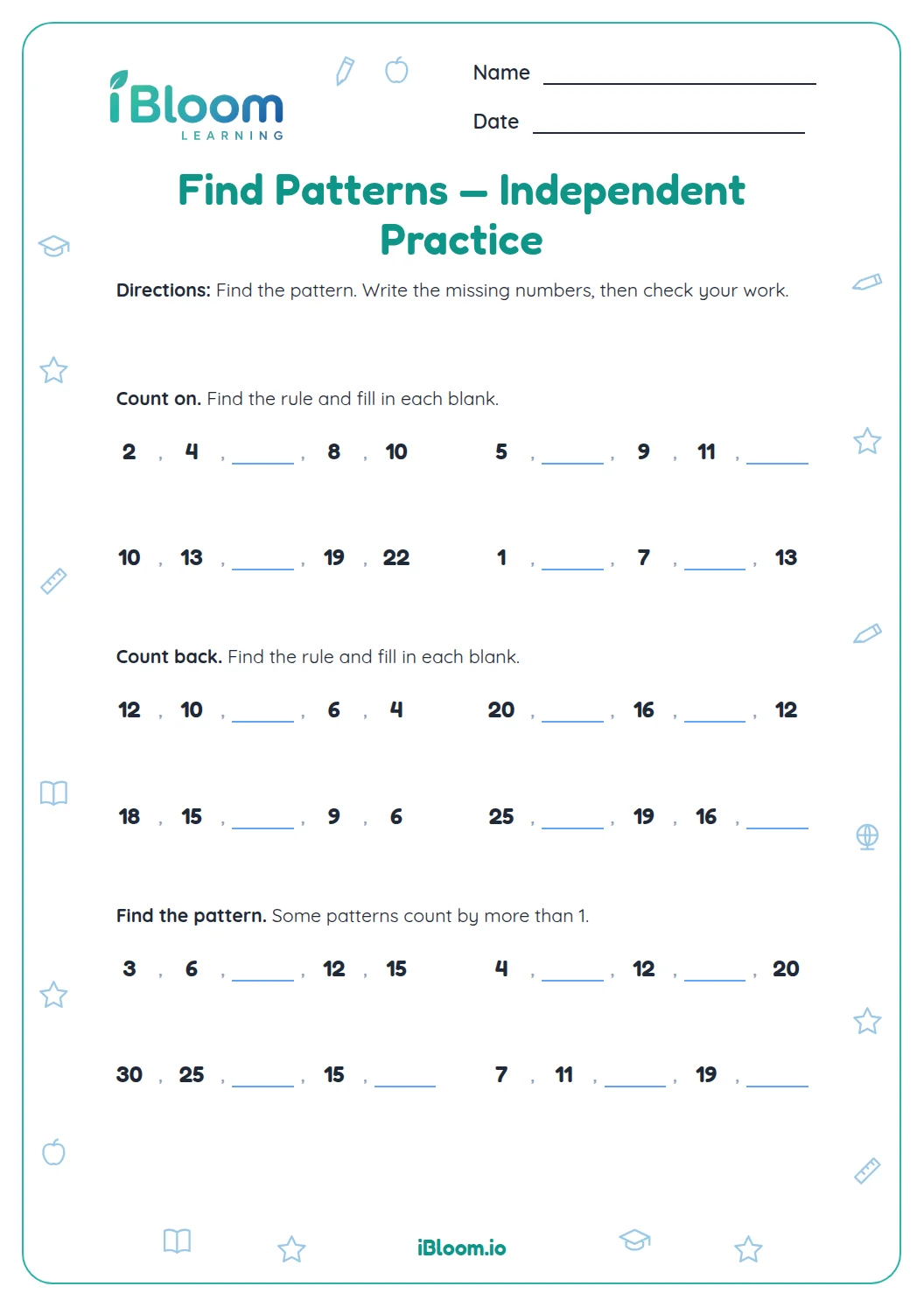
This page gives children repeated chances to spot a steady counting jump. The rows include counting by ones, twos, threes, fours, fives, and tens, with values kept within 120. One number is missing in each row so the child can focus on the pattern.
Aligned to 1.NBT.A.1
How do you find a skip-count pattern?
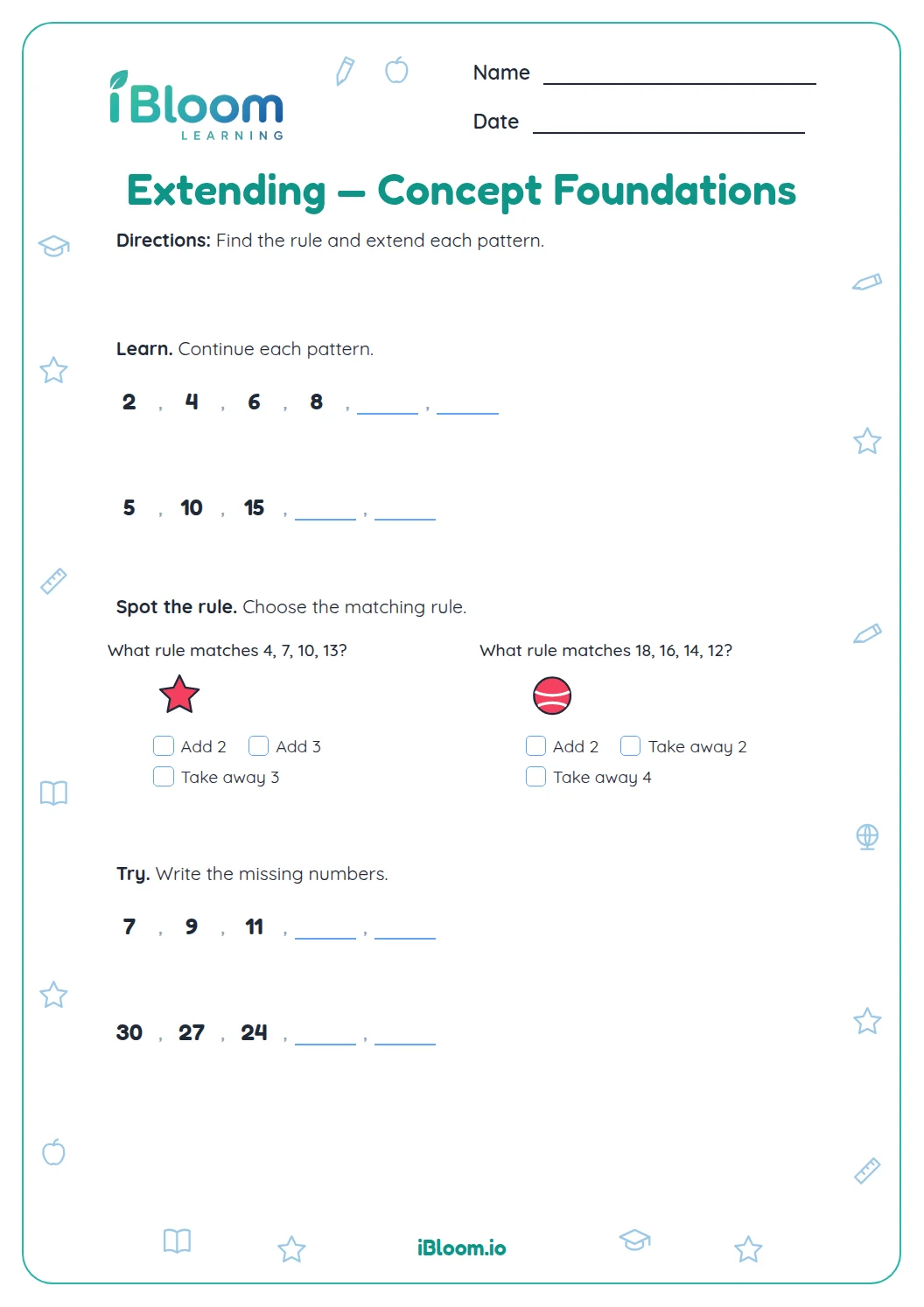
Compare two numbers next to each other. If the numbers go 5, 10, 15, they increase by 5 each time. Add 5 to find the next number: 20.
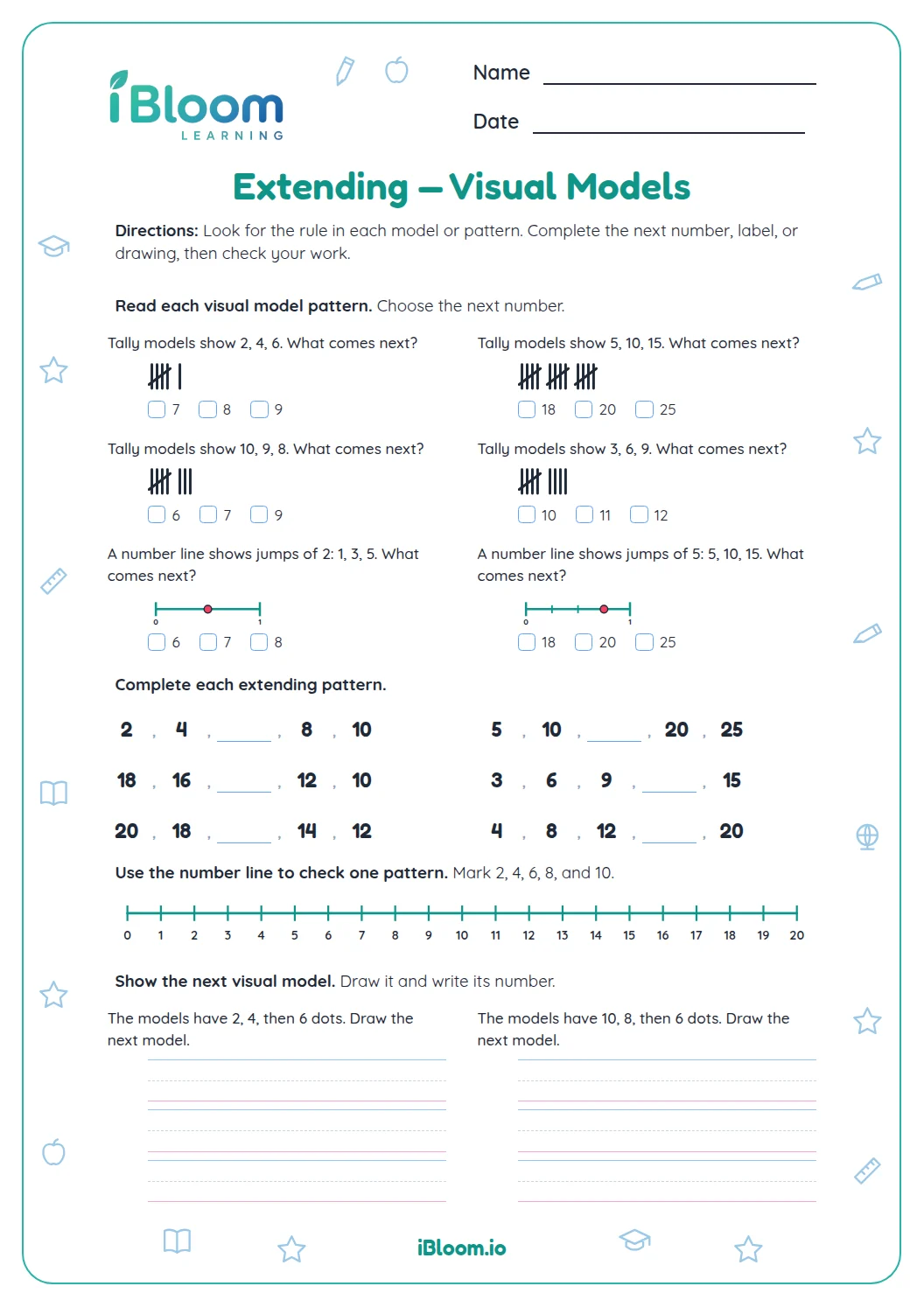
Some patterns begin at a number other than zero. Look at the jump, not just the first number. In 12, 14, 16, 18, the jump is 2.
What is included?
The worksheet has 18 rows, each with one missing number. The patterns use jumps of 1, 2, 3, 4, 5, and 10, and all values remain below 120.
- Part A: complete nine skip-count rows
- Part B: complete nine more rows with mixed counting jumps
- Answer key lists the missing value for each row
How do you find the counting jump?
In question 2, the numbers go 5, 10, 15. They increase by 5 each time, so the missing number is 20.
How to use this worksheet
- 1Compare two neighboring numbers.
- 2Find how much the numbers increase.
- 3Add that same amount to continue the pattern.
- 4Check that the jump stays the same on both sides of the blank.
Common mistakes and quick fixes
The mistake
Adding the first number instead of finding the jump.
The fix
Subtract neighboring numbers to find the amount added each time.
The mistake
Changing the jump halfway through a row.
The fix
Check that the same amount connects each pair.
The mistake
Counting from zero when the pattern starts elsewhere.
The fix
Use the first two given numbers to find the jump.
Common Core alignment
This worksheet practices the listed Common Core skill at the stated grade.
Count to 120, starting at any number less than 120.
On this sheet: The patterns extend forward from varied starting points and practice counting by ones and equal groups within 120.
Show the official wordingHide the official wording
Count to 120, starting at any number less than 120. In this range, read and write numerals and represent a number of objects with a written numeral.
What to practice next
Make more practice
Further reading
Questions parents and teachers ask
How can a child find the jump in a number pattern?
Compare two numbers next to each other and find their difference. In 5, 10, 15, each number is 5 more than the one before it. Keep adding 5 to find the missing number, then check the same jump on the other side.
Which skip-counting jumps appear on this page?
The 18 rows use jumps of 1, 2, 3, 4, 5, and 10. Children see several starting numbers, so they have to notice the amount between terms instead of assuming each sequence starts at zero. Every jump appears in the practice.
Are the numbers within Grade 1 counting range?
Yes. Every number on the sheet is below 120, and the questions ask students to continue a forward counting pattern. The page practices finding a repeated counting jump and writing the missing numeral. The key confirms the expected numeral for every blank on the sheet.
Does the answer key list each missing number?
Yes. The separate answer key gives the missing value for all 18 rows. A parent can compare the child’s number with the key and ask them to point out the repeated jump in that row. It is printed in green beside each row in the answer-key pages.
Why do some rows start above zero?
A skip-counting pattern can begin at different numbers and keep the same jump. Looking at two neighboring terms reveals the rule. For example, 22, 24, 26 continues by adding 2 even though the row does not begin at zero. in this example.