


About this worksheet
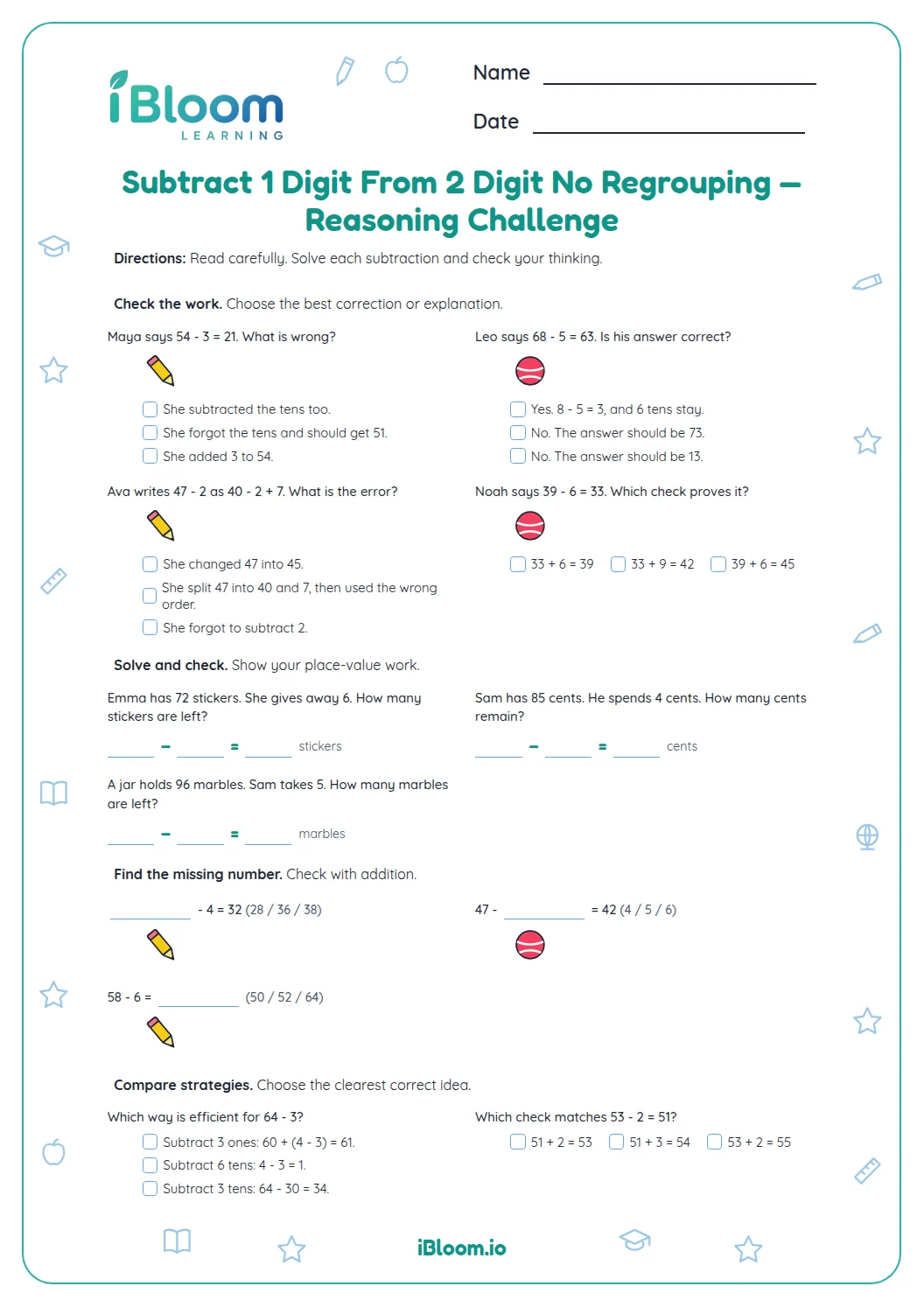
This free printable worksheet gives Grade 1 students 16 problems focused on two-digit minus one-digit stories and equations. The practice moves from guided questions to independent work, and the answer key shows the answer to each item. The questions use grade-appropriate numbers and clear equations so students can focus on the named skill.
What will students practice?
The worksheet has 2 parts, arranged from guided practice to independent problems. The questions vary the numbers and formats while staying with two-digit minus one-digit stories and equations.
The old page used repeated stories and included 32 − 4, which required regrouping. The replacement varies the situations, corrects that item, and adds eight equations.
How can a student check an answer?
Use the equation in the question to check the missing value. For example, 34 − 2 = 32; 4 ones minus 2 ones leaves 2 ones, and the 3 tens stay. | Check: 32 + 2 = 34.
- 134 − 2 = 32; 4 ones minus 2 ones leaves 2 ones, and the 3 tens stay.
- 2Check: 32 + 2 = 34.
What should students notice?
Read the whole equation before choosing an operation. In subtraction, check the ones first; for a no-regrouping problem, the ones being taken away must fit within the ones shown. Then check the result with addition.
How to use this worksheet
- 1Read what the story starts with.
- 2Circle the amount taken away.
- 3Write a subtraction equation.
- 4Subtract the ones and keep the tens.
- 5Check by adding the amount taken away back.
Common mistakes and quick fixes
The mistake
Subtracting the smaller digit from the larger one in the wrong place.
The fix
Line up the story numbers and subtract the amount taken from the starting amount.
The mistake
Forgetting what the answer counts.
The fix
Name the object after the number, such as 32 crayons.
The mistake
Changing a ten when none is needed.
The fix
Check the ones first; in 34 − 2, four ones are enough to take away two.
What to practice next
Make more practice
Further reading
Questions parents and teachers ask
What does no regrouping mean here?
No regrouping means the ones digit in the number being subtracted is no larger than the ones digit in the starting number. For example, 34 − 2 works with the 4 ones already there. Every number sentence on this page follows that rule.
How many questions are on the worksheet?
There are 16 questions across the worksheet: eight short real-world stories and eight subtraction equations. The stories use distinct settings, and each one asks for a single amount left after some are taken away. Ask the student to point to the numbers in the equation and explain what each one represents before calculating. This keeps the work connected to the question.
What should my child write for a story problem?
Have your child write a subtraction equation and then answer the story in a short phrase. For Lena’s crayons, 34 − 2 = 32, so 32 crayons remain. The answer key gives the number; students can include the object name in their written response.
Can students use a drawing to solve?
Yes. A quick tens-and-ones sketch can help students see the starting amount and cross out the ones taken away. The numbers were chosen so the child can cross out ones without trading a ten. Ask the student to point to the numbers in the equation and explain what each one represents before calculating. This keeps the work connected to the question.
Is there an answer key?
Yes. A separate two-page key lists the result for each story and equation. For the story questions, check both the subtraction and whether the answer matches the object named in the problem. Ask the student to point to the numbers in the equation and explain what each one represents before calculating. This keeps the work connected to the question.