




About this worksheet
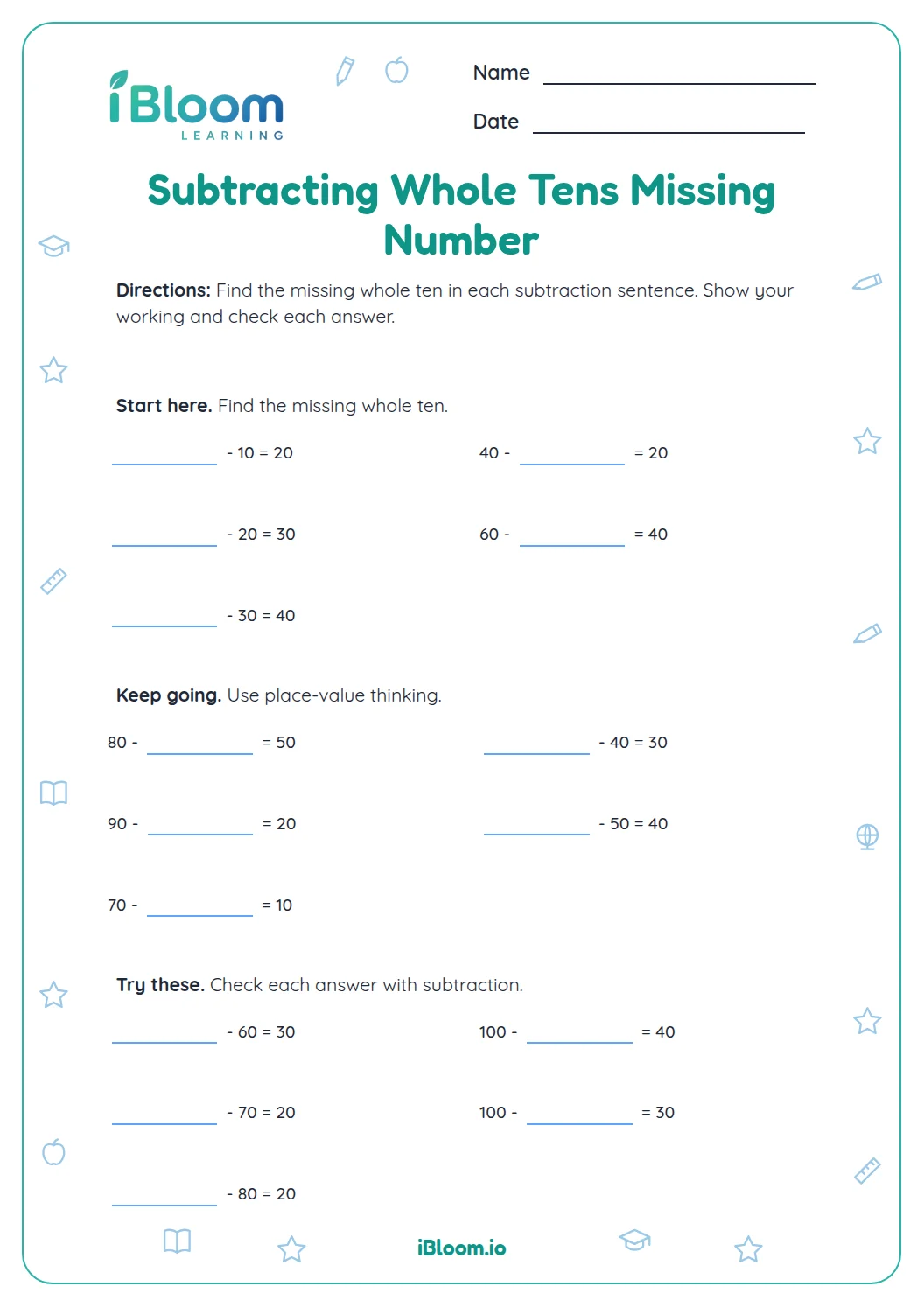
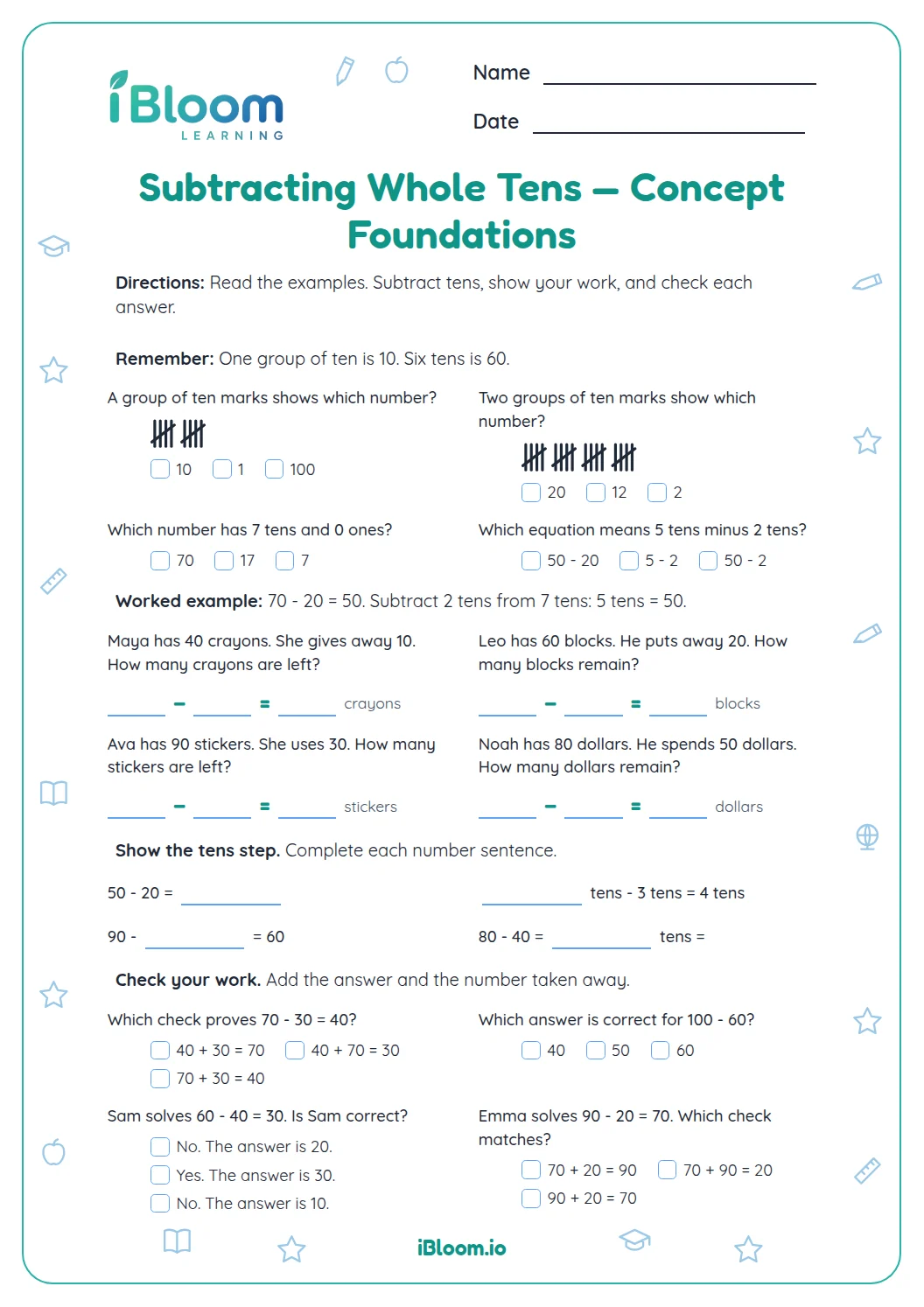
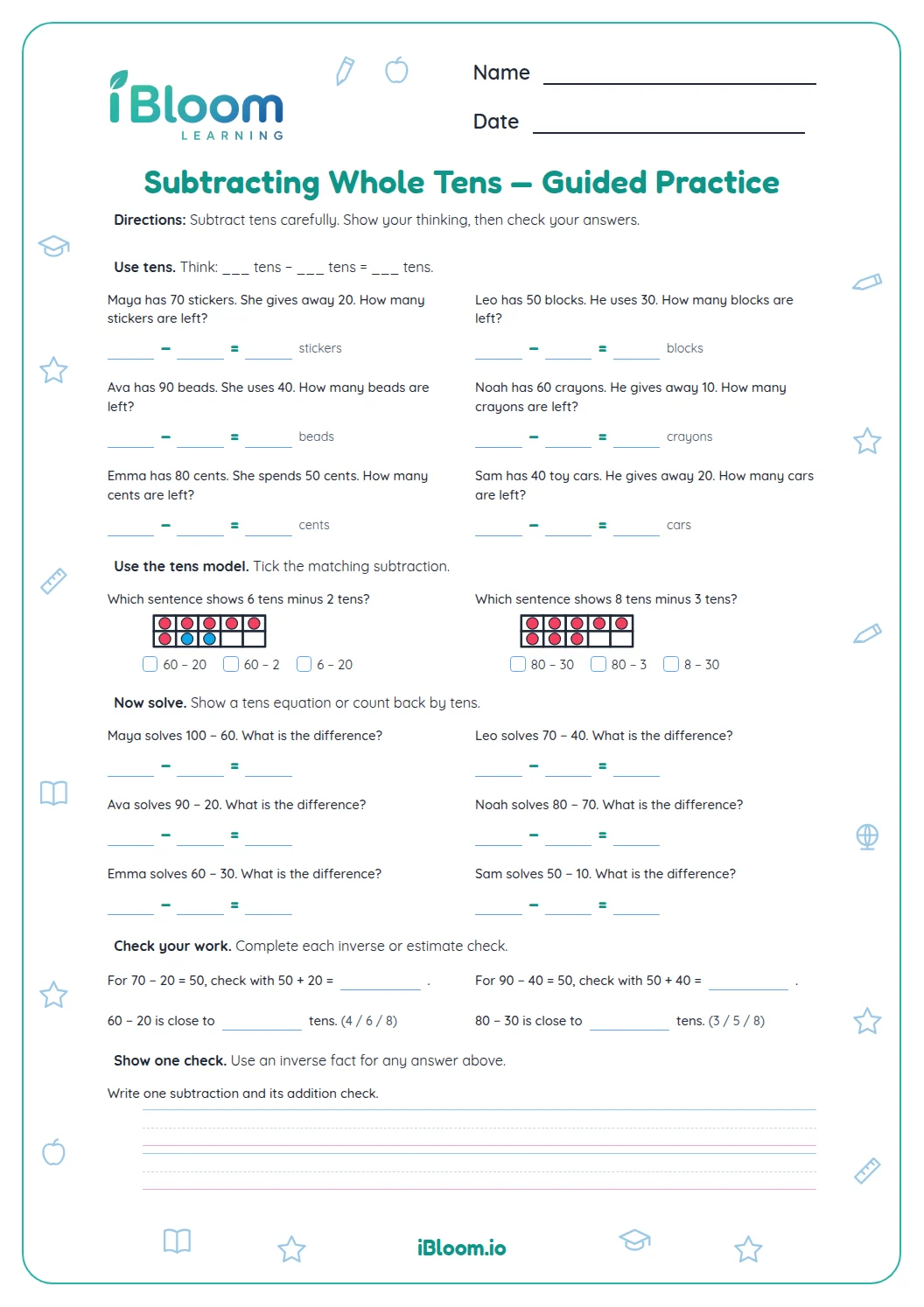
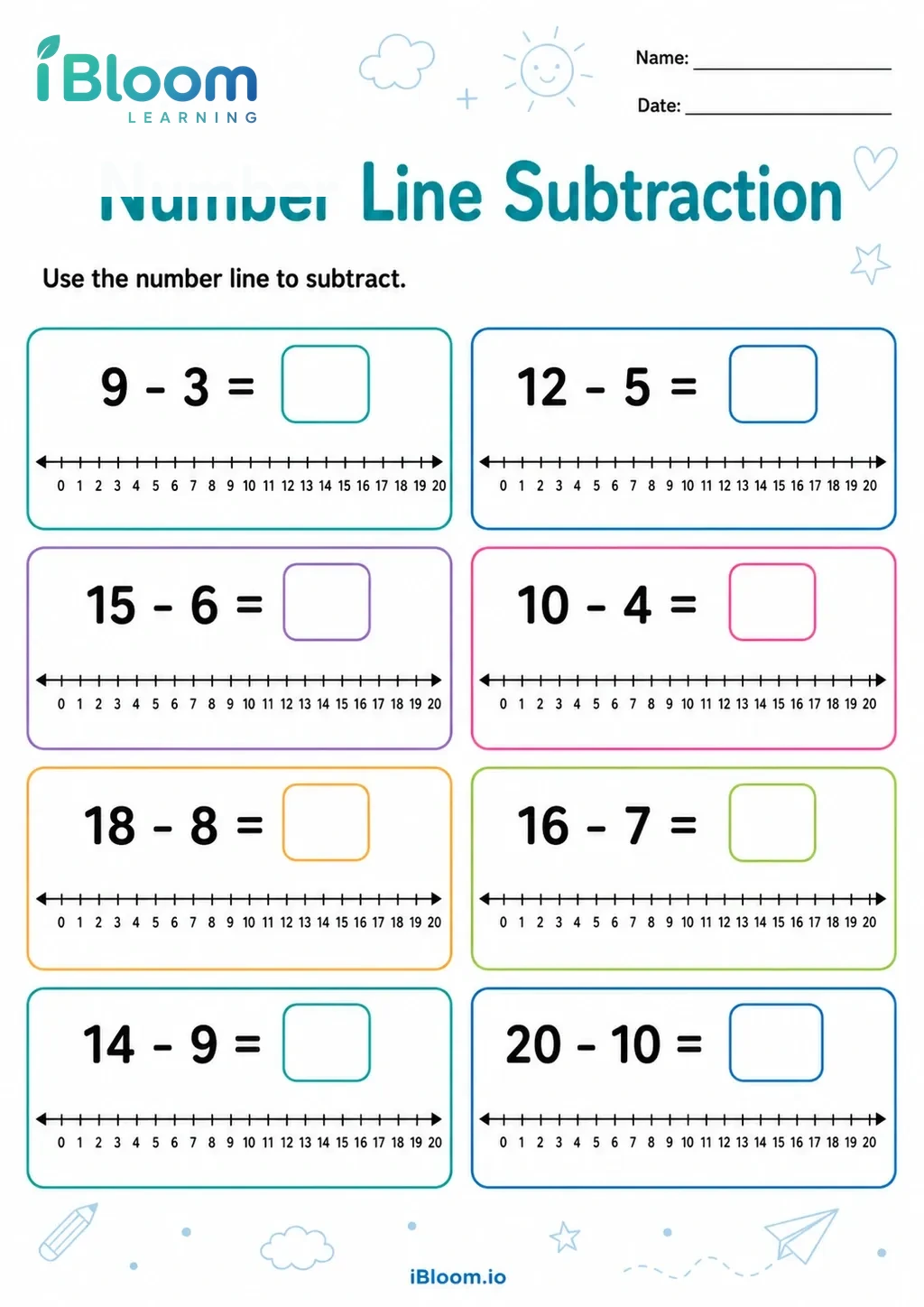
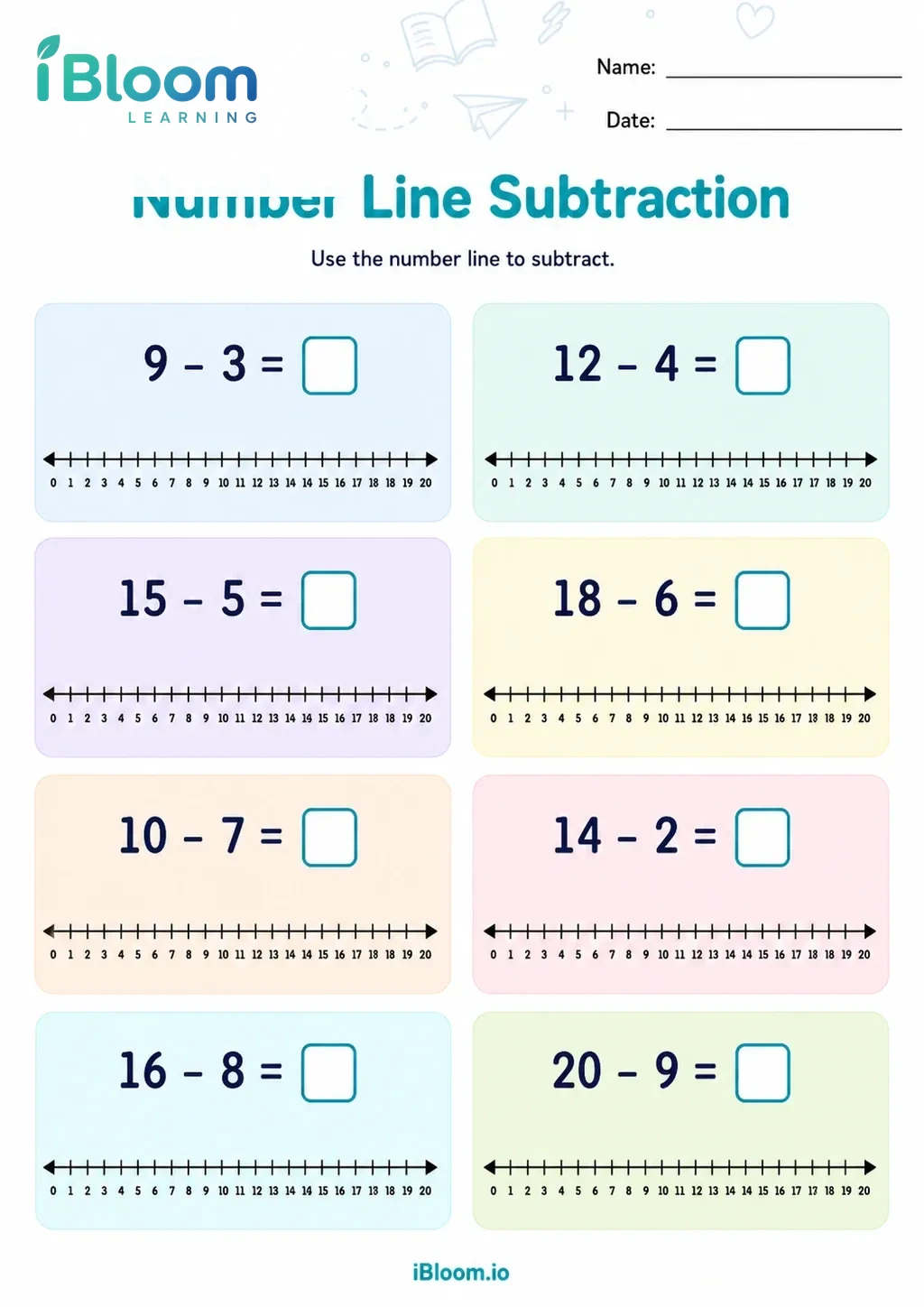
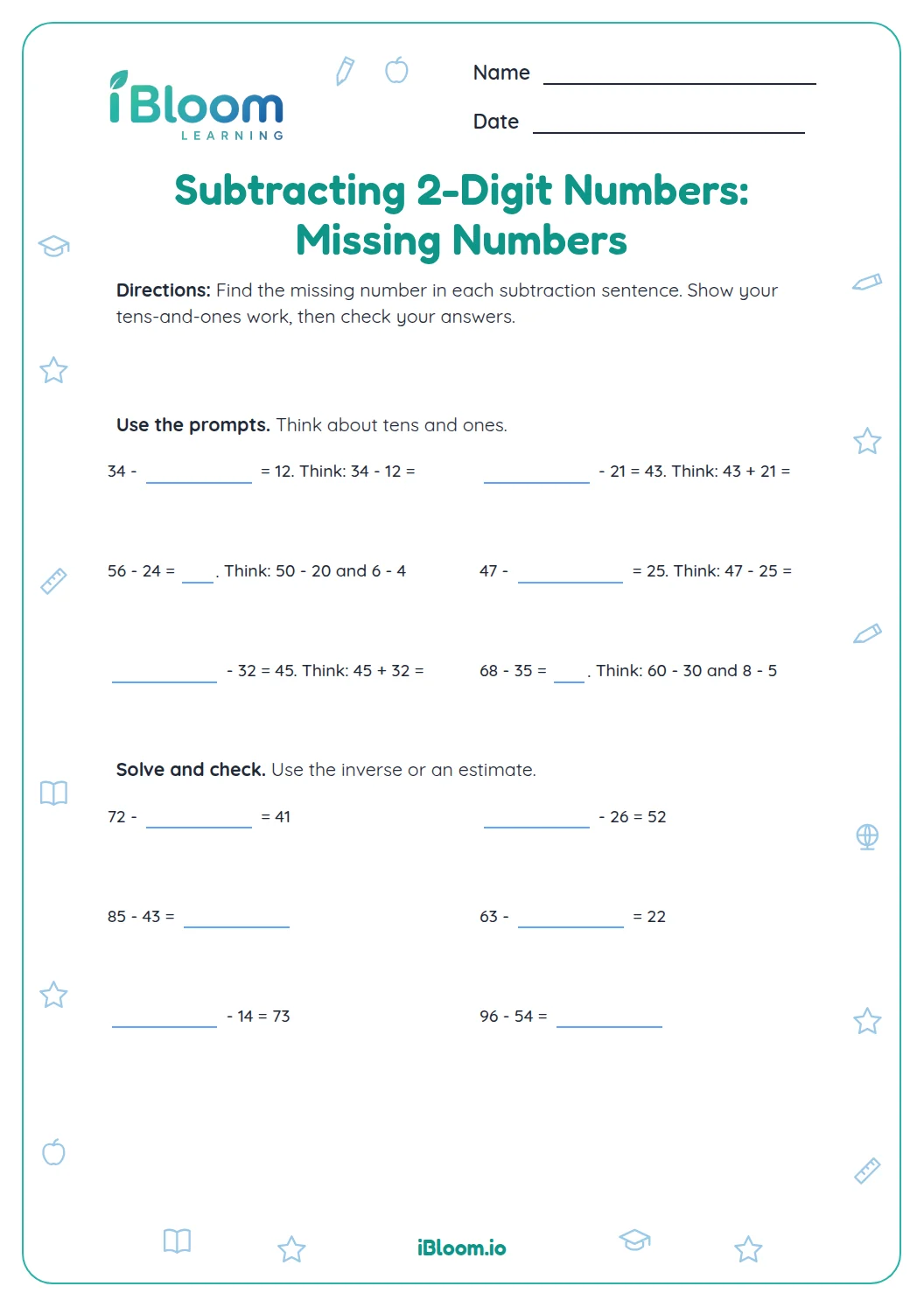
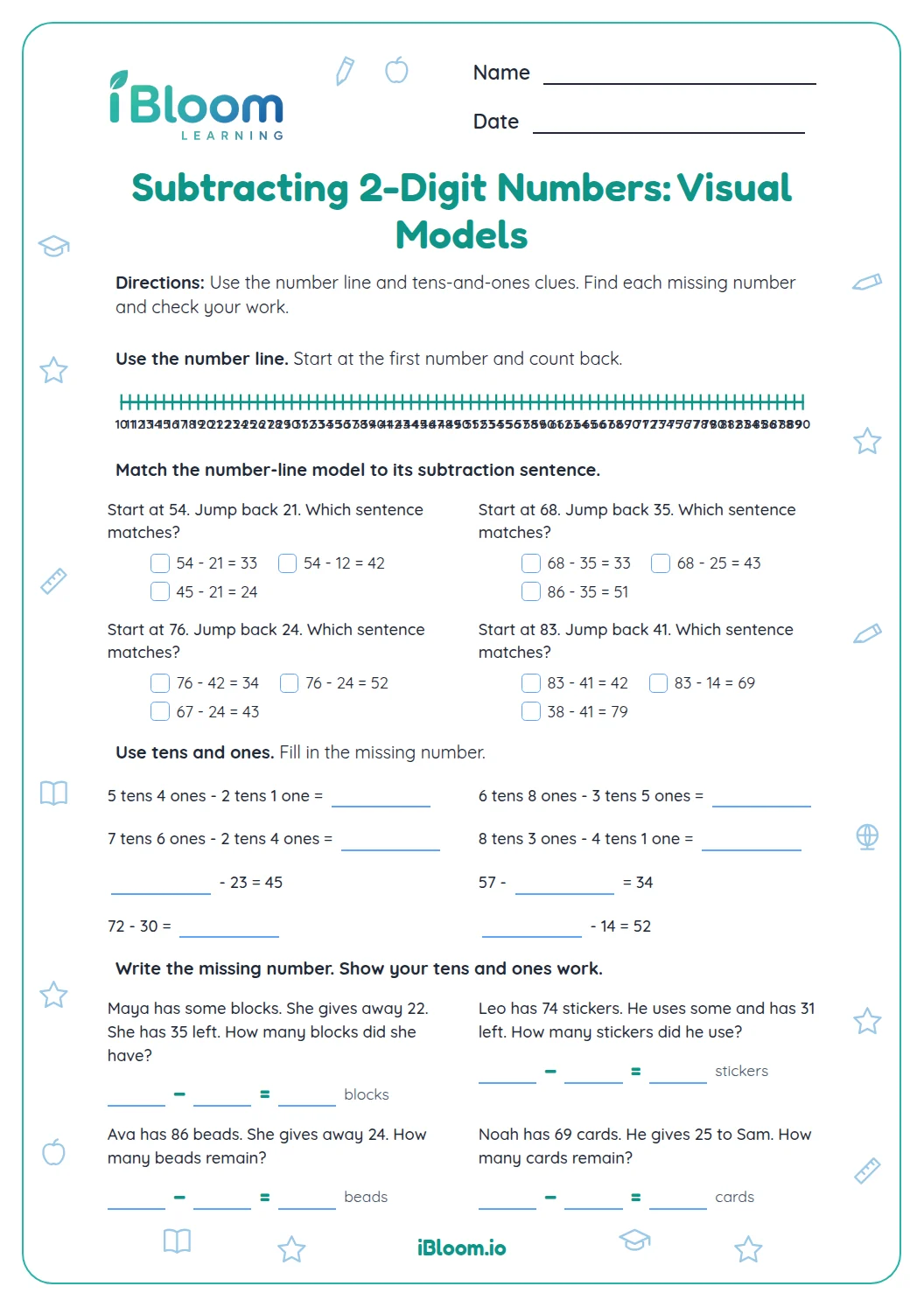
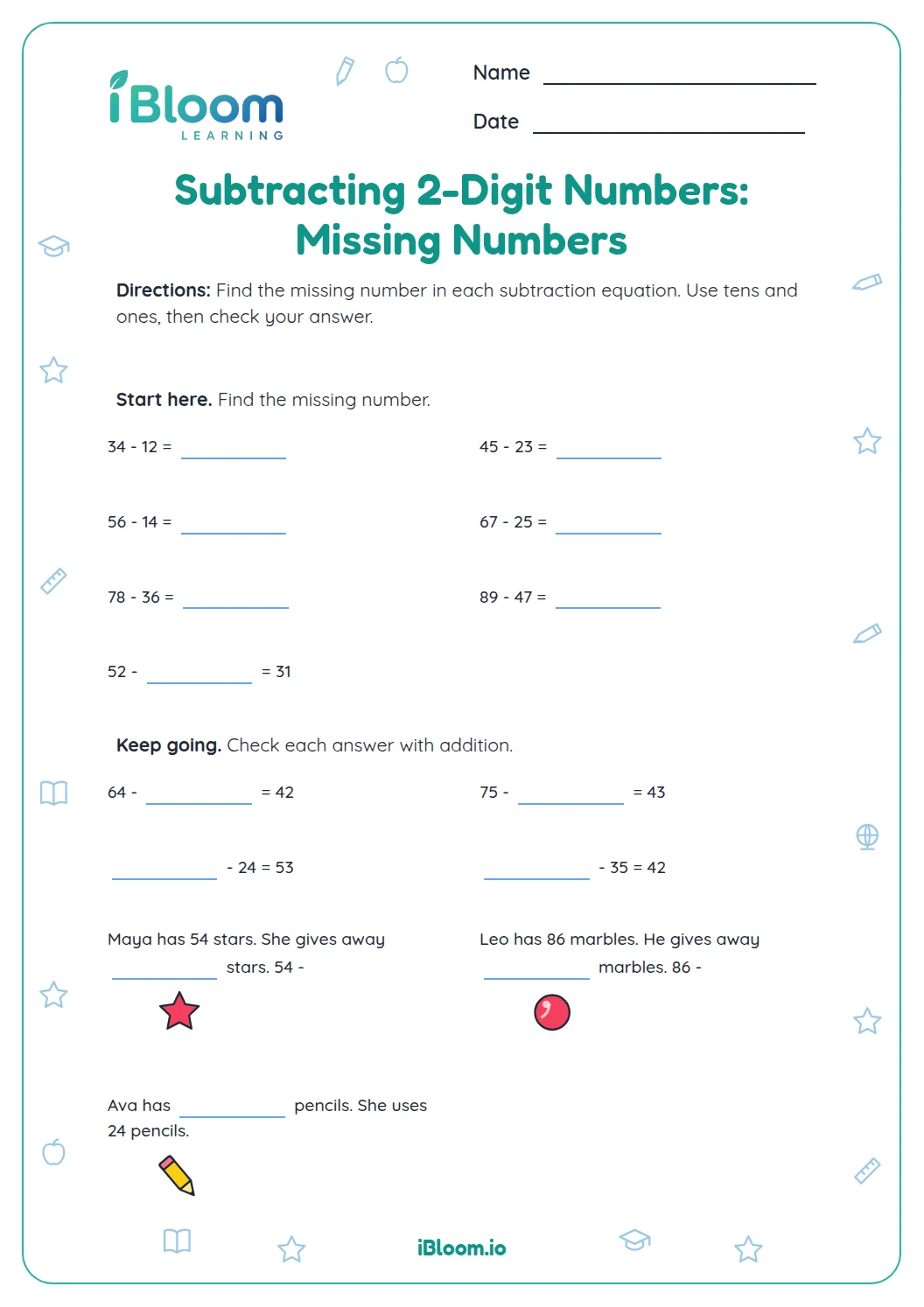
This free printable Grade 1 worksheet gives students practice finding a missing number in subtraction equations with multiples of ten. Number lines marked by tens accompany selected items; the equations move the blank among the starting number, the amount subtracted, and the difference. It practices Common Core 1.NBT.C.6 and includes a separate answer key.
Aligned to 1.NBT.C.6
What is the key idea?
A whole ten is one group of ten. On the number line, count by tens to compare the starting amount, the amount taken away, and what remains.
How does one problem work?
For 40 − ___ = 20, count back from 40 to 20 by tens: 30, then 20. That is two jumps, or 20, so the missing number is 20.
- 140 − ___ = 20
- 2Count back two jumps of 10: 40, 30, 20.
- 3Two tens were taken away.
- 4The missing number is 20.
What is on the worksheet?
There are 15 equations in three parts. Number lines are printed for questions 1–8; the remaining questions give students a chance to use the same whole-tens reasoning without a model beside each equation.
How can I use the sheet?
- 1Read the subtraction equation from left to right.
- 2Find the starting amount and the amount that remains.
- 3Count by tens to find how much was taken away, if needed.
- 4For a missing starting amount, add back the known tens.
- 5Substitute the missing value to check the equation.
Common mistakes and quick fixes
The mistake
Counting individual ones instead of tens.
The fix
Count each jump as 10.
The mistake
Subtracting the difference from the amount taken away.
The fix
Use starting amount minus amount taken away equals difference.
The mistake
Forgetting to find the starting amount when it is blank.
The fix
Add the amount taken away to the difference.
Common Core alignment
This worksheet practices the standard below.
Subtract multiples of 10 within 100 using place value and related strategies.
On this sheet: Subtract multiples of 10 within 100 using place value and related strategies.
Show the official wordingHide the official wording
Subtract multiples of 10 in the range 10-90 from multiples of 10 in the range 10-90 (positive or zero differences), using concrete models or drawings and strategies based on place value, properties of operations, and/or the relationship between addition and subtraction; relate the strategy to a written method and explain the reasoning used.
What to practice next
Make more practice
Further reading
Questions parents and teachers ask
What does a base-ten model show?
Each number line is marked in tens, so a jump represents 10. Students can count forward or backward between the values in the equation to see how many tens are involved. A number line is printed beside the first eight questions.
How do children solve 70 − ___ = 30?
For 70 − ___ = 30, count back from 70 to 30: 60, 50, 40, 30. Four jumps are 40, so the missing number is 40. Check: 70 − 40 = 30. The four jumps represent four groups of ten.
Why does the blank move in the equations?
The blank appears in different places so students find a missing starting number, amount subtracted, or difference. Each type can be checked by substituting the value into the equation. Check the equation by putting the answer back in the blank.
How many questions are included?
There are 15 questions in three parts. The first eight have a number line printed with the equation; the remaining seven continue the same whole-tens subtraction practice in equation form. The rest of the questions use equations without a nearby number line.
What numbers are used?
All values are multiples of ten from 10 to 100, and the differences are zero or greater. The number lines use ten-unit steps, matching the size of each quantity in the equations. Every value can be named as a number of tens.