



About this worksheet
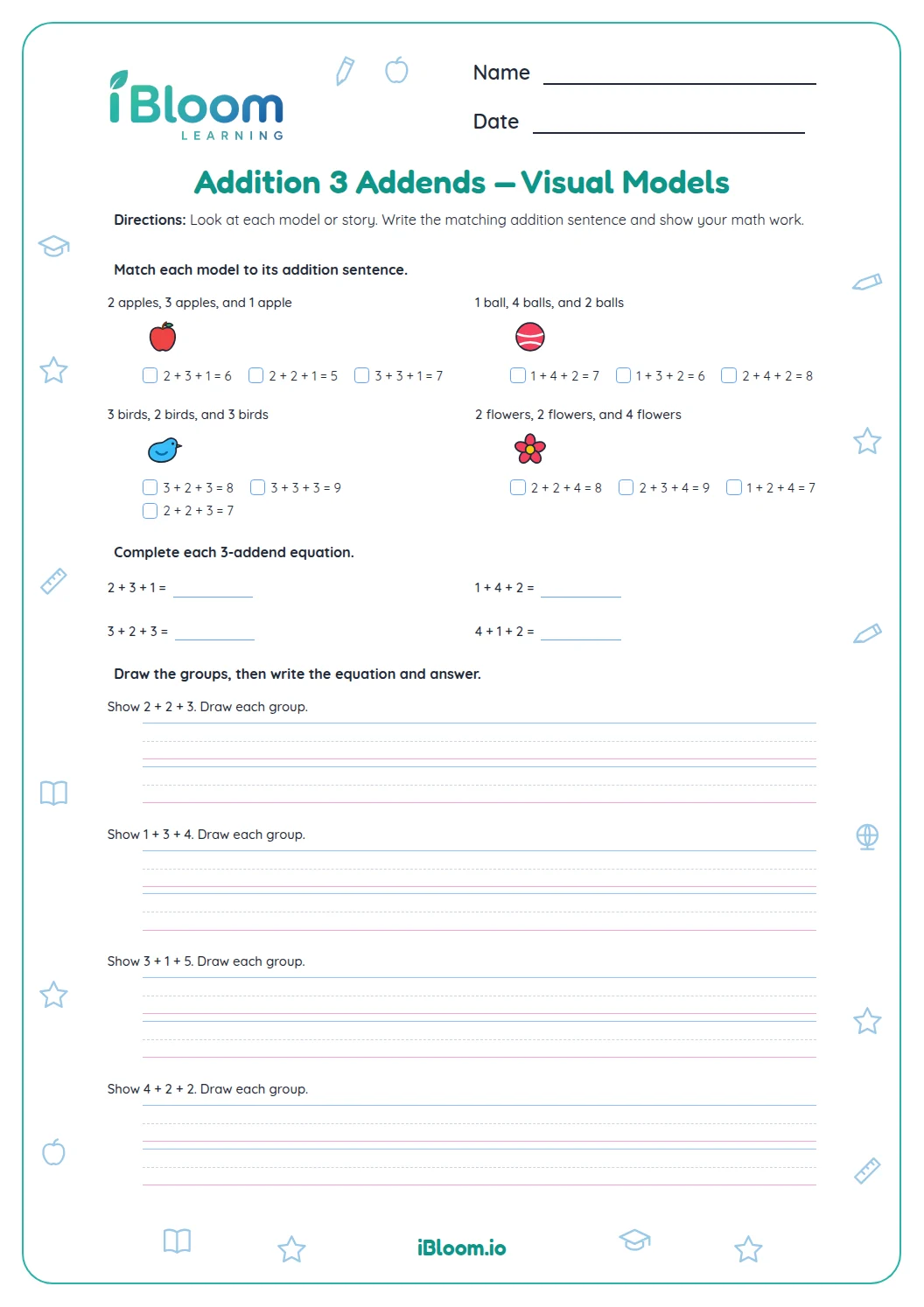
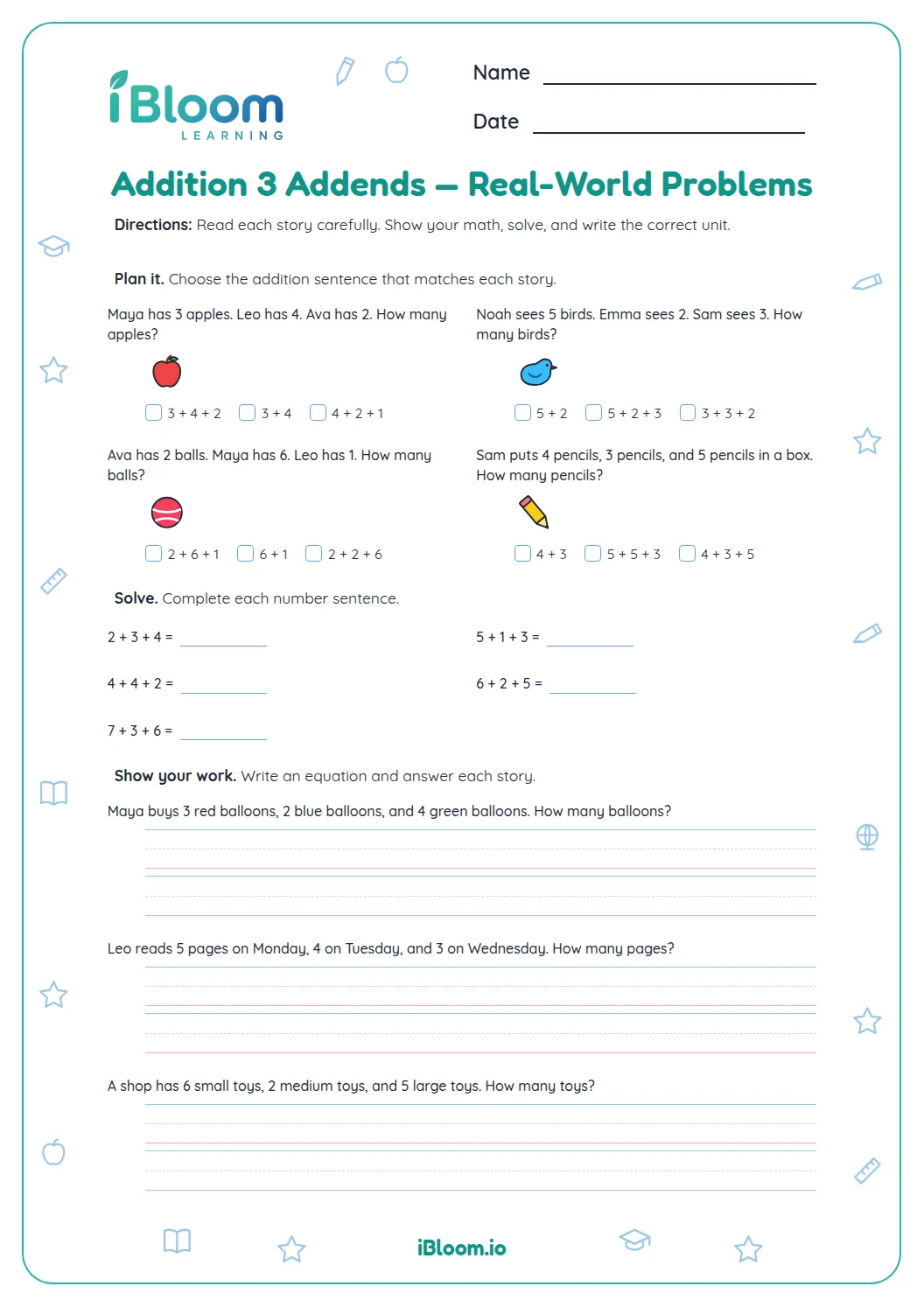
This printable is for Grade 1 students practicing addition word problems with three addends. Children combine groups, spot a sum that needs correcting, choose pairs that make ten, and solve short stories with working space. The questions keep totals within 20 and build the habit of checking each sum. It aligns with CCSS 1.OA.A.1, with a separate answer key.
Aligned to 1.OA.A.1
What does adding three groups look like?
Each addend names one group. A number sentence keeps all three groups visible before combining them.
For question 1, write 4 + 3 + 2. Combine 4 + 3 = 7, then 7 + 2 = 9 beads.
- 14 + 3 + 2
- 24 + 3 = 7
- 37 + 2 = 9 beads
How can making ten make a sum easier?
Find two addends that make ten, then add the third. In 3 + 7 + 4, use 3 + 7 = 10, followed by 10 + 4 = 14.
What practice is included?
The 16 items move from short stories to make-ten choices, number sentences, and word problems with space to work. A separate key lists each result.
What is included on the the worksheet?
The 16 items move from short stories to make-ten choices, number sentences, and word problems with space to work. A separate key lists each result.
How can I use this worksheet?
- 1Read each story and list all three groups.
- 2Choose two addends that make ten when possible.
- 3Add the remaining group.
- 4Check the answer by changing the order.
What addition slips should I watch for?
The mistake
Forgetting the third group.
The fix
Point to and record every group before adding.
The mistake
Trusting a sum without checking.
The fix
Add the numbers in a different order.
The mistake
Stopping at ten when another addend remains.
The fix
Add every number that has not yet been used.
Common Core alignment
This page practices the following Common Core math standard.
Solve addition story problems with three whole-number addends within 20.
On this sheet: Every story asks children to combine three groups or reason about an addition equation.
Show the official wordingHide the official wording
Use addition and subtraction within 20 to solve word problems involving situations of adding to, taking from, putting together, taking apart, and comparing, with unknowns in all positions, e.g., by using objects, drawings, and equations with a symbol for the unknown number to represent the problem.
What to practice next
Make more practice
Further reading
Questions parents and teachers ask
What does three addends mean?
An addend is a number being added. In 4 + 3 + 2, the three addends are 4, 3, and 2; this worksheet asks children to combine three groups in stories and number sentences. Ask the student to point to every group or addend as they explain the steps, then compare the result with the separate key.
What is the check for 6 + 1 + 3?
The sum is 10. Add 6 and 1 to get 7, then add 3 to get 10; a check can also combine 6 and 3 first to make 9, then add 1. Ask the student to point to every group or addend as they explain the steps, then compare the result with the separate key.
How does making ten help with three addends?
Look for a pair that totals ten, such as 3 + 7 in 3 + 7 + 4. Then add the remaining 4 to get 14; grouping changes the order, not the total. Ask the student to point to every group or addend as they explain the steps, then compare the result with the separate key.
How many questions are on the printable?
There are 16 questions in four parts: story problems, make-ten choices, addition sentences, and more stories with room to work. The separate answer key has answers for all 16. Ask the student to point to every group or addend as they explain the steps, then compare the result with the separate key.
What should I do if my child gets a different total?
Have them point to each group in the story and write all three addends. Then add two numbers and the last number, or start with a pair that makes ten, and check the total another way. Ask the student to point to every group or addend as they explain the steps, then compare the result with the separate key.