Free printable practice
Mixed Practice Activities
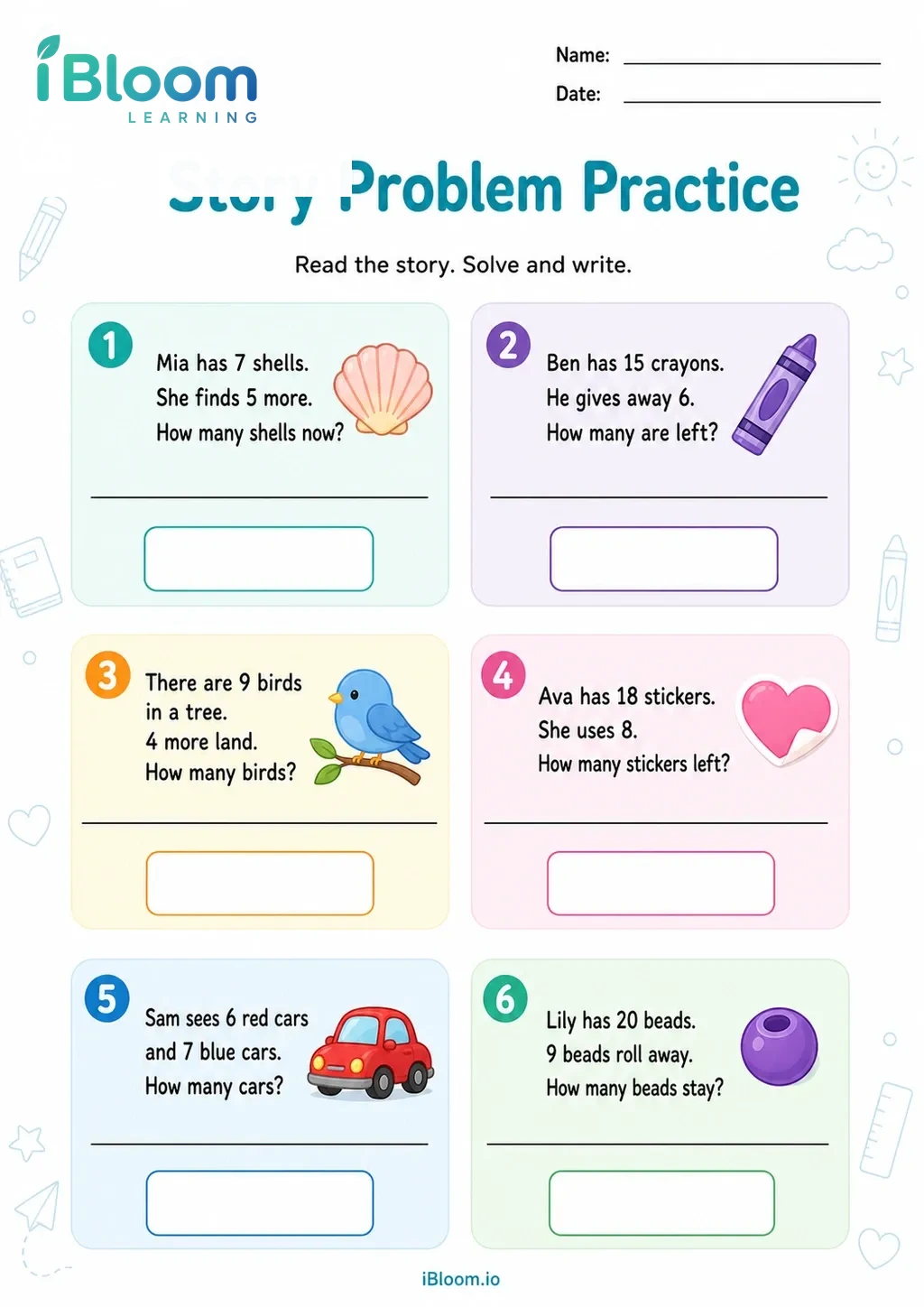
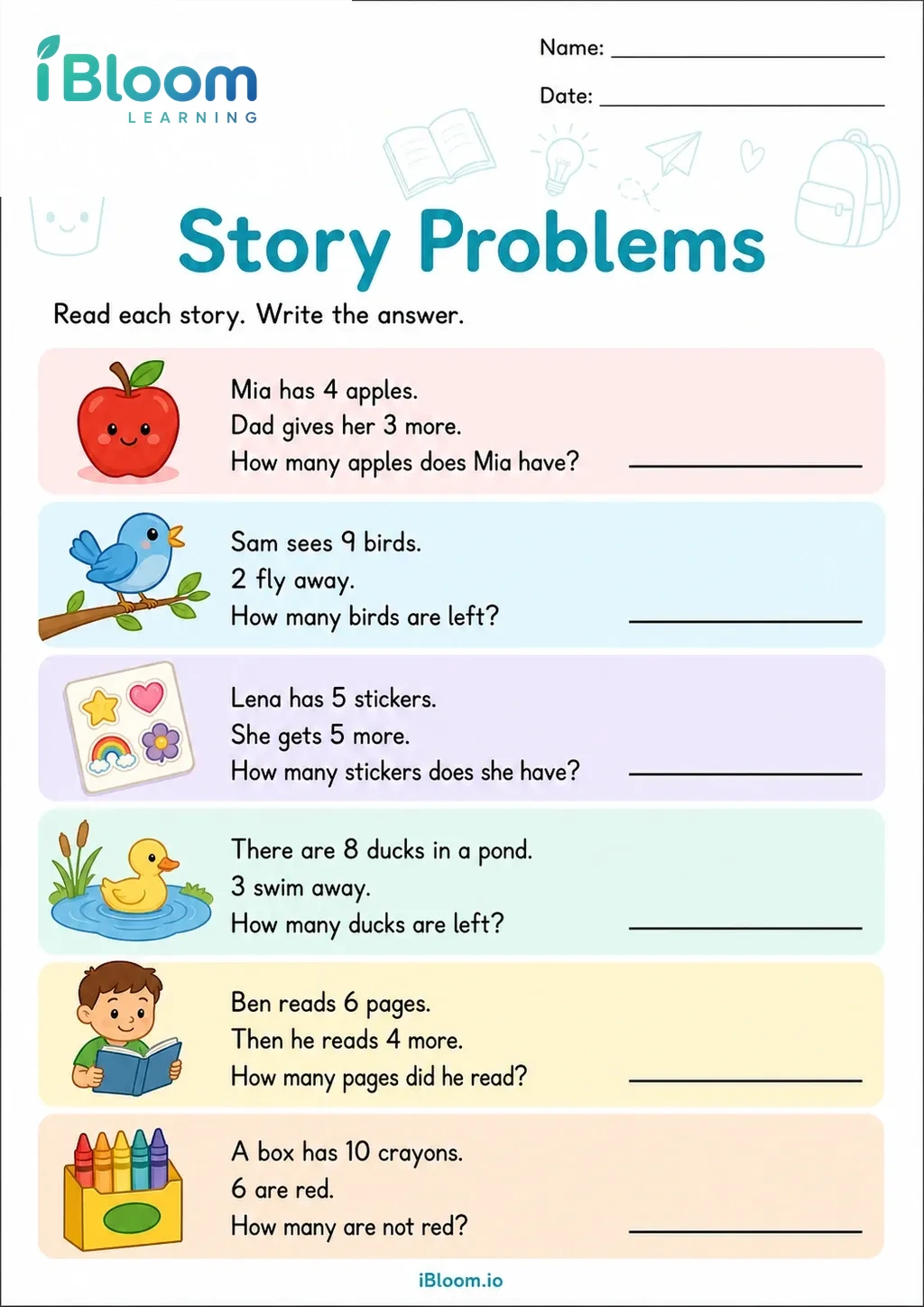
Mixed Grade 1 word problem worksheets help children choose between addition and subtraction while explaining their thinking with drawings, numbers, and equations.
Free printable worksheet PDFs
Preview every available page, then download the free worksheet PDF for home, homeschool, tutoring, or classroom practice.
Preview the exact activity before downloading it.
Practice that builds confidence
Building flexible problem solvers
These Grade 1 mixed word problem worksheets give children practice reading short math stories and deciding what to do next. Instead of seeing only one operation at a time, students sort out whether the problem asks them to join, take away, compare, or find a missing part.
The printable activities include varied first-grade situations with everyday objects, simple numbers, and space to show thinking. Children may draw a quick picture, circle important information, write an equation, and answer in a complete math sentence.
Mixed practice is important because real word problems do not announce the operation. A child has to understand the story before choosing addition or subtraction. These worksheets support that habit with varied contexts, such as toys, snacks, animals, classroom supplies, and groups of children, so students practise making sense of each situation rather than following a memorized pattern.

What students practise
Children read for quantities, action words, and the question being asked. They connect words such as altogether, left, more, fewer, gave away, and how many to mathematical actions. Some problems may be solved by adding two parts, while others require subtracting from a total or finding a missing amount. Students can use drawings, number bonds, ten frames, counting on, counting back, or equations to show their reasoning.
A simple parent routine
At home, have your child read the problem aloud first. Ask, “What is happening in the story?” before asking for an answer. Next, let them underline the numbers and circle the question. Encourage a quick sketch or counters if the numbers feel confusing. After solving, ask, “Does your answer make sense in the story?” This short routine builds independence without turning the worksheet into a guessing game.

Classroom uses for teachers
Teachers can use these pages for morning work, math centers, small-group review, homework, or a quick check after lessons on addition and subtraction word problems. Mixed pages are especially useful after students have learned separate problem types because they reveal whether children are choosing operations thoughtfully. They also make good partner activities: one student explains the story, and the other checks the equation.

Common errors to watch for
First graders often add every number they see, copy the first number as the answer, or rely on a keyword without understanding the story. Some children solve correctly but forget to label the answer or answer the wrong question. Remind students that the drawing, equation, and final answer should all match the same story.
Free printable PDF download
Use this grade 1 mixed word problem worksheet page to preview the activity, print it, or download it as a PDF for quick practice. It works well for homework, homeschool lessons, tutoring, morning work, revision, and classroom centers.
Answers and answer key support
After the child completes the worksheet independently, parents and teachers can use the answer support or answer key information to check the work, review mistakes, and choose the next practice step.
Why iBloom worksheets help
The iBloom mixed practice format gives children repeated chances to read, model, solve, and explain. Problems are written for Grade 1 readers and keep the focus on the mathematical decision: add, subtract, or find the missing piece. A child-friendly strategy is: Read it, picture it, choose it, solve it, check it.
Helpful answers
Frequently asked questions
What makes these Grade 1 word problems “mixed”?
Mixed means children see different problem types together, not just one operation. They must read the story and decide whether to add, subtract, compare, or find a missing part.
Should my child use drawings for every problem?
Drawings are very helpful in Grade 1, especially when the operation is not obvious. As children become more confident, they may move from detailed pictures to quick marks, number bonds, or equations.
How can I help if my child adds all the numbers?
Pause before solving and ask your child to retell the story in their own words. Then ask whether the amount is getting bigger, getting smaller, or missing a part. This helps them choose the operation based on meaning.
Are these worksheets useful after addition and subtraction lessons?
Yes. They are especially useful once students have practised addition and subtraction separately, because mixed problems check whether children can choose the correct strategy on their own.
What should a complete Grade 1 word problem answer include?
A complete answer usually includes a strategy or model, an equation, and a final answer that matches the question. A label such as apples, birds, or crayons helps show that the child understood the story.
Is this grade 1 mixed word problem worksheet free?
Yes. You can preview it for free and use the printable worksheet for home or classroom practice.
Can I download this grade 1 mixed word problem worksheet as a PDF?
Yes. Use the worksheet download option to save a printable PDF, or print the worksheet directly from the page.
Does this grade 1 mixed word problem worksheet include answers or an answer key?
When the activity has fixed answers, iBloom includes answer support so parents and teachers can check the completed worksheet.