


About this worksheet
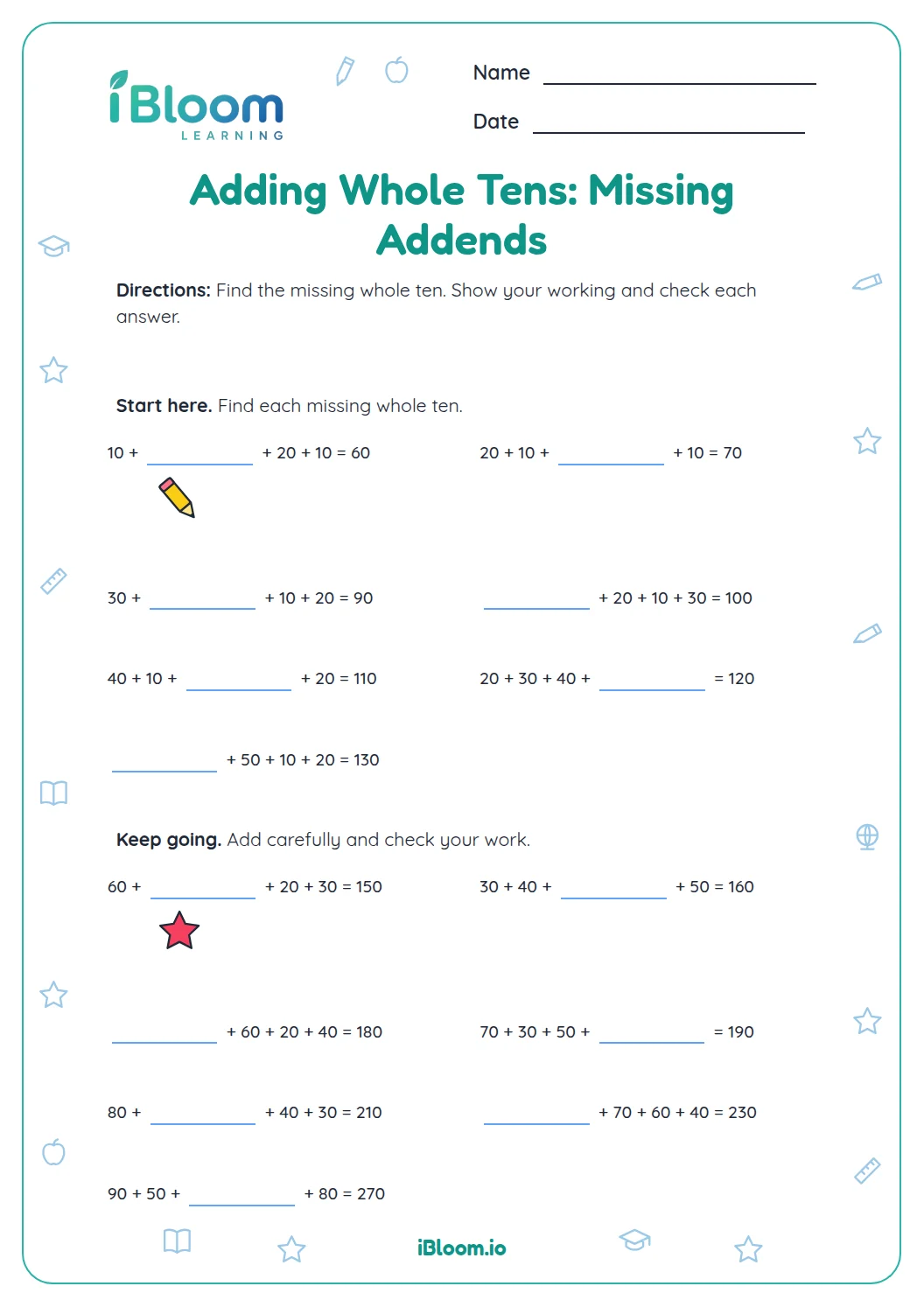
This Grade 2 printable gives students 18 problems with four whole-ten addends. First they total four amounts, then find a missing addend, and finally use a total to recover a hidden amount. In each story, every named amount appears in the equation, so the sum matches the situation. The work practices place-value strategies for adding several two-digit numbers under CCSS 2.NBT.B.6. A separate answer key is included.
Aligned to 2.NBT.B.6
How can a student add four whole tens?
Add the tens in any order, keeping track of all four addends. For 20 + 30 + 10 + 40, pair 20 + 30 = 50 and 10 + 40 = 50; then 50 + 50 = 100.
For a missing addend, first total the amounts you know. Subtract that subtotal from the stated total to find what is missing.
What does the worksheet practice?
Part A totals four whole-ten amounts in short stories. Part B uses an equation with one missing addend. Part C gives the total and asks students to recover a missing amount. Every amount stays within 1,000.
Which amounts make the first story total 100?
The first story names 20, 30, 10, and 40 caps. Add all four amounts: 20 + 30 + 10 + 40 = 100.
How to use this worksheet
- 1Read the part heading and note what each question asks you to find.
- 2Write or say an equation using the numbers and operation in the prompt.
- 3Solve carefully, keeping track of place value and what each blank represents.
- 4Use the answer key to check, then correct any equation that does not balance.
Common mistakes and quick fixes
The mistake
Leaving out a named amount when adding four groups.
The fix
Point to each of the four addends and check that each one is included once.
The mistake
Treating a missing addend as the total.
The fix
Add the known amounts first, then compare that subtotal with the total.
The mistake
Using a number without checking what the blank represents.
The fix
Read the words and labels beside the blank, then write the requested value or unit.
Common Core alignment
This worksheet practices 2.NBT.B.6 through whole-tens addition problems.
Add up to four two-digit numbers using strategies based on place value and properties of operations.
On this sheet: Students find a missing whole-ten addend or total in sums of four two-digit whole tens.
Show the official wordingHide the official wording
Add up to four two-digit numbers using strategies based on place value and properties of operations.
What to practice next
Make more practice
Further reading
Questions parents and teachers ask
How do you add four whole-ten amounts?
Add the tens in a way that is easy to track, then combine the partial totals. For question 1, 20 + 30 + 10 + 40 can be grouped as 50 + 50, which equals 100. Check that all four stated amounts appear once. Students can use the example and then try another item independently.
How can my child find a missing addend?
Add the known amounts first, then subtract that subtotal from the total. In 20 + 10 + 20 + ___ = 60, the known amounts total 50, so the missing whole ten is 10. Put it back to check. Students can use the example and then try another item independently.
What does this worksheet include?
It has 18 questions across three parts: adding four amounts in stories, finding a missing addend, and reasoning from a stated total. The stories and equations use whole tens, and a separate answer key follows the worksheet pages. Students can use the example and then try another item independently.
Why must every amount be included?
The total represents every group named in the story. Leaving out one group makes the equation describe a different situation. Students can point to each amount in the story and match it to one addend before calculating. Students can use the example and then try another item independently.
How can students check a total?
They can add the four amounts again in a different order or group the tens into easy pairs. For a missing addend, substitute the answer into the blank and confirm that all four addends make the stated total. Students can use the example and then try another item independently.