


About this worksheet
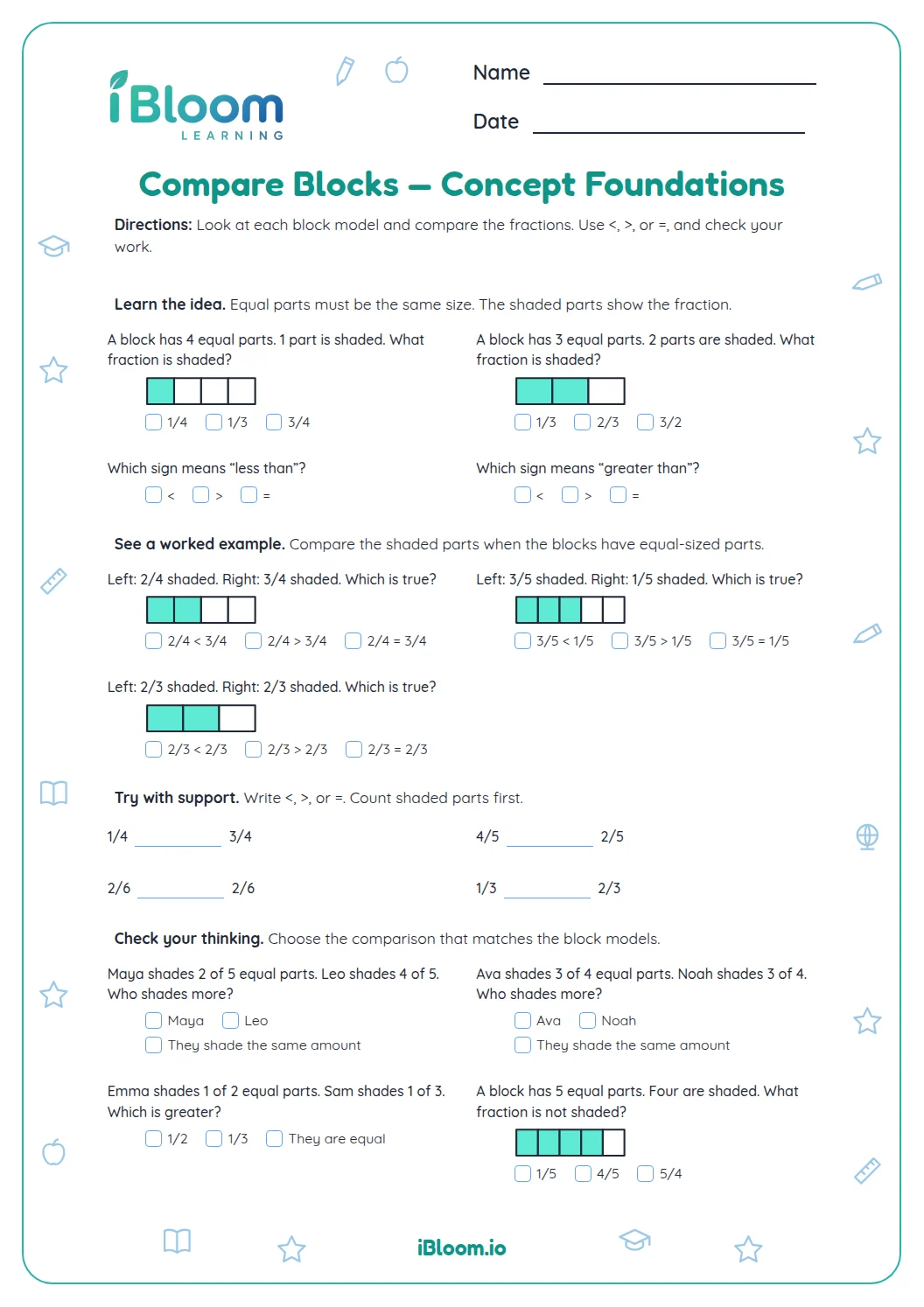
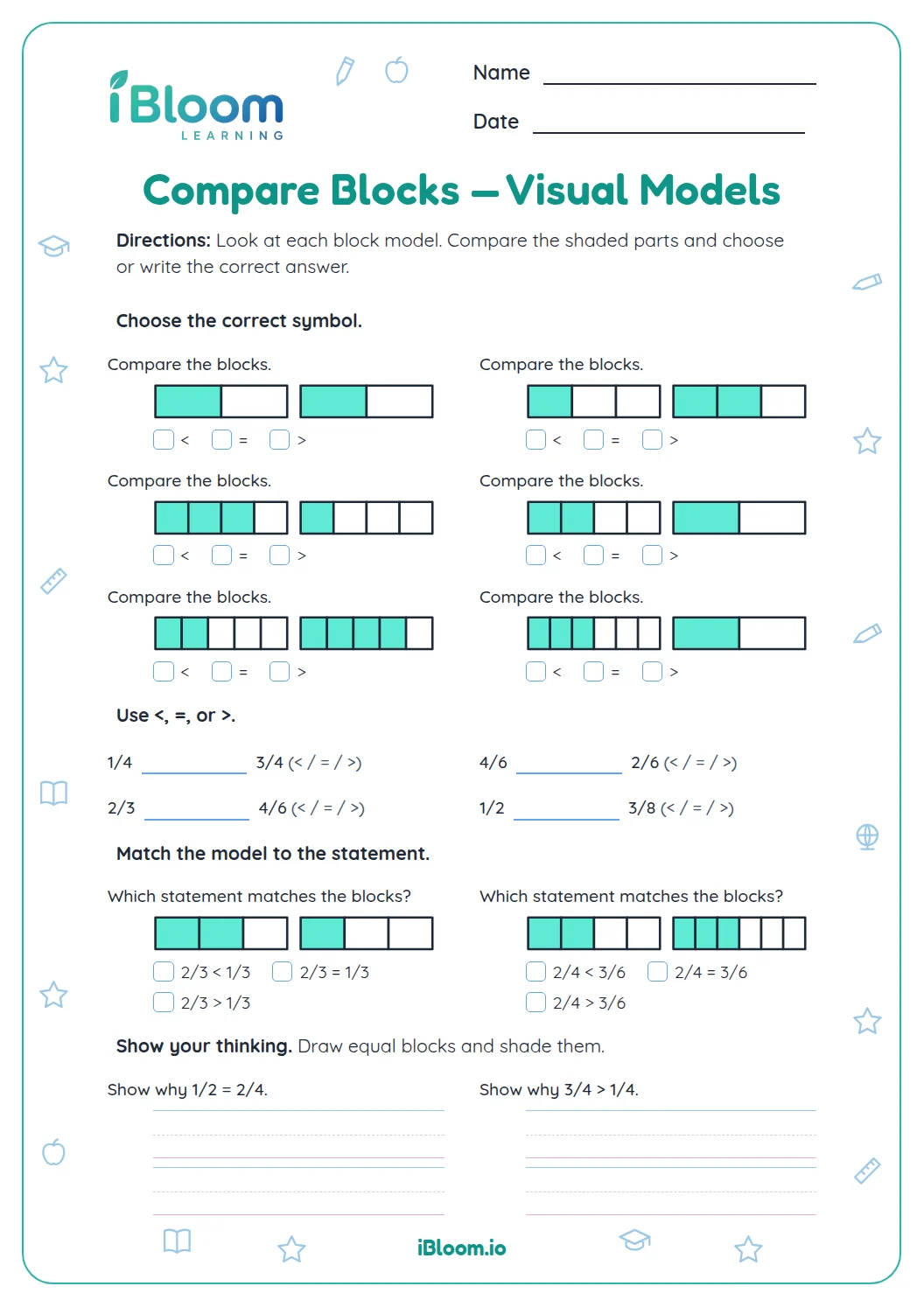
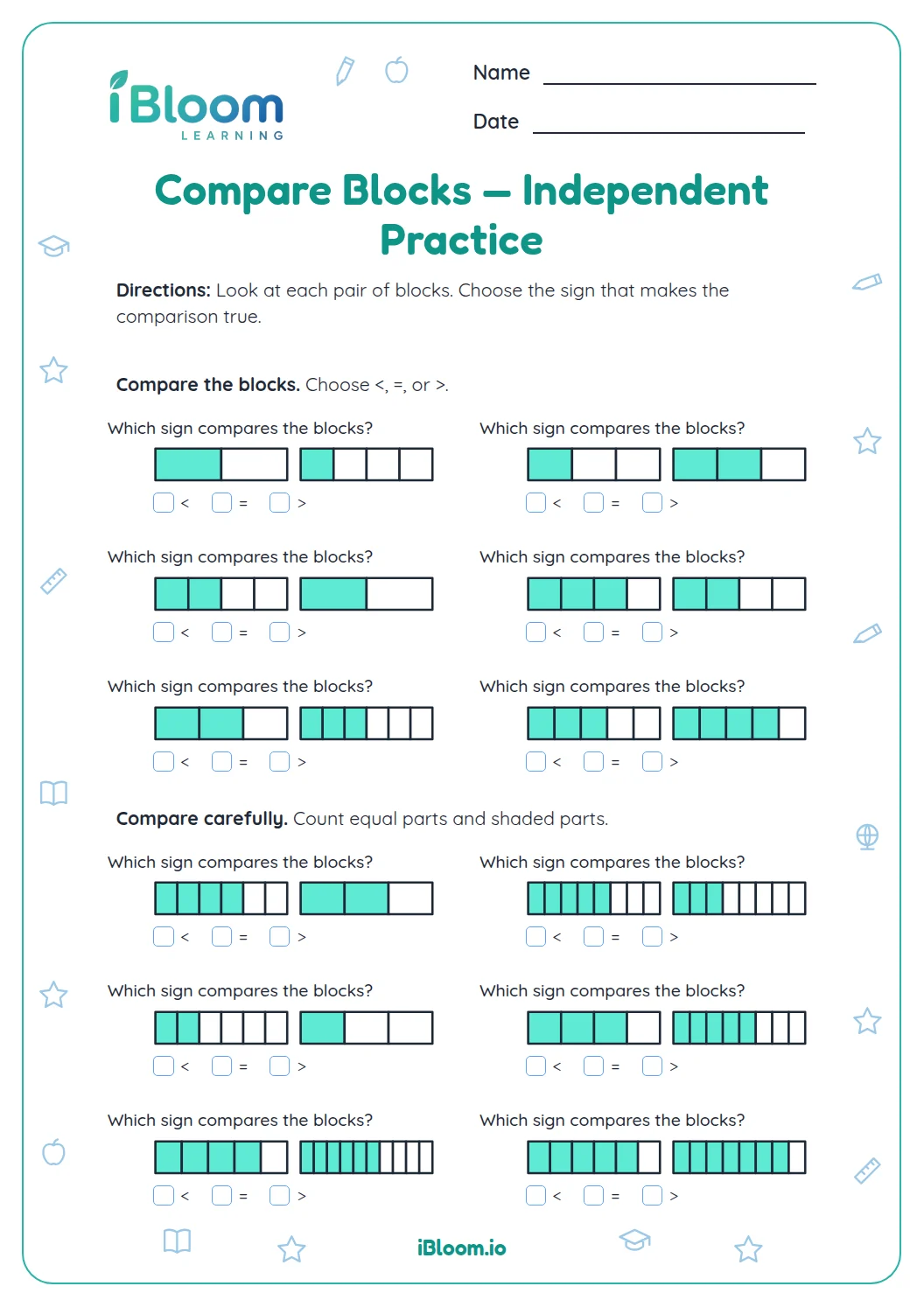
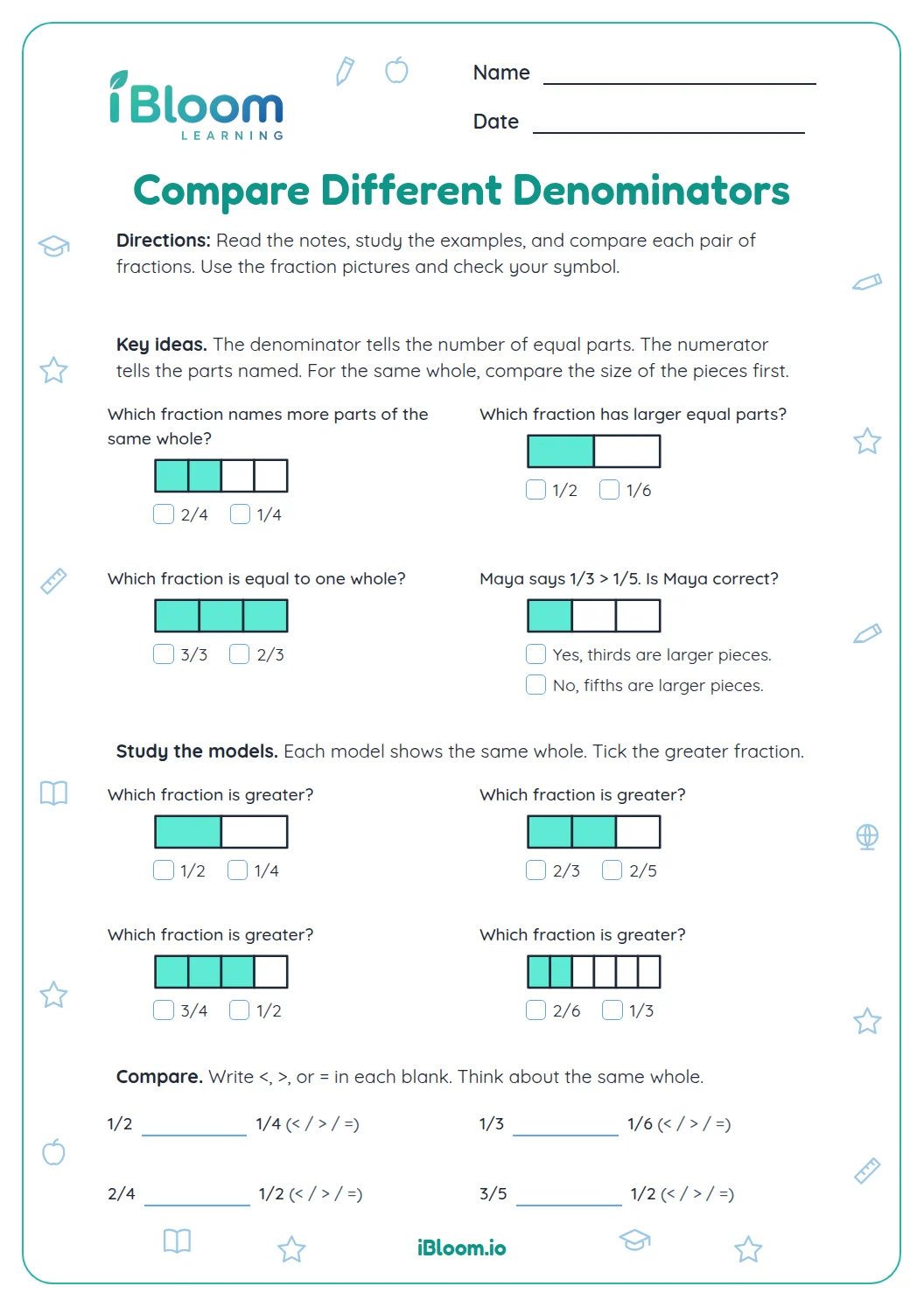
This printable combines Grade 2 reading comprehension with fraction reasoning. Children read an original passage about Maya and Ben dividing two garden beds into equal sections, then answer questions about details, 1/4 and 2/3, and how to compare shares fairly. Sixteen questions are grouped into three parts after the passage. The separate key includes sample answers for open responses. The page practices CCSS RI.2.1 and applies CCSS 2.G.A.3 to equal shares.
Aligned to RI.2.1 and 2.G.A.3
What details explain the garden fractions?
Read the short story once for the main idea and again to find exact details. The first bed has four equal sections and one section of lettuce, so its lettuce share is 1/4. The second bed has three equal sections and two flower sections, so its flower share is 2/3.
- 1The second bed has 3 equal sections.
- 2Flowers fill 2 of those sections.
- 3The flower fraction is 2/3.
Why do the whole and the pieces matter?
A fraction describes parts of one whole. To compare two fractions fairly, the wholes must be the same size. Even then, the number of pieces alone is not enough: more pieces can mean smaller pieces when the whole is divided into more sections.
How is the reading challenge organized?
Sixteen questions check details, name fractions in the passage, and ask children to reason about Ben’s claim. The answer key includes sample responses for questions that invite an explanation.
- Part B: locate names and details
- Part C: identify the fractions in each bed
- Part D: reason about equal wholes and share size
How can an adult guide this practice?
- 1Read once to learn who and what the passage is about.
- 2Read again and mark the numbers and details about each garden bed.
- 3Answer detail questions in a short phrase or sentence.
- 4For reasoning questions, explain what the numerator and denominator count.
- 5Check open responses against the sample answers in the key.
Common fraction mistakes and fixes
The mistake
Comparing only the numerators.
The fix
Name the denominator too; it tells how many equal pieces make each whole.
The mistake
Treating different numbers of sections as equal-sized pieces.
The fix
Check that each whole is split into equal parts before comparing a share.
The mistake
Answering from memory without returning to the passage.
The fix
Point to the sentence that gives the detail before writing the answer.
Common Core alignment
This worksheet gives children focused practice with the ideas named in the standards below.
Ask and answer who, what, and why questions using details from a short passage.
On this sheet: Children answer questions about stated details and inferences in an informational passage.
Show the official wordingHide the official wording
Ask and answer such questions as who, what, where, when, why, and how to demonstrate understanding of key details in a text.
Name halves, thirds, and fourths in equal shares of circles and rectangles.
On this sheet: Children identify and describe equal shares in circle and rectangle models.
Show the official wordingHide the official wording
Partition circles and rectangles into two, three, or four equal shares, describe the shares using the words halves, thirds, half of, a third of, etc., and describe the whole as two halves, three thirds, four fourths. Recognize that equal shares of identical wholes need not have the same shape.
What to practice next
Make more practice
Further reading
Questions parents and teachers ask
What is the main idea of the passage?
Maya and Ben are figuring out how to describe and compare shares in two garden beds. One bed has four equal sections with one planted with lettuce. The other has three equal sections with two planted with flowers. Ask the child to point to the related question and explain the clue before checking the answer key.
Why does the passage say the beds have the same area?
The same area gives children a fair basis for thinking about the fractions. The passage also says the beds have different shapes, which helps distinguish a whole’s shape from its size. Ask the child to point to the related question and explain the clue before checking the answer key.
Why is Ben’s reasoning incomplete?
Ben counts two sections against one section, but the sections may have different sizes because each bed is divided into a different number of equal parts. A fraction needs both the number of parts and the number of equal parts in the whole.
What does 1/4 mean in the story?
The first garden bed is divided into four equal sections, and lettuce fills one section. The numerator 1 counts the lettuce section; the denominator 4 tells how many equal sections make the whole bed. Ask the child to point to the related question and explain the clue before checking the answer key.
Are sample answers the only acceptable responses?
No. The key gives concise examples for open responses. A child may use different words and still be correct if the response uses a passage detail and explains the fraction or comparison accurately. Ask the child to point to the related question and explain the clue before checking the answer key.