

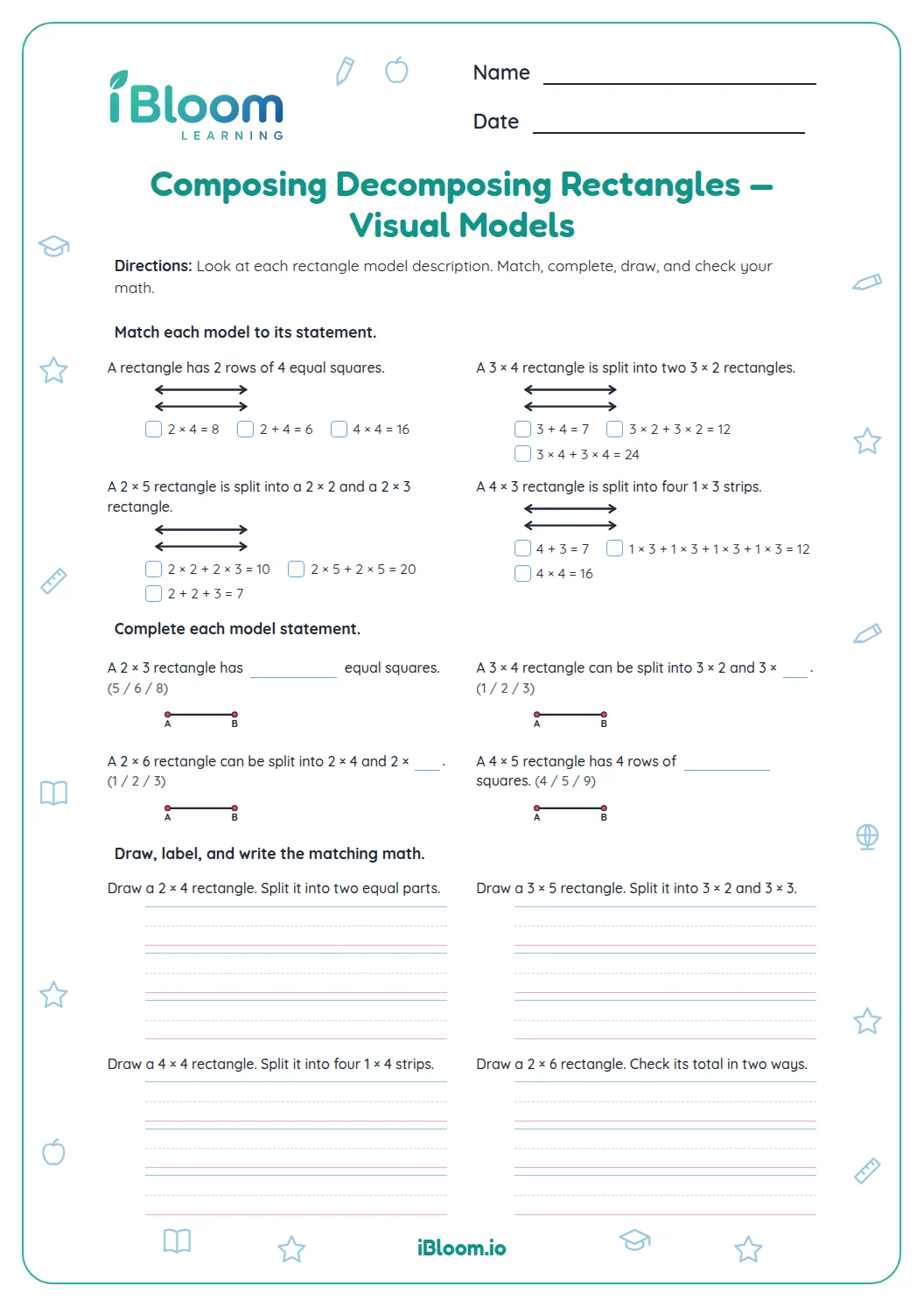
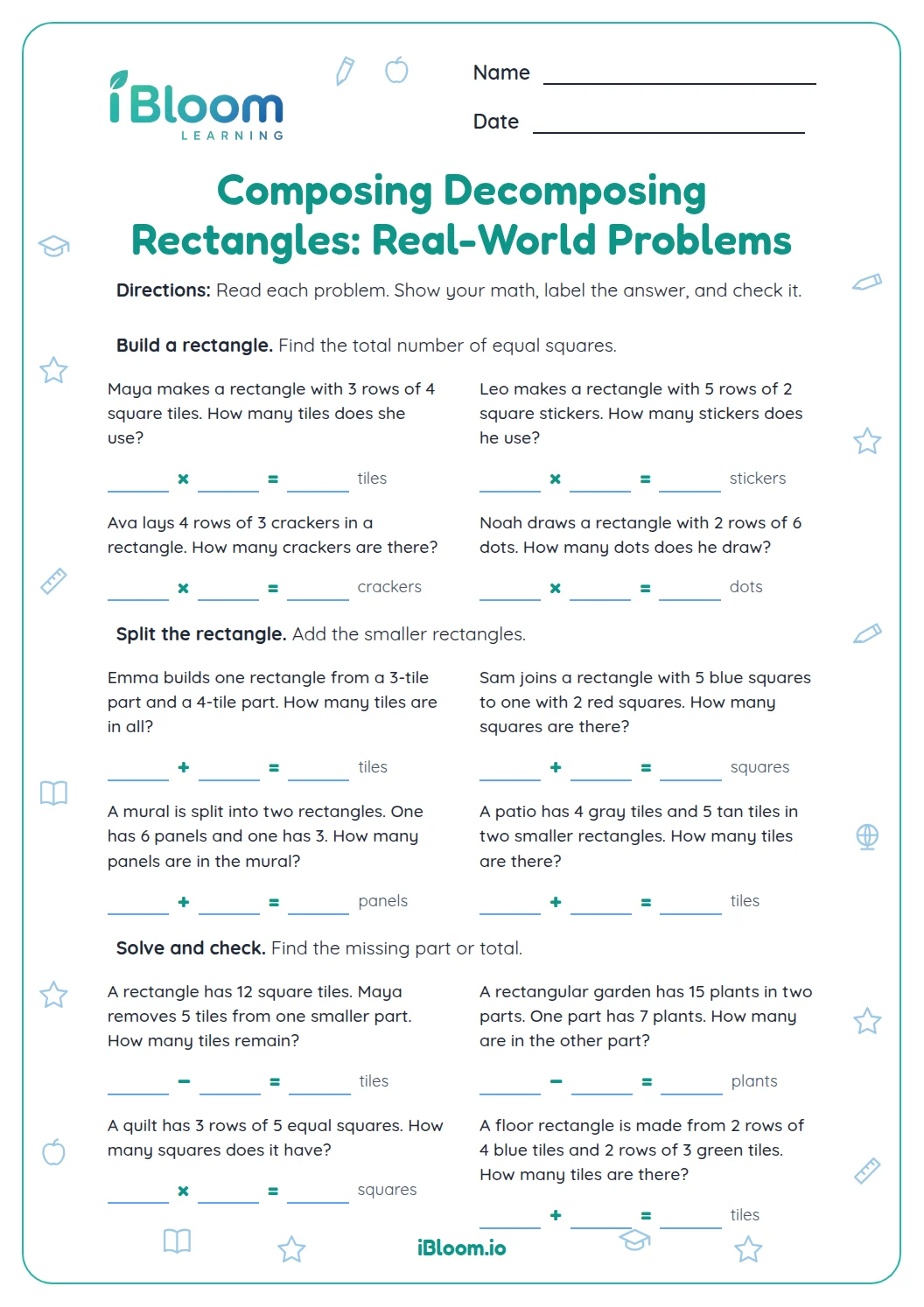
About this worksheet
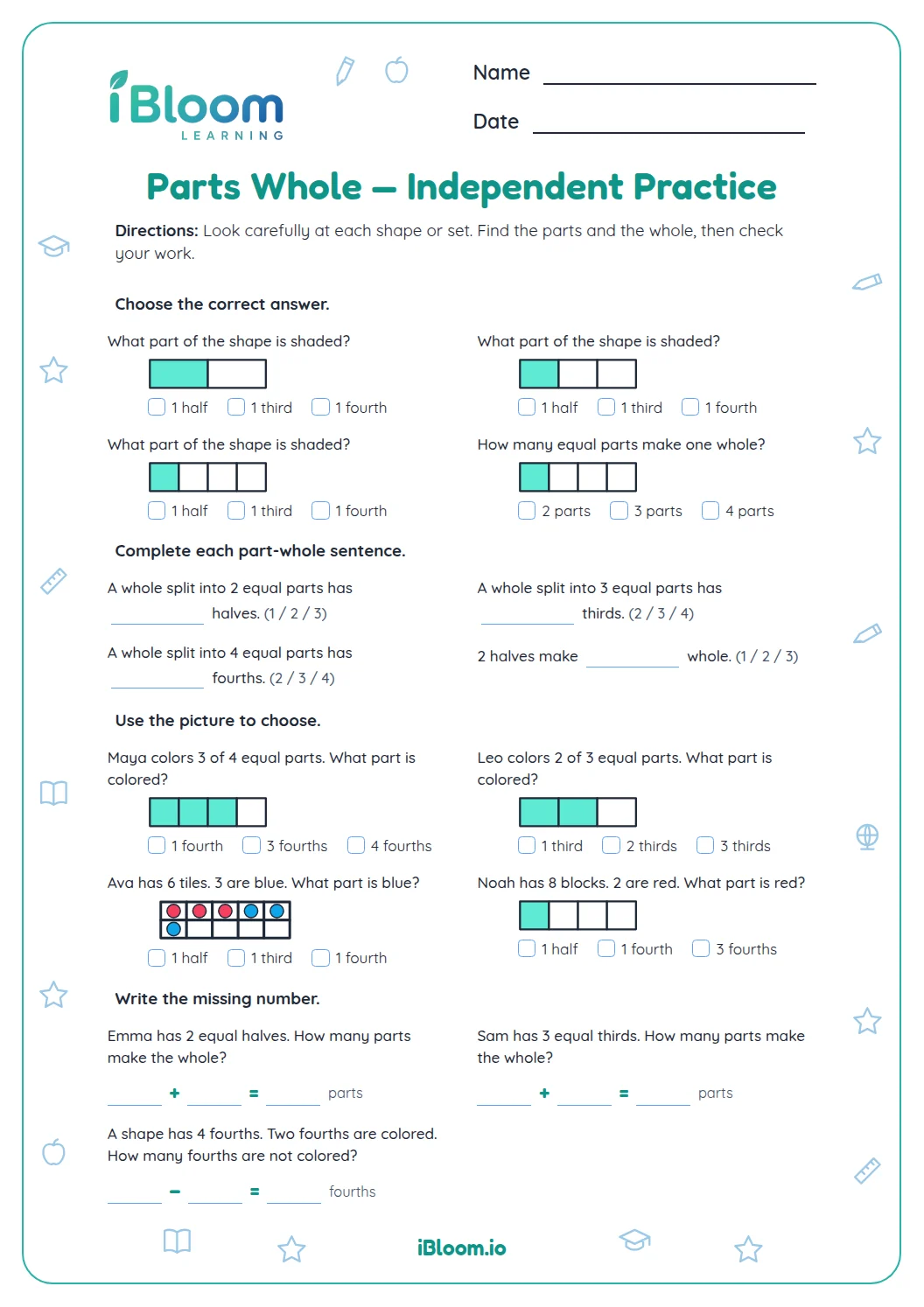
This Grade 2 geometry worksheet focuses on parts and wholes in circles, squares, and rectangles. Children study real shaded models, name halves, thirds, and fourths, and explain how equal shares make one whole. Fourteen questions are arranged from picture reading to fraction language and reasoning, with a separate answer key. The practice aligns with CCSS 2.G.A.3.
Aligned to 2.G.A.3
How do shapes show equal shares?
A circle or rectangle can be partitioned into equal shares. If a shape is split into two equal parts, the parts are halves. If it is split into four equal parts, they are fourths. The whole is still one shape, even when it is divided.
Question 5 shows a bar with four equal parts and three shaded. The shaded share is 3/4.
- 1Count four equal parts in the bar.
- 2Three parts are shaded.
- 3The model shows 3/4.
How do the part names describe one whole?
The denominator tells the number of equal parts in the whole. Two halves, three thirds, and four fourths each make one whole. The shape’s outline can change while its equal share still has the same fraction name.
What is on the parts and wholes sheet?
Sixteen questions move from pictured shape models to fraction words and whole statements. The answer key gives a clear answer for each item and a sample for the final explanation.
- Part A: read circles, squares, and bars
- Part B: name halves, thirds, and fourths
- Part C: connect equal shares to the whole
How can an adult guide this practice?
- 1Look at the outline and count the equal parts.
- 2Name each part using the total part count.
- 3Count shaded parts only after you know how many parts make the whole.
- 4Use the words halves, thirds, or fourths to explain the model.
- 5Check each answer with the key.
Common fraction mistakes and fixes
The mistake
Calling unequal pieces equal shares.
The fix
Compare the pieces; fraction names require equal parts.
The mistake
Naming only the shaded count.
The fix
Read the full fraction: the bottom number tells the total equal shares.
The mistake
Thinking a whole changes when split.
The fix
Put all the shares together in your mind; they still make one whole shape.
Common Core alignment
This worksheet gives children focused practice with the ideas named in the standards below.
Name halves, thirds, and fourths in equal shares of circles and rectangles.
On this sheet: Children identify and describe equal shares in circle and rectangle models.
Show the official wordingHide the official wording
Partition circles and rectangles into two, three, or four equal shares, describe the shares using the words halves, thirds, half of, a third of, etc., and describe the whole as two halves, three thirds, four fourths. Recognize that equal shares of identical wholes need not have the same shape.
What to practice next
Make more practice
Further reading
Questions parents and teachers ask
What does partition mean on this worksheet?
To partition a shape means to split it into parts. The parts must be equal shares for names such as halves, thirds, or fourths to apply. Ask the child to point to the related question and explain the clue before checking the answer key.
How many thirds make one whole?
Three thirds make one whole. The word thirds means the whole has been split into three equal parts, so all three parts together restore the full shape. Ask the child to point to the related question and explain the clue before checking the answer key.
Can a half look different in different shapes?
Yes. A circle and a square can each be divided into two equal shares. Their parts have different outlines, but each part is one-half of its own whole. Ask the child to point to the related question and explain the clue before checking the answer key.
How can children tell if the shares are equal?
They can compare the size of each piece in the model. Each piece should cover the same amount of the whole, even if the pieces have different outlines. Ask the child to point to the related question and explain the clue before checking the answer key.
Does the answer key include explanations?
The key marks the correct share name or statement for every item. For the final question, it also gives the concise check: each piece must be equal in size. Children can compare that idea with the model questions.