Free printable practice
Measurement Practice Activities
Grade 2 measurement worksheets for length, weight, capacity, temperature, estimation, and simple unit conversions.
Explore Measurement
Free printable worksheet PDFs
Preview every available page, then download the free worksheet PDF for home, homeschool, tutoring, or classroom practice.
Preview the exact activity before downloading it.
Practice that builds confidence
Build real measurement sense
These Grade 2 measurement worksheets help children practise choosing units, measuring objects, comparing lengths, reading thermometers, and working with weight and capacity. Activities move between customary units such as inches, feet, yards, ounces, pounds, cups, pints, quarts, and gallons, and metric units such as centimeters, meters, grams, kilograms, milliliters, and liters.
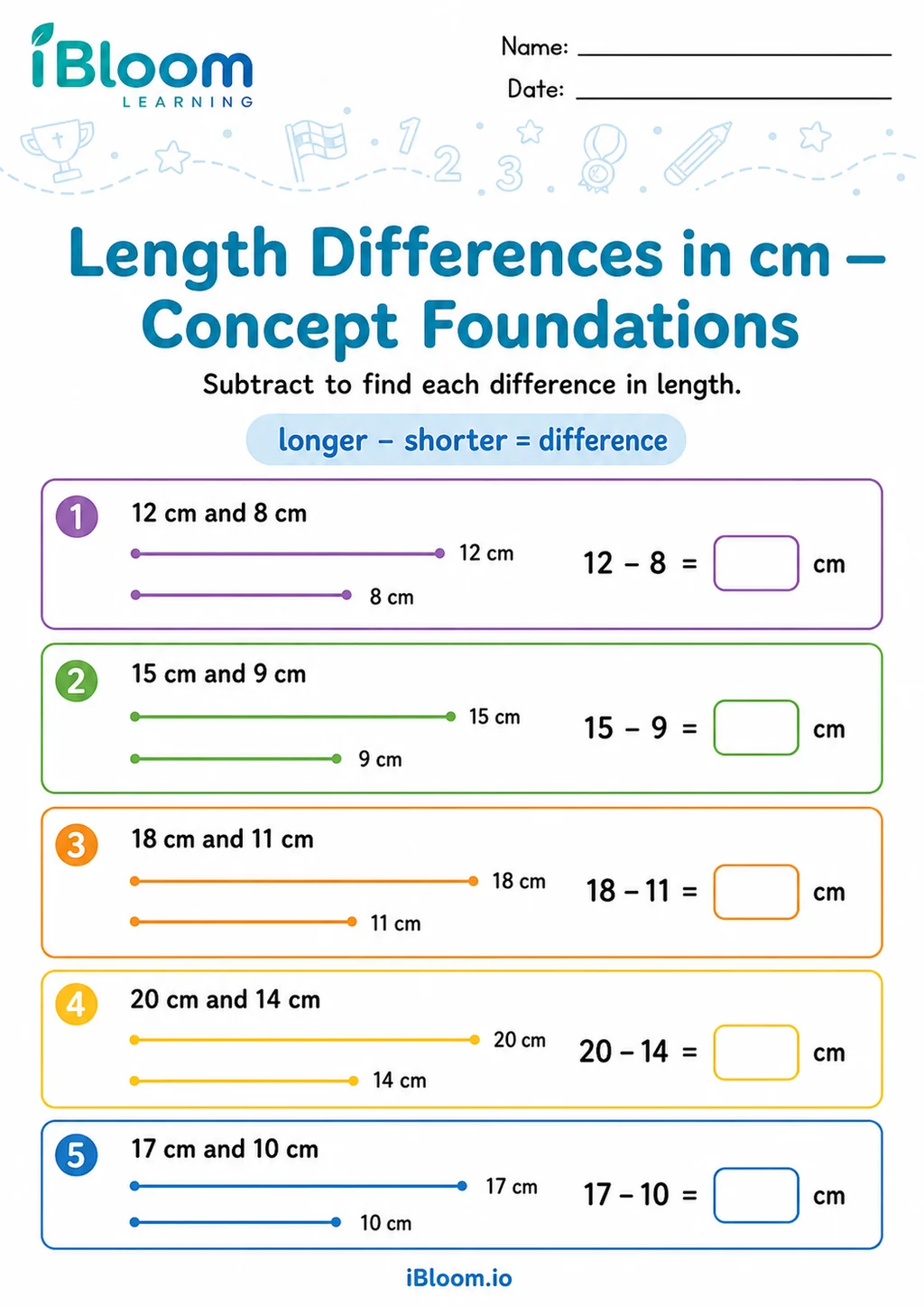
The printable pages include estimating lengths, measuring with nonstandard units, measuring in inches and centimeters, finding length differences in centimeters, reading metric and customary thermometers, and solving easy and harder conversion questions. Children build accuracy while connecting numbers to real objects and everyday situations.
Second graders need to see measurement as more than a number on a ruler. These worksheets connect each measure to a purpose: centimeters and inches for small objects, feet and yards for longer distances, ounces and pounds for weight, kilograms and grams for mass, and liters, milliliters, cups, pints, quarts, and gallons for capacity.

Progress from hands-on units to standard units
Children start by counting nonstandard units, such as equal paper clips or blocks, then move toward rulers marked in inches and centimeters. Estimation tasks help them decide whether an object is about a few centimeters, many inches, or closer to a meter. Length-difference problems in centimeters extend measuring into subtraction and comparison.
Conversions without overload
The conversion pages give Grade 2 learners repeated practice with related units. Easy sets introduce familiar relationships, such as cups to pints or yards to feet, while harder sets require more attention to the unit named in the question. Capacity work includes cups, pints, quarts, gallons, liters, and milliliters; weight work includes ounces, pounds, grams, and kilograms.
A simple parent routine
Pick one worksheet and one real object. Before your child writes, ask, “Which unit makes sense?” Then have them estimate, measure, and compare. For example, estimate the length of a spoon in centimeters, measure it, and talk about whether the estimate was close. For capacity, point to a water bottle, measuring cup, or milk jug and discuss the unit printed on it.

Classroom uses and errors to watch
Teachers can use these pages in centers, morning review, partner measuring tasks, or quick checks after a mini-lesson. Common errors include starting a ruler at 1 instead of 0, mixing up grams and kilograms, reading the wrong thermometer scale, or converting in the wrong direction. Encourage children to underline the unit in the question before solving.

Free printable PDF download
Use this grade 2 measurement worksheet page to preview the activity, print it, or download it as a PDF for quick practice. It works well for homework, homeschool lessons, tutoring, morning work, revision, and classroom centers.
Answers and answer key support
After the child completes the worksheet independently, parents and teachers can use the answer support or answer key information to check the work, review mistakes, and choose the next practice step.
Why iBloom worksheets help
The collection gives varied practice across length, mass, weight, capacity, and temperature so children do not learn each idea in isolation. A child-friendly strategy is: name the object, choose the unit, estimate first, then measure or convert. This routine builds confidence and makes measurement vocabulary easier to remember.
Helpful answers
Frequently asked questions
What measurement skills are covered in these Grade 2 worksheets?
They cover measuring and estimating length, comparing length differences, weight and mass, capacity, temperature reading, nonstandard units, and simple conversions in customary and metric units.
Do the worksheets use both inches and centimeters?
Yes. Children practise measuring in inches and centimeters, comparing lengths, estimating in centimeters, and recognizing when each unit is a sensible choice.
Are customary and metric units both included?
Yes. Customary units include inches, feet, yards, ounces, pounds, cups, pints, quarts, and gallons. Metric units include centimeters, meters, grams, kilograms, milliliters, and liters.
How can I help my child with unit conversions?
Have your child underline the starting unit and the unit needed in the answer. Then use a known relationship, such as 1 yard = 3 feet or 1 pint = 2 cups, before doing the calculation.
What is a common ruler mistake in Grade 2?
Many children begin measuring at the number 1 instead of the zero mark or the ruler edge. Remind them to line up the object with 0 before counting the units.
Is this grade 2 measurement worksheet free?
Yes. You can preview it for free and use the printable worksheet for home or classroom practice.
Can I download this grade 2 measurement worksheet as a PDF?
Yes. Use the worksheet download option to save a printable PDF, or print the worksheet directly from the page.
Does this grade 2 measurement worksheet include answers or an answer key?
When the activity has fixed answers, iBloom includes answer support so parents and teachers can check the completed worksheet.