



About this worksheet
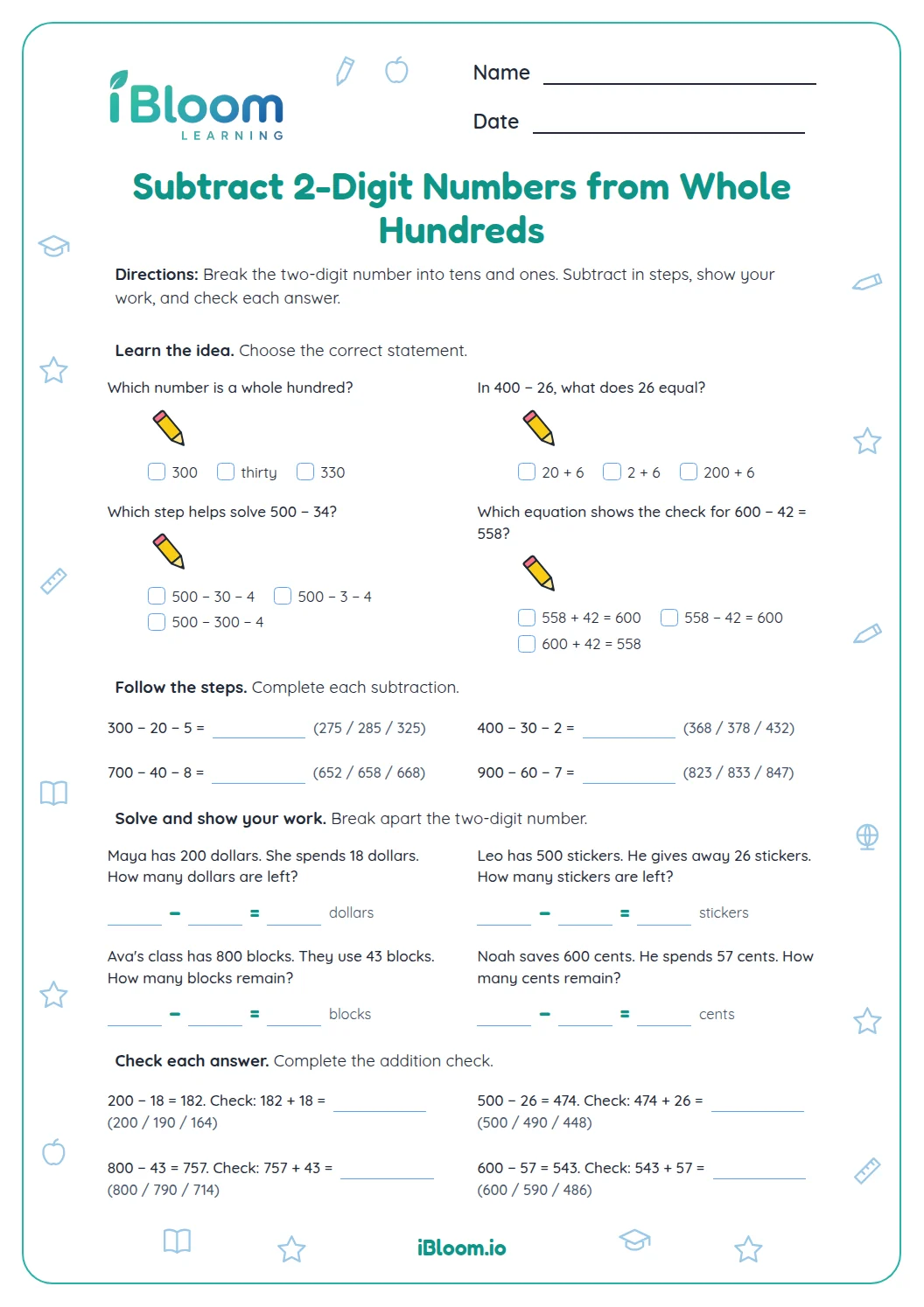
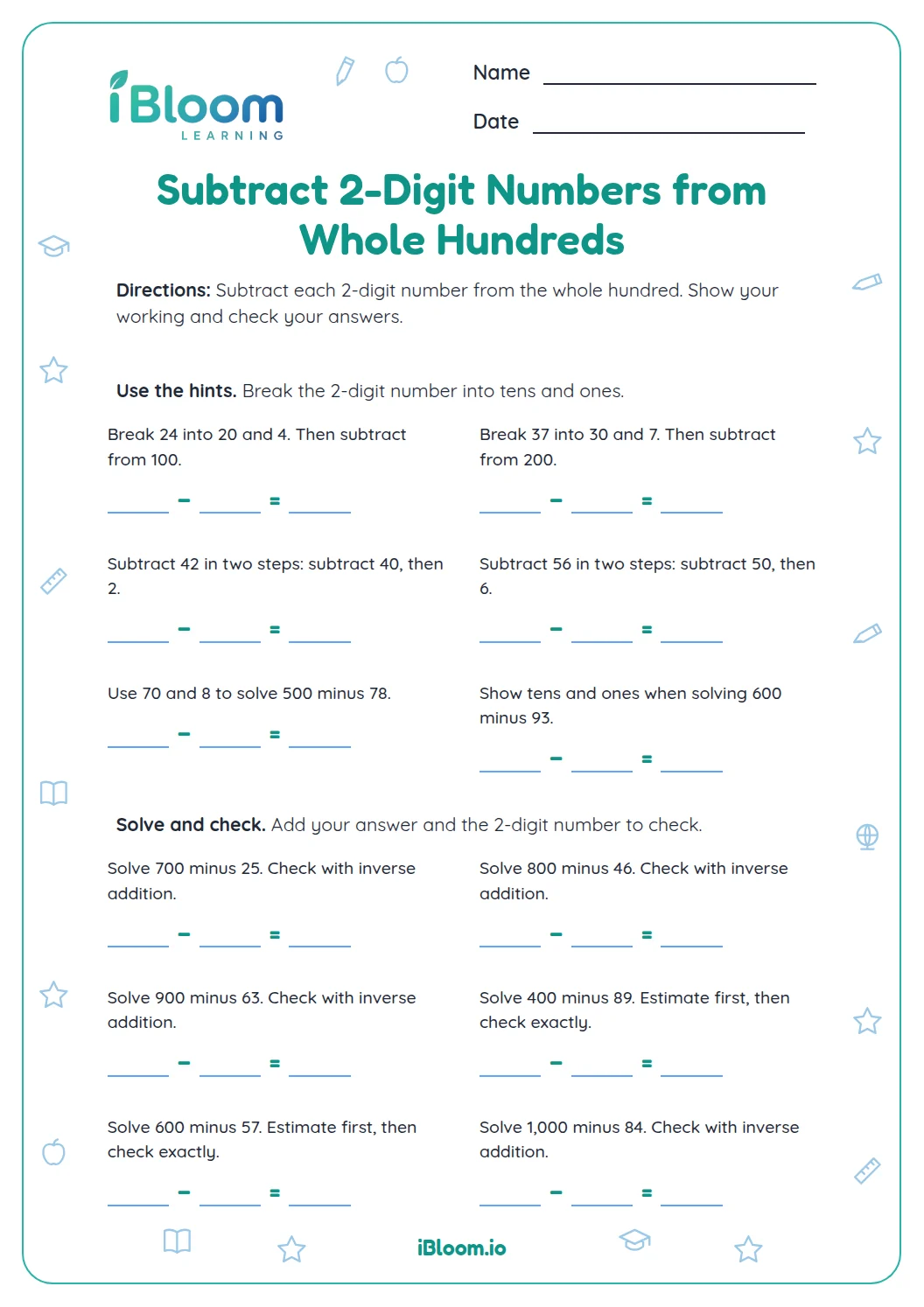
This Grade 2 reasoning worksheet focuses on subtracting a two-digit number from a whole hundred. Students calculate differences, decide whether a classmate’s claim is correct, and select the true correction. The first equation, 700 − 82, is treated accurately: its difference is 618. The questions support place-value subtraction and checking within 1,000 under CCSS 2.NBT.B.7. The multi-page printable has a separate answer key.
Aligned to 2.NBT.B.7
How do you subtract from a whole hundred?
A whole hundred has zero tens and zero ones, so subtracting a two-digit number may require regrouping. For 700 − 82, rename 7 hundreds as 6 hundreds, 9 tens and 10 ones. Then subtract 2 ones and 8 tens to get 618.
A quick check uses addition: 618 + 82 = 700. If the difference and subtrahend add back to the starting number, the subtraction is consistent.
How does the reasoning challenge work?
Part A asks for differences directly. Part B asks students to test a claim. Part C asks them to identify a correct equation. The student must calculate each result; no mistaken claim is repeated as the answer key.
How do you check 700 − 82?
Subtract 80, then 2: 700 − 80 = 620 and 620 − 2 = 618. Check with addition: 618 + 82 = 700.
How to use this worksheet
- 1Read the part heading and note what each question asks you to find.
- 2Write or say an equation using the numbers and operation in the prompt.
- 3Solve carefully, keeping track of place value and what each blank represents.
- 4Use the answer key to check, then correct any equation that does not balance.
Common mistakes and quick fixes
The mistake
Subtracting the smaller digit from the larger digit in each place without regrouping.
The fix
Rename one hundred as ten tens before subtracting 8 tens from 10 tens.
The mistake
Accepting a claim before calculating it.
The fix
Work out the difference independently, then compare the result with the claim.
The mistake
Using a number without checking what the blank represents.
The fix
Read the words and labels beside the blank, then write the requested value or unit.
Common Core alignment
This worksheet practices 2.NBT.B.7 through subtract from hundreds problems.
Subtract within 1,000 using place-value strategies and explain the method.
On this sheet: Students subtract two-digit numbers from whole hundreds and evaluate subtraction claims.
Show the official wordingHide the official wording
Add and subtract within 1000, using concrete models or drawings and strategies based on place value, properties of operations, and/or the relationship between addition and subtraction.
What to practice next
Make more practice
Further reading
Questions parents and teachers ask
How can you subtract a two-digit number from a hundred?
Subtract the tens and ones while keeping track of the value of each place. For 700 − 82, subtract 80 to get 620, then subtract 2 to get 618. A quick check is 618 + 82 = 700. Students can use the example and then try another item independently.
What is the correct answer to 700 − 82?
The difference is 618. Subtracting 80 from 700 gives 620, and subtracting 2 more gives 618. The answer key marks 618 as correct and the other options as incorrect. Students can use the example and then try another item independently.
How does the worksheet ask students to reason?
Students select correct differences, decide whether subtraction claims are true, and calculate additional differences. These three formats ask them to compute and check, rather than rely on a single repeated procedure. Students can use the example and then try another item independently.
How can a student check a subtraction claim?
Add the claimed difference to the number being subtracted. If the sum equals the starting hundred, the claim is true. For example, 253 + 47 = 300 confirms that 300 − 47 = 253. Students can use the example and then try another item independently.
What does the key include?
The answer key marks the correct choices, gives yes or no for each claim, and supplies the differences for the calculation section. Students can use the inverse operation to explain why a selected difference is reasonable. Students can use the example and then try another item independently.