



About this worksheet
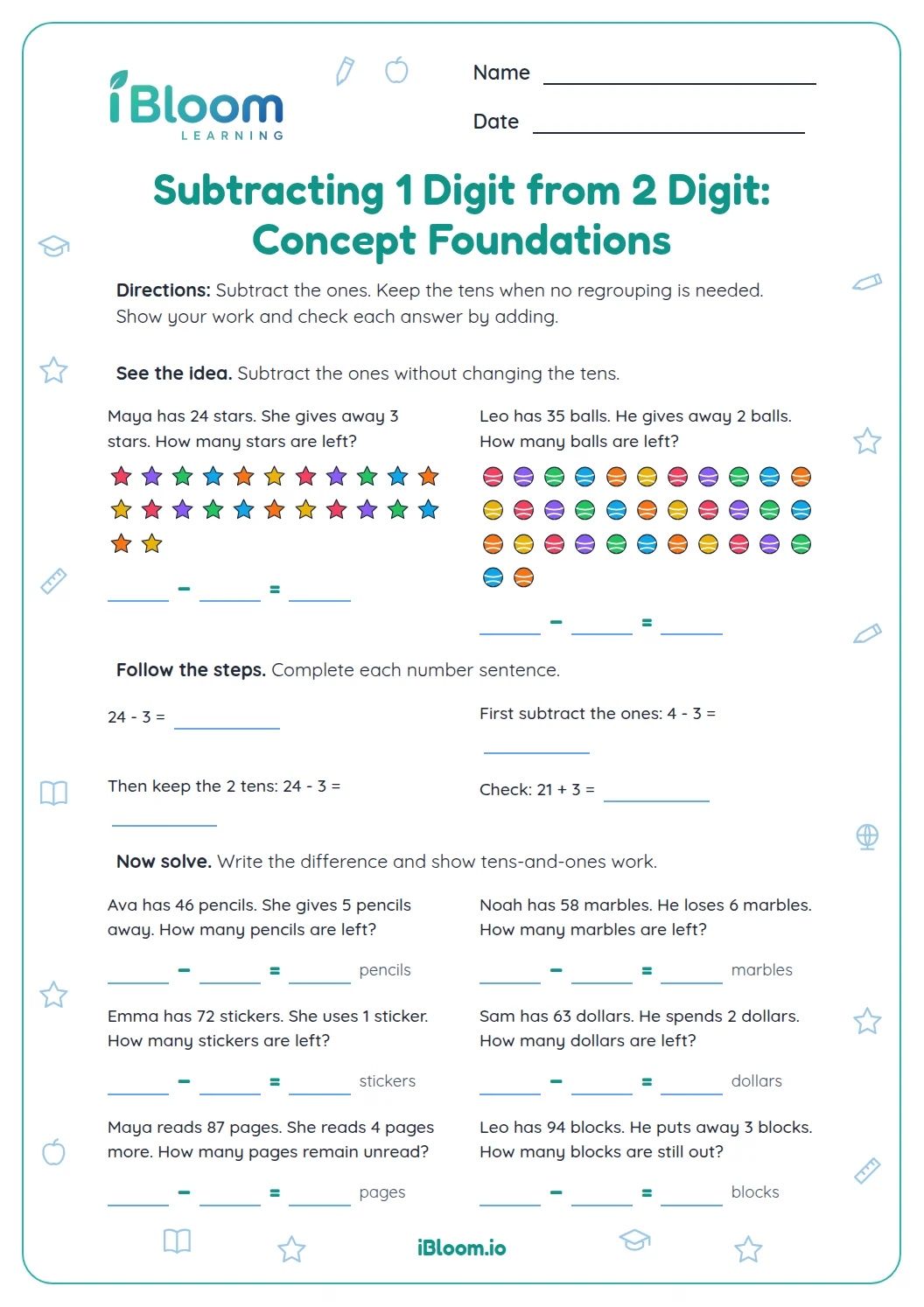
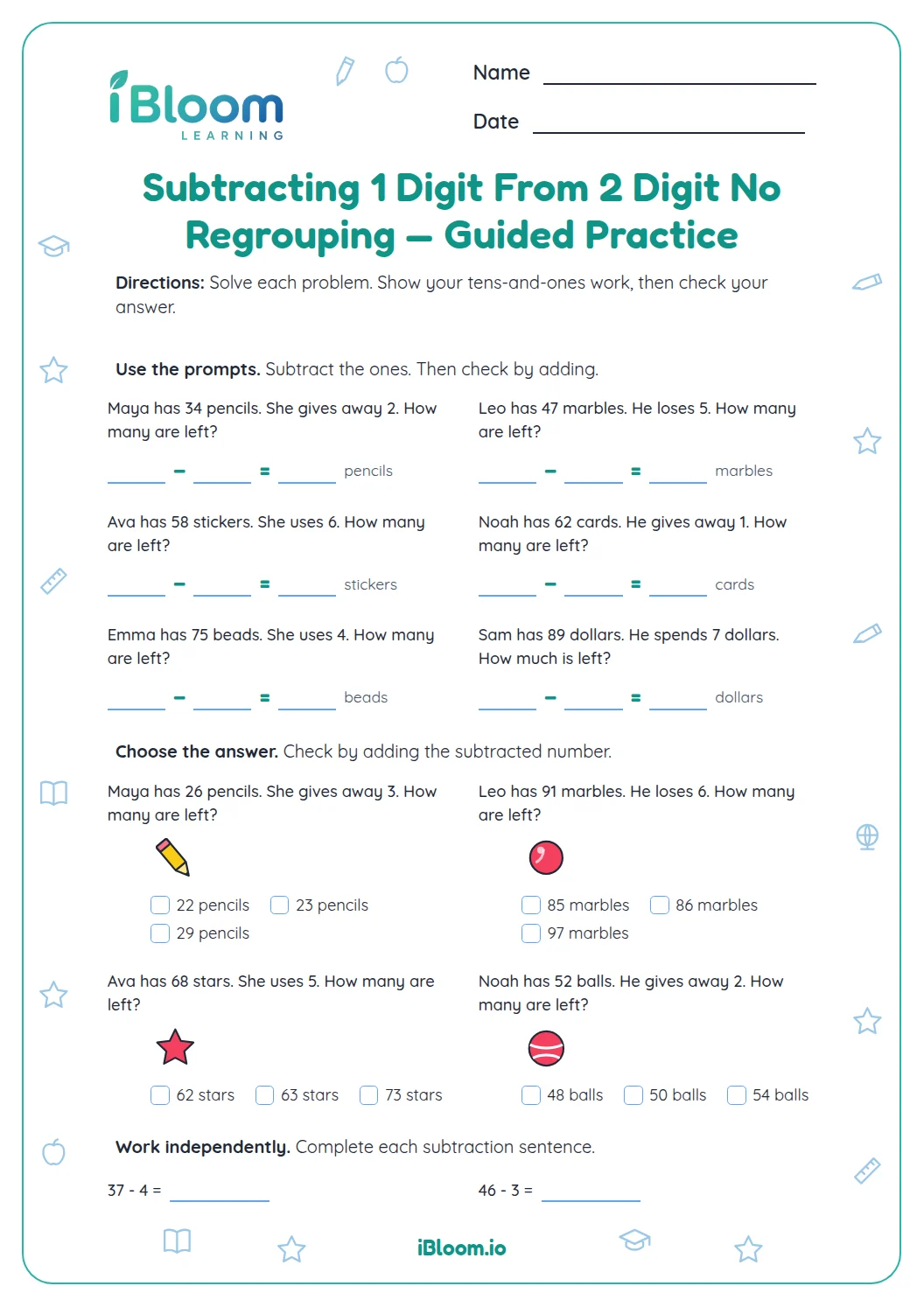
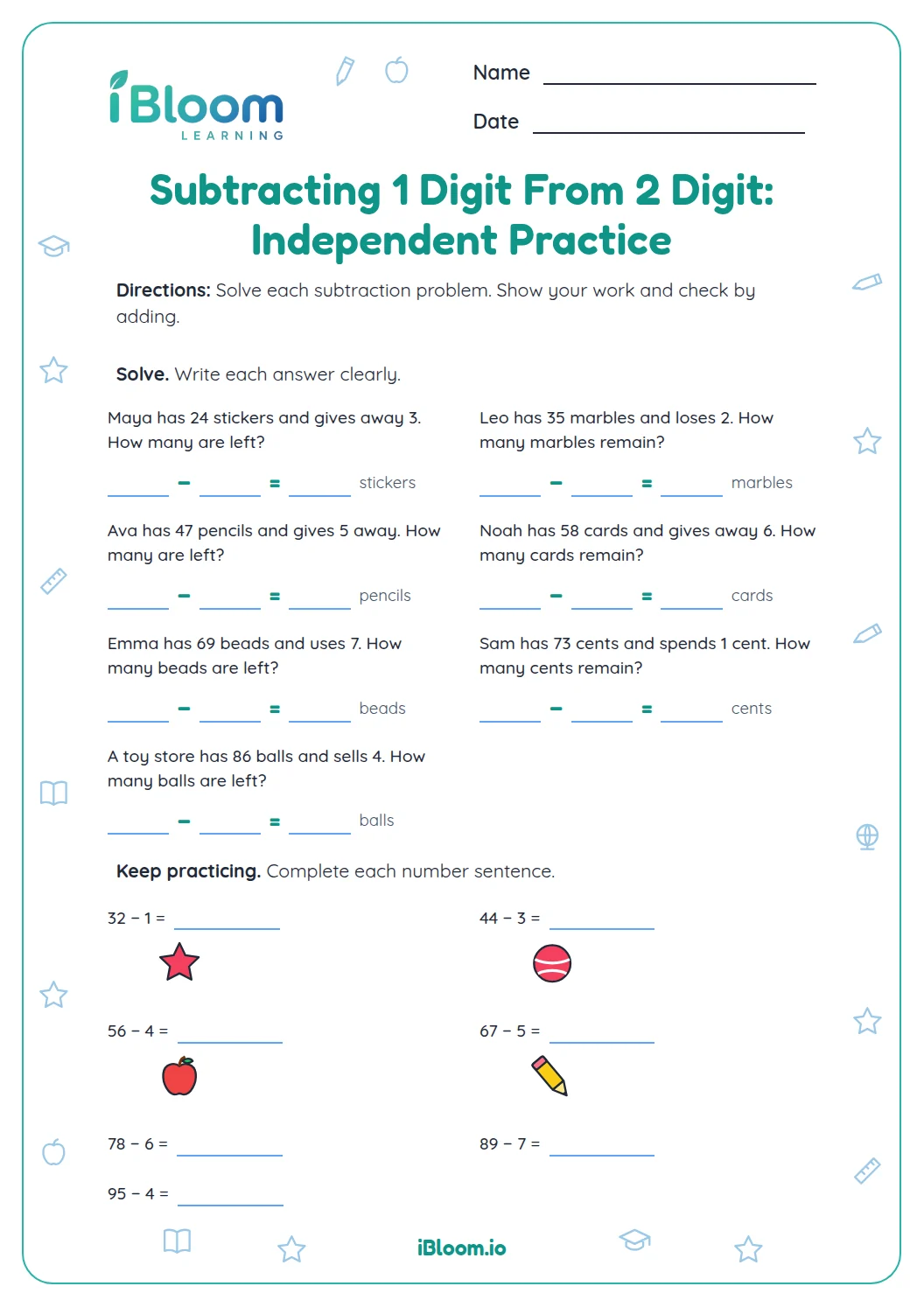
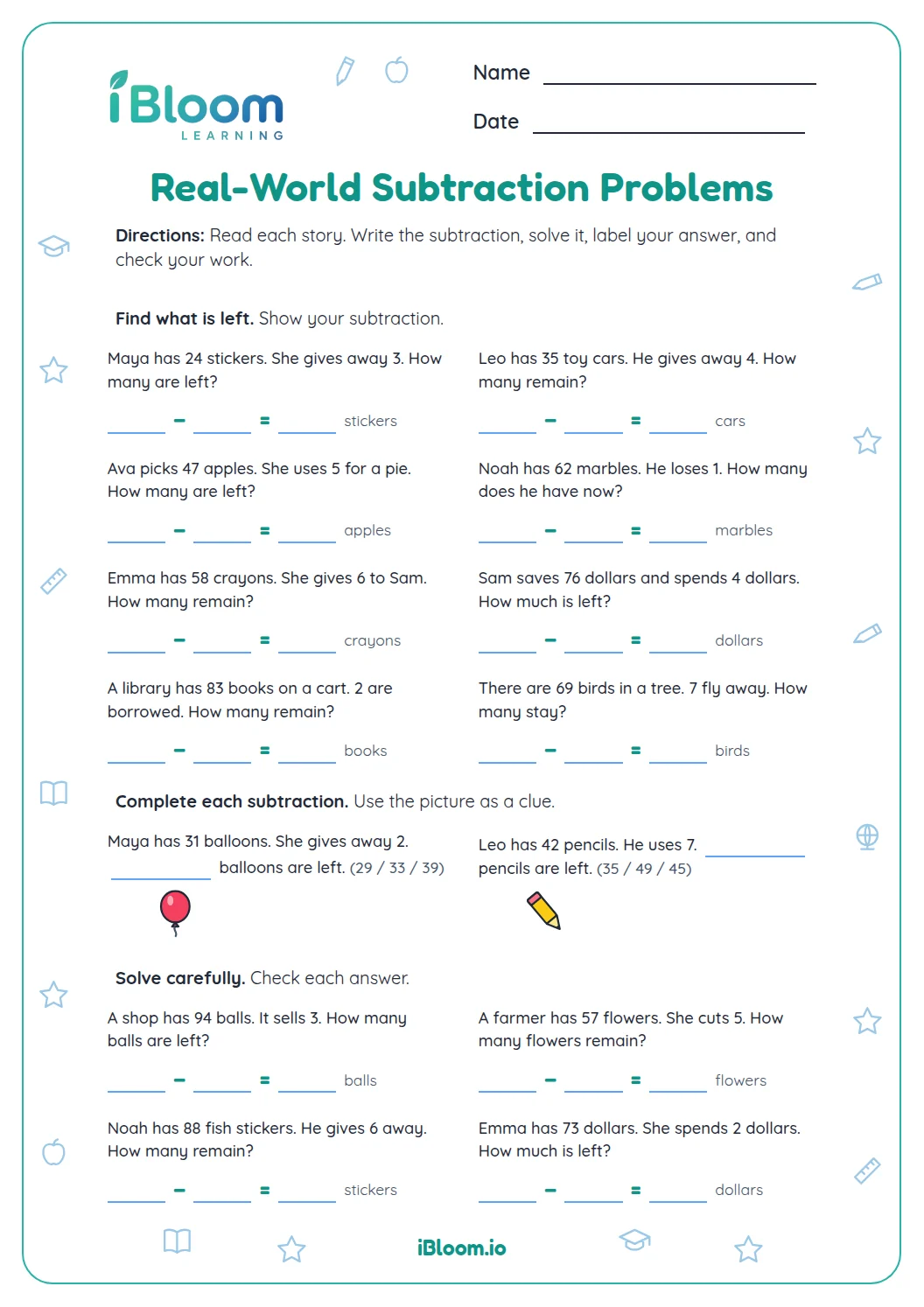
This free printable worksheet gives Grade 2 students 16 problems focused on one-digit subtraction supported by base-ten blocks and student sketches. The practice moves from guided questions to independent work, and the answer key shows the answer to each item. The questions use grade-appropriate numbers and clear equations so students can focus on the named skill. It practices Common Core 2.NBT.B.5.
Aligned to 2.NBT.B.5
What will students practice?
The worksheet has 3 parts, arranged from guided practice to independent problems. The questions vary the numbers and formats while staying with one-digit subtraction supported by base-ten blocks and student sketches.
The old page mixed generic number lines and drawing instructions with no actual blocks, and included 51 − 2, which needs regrouping. The new page shows base-ten blocks for eight problems, prints every number named in each prompt, and uses only no-regrouping ones amounts.
How can a student check an answer?
Use the equation in the question to check the missing value. For example, the model shows 3 tens and 6 ones. Cross out 2 ones: 36 − 2 = 34. | The 3 tens stay, and 6 − 2 leaves 4 ones.
- 1The model shows 3 tens and 6 ones. Cross out 2 ones: 36 − 2 = 34.
- 2The 3 tens stay, and 6 − 2 leaves 4 ones.
What should students notice?
Read the whole equation before choosing an operation. In subtraction, check the ones first; for a no-regrouping problem, the ones being taken away must fit within the ones shown. Then check the result with addition.
How to use this worksheet
- 1Name the tens and ones in the starting number.
- 2Find the amount of ones to cross out.
- 3Check that enough ones are shown before subtracting.
- 4Write the matching subtraction equation.
- 5Check by adding the difference and removed amount.
Common mistakes and quick fixes
The mistake
Subtract more ones than the model has.
The fix
Check the ones count first; if the amount does not fit, it would require regrouping.
The mistake
Forget that the tens remain.
The fix
Cross out only the requested ones and keep the tens rods.
The mistake
Solve a worded prompt without copying its printed numbers.
The fix
Use the displayed starting number and subtraction amount to write the equation.
Common Core alignment
This worksheet connects the printed practice to a specific Common Core math goal.
Subtract within 100 using place value and related addition facts.
On this sheet: Subtract within 100 using place value and related addition facts.
Show the official wordingHide the official wording
Fluently add and subtract within 100 using strategies based on place value, properties of operations, and/or the relationship between addition and subtraction.
What to practice next
Make more practice
Further reading
Questions parents and teachers ask
How do the visual models help with subtraction?
Each base-ten model shows the starting tens and ones. Students cross out the requested number of ones and read what remains, linking the drawing to the subtraction equation. Ask the student to point to the numbers in the equation and explain what each one represents before calculating. This keeps the work connected to the question.
What does no regrouping mean on this sheet?
The number of ones being subtracted is no greater than the ones shown in the starting number. For example, 58 − 4 uses the eight ones already shown and leaves four. Ask the student to point to the numbers in the equation and explain what each one represents before calculating. This keeps the work connected to the question.
Why does the student page print the starting number?
The student needs to know which amount to model and subtract. Every model question prints the starting number and the amount taken away beside the blocks. Ask the student to point to the numbers in the equation and explain what each one represents before calculating. This keeps the work connected to the question.
Are all items visual models?
Eight questions show base-ten blocks. Four ask students to sketch tens and ones, and four are equations for independent practice. The models fade as students carry the same place-value idea into their own work. This gradual change lets children connect each picture with the matching equation and then solve without a picture.
How many questions are included?
There are 16 questions in the worksheet with a separate answer key. The items progress from printed block models to student-created sketches and then equations. Ask the student to point to the numbers in the equation and explain what each one represents before calculating. This keeps the work connected to the question.
Is there an answer key?
Yes. The key lists the difference for every model and equation. For each printed block model, the number of tens and ones is part of the prompt, and the subtracted ones amount appears explicitly. Ask the student to point to the numbers in the equation and explain what each one represents before calculating. This keeps the work connected to the question.