

About this worksheet
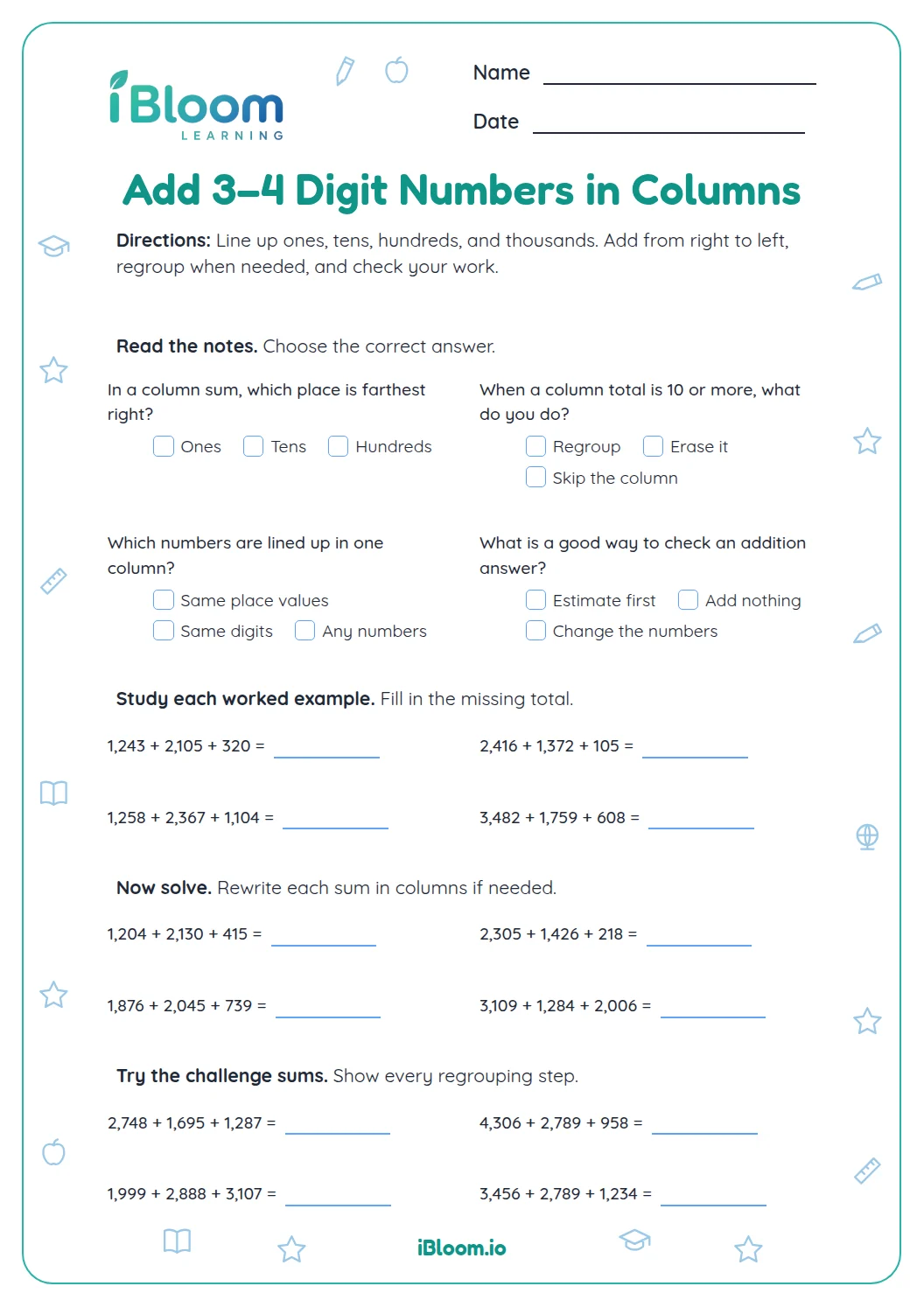
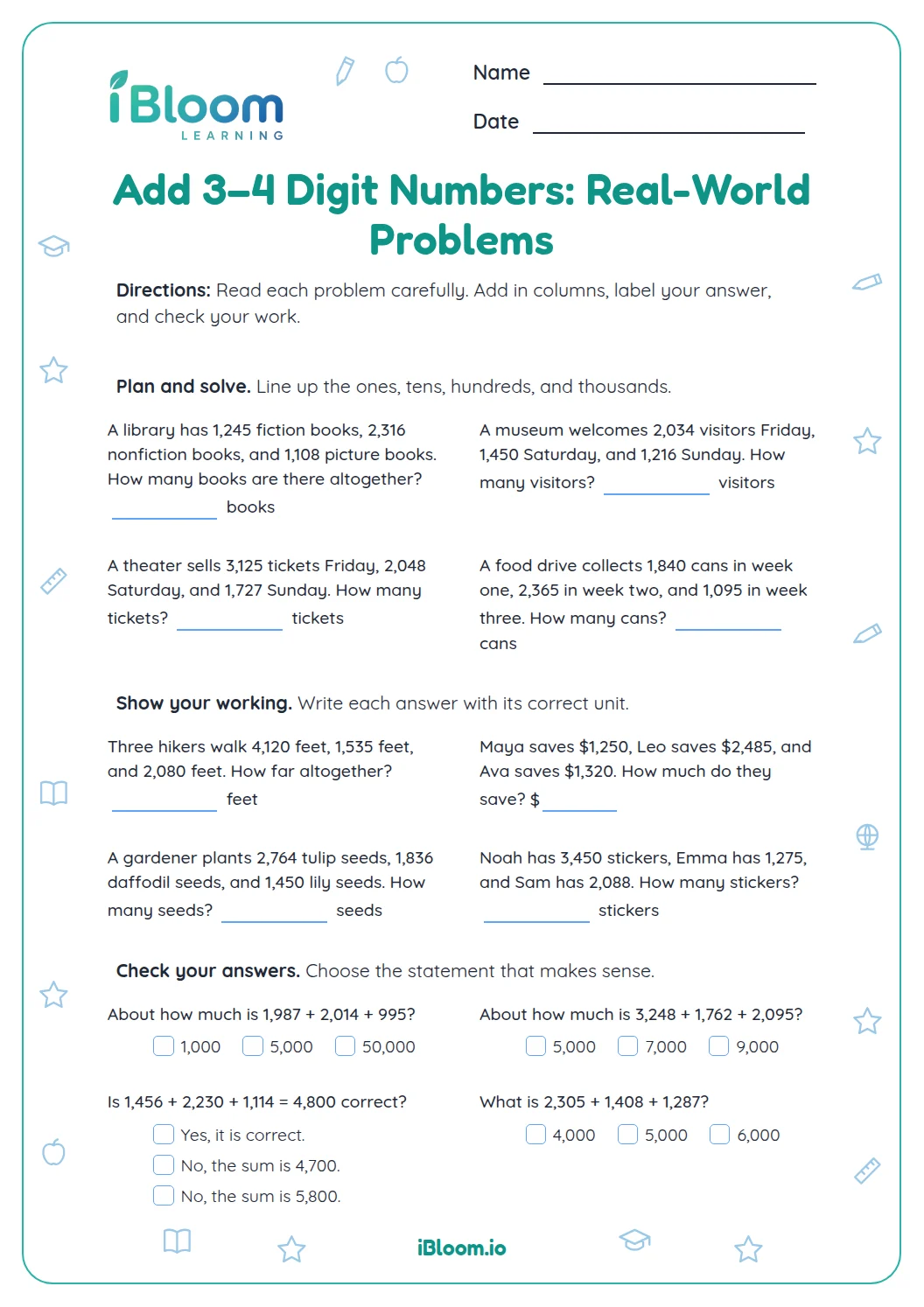
Fourteen problems build practice adding three four-digit addends while aligning each place value. The printable provides work space and an answer key for checking each result.
Aligned to CCSS.MATH.CONTENT.3.NBT.A.2
How can you work through the sheet?
In 1,246 + 2,135 + 1,402, align the thousands, hundreds, tens, and ones before adding each column.
What should learners check?
Use the place-value columns and directions printed on the worksheet. Work one item at a time, then use the key to locate and correct any calculation error. Use the answer key after completing the student pages to check each response.
How to use this worksheet
- 1Set each addend on its own row.
- 2Align thousands with thousands, hundreds with hundreds, tens with tens, and ones with ones.
- 3Add the ones and record any regrouping.
- 4Continue through tens, hundreds, and thousands.
- 5Check the total by estimating or adding the addends in a different order.
Common mistakes and quick fixes
The mistake
Shifting a digit into the wrong column: align the final digits in the ones column.
The fix
align the final digits in the ones column.
The mistake
Dropping a regrouped value: add it to the next column.
The fix
add it to the next column.
The mistake
Adding only two rows: include all three addends in each column total.
The fix
include all three addends in each column total.
Use place-value algorithms to add whole numbers, including four-digit sums.
On this sheet:
Show the official wordingHide the official wording
Fluently add and subtract within 1000 using strategies and algorithms based on place value, properties of operations, and/or the relationship between addition and subtraction.
What to practice next
Make more practice
Further reading
Questions parents and teachers ask
How many questions are included?
The worksheet has 14 problems in two sets. Each problem asks learners to add three four-digit numbers, and an answer key follows the student pages. Encourage the learner to write each step clearly and review the relevant columns or fraction parts when checking.
Why are four-digit numbers used?
Each addend has four places, so learners practice aligning ones through thousands. Some totals exceed 9,999, giving practice recording a carry into the next place. Encourage the learner to write each step clearly and review the relevant columns or fraction parts when checking.
What is the first step for column addition?
Write each number on its own row and align digits by place value. Starting with the ones column makes it easier to track regrouping from right to left. Encourage the learner to write each step clearly and review the relevant columns or fraction parts when checking.
How can a learner check a sum?
Estimate the addends to get a reasonable range, then compare the exact total with the answer key. Recheck each column if the result differs. Encourage the learner to write each step clearly and review the relevant columns or fraction parts when checking.
Does the key show the completed totals?
Yes. The answer key lists the total for each of the 14 expressions so learners or adults can check completed work. Encourage the learner to write each step clearly and review the relevant columns or fraction parts when checking.