


About this worksheet
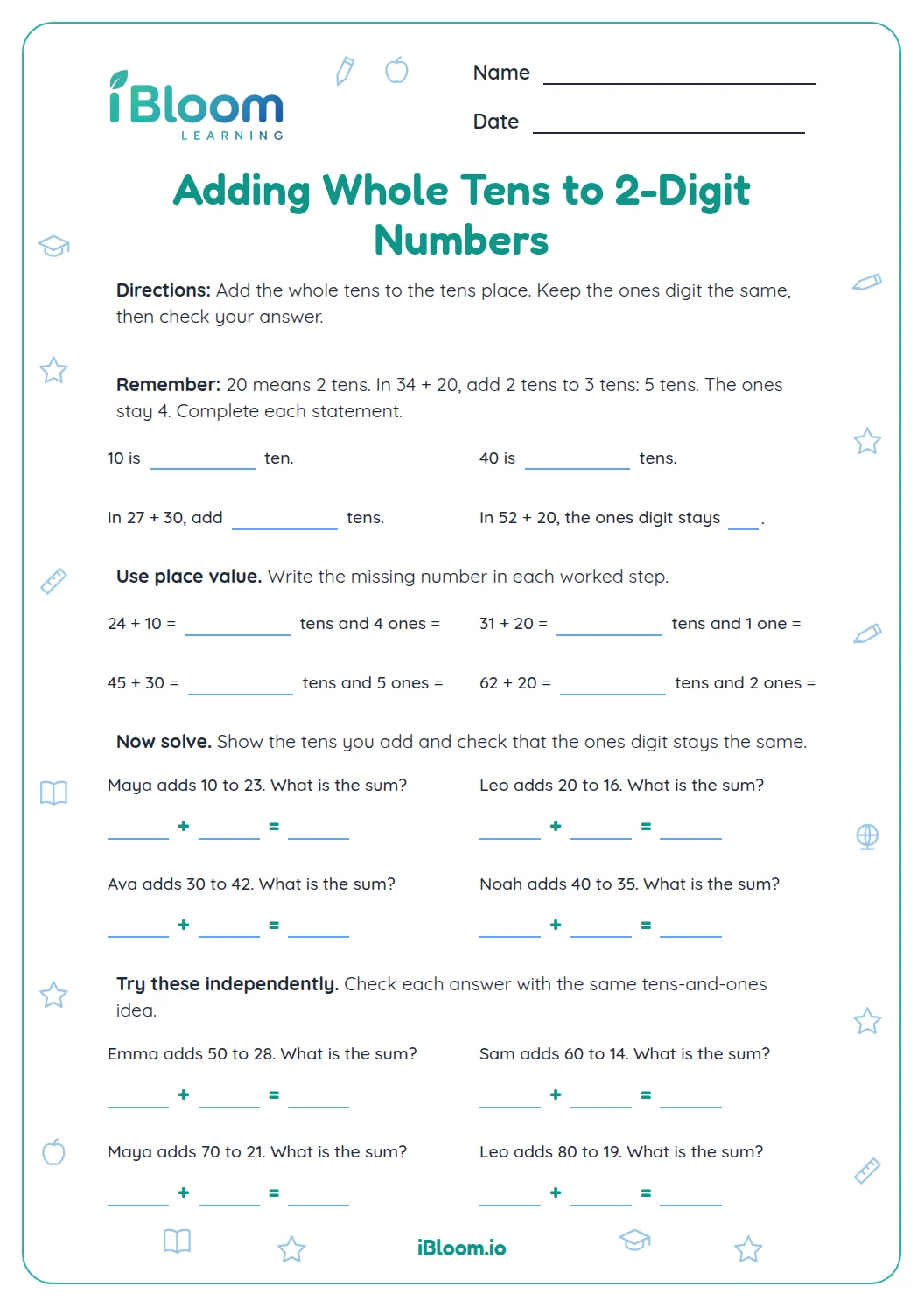
This Grade 3 guided practice focuses on adding whole tens to two-digit numbers. Students first identify the tens and ones in each starting number and the number of tens being added; the sum has its own blank. They then practice mental addition and apply it in book-count stories. The steps make the place-value change visible and avoid confusing an intermediate tens value with the final sum. This page reviews the whole-tens mental strategy in CCSS 2.NBT.B.5 and includes an answer key.
Aligned to 2.NBT.B.5
How does place value help with adding whole tens?
A whole ten changes the tens part of a two-digit number and leaves its ones part unchanged. For 34 + 20, 34 is 3 tens and 4 ones. Add 2 tens to 3 tens to get 5 tens; 5 tens and 4 ones make 54.
The first part asks students to record the number of tens in the addend and in the sum as separate values. That distinction makes each blank’s meaning clear.
What comes after the guided examples?
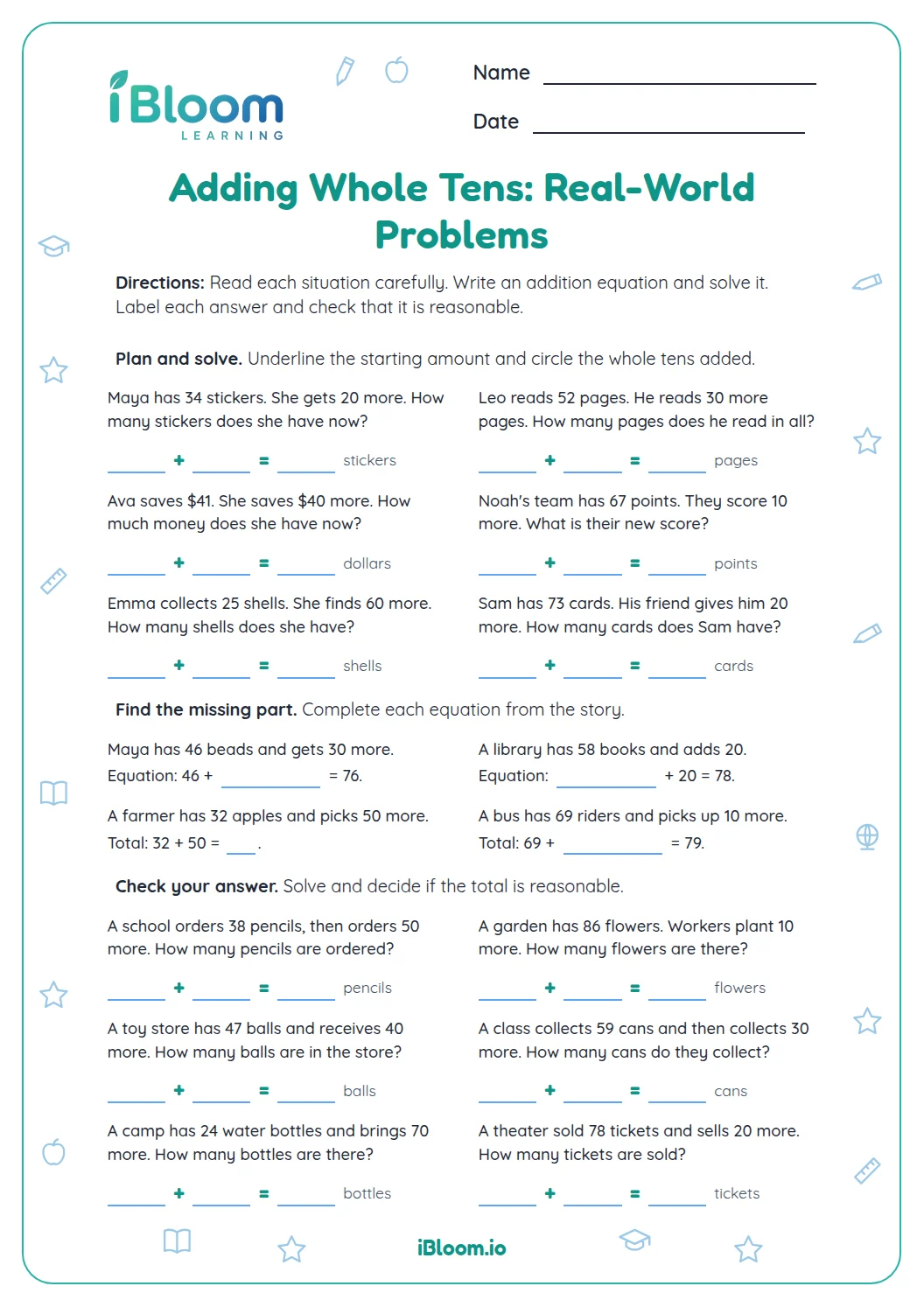
Part B practices the same idea mentally with a single answer. Part C uses short stories about adding books, so students connect the tens strategy to a real quantity.
How does place value solve 34 + 20?
Write 34 as 3 tens and 4 ones. Add 2 tens to get 5 tens and 4 ones, which is 54.
How to use this worksheet
- 1Read the part heading and note what each question asks you to find.
- 2Write or say an equation using the numbers and operation in the prompt.
- 3Solve carefully, keeping track of place value and what each blank represents.
- 4Use the answer key to check, then correct any equation that does not balance.
Common mistakes and quick fixes
The mistake
Writing the final sum in a blank that asks for tens.
The fix
Read the label beside each blank: a tens blank takes the count of tens, while a sum blank takes the full number.
The mistake
Changing the ones digit when adding a whole ten.
The fix
Keep the ones unchanged and increase the tens by the number of tens added.
The mistake
Using a number without checking what the blank represents.
The fix
Read the words and labels beside the blank, then write the requested value or unit.
Common Core alignment
This worksheet practices 2.NBT.B.5 with place-value addition and subtraction problems.
Use place-value strategies to add whole tens to two-digit numbers within 100.
On this sheet: The worksheet adds whole tens to two-digit numbers within 100 and identifies the tens and ones.
Show the official wordingHide the official wording
Fluently add and subtract within 100 using strategies based on place value, properties of operations, and/or the relationship between addition and subtraction.
What to practice next
Make more practice
Further reading
Questions parents and teachers ask
What changes when you add whole tens?
The tens count increases while the ones count stays the same. For 34 + 20, add 2 tens to 3 tens to make 5 tens; the 4 ones remain. The sum is 54. Students can use the example and then try another item independently.
Why are there separate place-value blanks?
Each blank asks for a different value: the full sum, a count of tens, or the final number. In question 1, 34 is 3 tens and 4 ones; after adding 2 tens, the sum is 5 tens and 4 ones, or 54. Students can use the example and then try another item independently.
What practice comes after the guided steps?
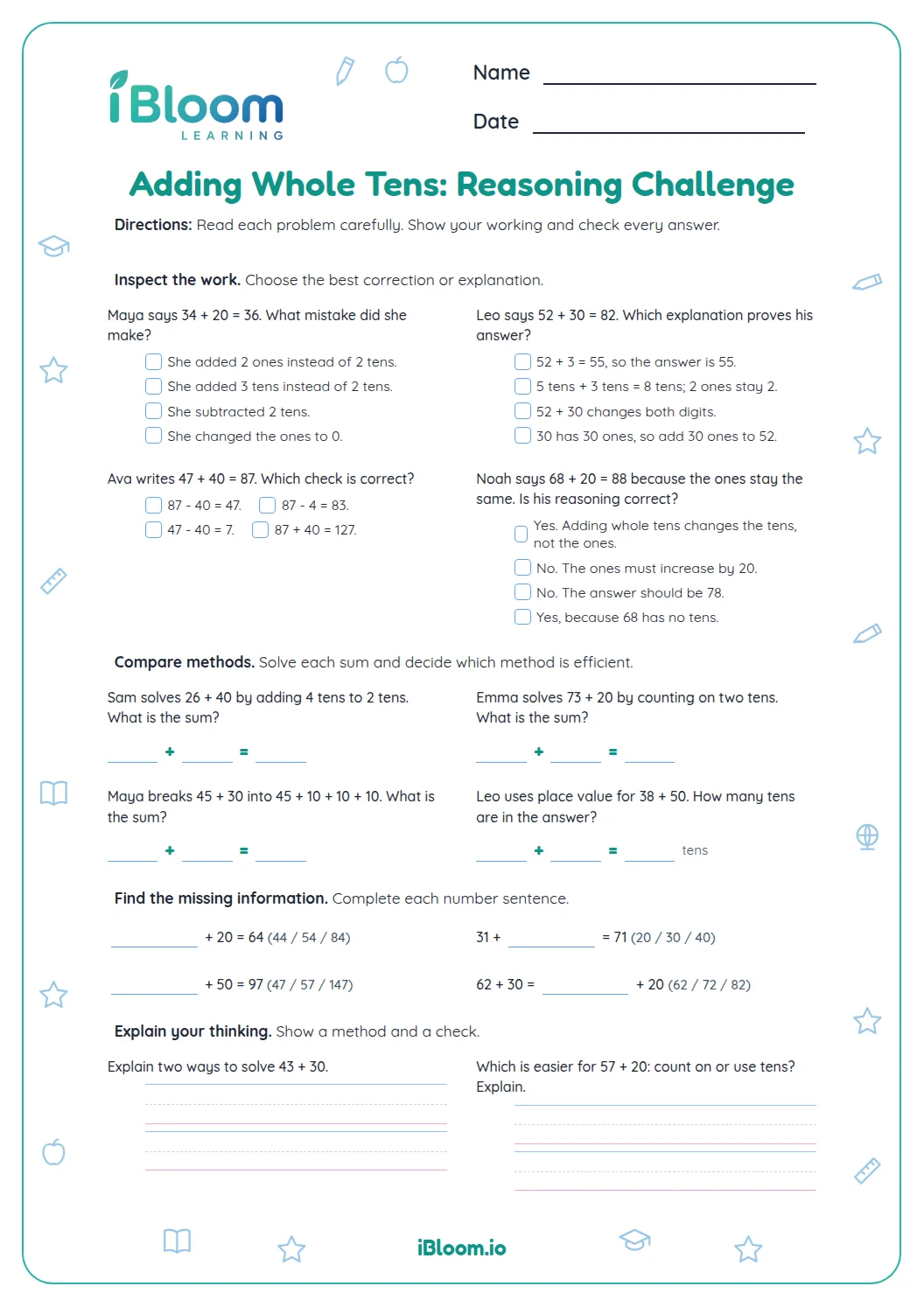
The sheet moves from decomposing numbers into tens and ones to mental addition, then to short book-count stories. This sequence lets students use the same whole-ten strategy in a number sentence and a familiar context. Students can use the example and then try another item independently.
How can a student check a whole-ten sum?
Compare the ones digit before and after adding, then check the tens. In 63 + 20, the 3 ones remain and the tens increase from 6 to 8, making 83. Subtracting 20 from 83 returns 63. Students can use the example and then try another item independently.
What does the answer key include?
The separate key gives the ordered values for each guided place-value item and the sums for mental practice and stories. For multi-blank questions, read the entries in the same order as the blanks. Students can use the example and then try another item independently.