




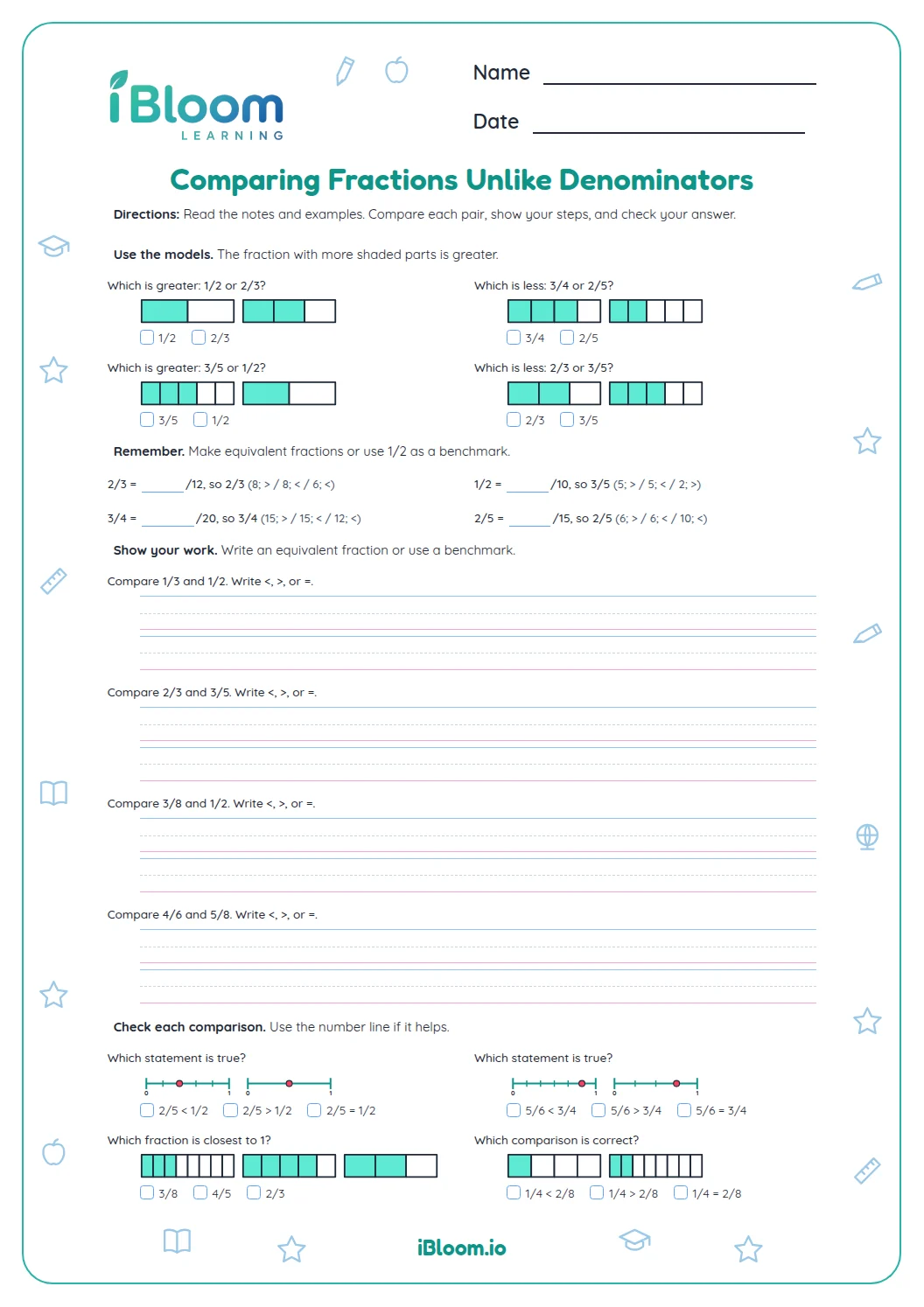
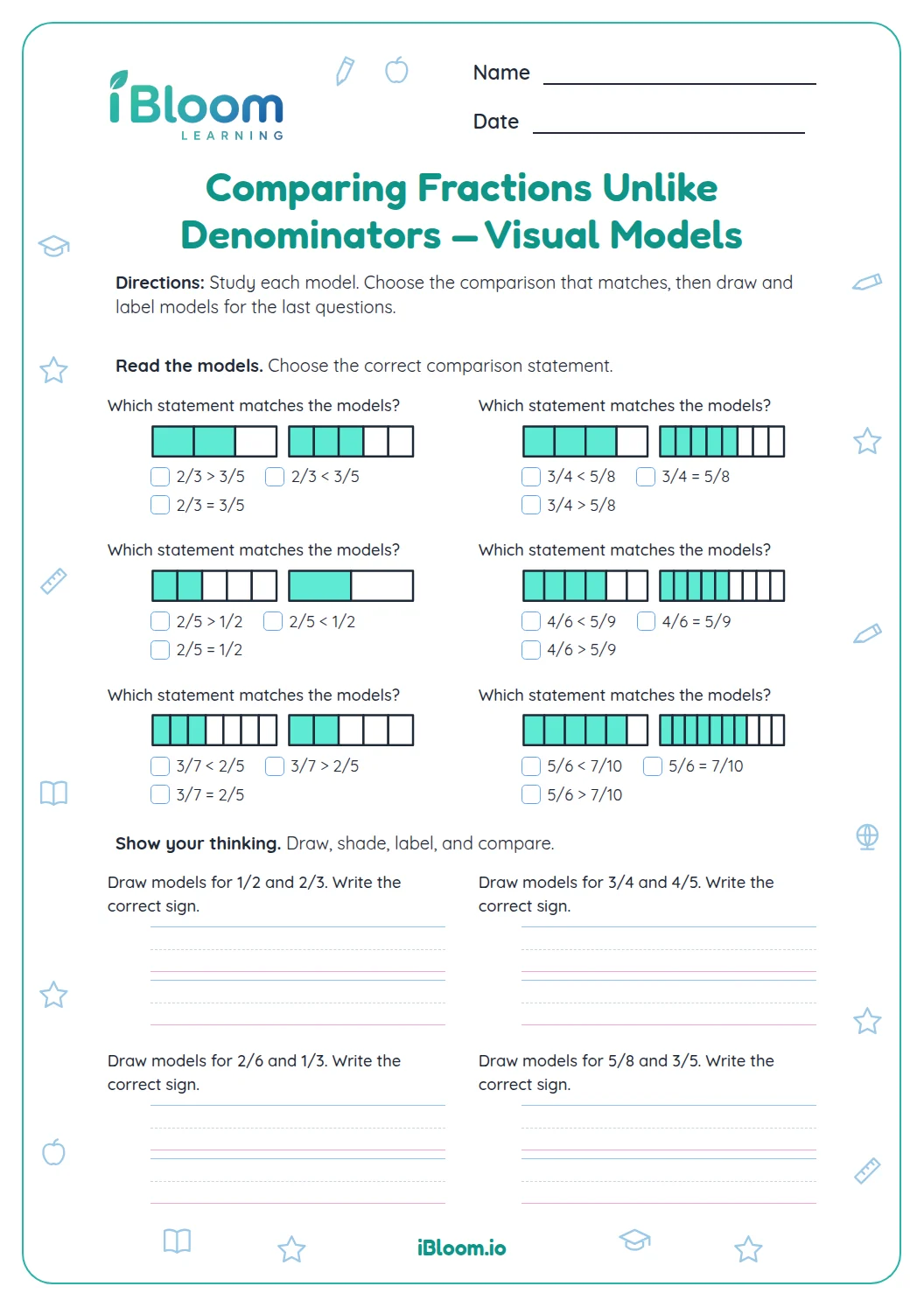
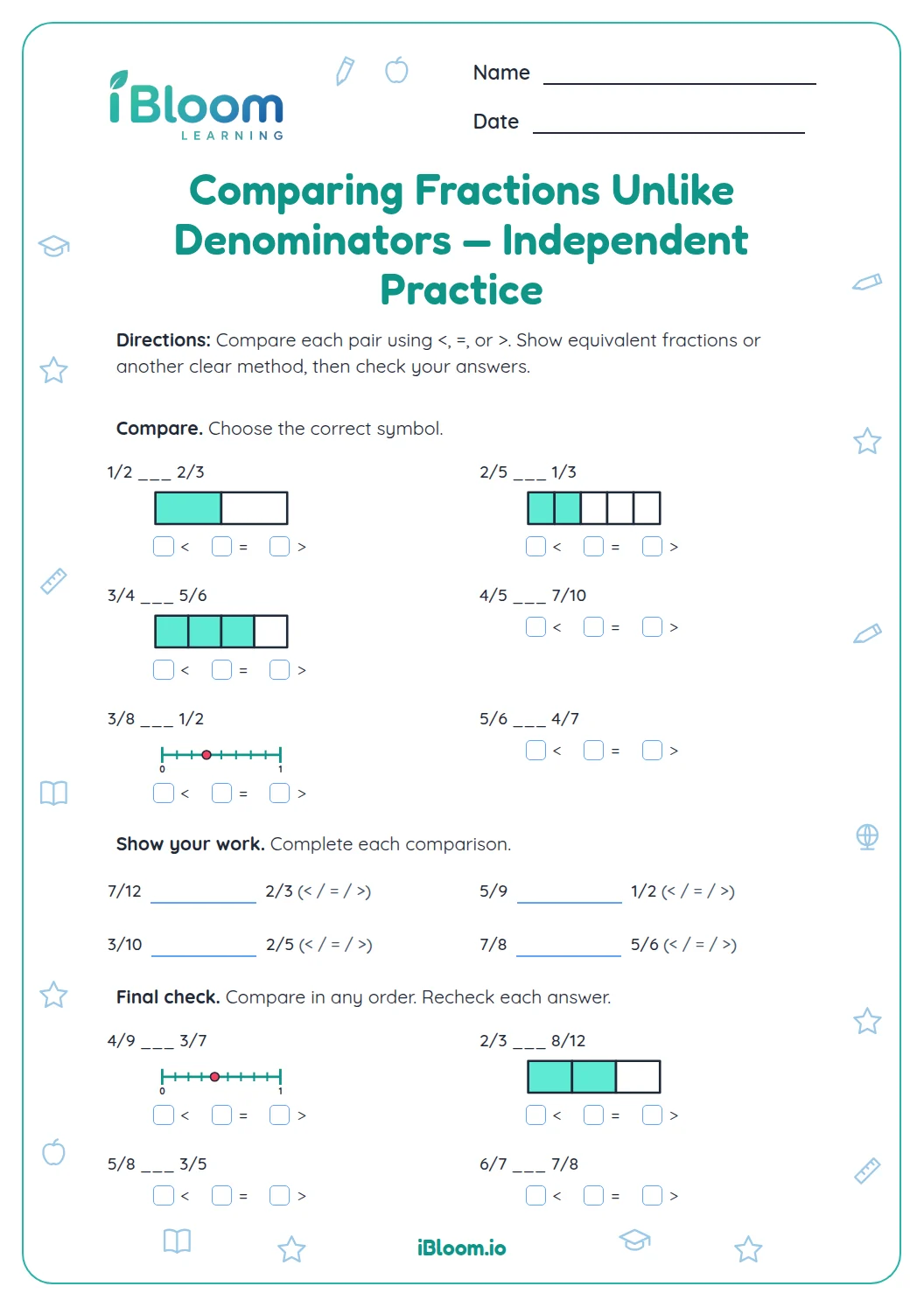


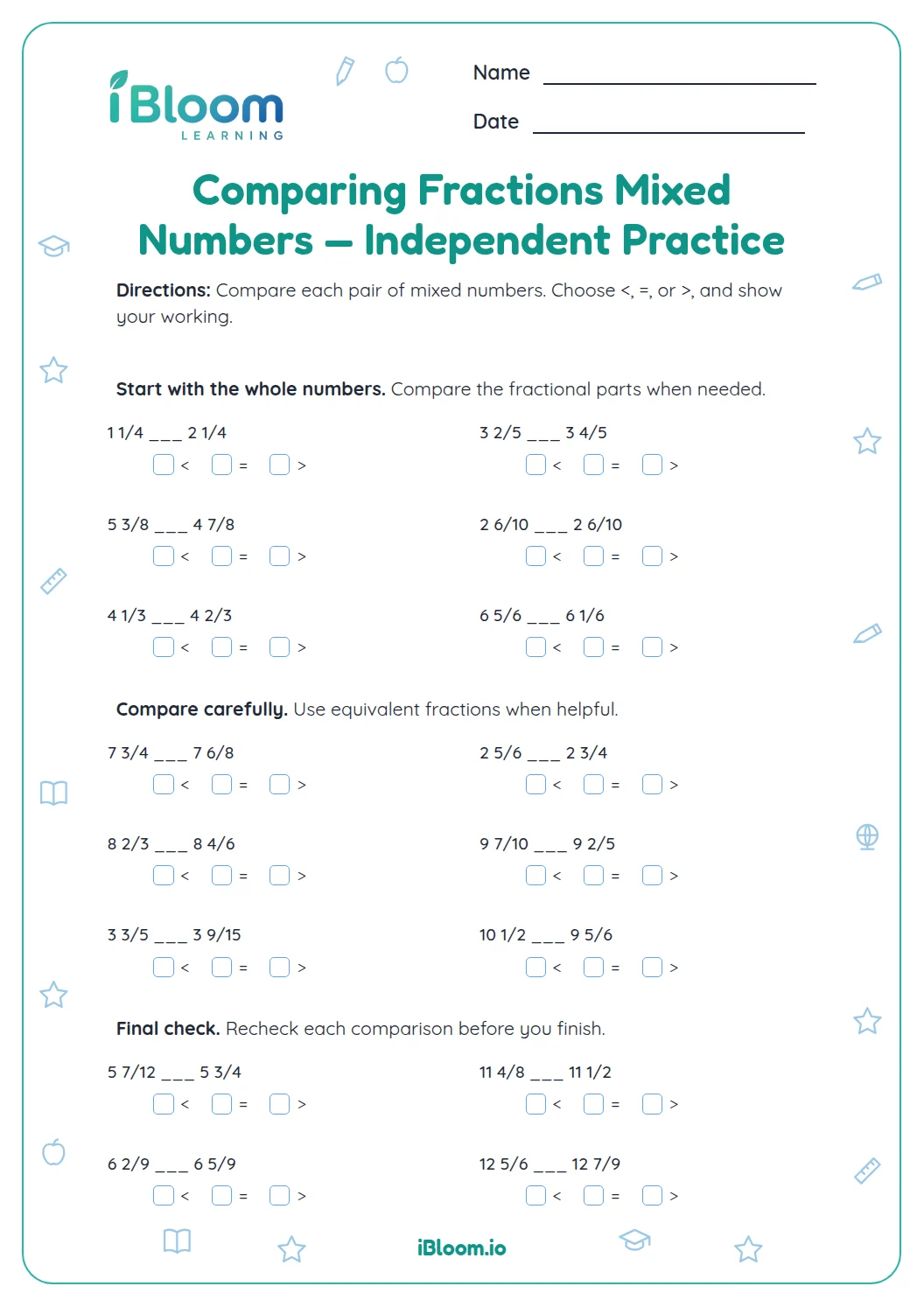


About this worksheet
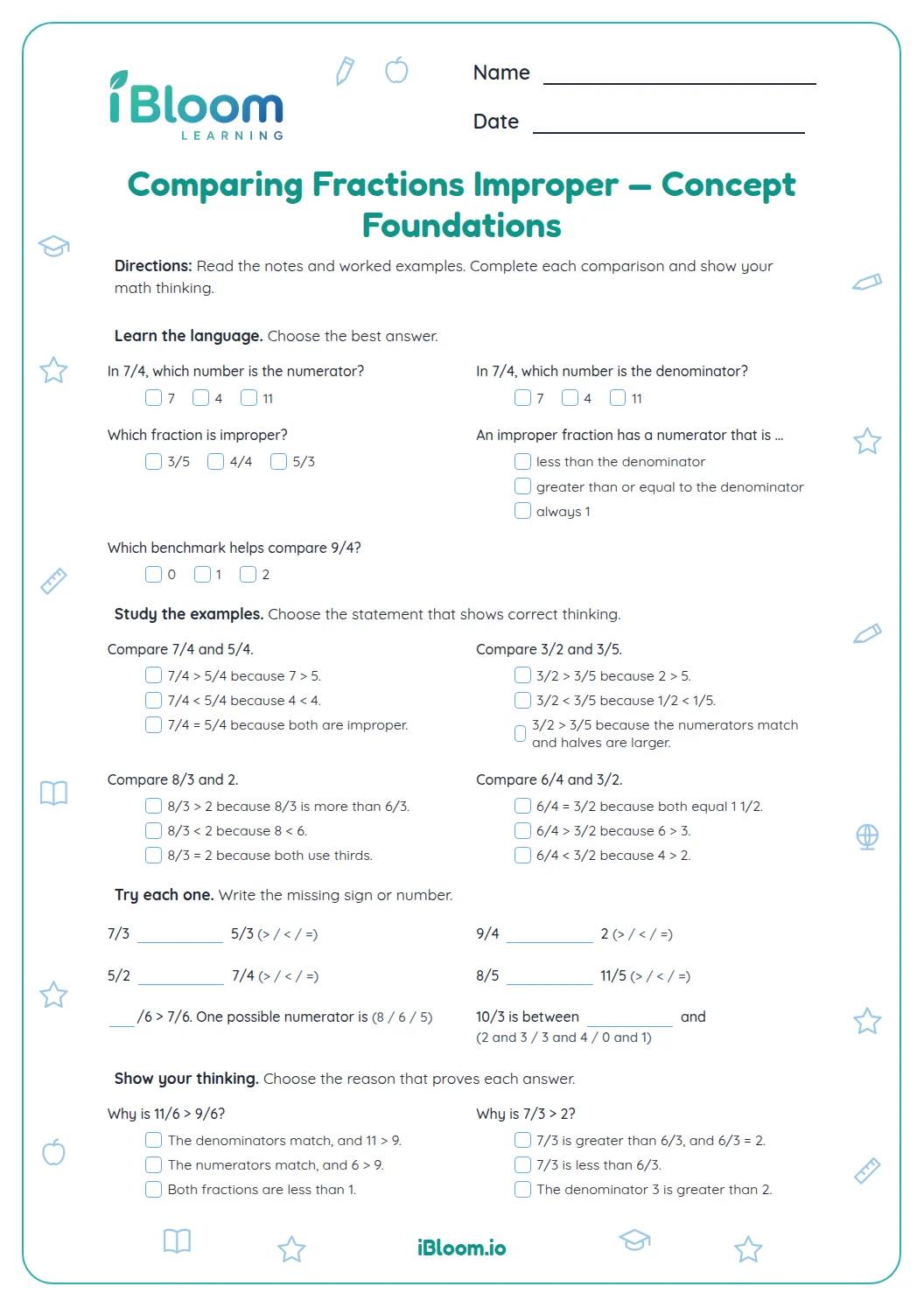
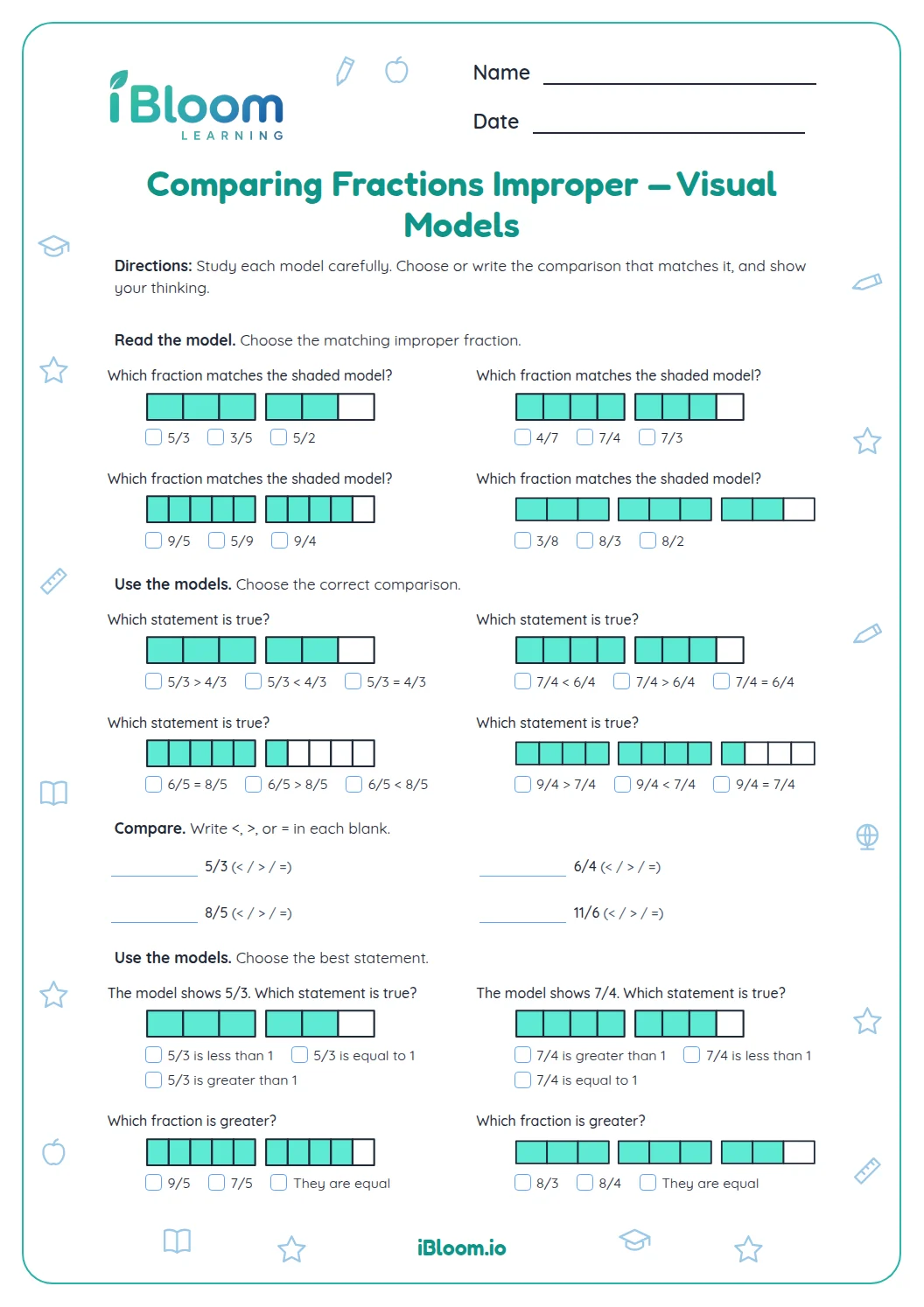
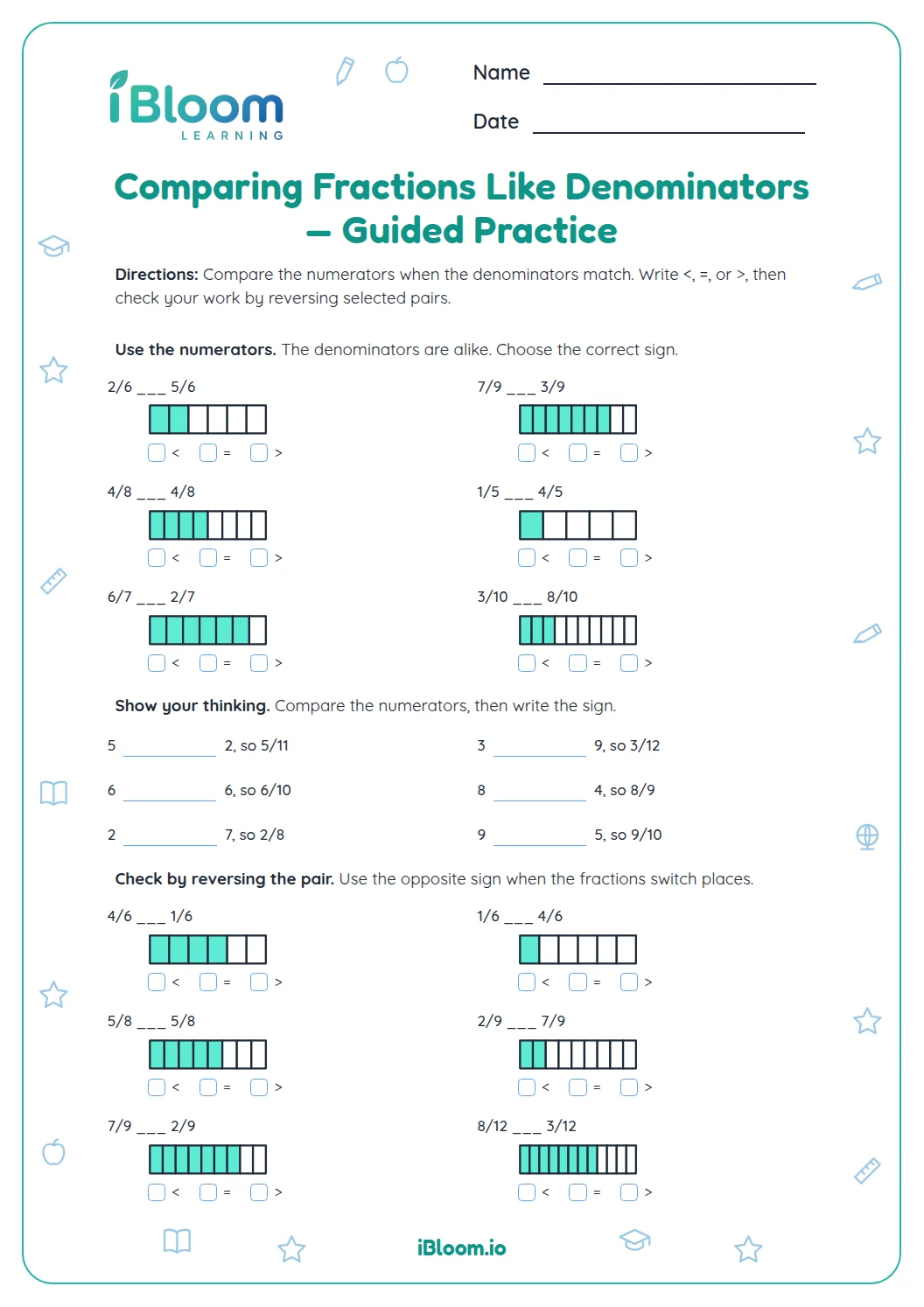
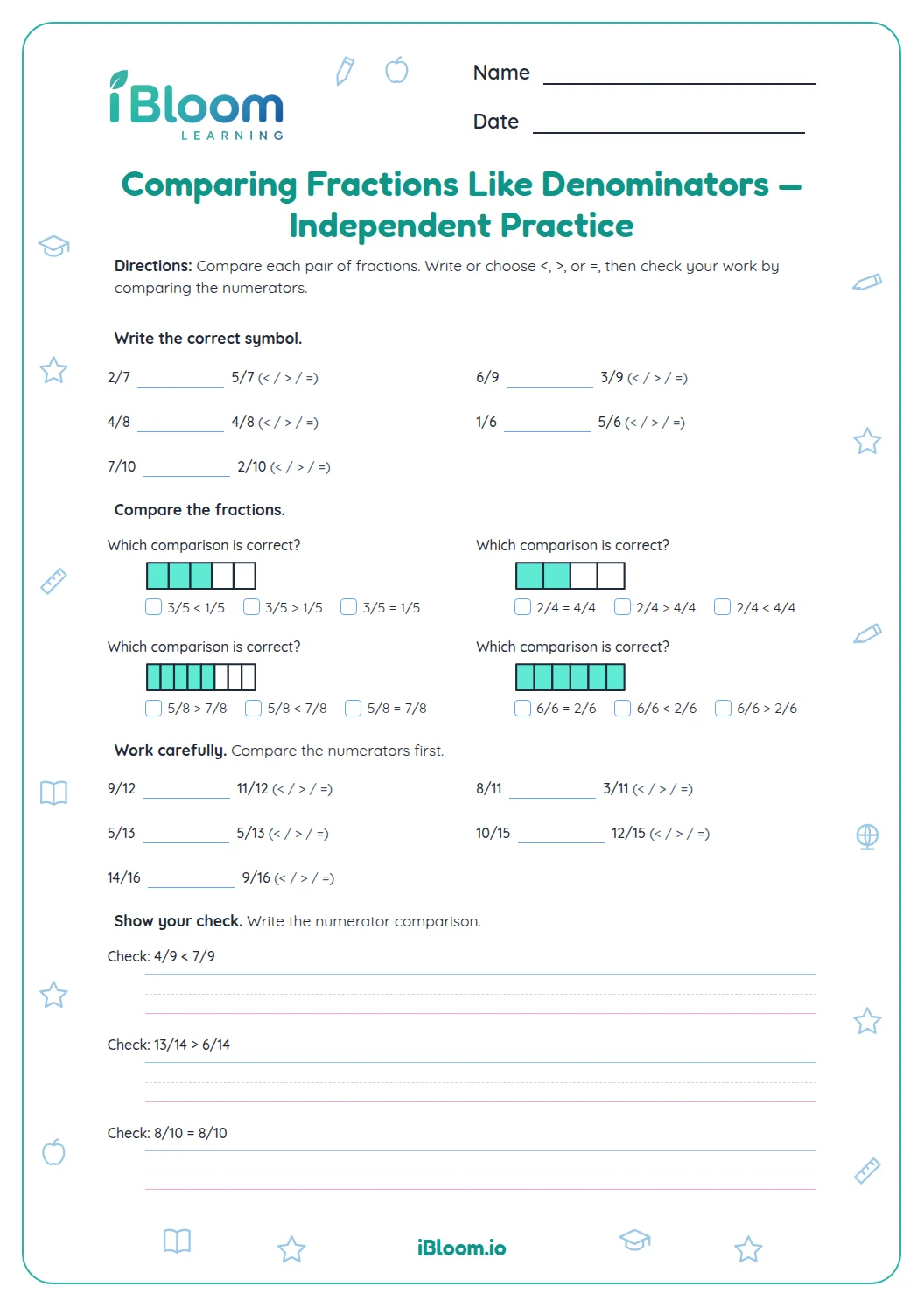
This printable gives Grade 3 learners practice comparing fractions greater than one, including values such as 11/6 and 2. Fifteen questions move from comparison signs to reasoning and short contexts. A fraction bar and number line make selected values visible, and the separate key supports checking. The questions practice comparing fractions and recording the result with >, =, or <.
Aligned to 4.NF.A.2
How can a whole number help compare fractions?
Rewrite the whole number using the fraction’s denominator. Since 2 = 12/6, 11/6 is less than 2. Comparing equal-sized pieces makes the relationship visible.
Question 1 checks the common-denominator idea: 2 = 12/6, so 11/6 < 12/6.
- 12 = 12/6
- 211/6 < 12/6
- 3So 11/6 < 2
Why must both fractions refer to the same whole?
A comparison is meaningful when the wholes are the same size. The sheet uses same-sized units such as cups and pans so the fraction values can be compared fairly.
What kinds of comparisons are included?
The 15 questions include comparison signs, a visual number line, equal whole values, and two explanations to evaluate. The answer key is separate.
How to use this worksheet
- 1Rewrite a whole number with the denominator in the fraction.
- 2Compare values using the same-sized parts.
- 3Use the number line to check which value lies farther right.
- 4Choose >, <, or = only after deciding which value is greater.
- 5Read each context for the unit and compare like amounts.
Common mistakes and quick fixes
The mistake
Comparing numerators when denominators differ
The fix
Rename one fraction so both have the same denominator, then compare.
The mistake
Assuming every improper fraction is greater than 2
The fix
Divide the numerator by the denominator or compare with equivalent whole numbers.
The mistake
Using > in the wrong direction
The fix
Read the sign as “greater than” from left to right.
Common Core alignment
The questions use fraction comparisons, models, and symbols.
Compare fractions and whole numbers, record the relation, and justify it.
On this sheet: Learners compare fractions with whole numbers and other fractions, using symbols, models, and reasoning.
Show the official wordingHide the official wording
Compare two fractions with different numerators and different denominators, e.g., by creating common denominators or numerators, or by comparing to a benchmark fraction such as 1/2. Recognize that comparisons are valid only when the two fractions refer to the same whole. Record the results of comparisons with symbols >, =, or <, and justify the conclusions, e.g., by using a visual fraction model.
What to practice next
Make more practice
Further reading
Questions parents and teachers ask
Why is 11/6 less than 2?
It is less because 2 equals 12/6, and 11 sixths is one sixth less than 12 sixths. Question 1 asks for this comparison directly. The denominator tells the size of each piece; comparing the numerators is valid after both values are written in sixths. It is less because the equal-sized sixths make the difference easy to see.
Can an improper fraction equal a whole number?
Yes. For example, 8/4 equals 2 because eight fourth-size pieces make two groups of four. Question 5 checks that equivalence. A fraction can also be more or less than a whole, depending on how its numerator compares with the denominator. Use the given whole as a benchmark, then compare each fraction with that amount.
What does the number line help show?
The number line puts fractions and whole numbers on one scale, so a point farther right has the greater value. In question 3, point A marks 10/4 and point B marks 11/6. Their positions let learners check the comparison by location. The points are labeled A and B, while the child supplies the comparison sign.
What should my child do with a comparison sign?
Use > when the left value is greater, < when it is smaller, and = when both values match. The prompt names the two values and asks for just one sign, so the key can be checked quickly. Equivalent fractions make comparisons possible even when the denominators start out different.
Why do some questions use cups or ribbons?
Those contexts give the fractions the same unit, so comparing the amounts is sensible. The fraction comparison still depends on equal-sized units, such as fourths compared with fourths or equivalent fractions. Both ribbon lengths use feet, so their fraction values describe the same unit.
Is an answer key included?
Yes. The separate answer key lists the sign or choice for every question. For explanation items, it records the correct conclusion so an adult can discuss why the other reasoning does not work. An adult can use the key to check the sign and review the reasoning together.