




About this worksheet
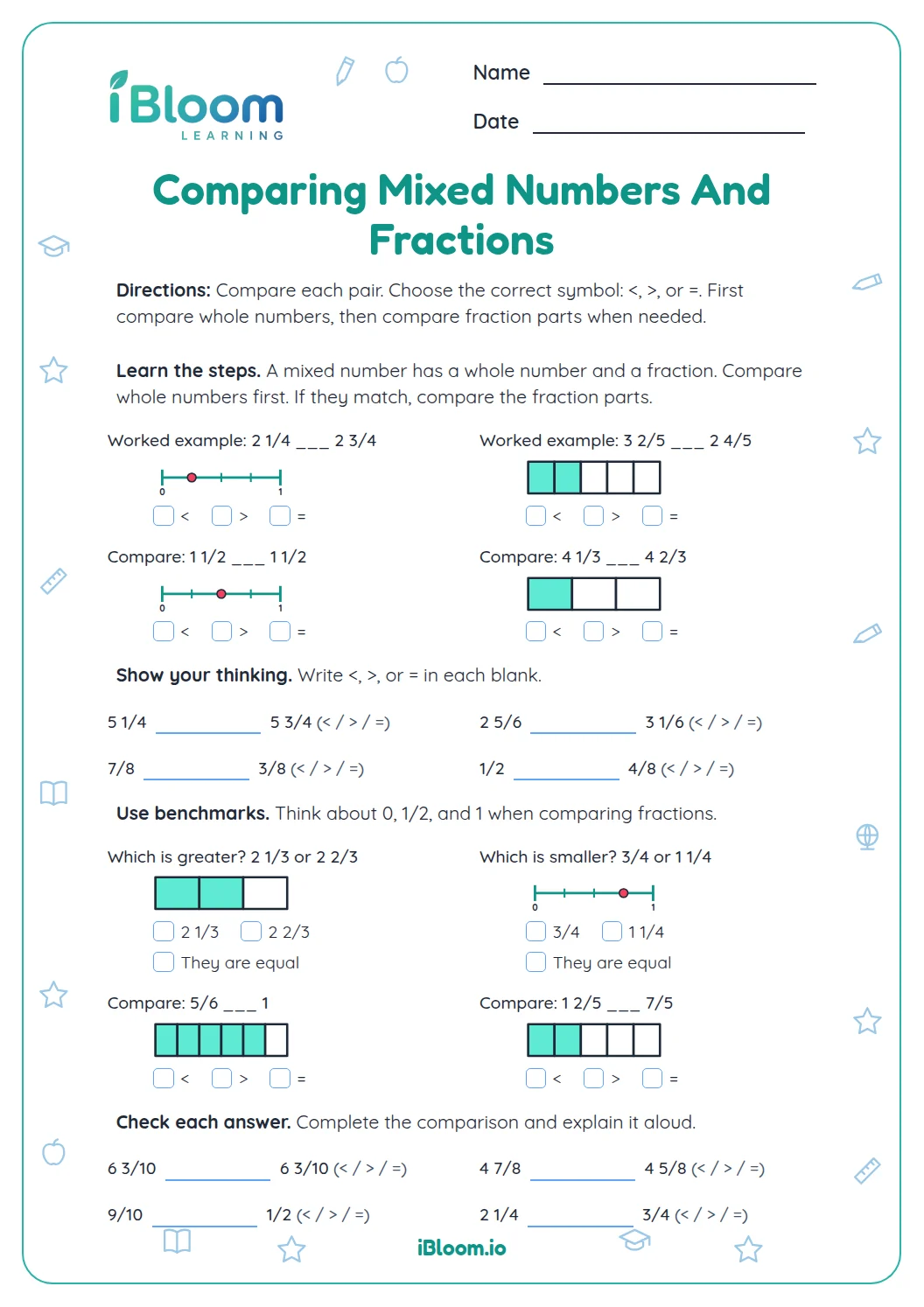
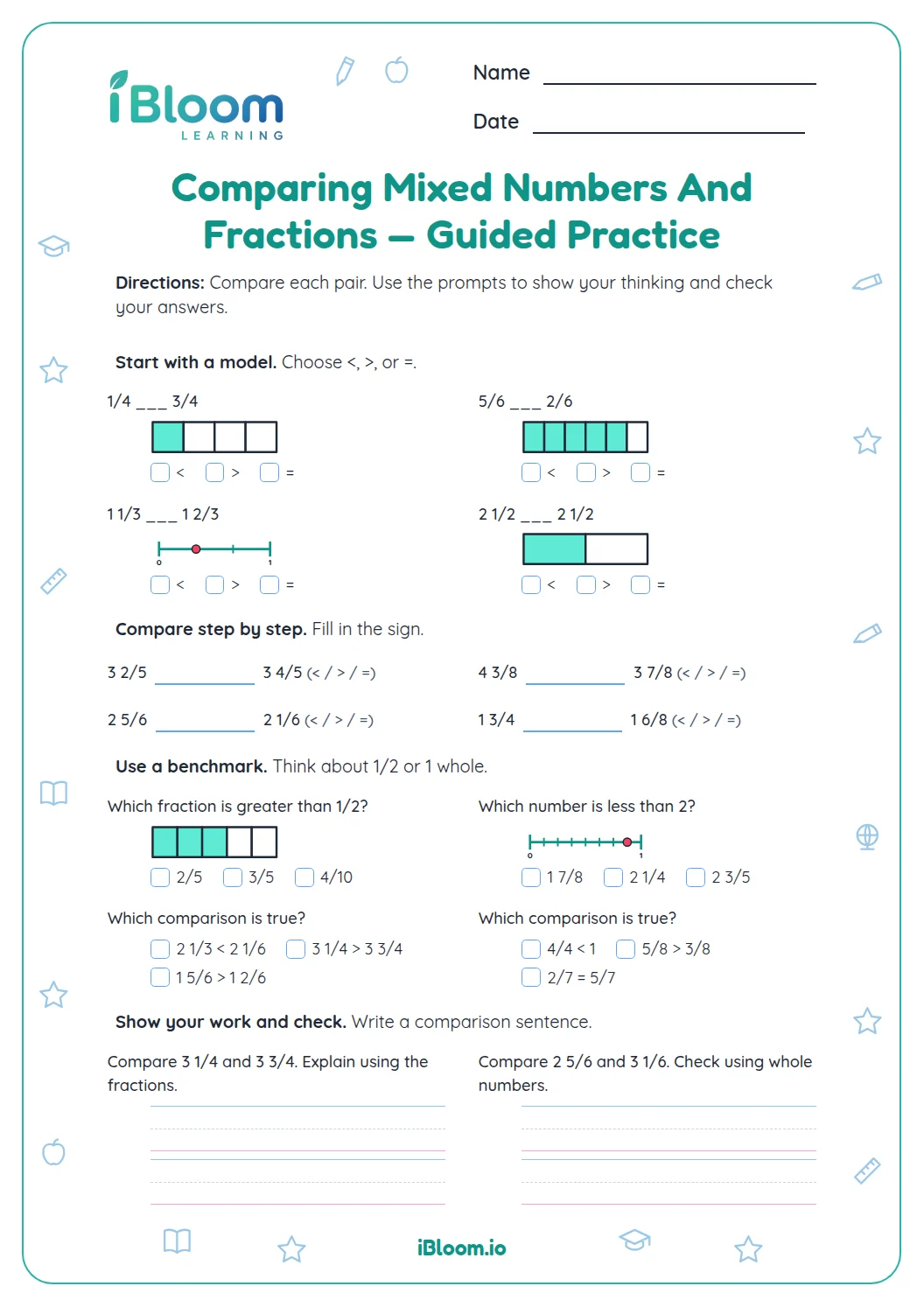
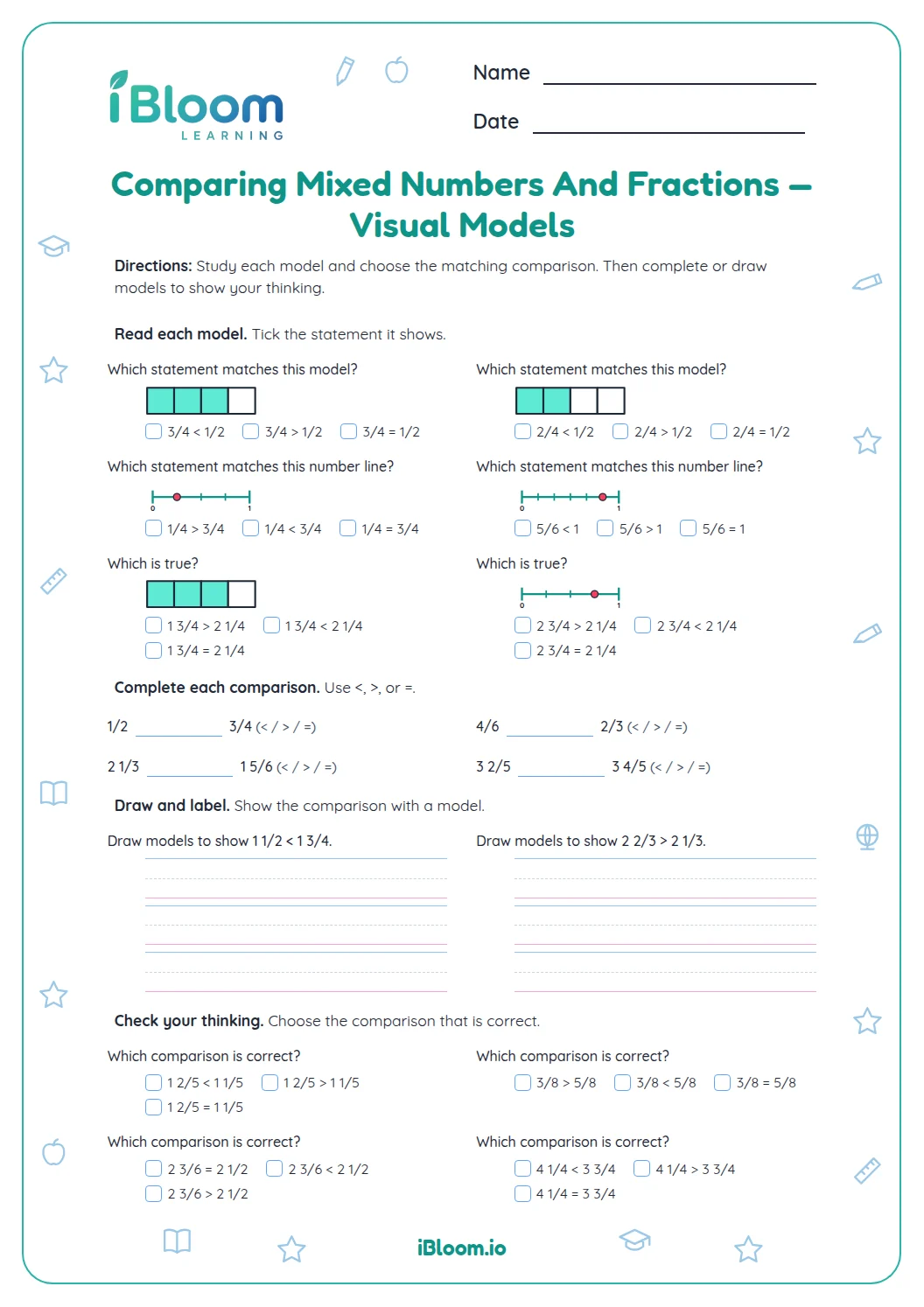
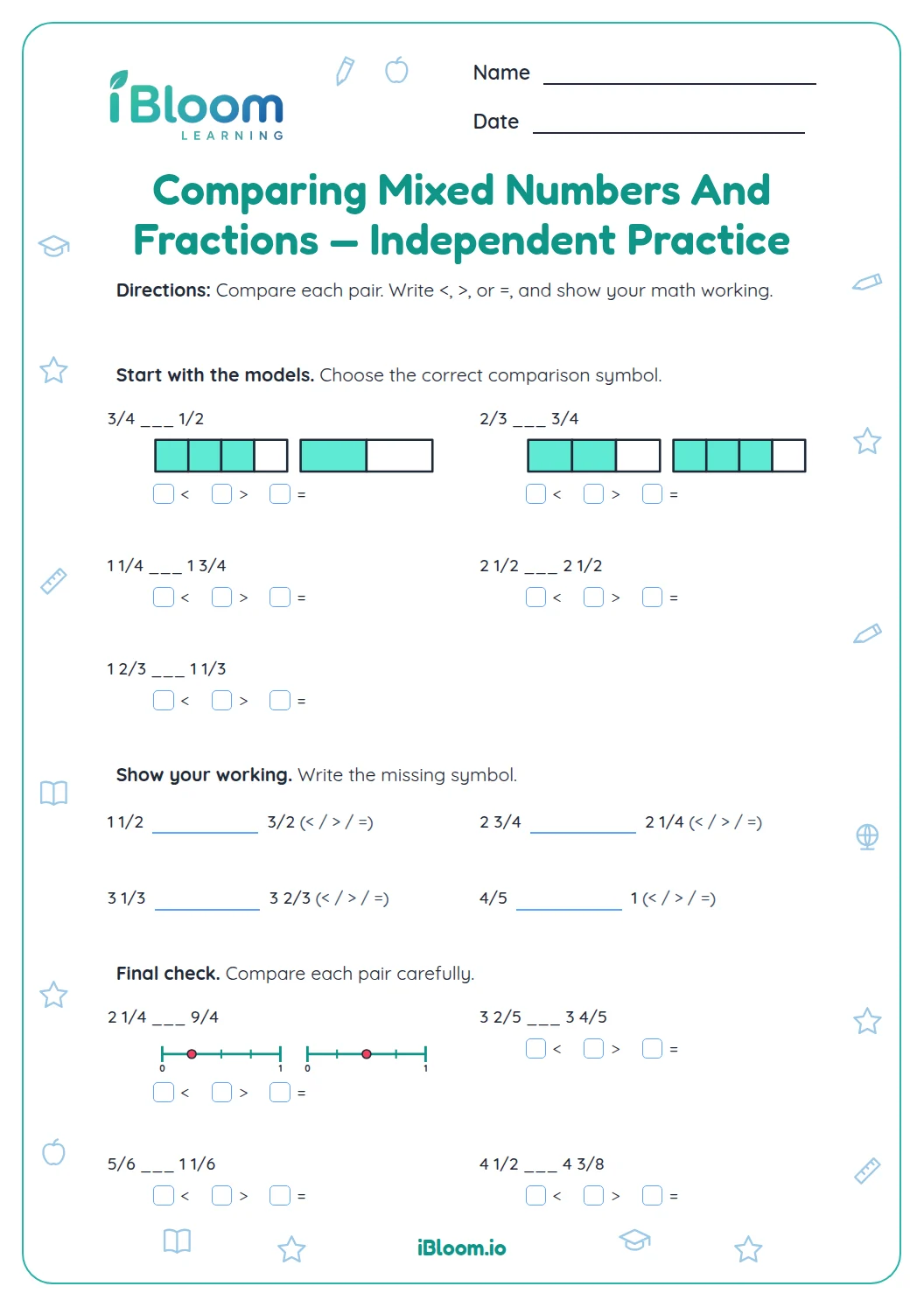
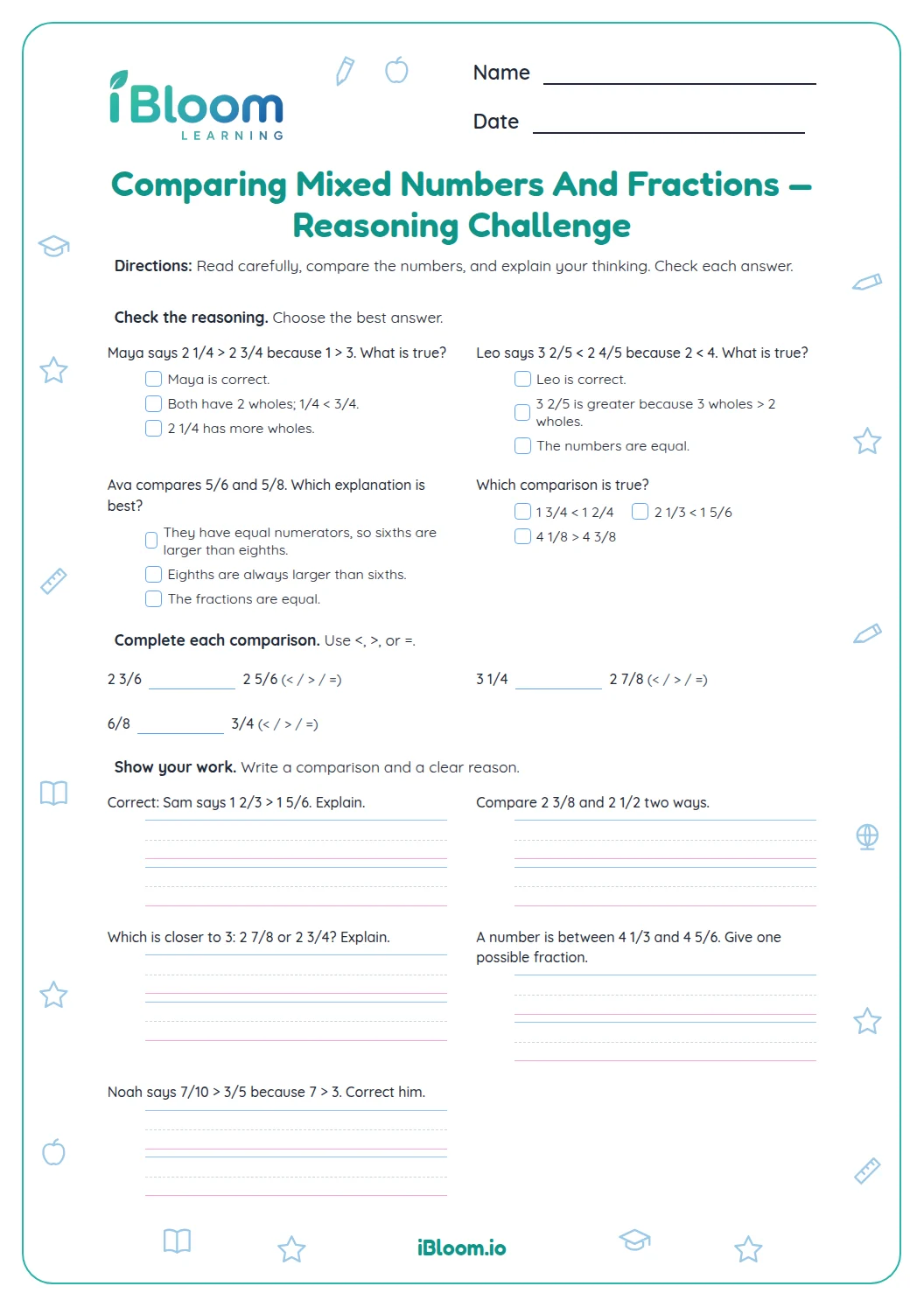
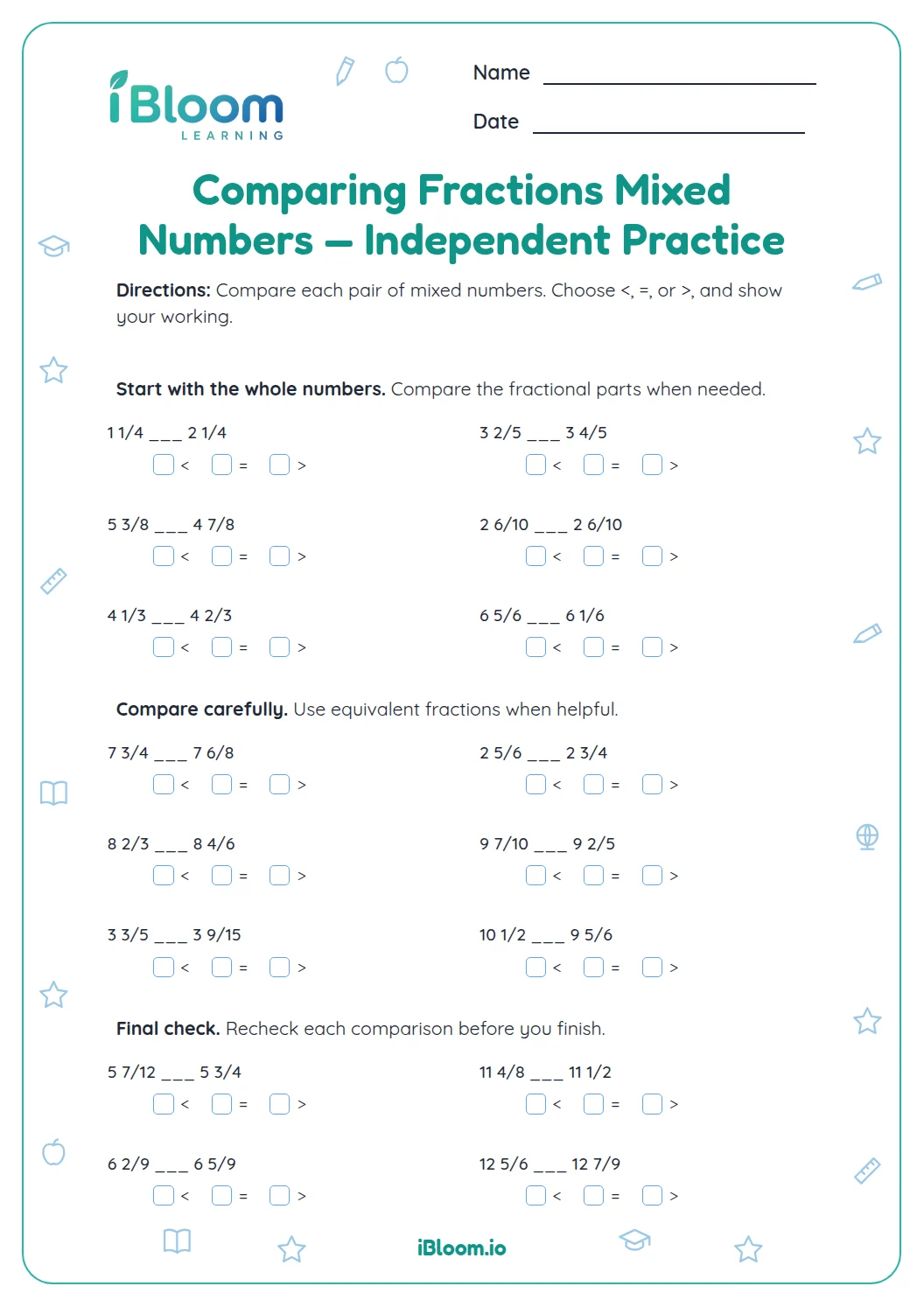
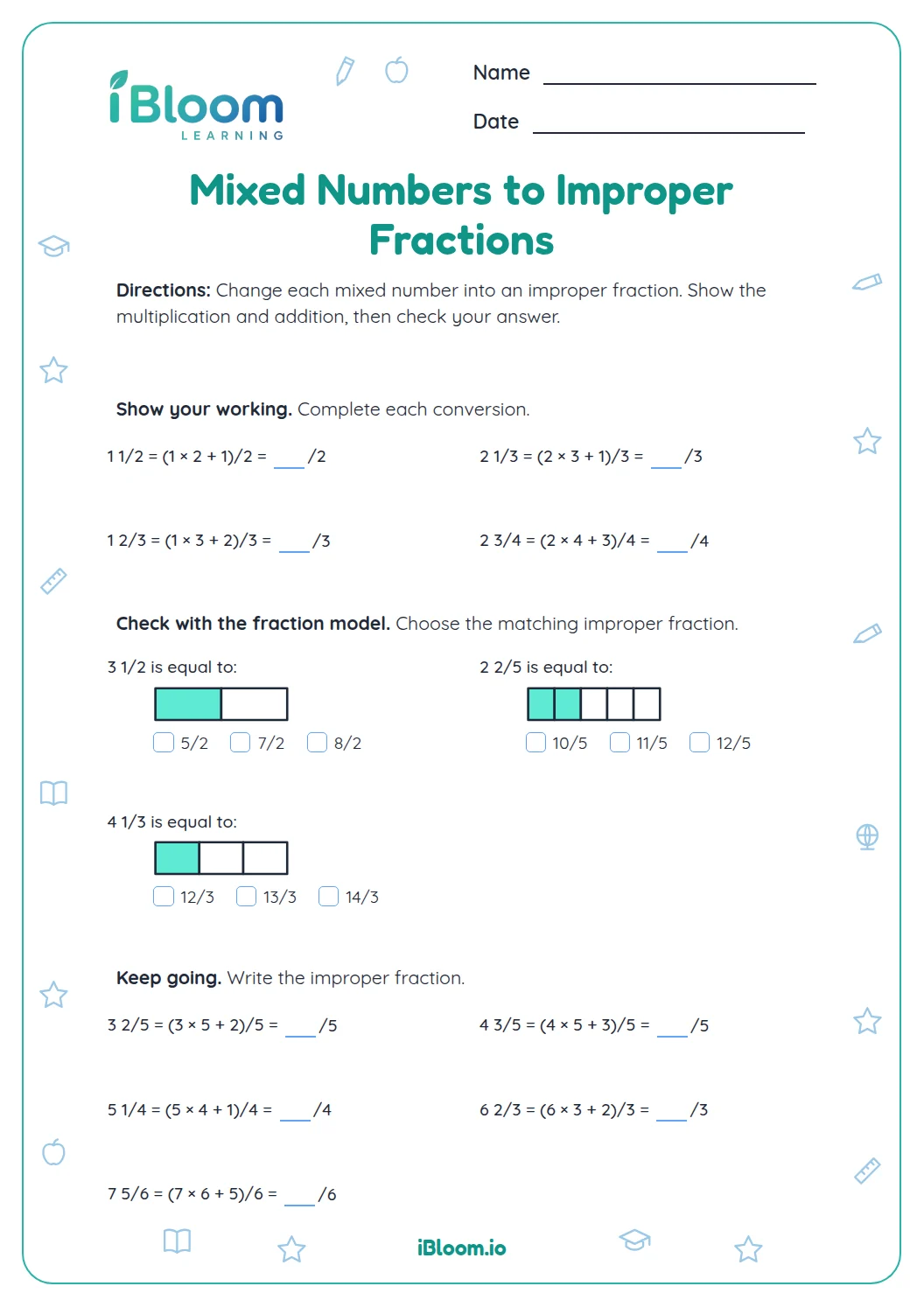
This printable gives Grade 3 learners 14 questions about comparing mixed numbers and fractions. Children compare measures such as 1 7/8 liters and 2 liters, find equivalent improper fractions, and check whether a comparison is true. The answer key includes the correct comparisons and conversions. The fraction denominators stay within thirds, fourths, sixths, and eighths.
How can you compare a mixed number with a whole number?
Compare the fractional part with what is needed to reach the next whole. For question 1, 1 7/8 is 1 + 7/8, while 2 is 1 + 8/8. Since 7/8 is less than 8/8, the pitcher holds less than 2 liters.
- 11 7/8 = 1 + 7/8
- 22 = 1 + 8/8
- 37/8 < 8/8, so 1 7/8 < 2
How do you rewrite a mixed number as a fraction?
Multiply the whole number by the denominator, then add the numerator. Keep that denominator. For 1 7/8, 1 × 8 + 7 = 15, so the improper fraction is 15/8.
What kinds of questions are on the sheet?
The 14 questions are arranged in three parts: comparisons, equivalent fraction forms, and a claim to check. The examples use measures of length, capacity, and weight.
How to use this worksheet
- 1Read the whole number and fractional part together.
- 2Name the fraction pieces that complete the next whole.
- 3Compare the fractional parts or rewrite both amounts in the same form.
- 4For mixed-to-improper conversion, multiply the whole by the denominator and add the numerator.
- 5Check whether the result makes sense for the original amounts.
Common mistakes and quick fixes
The mistake
Changing the denominator during conversion.
The fix
Keep the denominator; multiply the whole by it, then add the numerator.
The mistake
Calling 1 7/8 greater than 2 because 7 is close to 8.
The fix
Compare it with 2 = 1 8/8; 7/8 is one eighth less.
The mistake
Reading 1 3/4 as 13/4.
The fix
Compute 1 × 4 + 3 to get 7/4.
What to practice next
Make more practice
Further reading
Questions parents and teachers ask
How many questions are included?
The worksheet has 14 questions in three parts. It covers comparisons, mixed-number conversions, and a claim to check. The included answer key gives the correct comparison or conversion for every item. The contexts include capacity, length, and weight, so the fractions describe measurable amounts.
What fractions does the sheet use?
The questions use thirds, fourths, sixths, and eighths. These denominators let children compare familiar parts and convert mixed numbers without introducing decimal notation or fractions outside the stated Grade 3 range. The same-factor rule preserves the value while changing how many equal parts are named.
How do I change 1 7/8 into an improper fraction?
Multiply the whole number by the denominator, then add the numerator: 1 × 8 + 7 = 15. Keep the denominator 8, so 1 7/8 equals 15/8. This value is greater than 1 and less than 2. The denominator stays 8 because the original fraction is measured in eighths.
Does the worksheet include an answer key?
Yes. A separate answer key gives the answer to each of the 14 questions, including comparison choices and improper fractions. Children can finish the page first, then check one response at a time. The key is separate from the student questions, making it easy to check work after completion.
Can this be used for independent practice?
Yes. Each prompt asks one clear question and uses familiar measures. An adult can model question 1 by comparing 1 7/8 with 2 = 1 8/8 before the child works through the remaining items. Ask the child to explain which fraction is closest to the next whole before checking the key.