Free printable practice
Equivalent Fractions Numerators Missing Practice Activities
Grade 3 students find missing numerators in equivalent fractions using visual models, multiplication patterns, and careful fraction reasoning.
Free printable worksheet PDFs
Preview every available page, then download the free worksheet PDF for home, homeschool, tutoring, or classroom practice.
Preview the exact activity before downloading it.
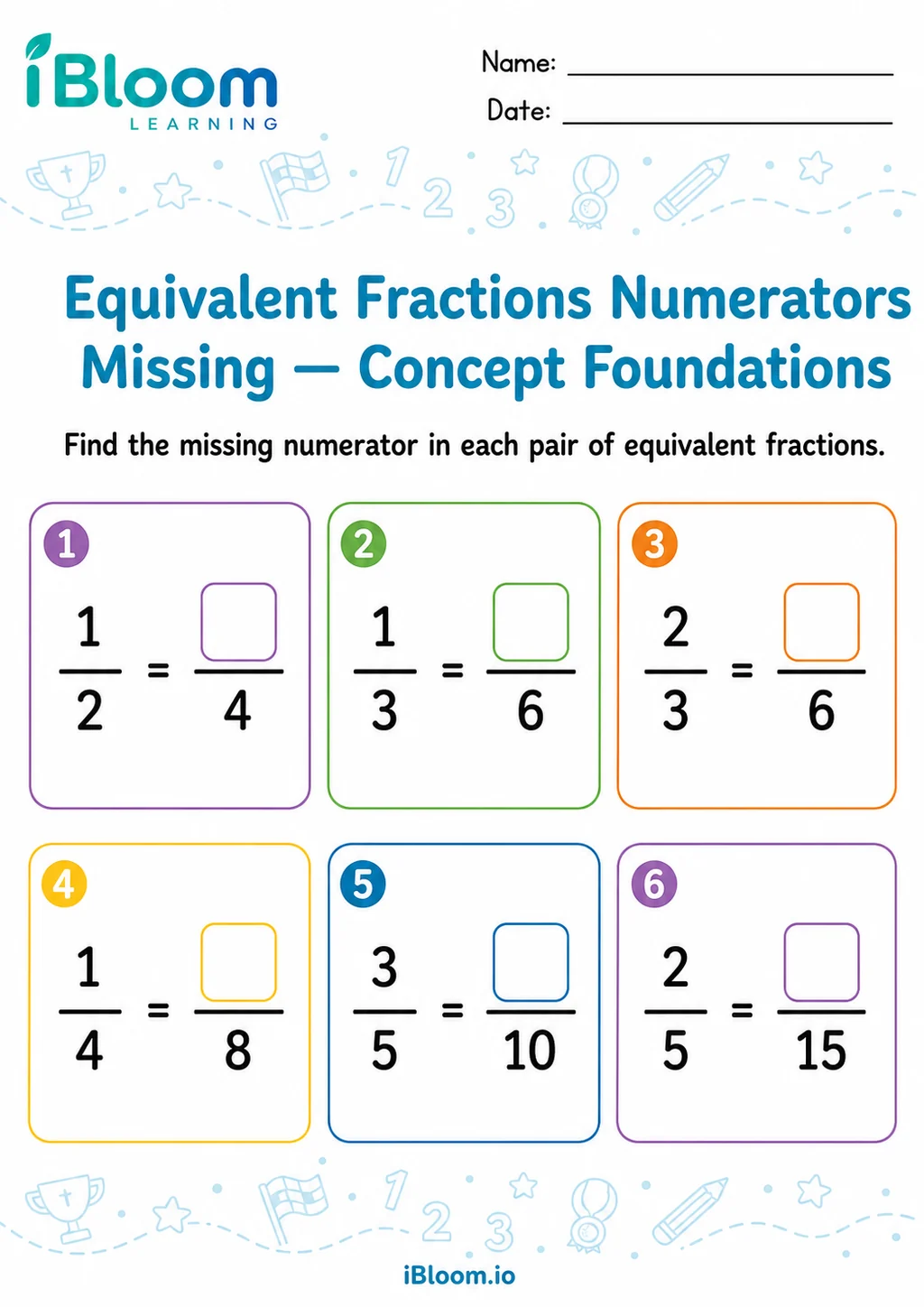 Equivalent Fractions Numerators Missing — Concept FoundationsGrade 3 students find missing numerators in equivalent fractions using visual models, multiplication patterns, and careful fraction reasoning. This Grade 3 foundations worksheet adds concise teaching notes, worked examples, and supported first attempts.Grade 3Free PDF preview
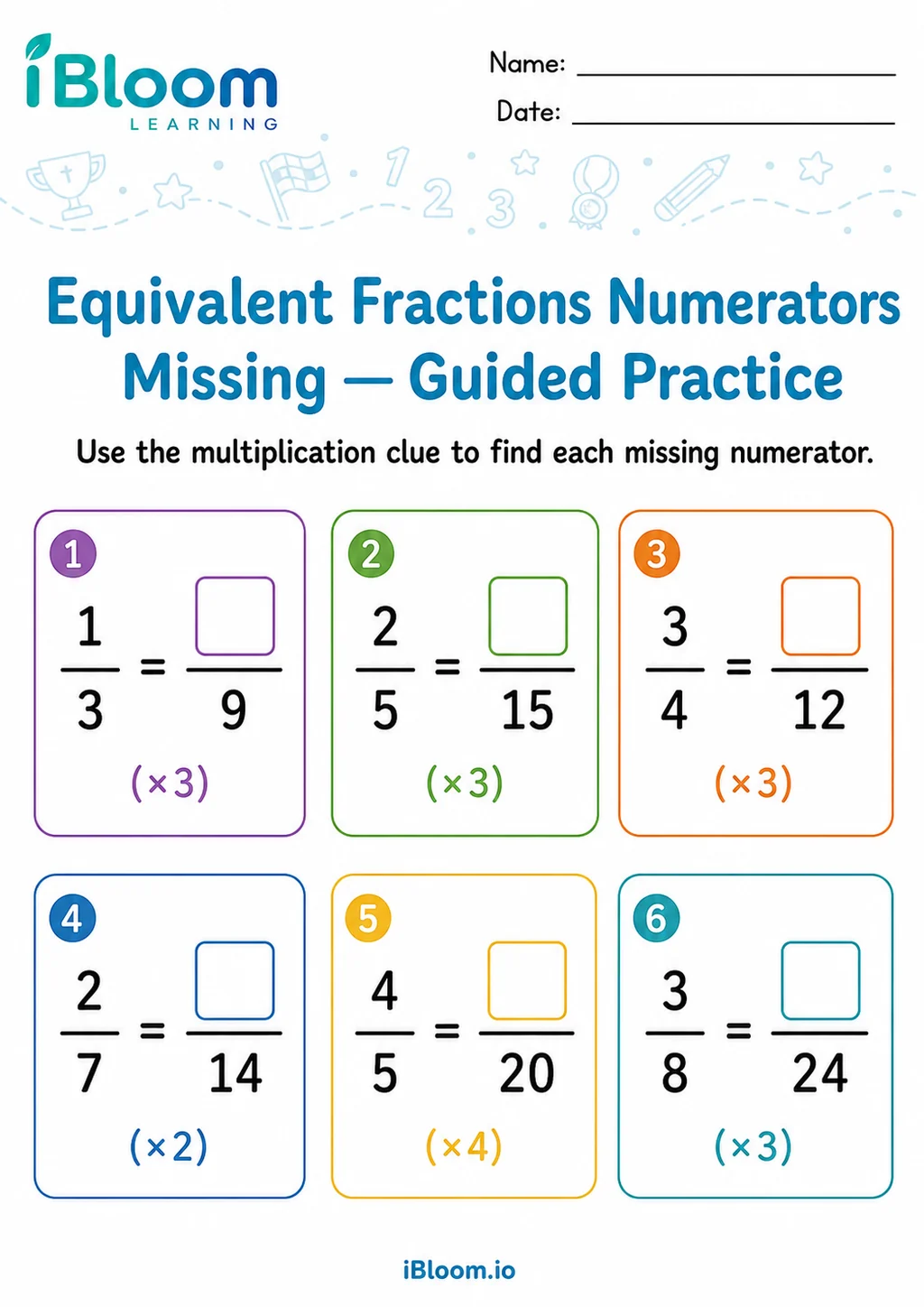 Equivalent Fractions Numerators Missing — Guided PracticeGrade 3 students find missing numerators in equivalent fractions using visual models, multiplication patterns, and careful fraction reasoning. This Grade 3 guided-practice worksheet progresses from prompts and checkpoints to independent questions.Grade 3Free PDF preview
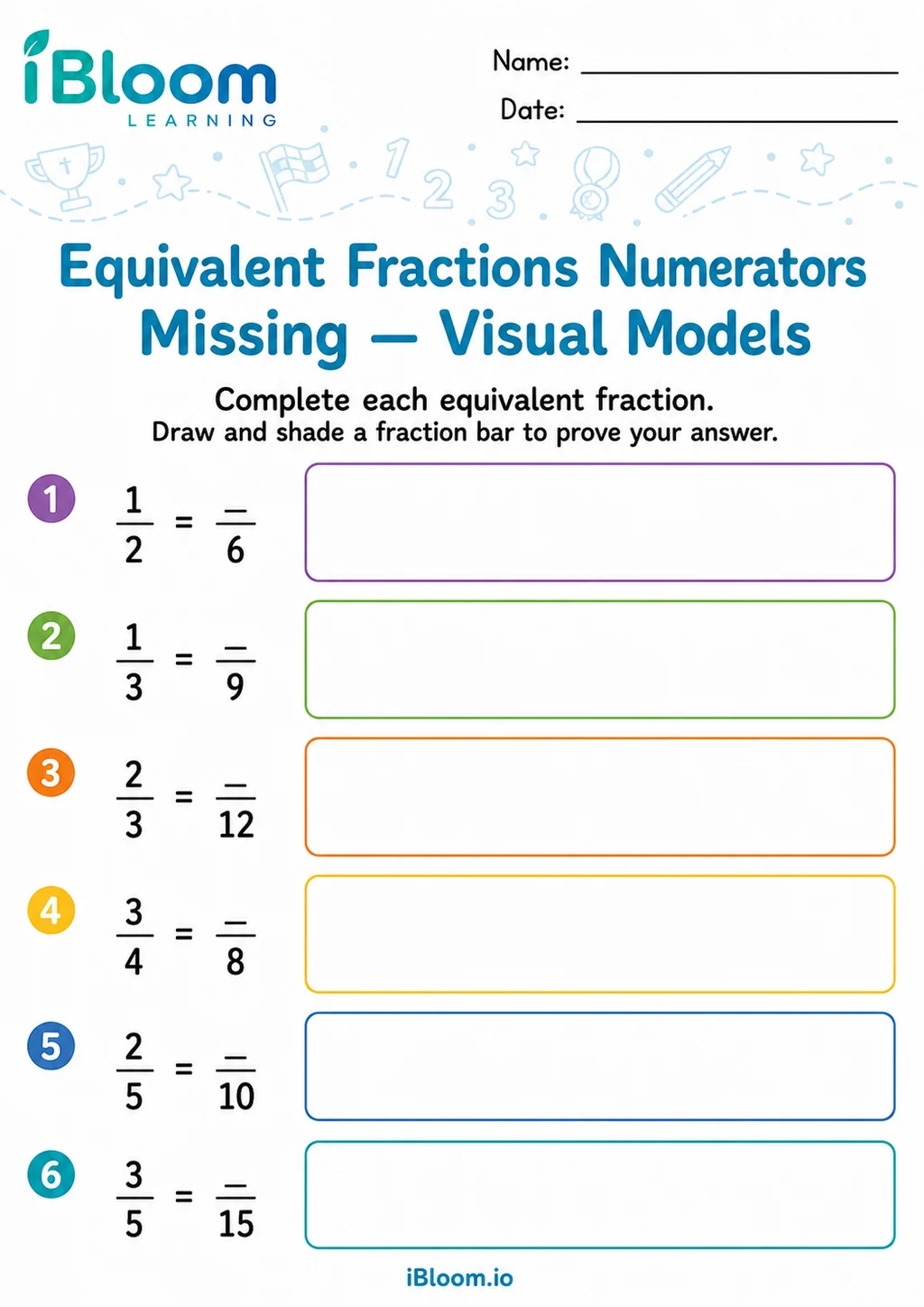 Equivalent Fractions Numerators Missing — Visual ModelsGrade 3 students find missing numerators in equivalent fractions using visual models, multiplication patterns, and careful fraction reasoning. This Grade 3 visual-model worksheet connects suitable diagrams, tables, number lines, or place-value models to mathematical notation.Grade 3Free PDF preview
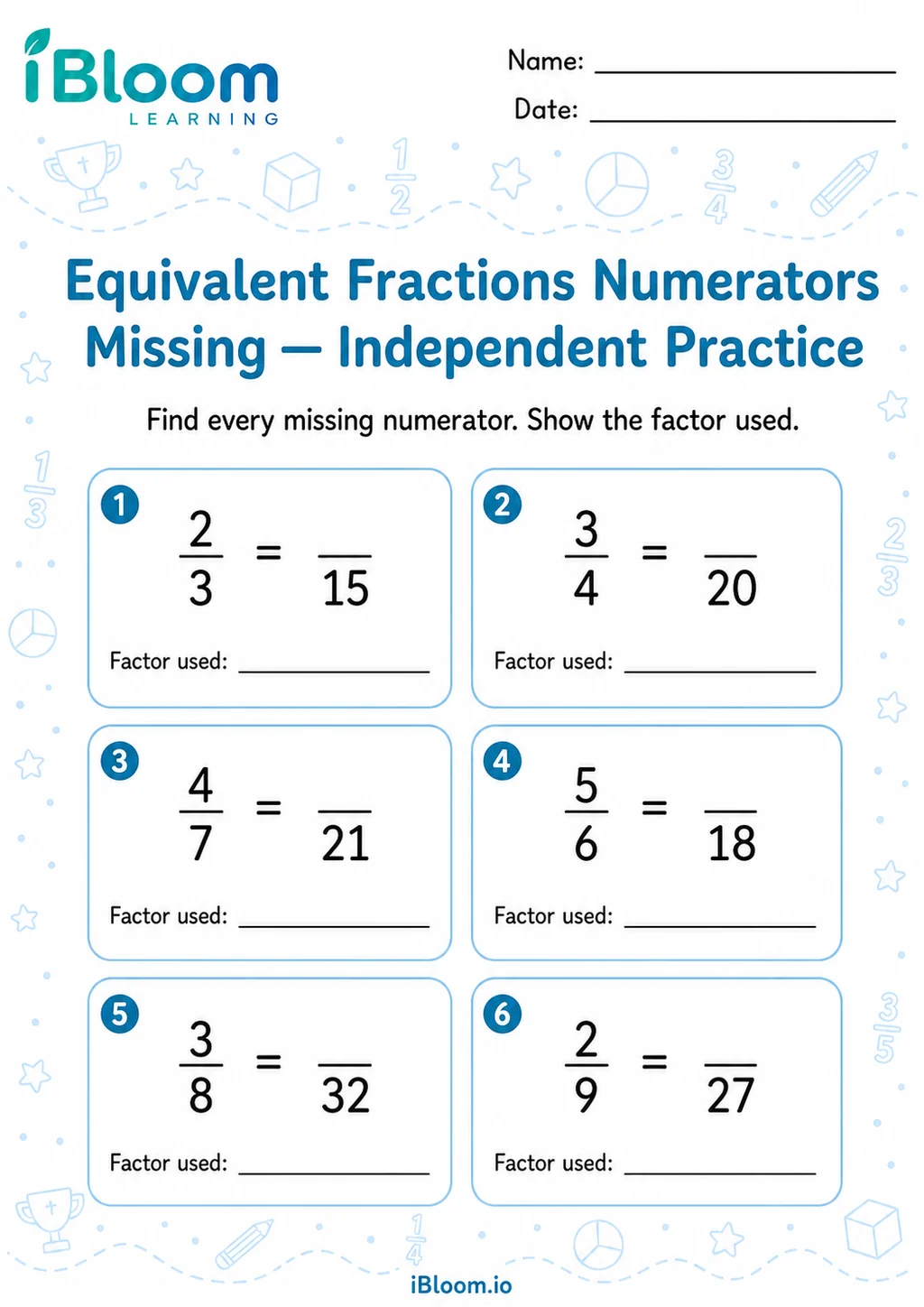 Equivalent Fractions Numerators Missing — Independent PracticeGrade 3 students find missing numerators in equivalent fractions using visual models, multiplication patterns, and careful fraction reasoning. This Grade 3 independent-practice worksheet provides a balanced sequence of accurate, grade-level exercises.Grade 3Free PDF preview
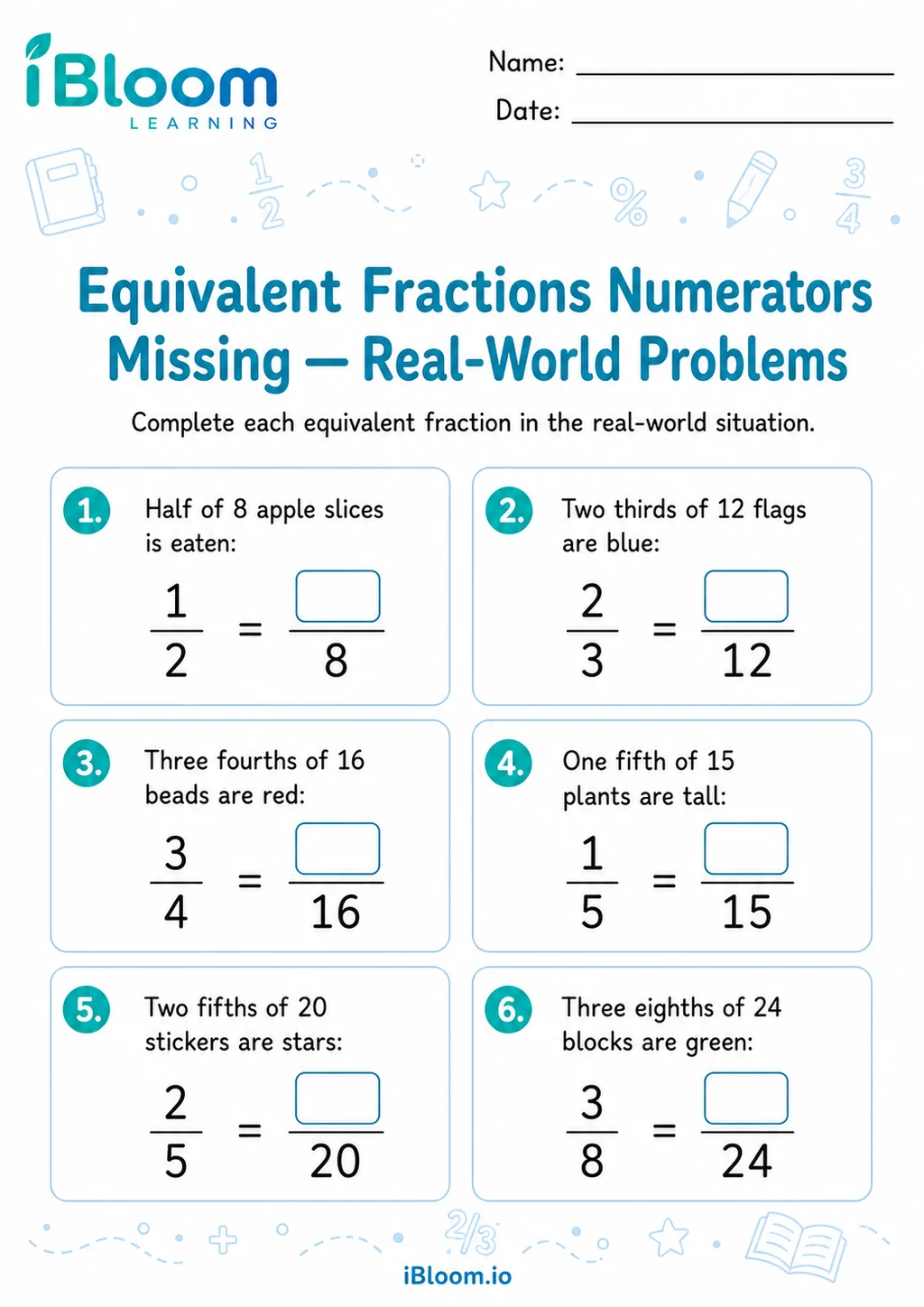 Equivalent Fractions Numerators Missing — Real-World ProblemsGrade 3 students find missing numerators in equivalent fractions using visual models, multiplication patterns, and careful fraction reasoning. This Grade 3 application worksheet uses realistic one-step and multi-step situations with room to model and solve.Grade 3Free PDF preview
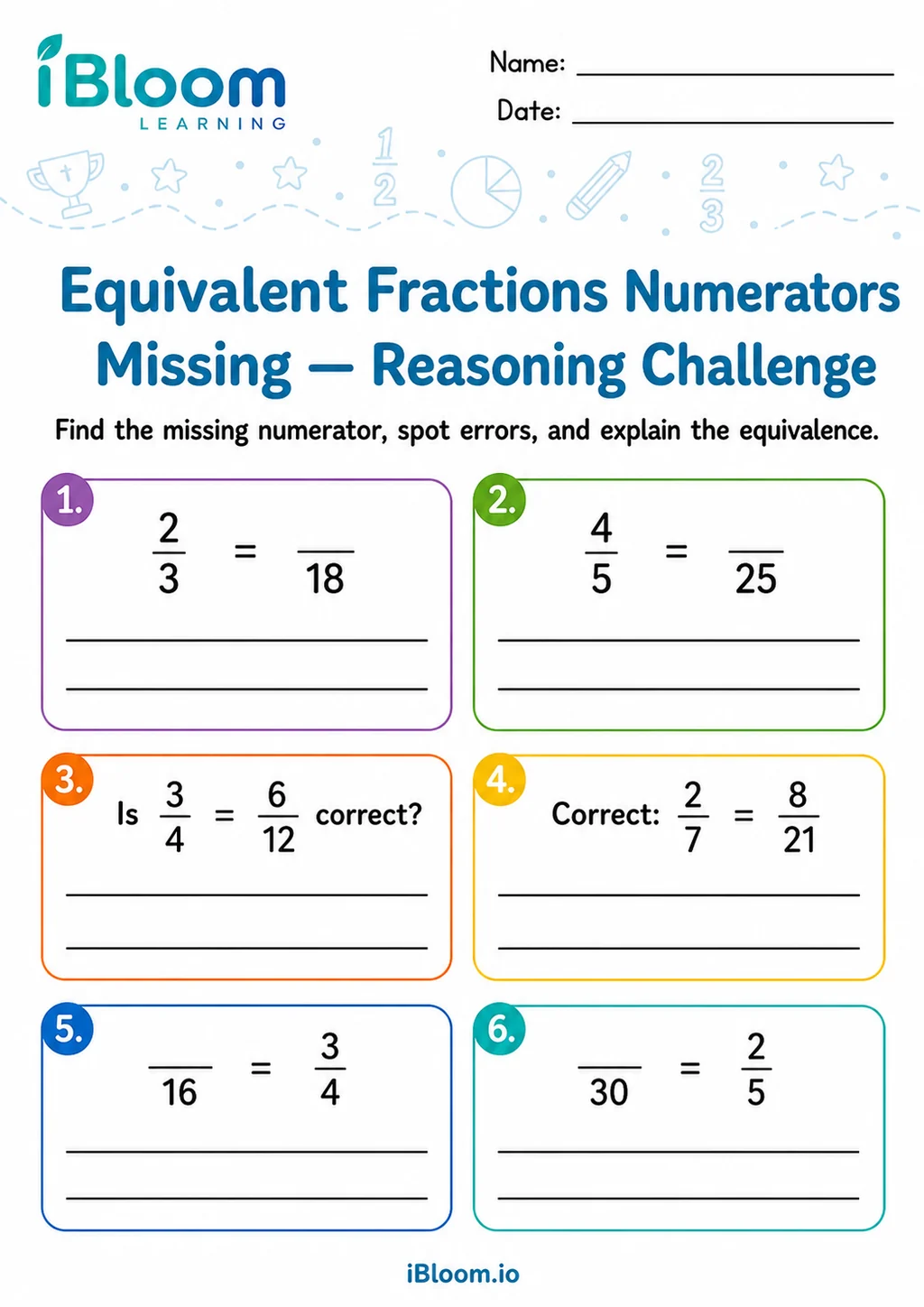 Equivalent Fractions Numerators Missing — Reasoning ChallengeGrade 3 students find missing numerators in equivalent fractions using visual models, multiplication patterns, and careful fraction reasoning. This Grade 3 reasoning worksheet combines error analysis, strategy comparison, missing information, and a gentle extension.Grade 3Free PDF preview
Practice that builds confidence
What students are learning
These Grade 3 math worksheets help children practice equivalent fractions when the numerator is missing, such as ?/6 = 1/2 or ?/8 = 3/4. Students learn to see how the size of the parts changes while the total amount stays equal.
The printable activities include fraction models, number patterns, and equation-style problems that ask children to fill in the missing top number. The work supports the Fractions and Decimals unit by building flexible fraction sense before students move into more complex comparisons.
Finding a missing numerator is more than guessing a number for the top of a fraction. Grade 3 students learn that equivalent fractions name the same amount, even when the number of parts changes. For example, 1/2 and 3/6 are equal because each shows the same portion of a whole divided in different ways.

How the skill progresses
The worksheets begin with visual support, such as shaded bars, circles, or partitioned shapes, so children can count how many smaller parts match the original fraction. Then students move toward numeric reasoning: if the denominator is multiplied by 3, the numerator must also be multiplied by 3. Problems like 2/3 = ?/6 encourage children to connect models with multiplication patterns.
A simple parent routine
At home, start by drawing two same-size rectangles. Shade 1/2 of the first, then divide the second into 6 equal parts and ask, “How many sixths cover the same space?” After your child says 3/6, write 1/2 = 3/6 and point to the missing numerator. Repeat with a few familiar fractions, asking your child to explain the equal amount before writing the answer.

Classroom uses for teachers
Teachers can use these pages during fraction centers, small-group reteaching, math warm-ups, or independent practice after a mini-lesson on equivalent fractions. The mix of models and equations makes it easy to see whether a student is relying on visual counting, skip-counting, or the relationship between numerator and denominator.

Common errors to watch for
Some children change only the missing numerator without checking how the denominator changed. Others add the same number to the numerator instead of multiplying, which can produce fractions that are not equivalent. Watch for unequal wholes in drawings, too: equivalent fractions must compare parts of the same-size whole.
Free printable PDF download
Use this equivalent fractions missing numerator worksheets grade 3 page to preview the activity, print it, or download it as a PDF for quick practice. It works well for homework, homeschool lessons, tutoring, morning work, revision, and classroom centers.
Answers and answer key support
After the child completes the worksheet independently, parents and teachers can use the answer support or answer key information to check the work, review mistakes, and choose the next practice step.
Why iBloom worksheets help
These iBloom practice activities keep the focus on one precise Grade 3 skill: missing numerators in equivalent fractions. The problems encourage students to say, draw, and calculate the relationship, helping them build a dependable strategy: “Find how the denominator changed, then do the same to the numerator.”
Helpful answers
Frequently asked questions
What does a missing numerator in an equivalent fraction mean?
It means the top number of one fraction is blank, and the student must find the number that makes both fractions name the same amount.
How should my child solve ?/6 = 1/2?
They can divide a same-size whole into 6 equal parts and see that 3 of those parts match 1/2. So the missing numerator is 3.
Do these worksheets use visual fraction models?
Yes. The practice includes visual representations and fraction equations so students can connect shaded parts with the numerical relationship.
What is the most common mistake with this skill?
A common mistake is adding to the numerator and denominator instead of multiplying both by the same factor to create an equivalent fraction.
Are these worksheets suitable for independent Grade 3 practice?
Yes, once students understand numerator, denominator, and equal parts, these worksheets work well for independent practice, review, or homework.
Is this equivalent fractions missing numerator worksheets grade 3 free?
Yes. You can preview it for free and use the printable worksheet for home or classroom practice.
Can I download this equivalent fractions missing numerator worksheets grade 3 as a PDF?
Yes. Use the worksheet download option to save a printable PDF, or print the worksheet directly from the page.
Does this equivalent fractions missing numerator worksheets grade 3 include answers or an answer key?
When the activity has fixed answers, iBloom includes answer support so parents and teachers can check the completed worksheet.