



About this worksheet
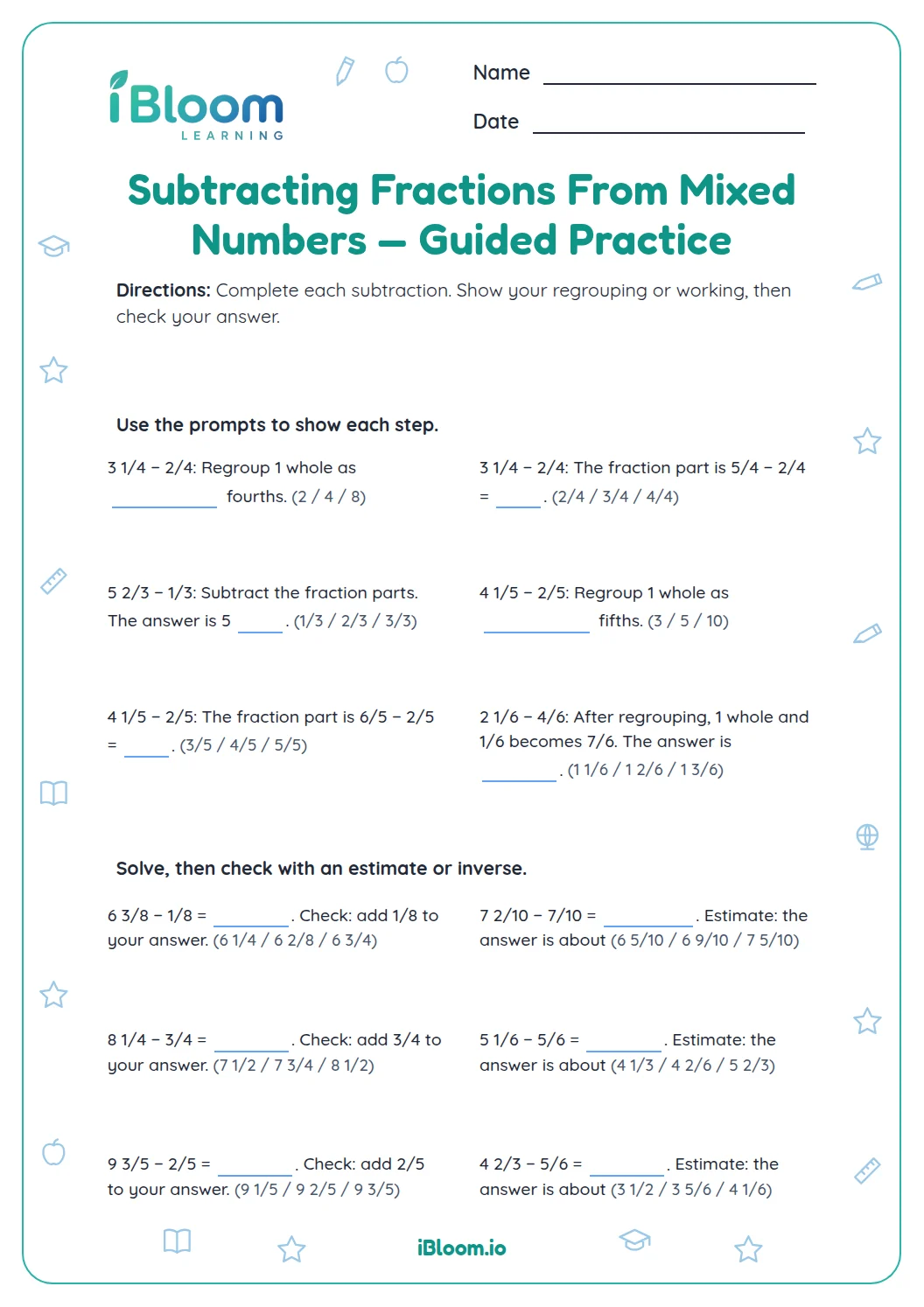
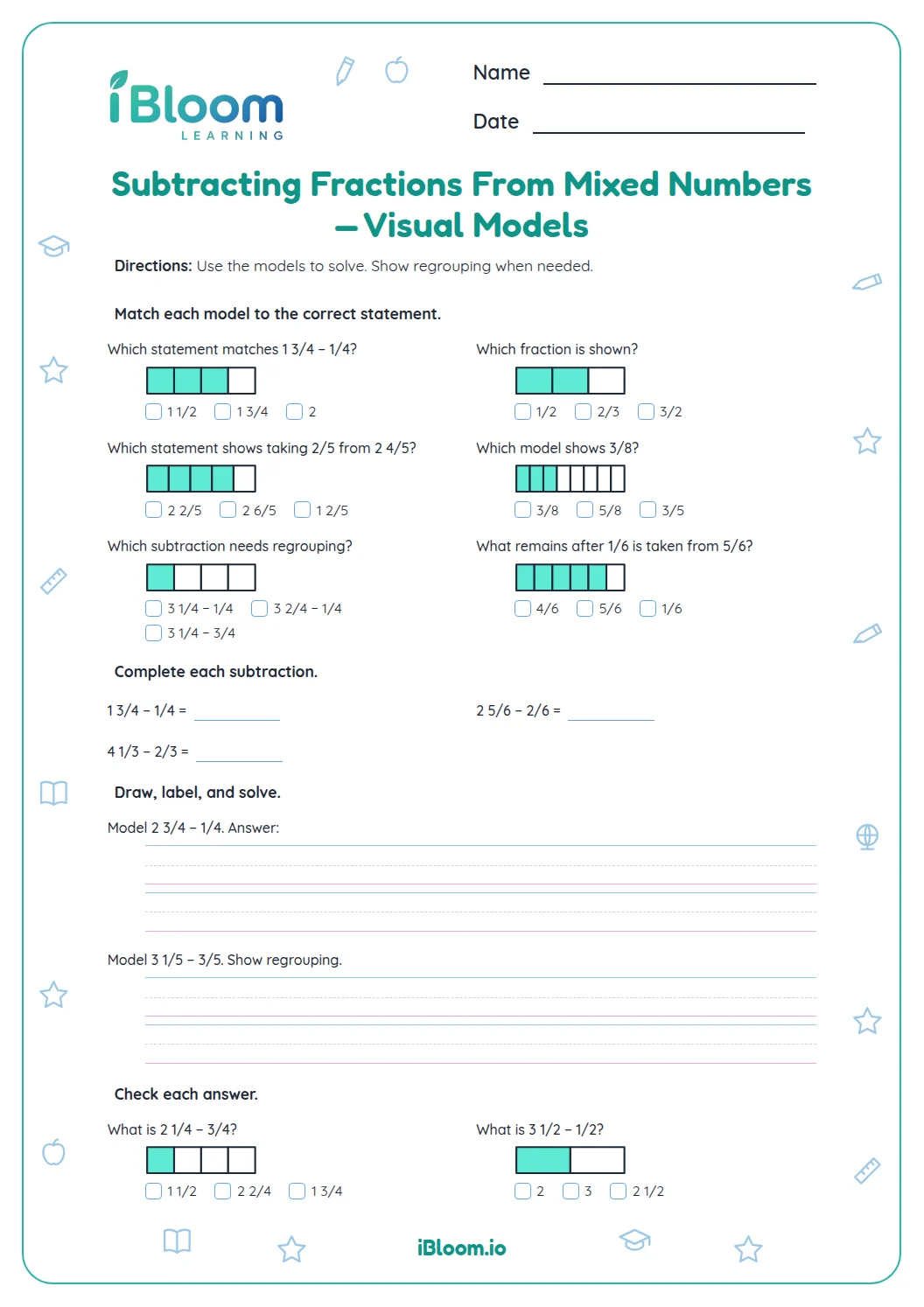
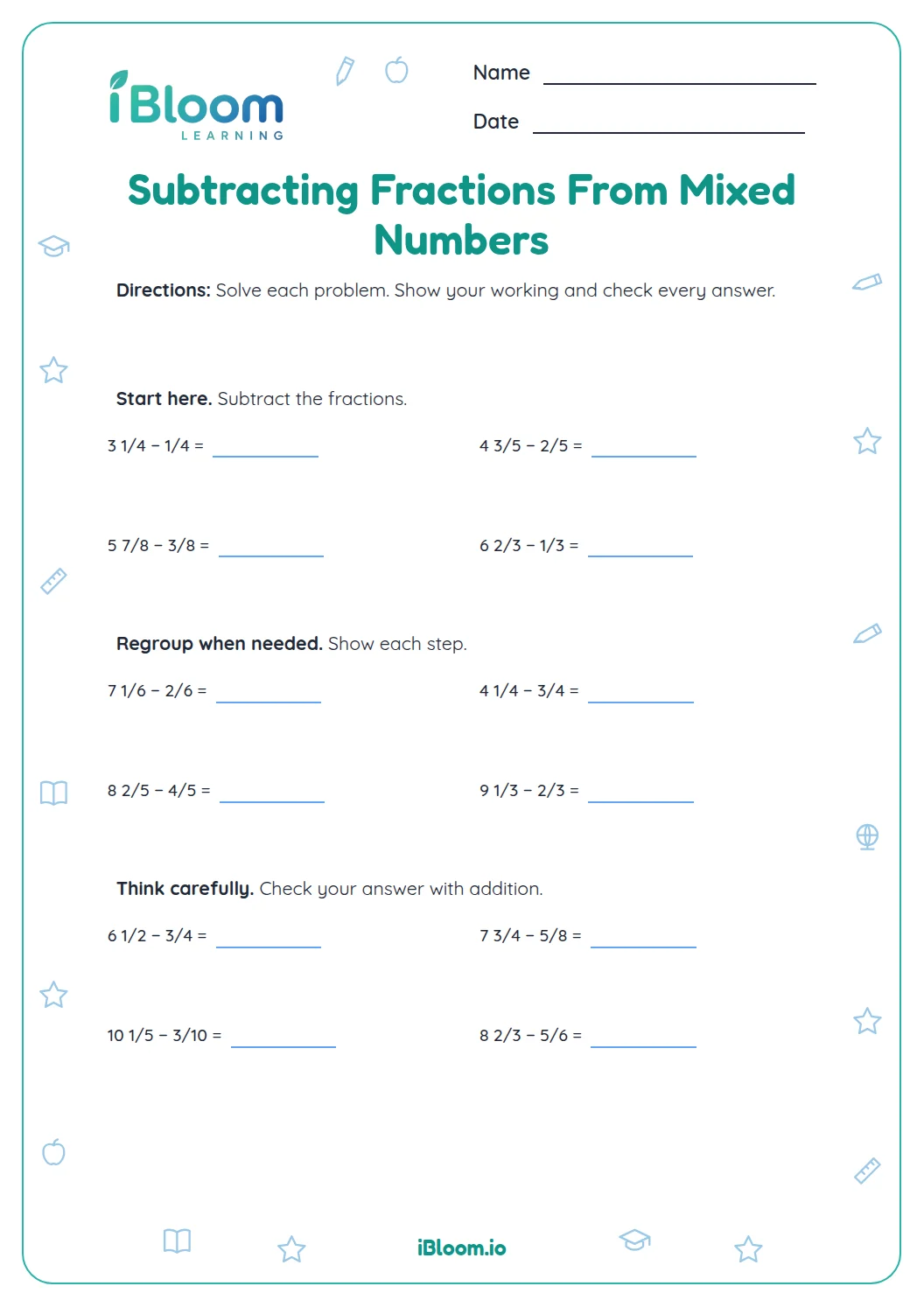
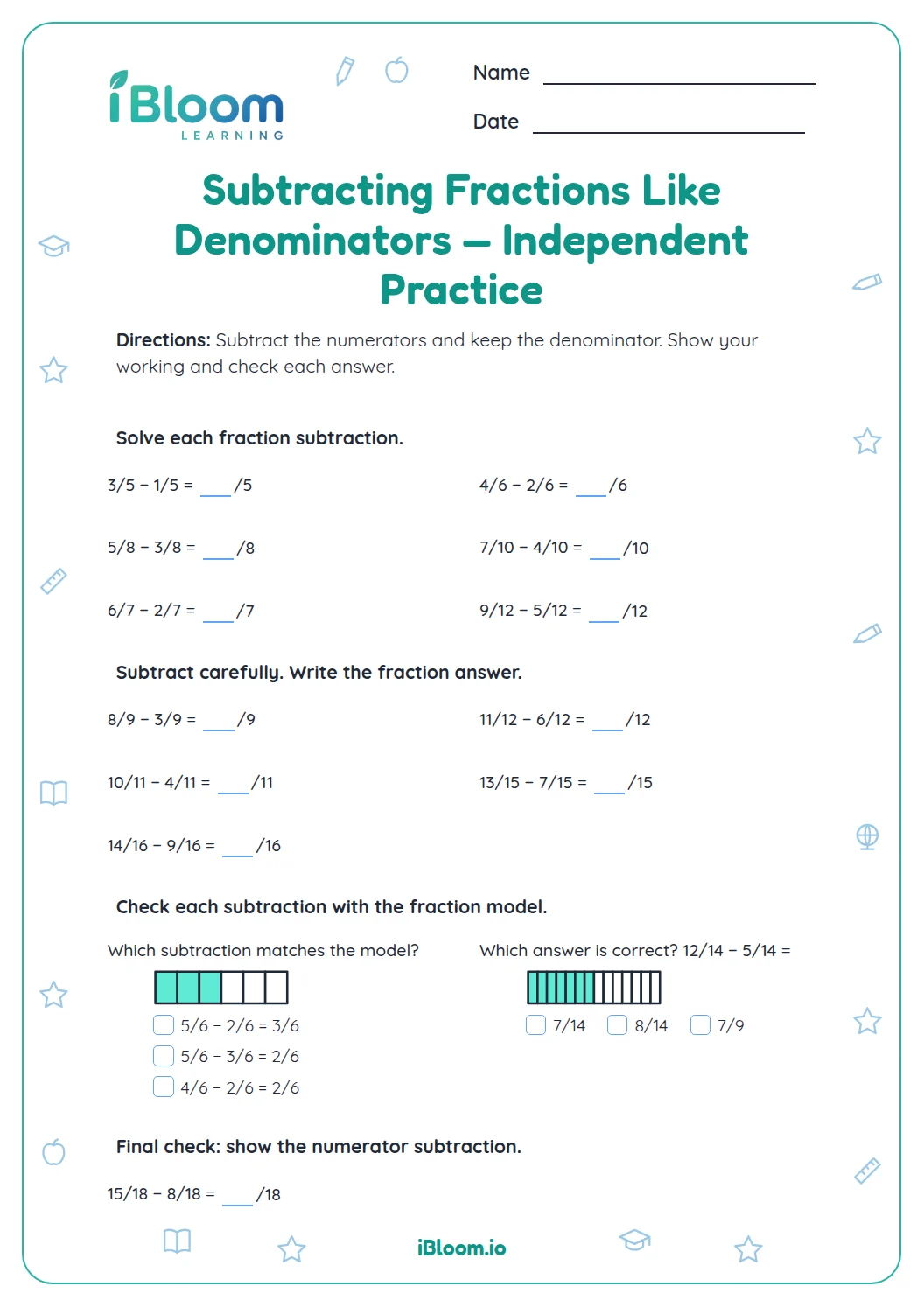
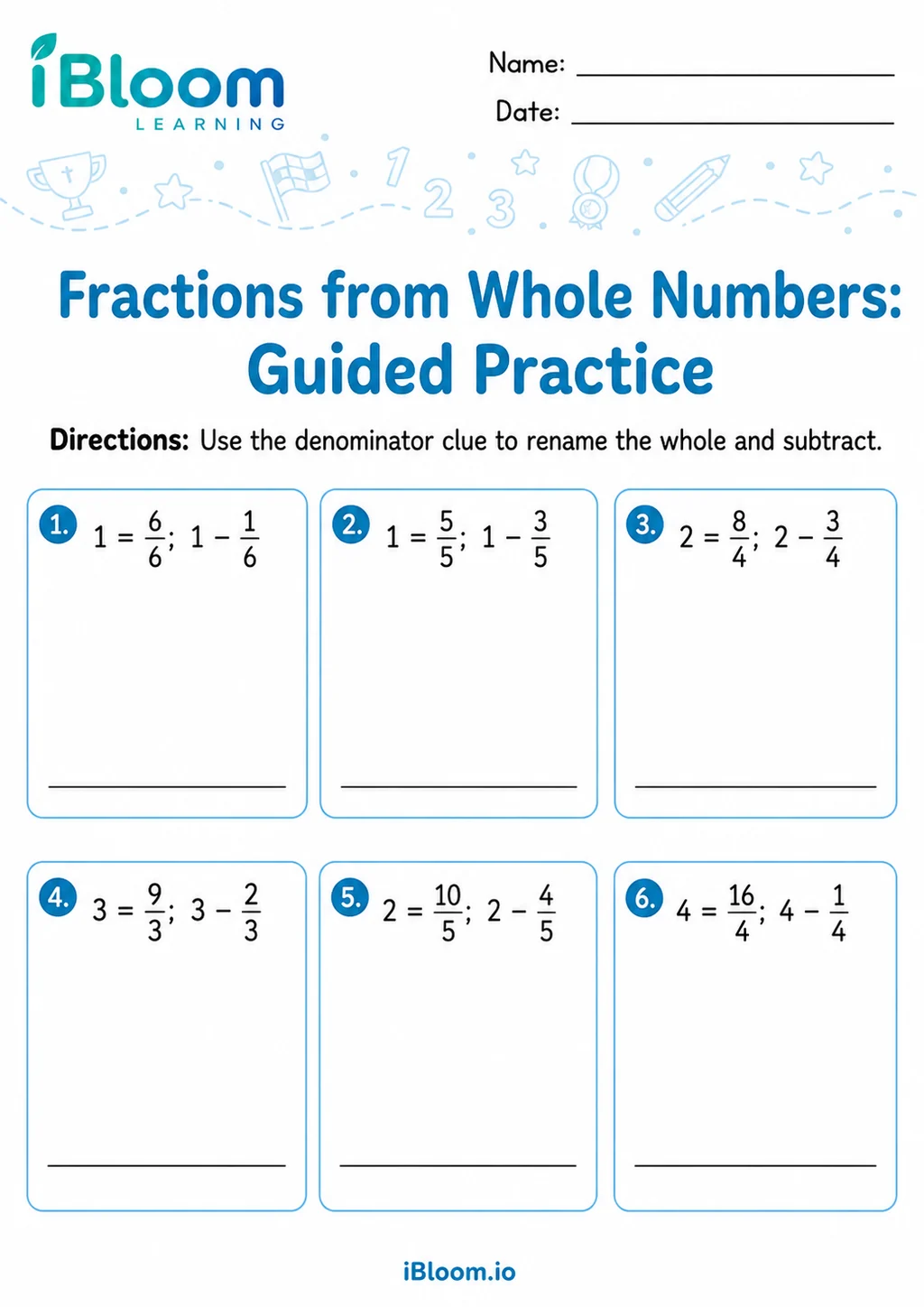
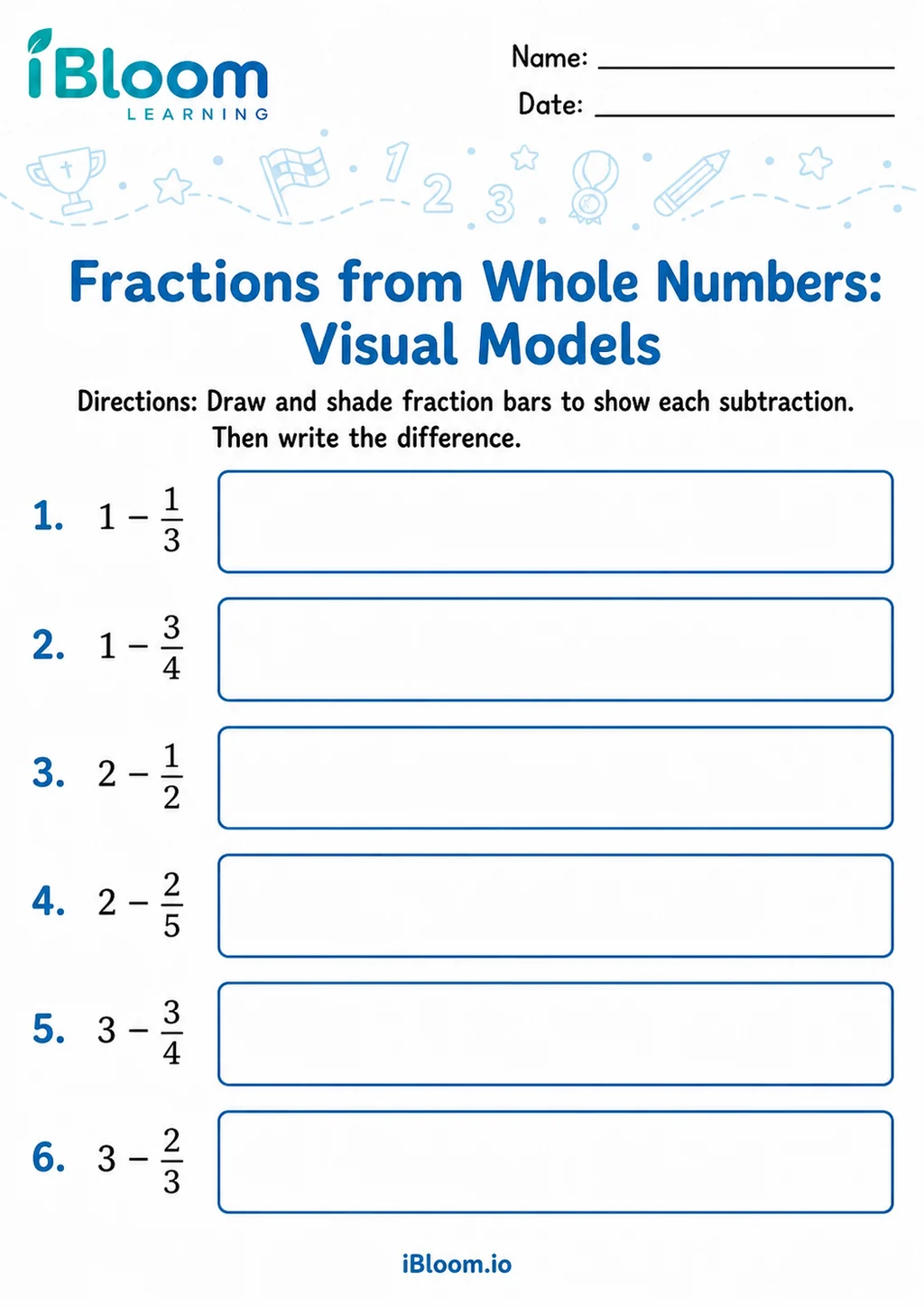
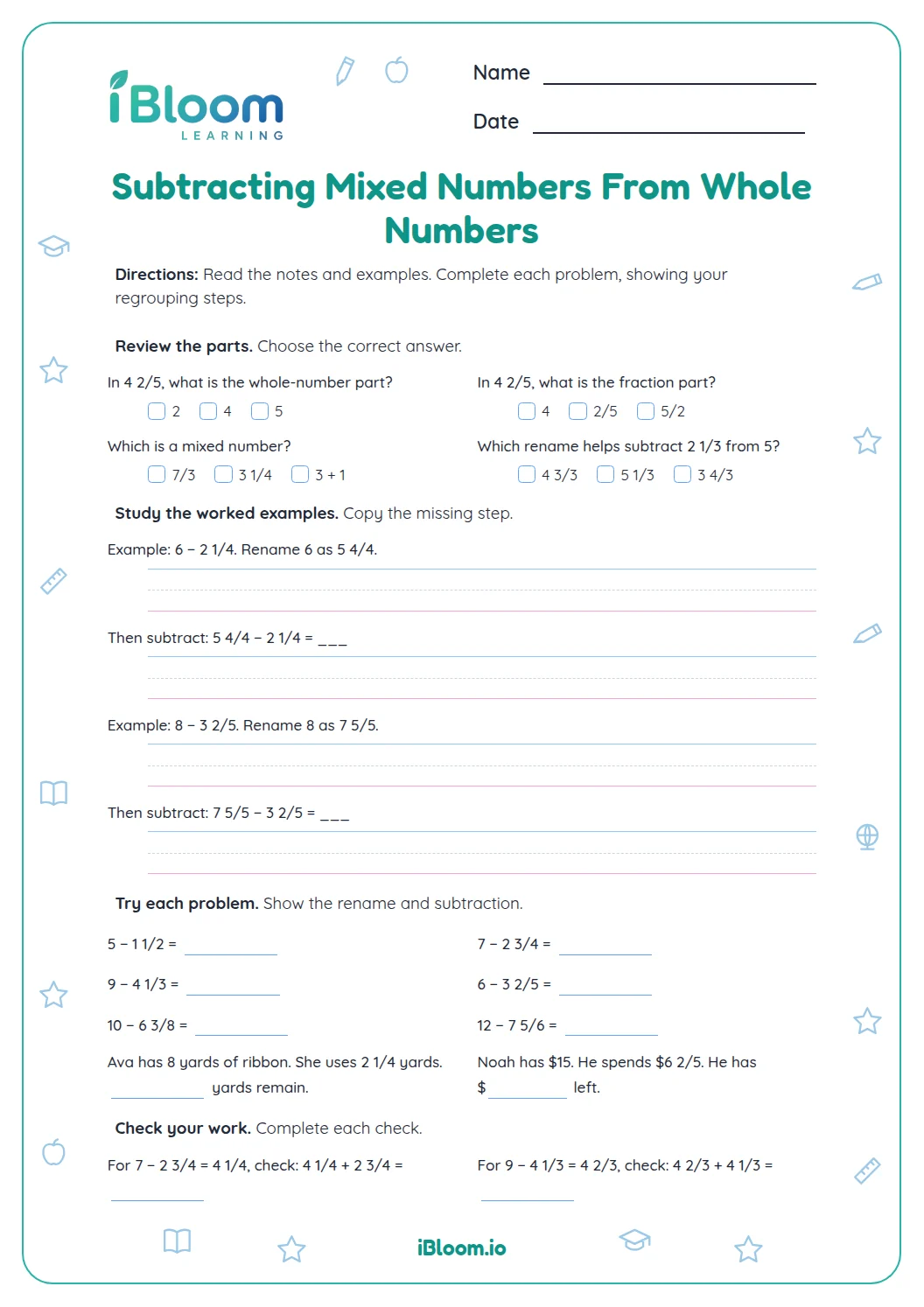
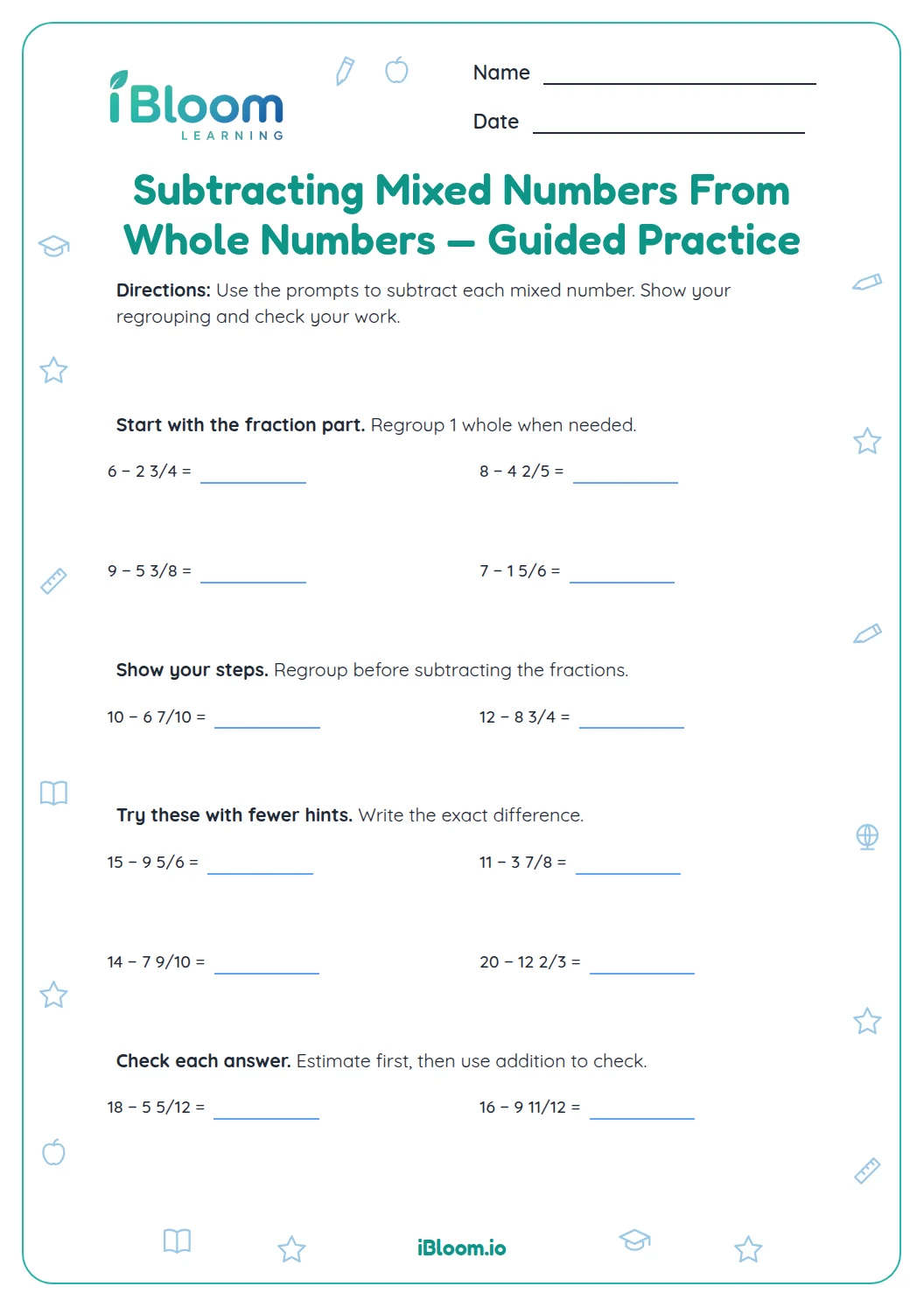
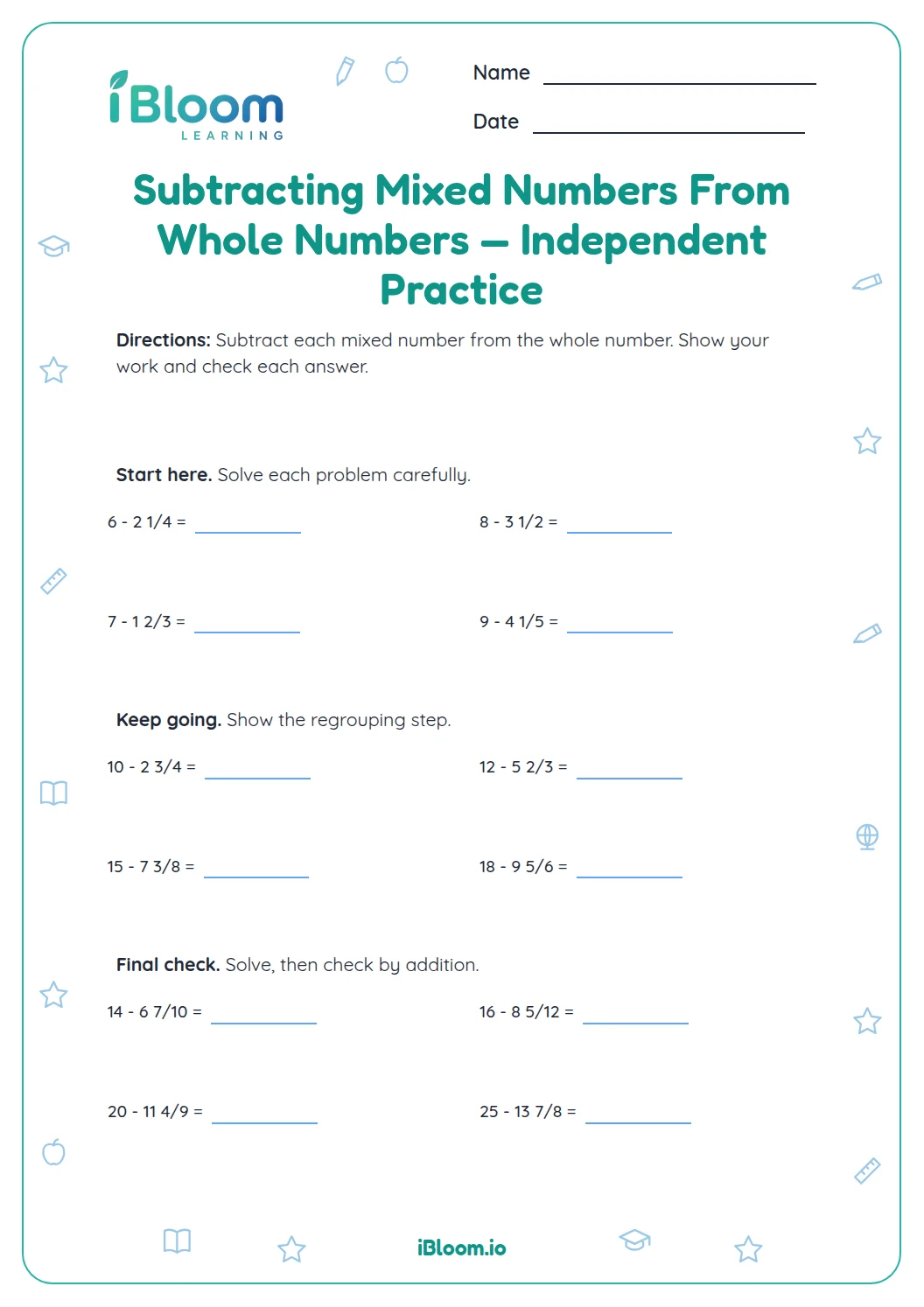
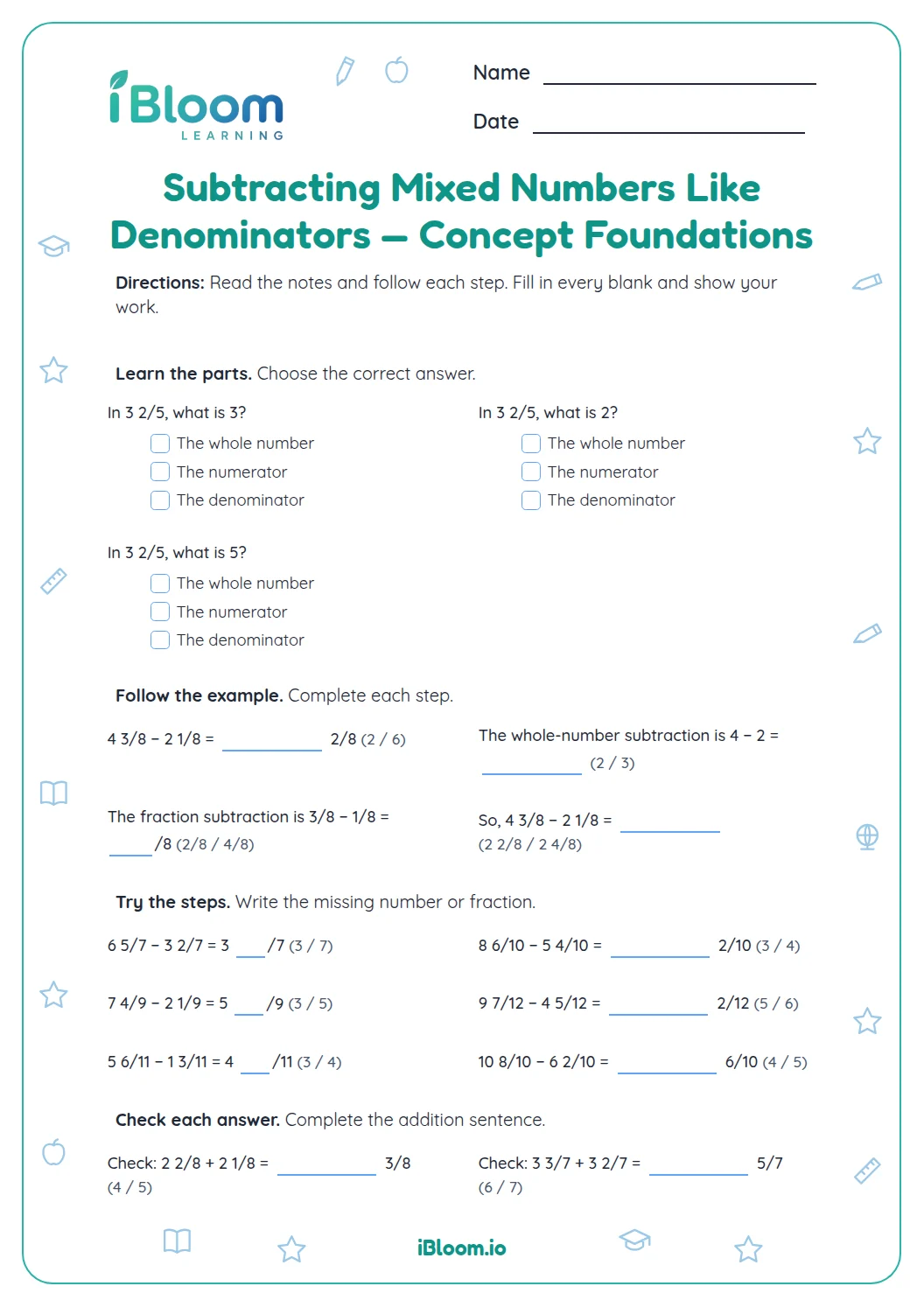
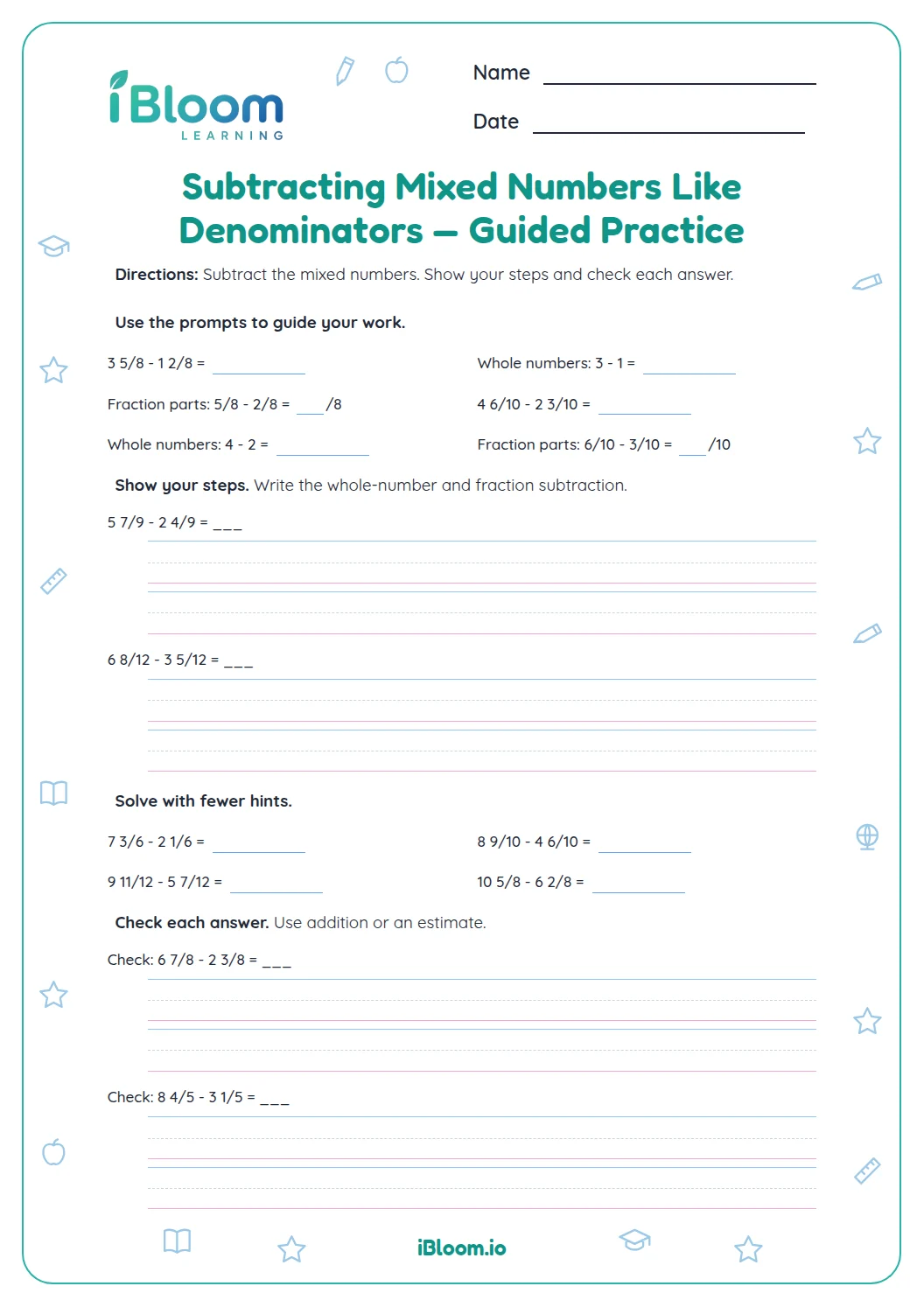
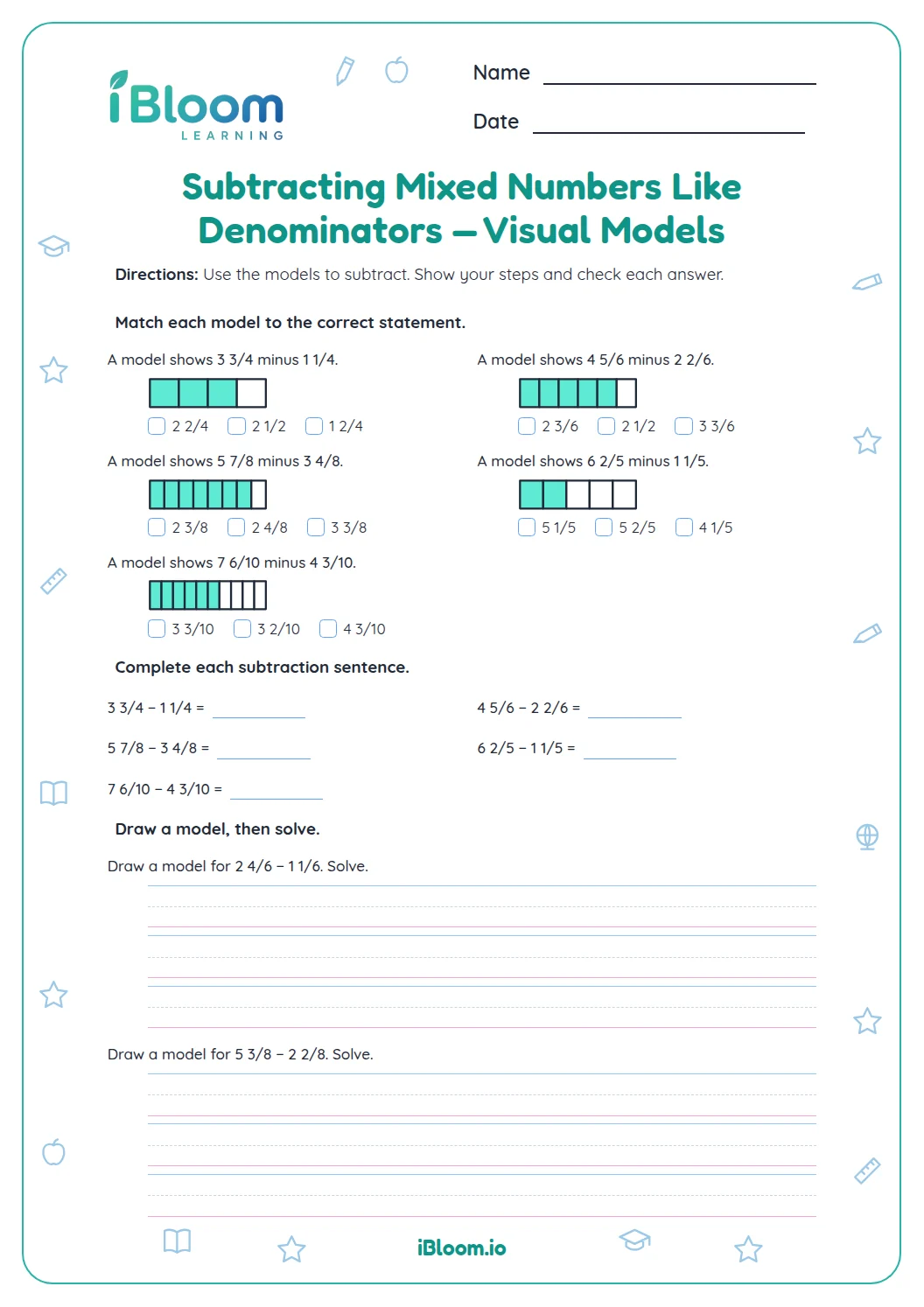
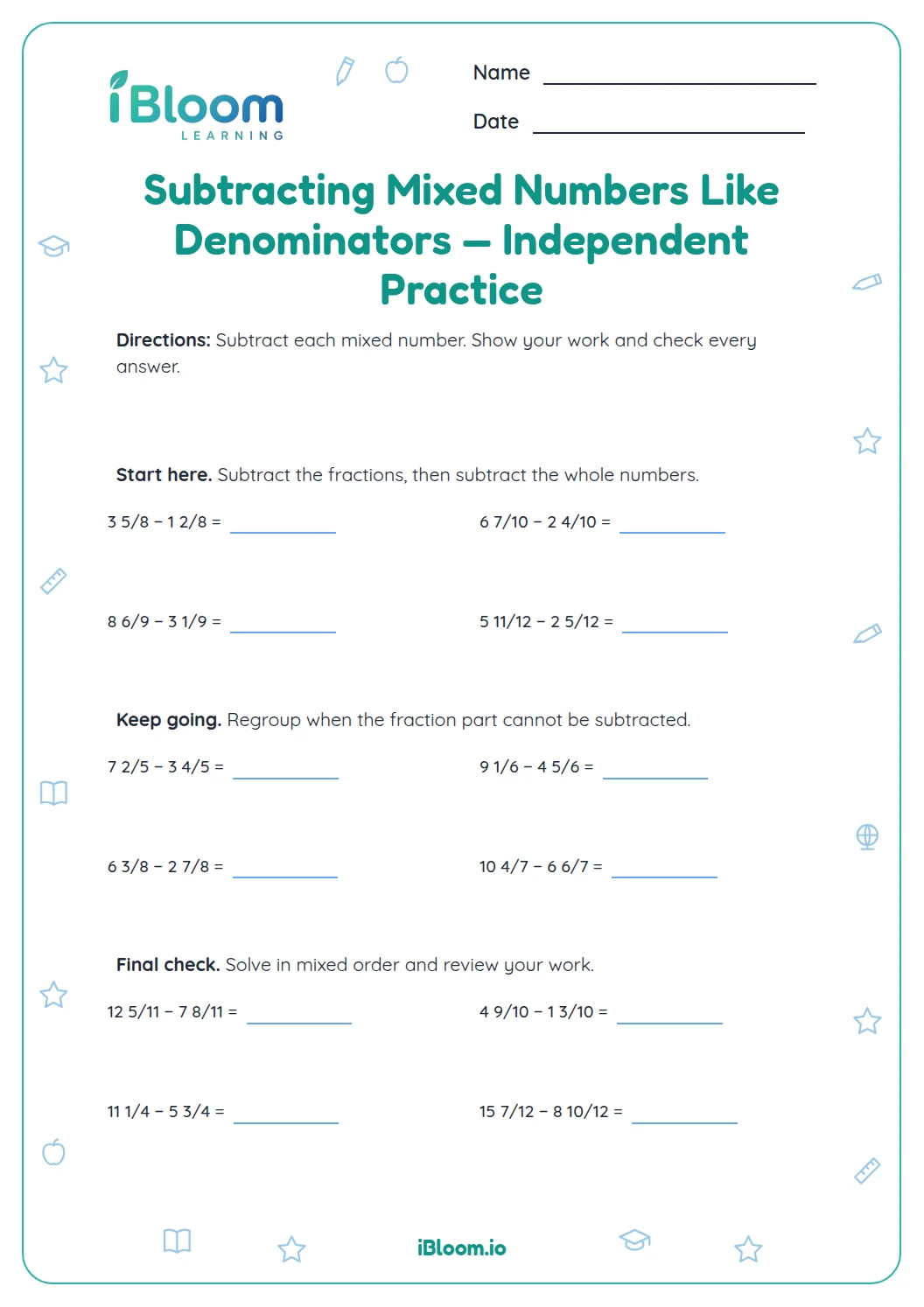
This Grade 3 worksheet builds the idea of subtracting fractions from mixed numbers with equal denominators. Fifteen questions combine regrouping practice, starting-amount fraction models, answer checks, and short stories. One example subtracts more than one whole, so learners account for the full value taken away. The questions practice separating fractional parts and subtracting mixed numbers with like denominators.
Aligned to 4.NF.B.3.c and 4.NF.B.3.a
How do you subtract when the fraction is too small?
If the mixed number’s fraction is smaller than the fraction being subtracted, rename one whole as equal fractional parts. For 6 1/3 − 2/3, write 6 1/3 as 5 4/3, then subtract to get 5 2/3.
Question 7 uses this regrouping: one of the six wholes becomes 3/3, which joins the original 1/3.
- 16 1/3 = 5 4/3
- 25 4/3 − 2/3 = 5 2/3
- 3Check: 5 2/3 is less than 6 1/3
What if the fraction being subtracted is greater than one?
Subtract all the fractional parts shown. In 8 2/3 − 5/3, the amount taken away is one whole and two thirds. The answer is 7, because 26/3 − 5/3 = 21/3.
How does subtraction work in a story?
Name the starting mixed number, subtract the amount used or poured, and keep the unit in the answer. The final three questions connect the same regrouping idea to ribbon, juice, and hiking distance.
How to use this worksheet
- 1Check whether the starting fractional part is large enough to subtract.
- 2If needed, trade one whole for equal fractional parts.
- 3Subtract the fractional parts and whole numbers.
- 4Keep the denominator because the pieces stay the same size.
- 5Check by adding the amount subtracted back to the answer.
Common mistakes and quick fixes
The mistake
Subtracting only the whole-number parts
The fix
Account for every fractional part in the amount taken away.
The mistake
Forgetting to rename a whole
The fix
Trade one whole for as many fractional parts as the denominator names.
The mistake
Treating 5/3 as less than one
The fix
Notice that three thirds make one whole, so five thirds is more than one.
Common Core alignment
The questions model subtraction as separating like-denominator fractional parts.
Subtract mixed numbers with like denominators by regrouping or renaming.
On this sheet: Learners rename whole numbers as like-denominator fractional parts to subtract.
Show the official wordingHide the official wording
Add and subtract mixed numbers with like denominators, e.g., by replacing each mixed number with an equivalent fraction, and/or by using properties of operations and the relationship between addition and subtraction.
Interpret subtraction as separating parts that refer to the same whole.
On this sheet: The equations and stories model taking fractional parts away from a stated amount.
Show the official wordingHide the official wording
Understand addition and subtraction of fractions as joining and separating parts referring to the same whole.
What to practice next
Make more practice
Further reading
Questions parents and teachers ask
How do you solve 6 1/3 − 2/3?
Rename one of the six wholes as 3/3, leaving 5 wholes and 4/3. Then subtract 2/3 from 4/3 to get 5 2/3. This keeps the fractional pieces the same size and preserves the total amount. Trade one whole for three thirds, then subtract two thirds from the renamed amount.
Why is 8 2/3 − 5/3 equal to 7?
Because 8 2/3 equals 26/3, and 26/3 − 5/3 = 21/3 = 7. The amount subtracted is more than one whole, so both the whole and fractional portions must be considered. When the fractions already have enough parts, subtract the numerators and keep the whole.
When do I need to rename a whole?
Rename when the fraction in the mixed number has fewer parts than the fraction being subtracted. For example, 4 1/4 − 3/4 needs regrouping because one fourth is less than three fourths. The starting amount and amount taken away use equal-sized pieces throughout each problem.
What happens when the fractions subtract to zero?
If the fractional parts are equal, they cancel and only the whole-number difference remains. For example, 3 1/2 − 1/2 = 3. The worksheet includes this kind of check in a multiple-choice item. For 5/3, remove one whole and two thirds; the remaining amount is exactly seven.
How should a child check a subtraction answer?
Estimate whether the result should be smaller than the starting amount, then add the amount taken away back to the result. The sum should match the original mixed number. Use the same unit in a story problem. The story names the unit so the result can be stated in yards, liters, or miles.
Does the answer key include the units?
Yes. Story answers include yards, liters, or miles as asked. Number sentences are keyed with just the numeric result, matching the blank after the equals sign. Adding the amount taken away to the answer checks the subtraction result.