

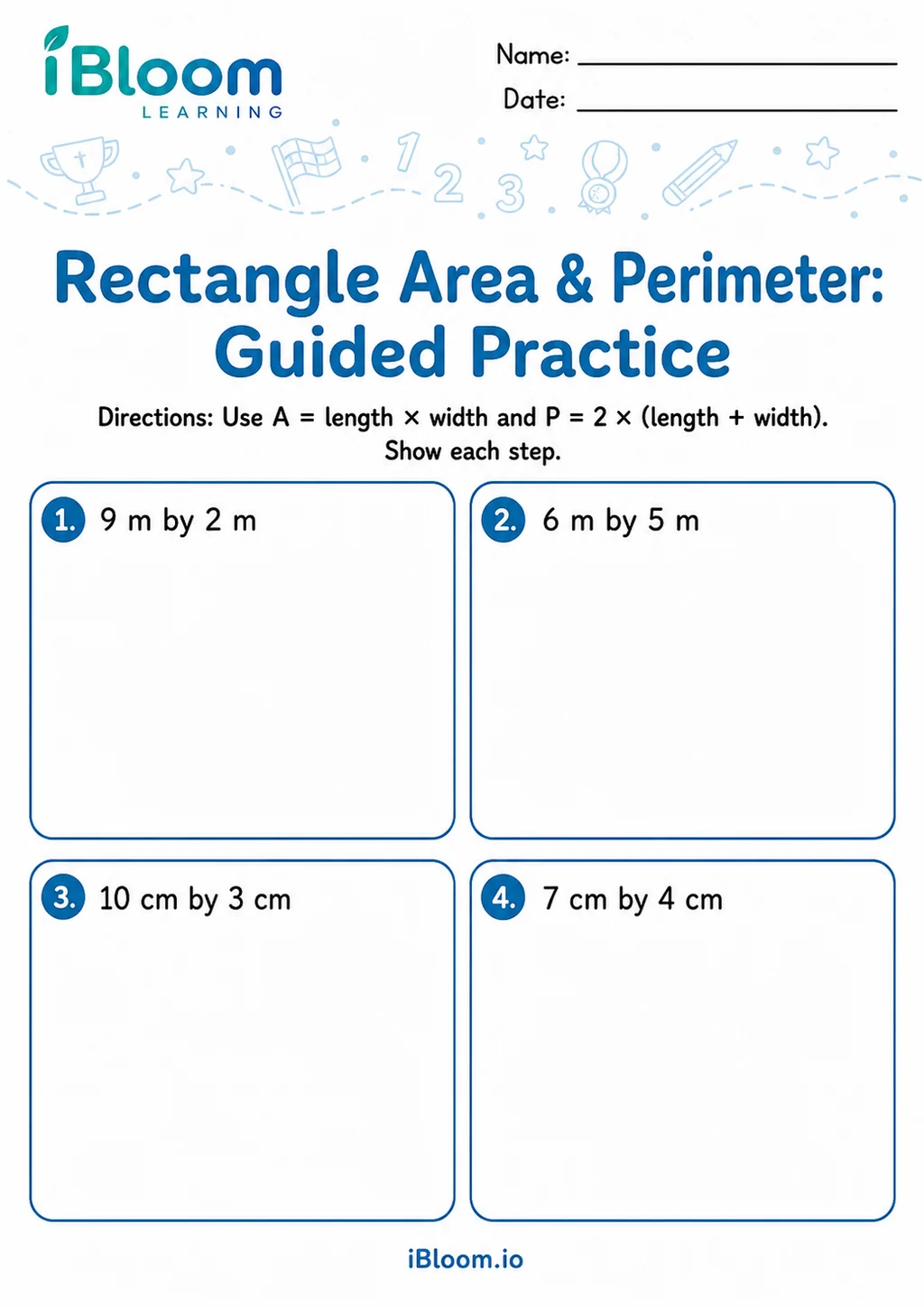
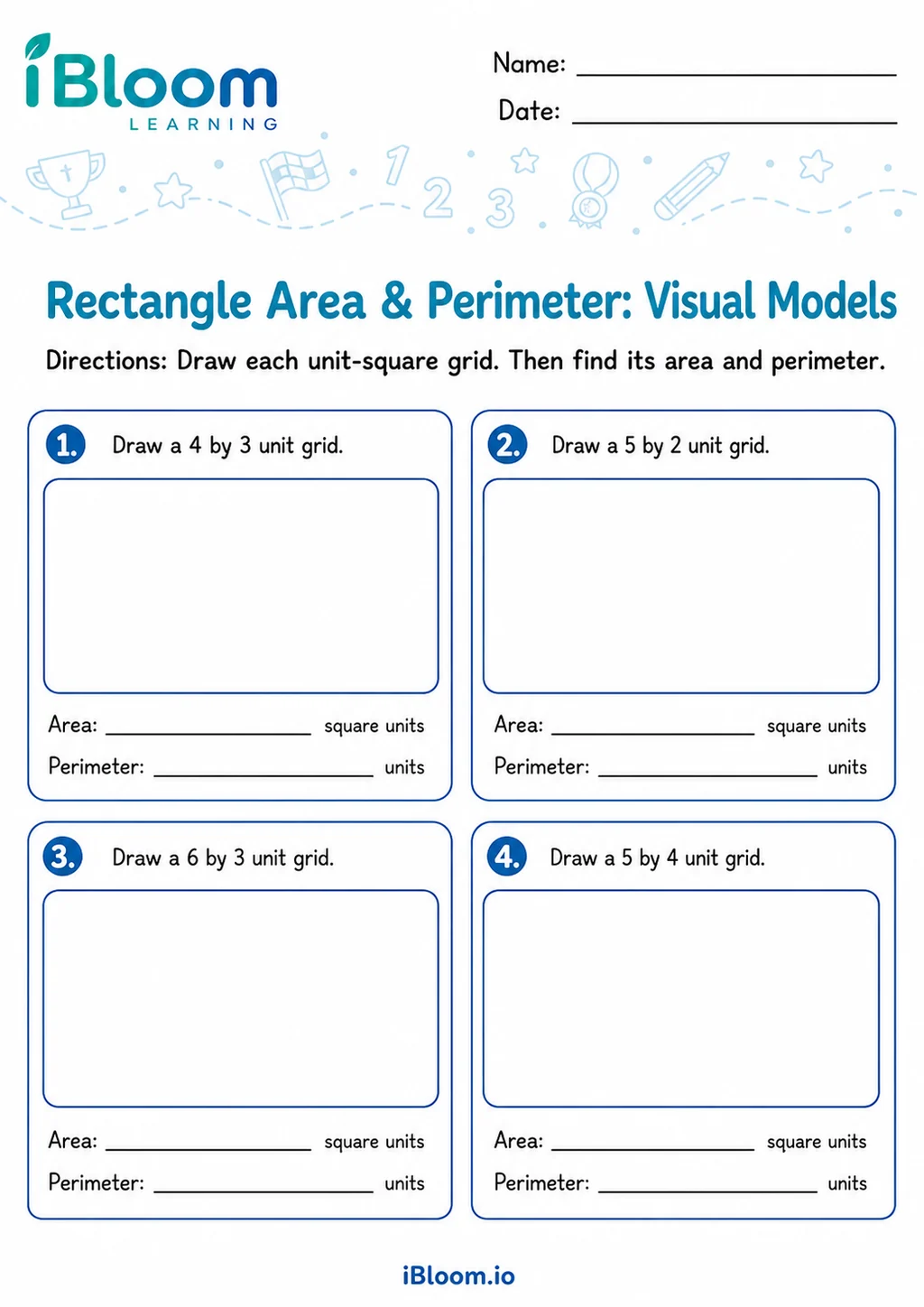
About this worksheet
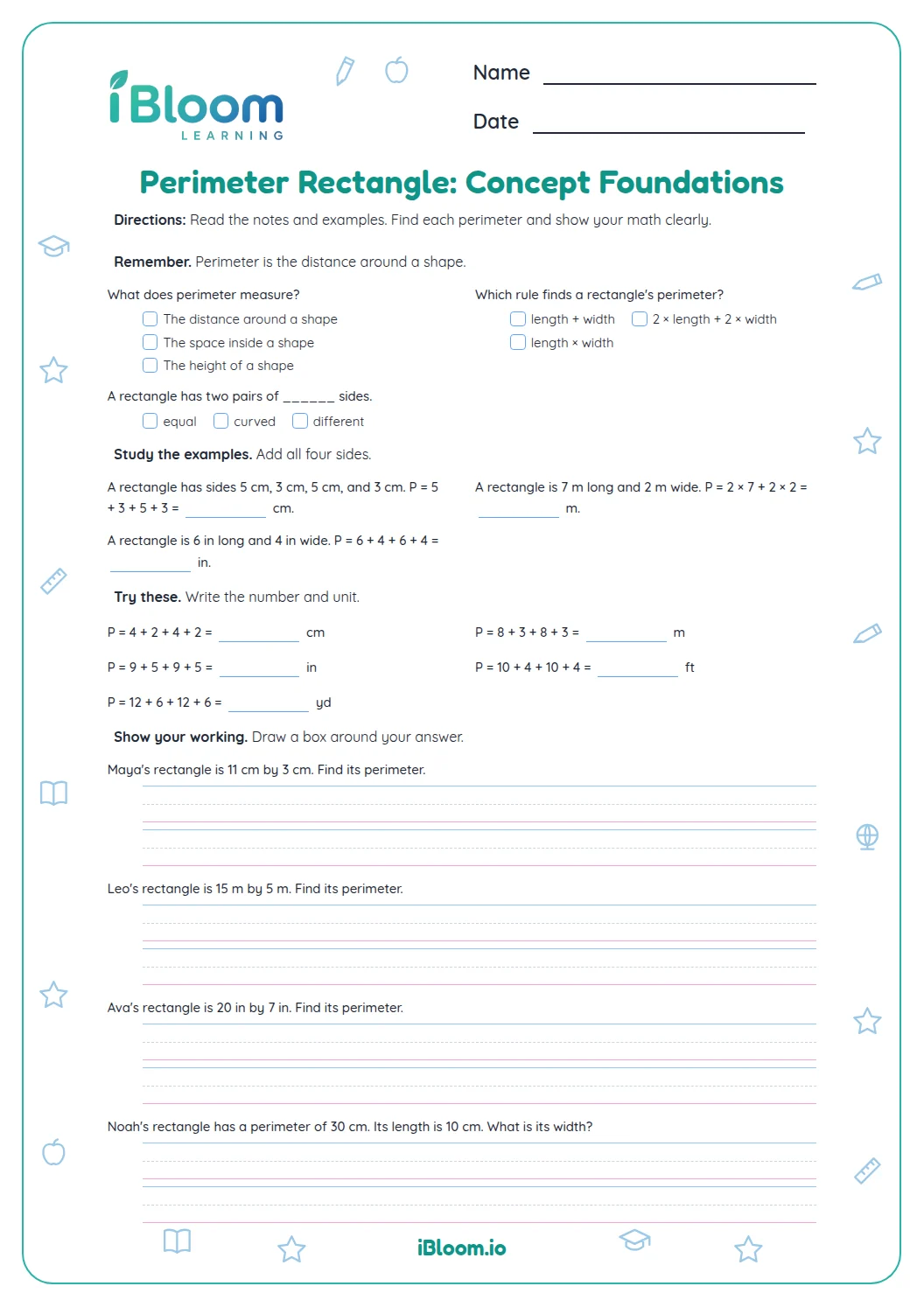
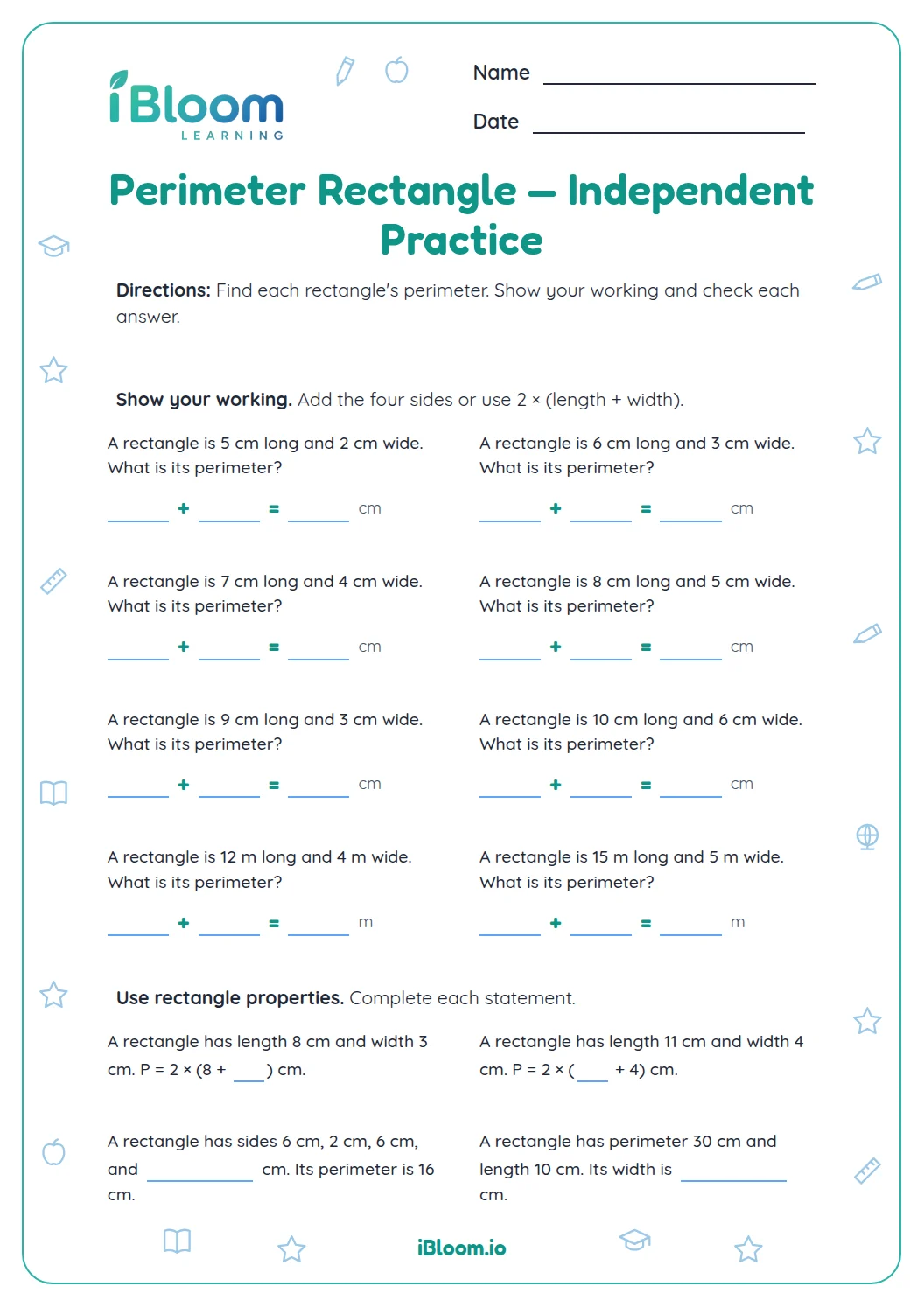
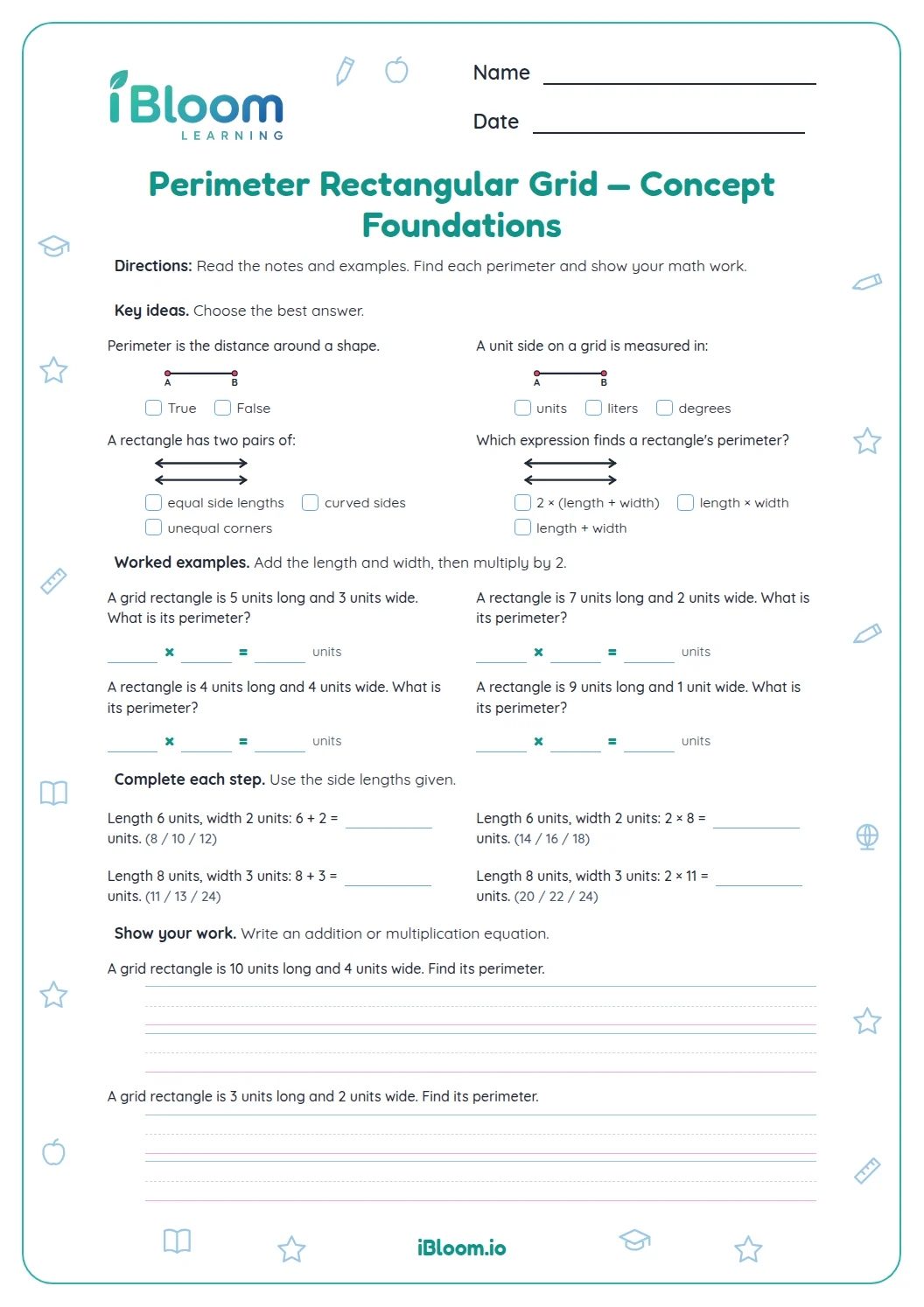
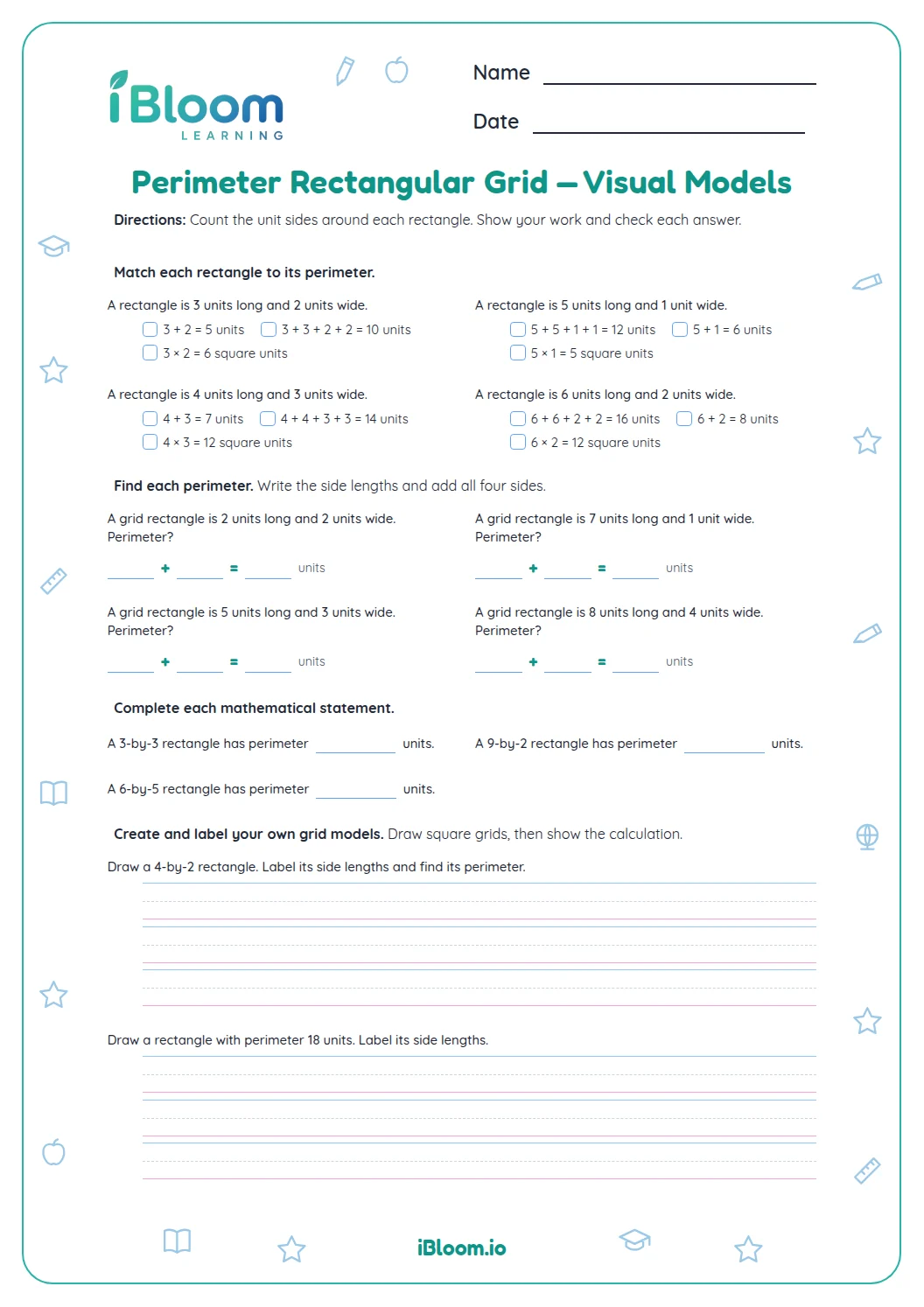
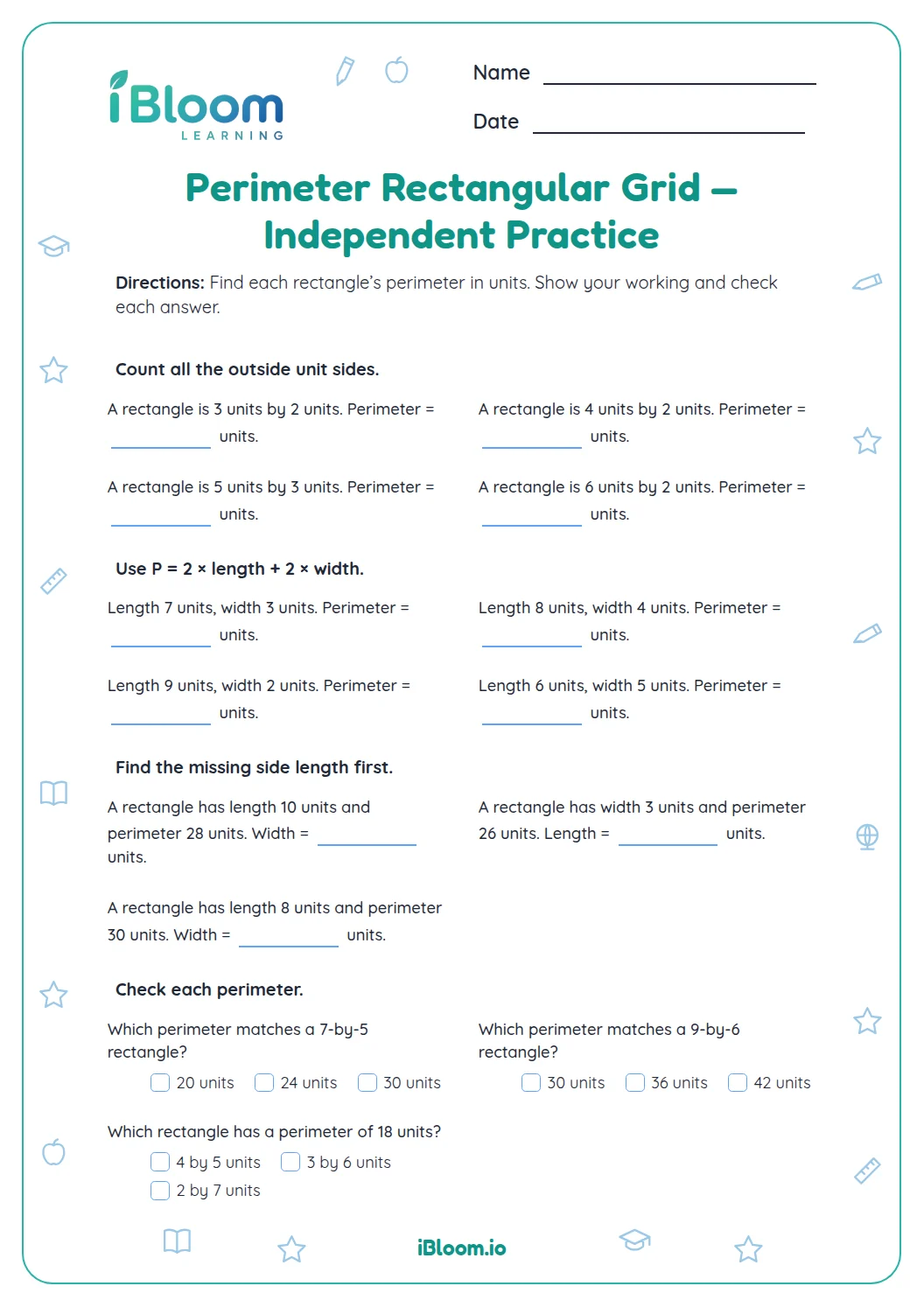
This printable gives Grade 3 learners 14 questions on rectangle perimeter. The first four items include rectangle diagrams and side lengths; later questions use everyday contexts, ask for a missing side, or compare a perimeter method. Children can add all four sides or use P = 2 × (length + width). A separate answer key gives the perimeter or side length with its unit.
How can you find a rectangle’s perimeter?
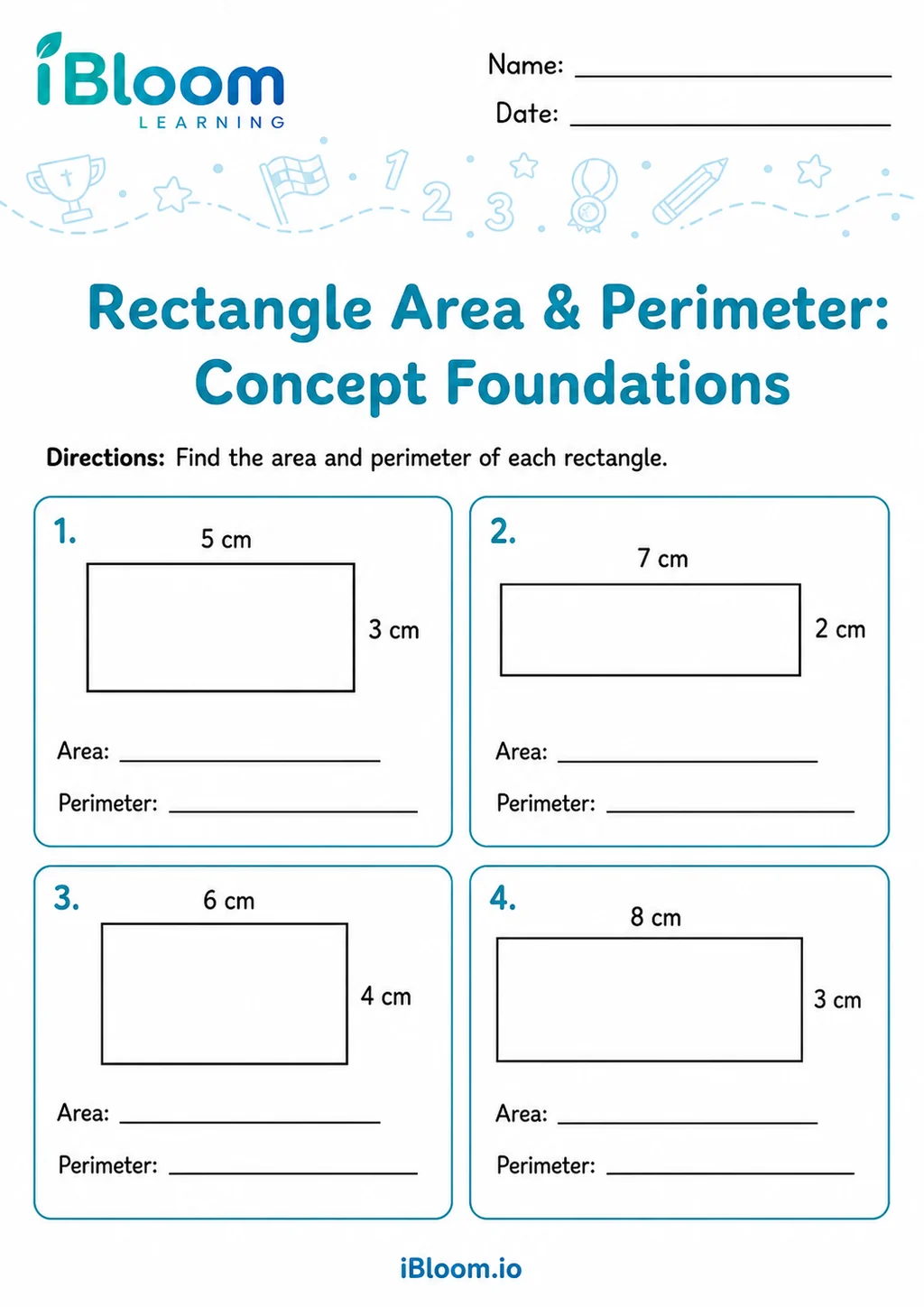
Perimeter measures the distance around a shape. Add the two lengths and two widths, or use P = 2 × (length + width). For question 1, 2 × (4 + 3) = 14 cm.
- 1Length = 4 cm; width = 3 cm
- 2P = 2 × (4 + 3)
- 3P = 14 cm
How do you find a missing side?
Opposite sides of a rectangle match. If the perimeter is 18 cm and the width is 3 cm, the two widths total 6 cm. Subtract 6 from 18, then split the remaining 12 cm between the two equal lengths: each length is 6 cm.
What does this worksheet practice?
The 14 items include perimeter calculations with units, perimeter stories, and missing-side reasoning. The first part includes rectangle drawings to connect the side lengths with the shape.
How to use this worksheet
- 1Identify the rectangle’s length and width.
- 2Add the length and width.
- 3Double that sum, or add all four sides.
- 4Write the unit used for the side lengths.
- 5For a missing side, subtract the known pair of sides from the perimeter.
Common mistakes and quick fixes
The mistake
Finding area by multiplying length and width.
The fix
Perimeter goes around the rectangle; add all four side lengths.
The mistake
Adding only one length and one width.
The fix
A rectangle has two of each, so double their sum.
The mistake
Dropping the unit.
The fix
Carry cm, m, in, ft, or yd through the calculation.
What to practice next
Make more practice
Questions parents and teachers ask
How many problems are included?
The worksheet has 14 questions in three parts. It includes perimeter calculations, everyday contexts, a choice of expression, and missing-side problems. The answer key shows a result with the correct unit when needed. It also asks learners to reason backward from a known perimeter.
What formula can a student use?
For a rectangle, add length and width, then multiply by 2: P = 2 × (length + width). Adding all four sides also works. Question 1 uses 4 cm and 3 cm to get 14 cm. The formula counts two lengths and two widths, just like adding all four sides.
Are units part of the answers?
Yes. Keep the unit from the question, such as centimeters, meters, inches, feet, or yards. When a unit is printed after the answer blank, the key gives only the number so the unit is not repeated. Keeping units attached helps distinguish a length from an area calculation.
How can perimeter help find a missing side?
Subtract the known sides from the perimeter. Opposite rectangle sides are equal, so if one length or width is missing, the remaining total belongs to the matching pair. Divide that total by 2 to find the side. The matching pair is equal because each pair of opposite sides in a rectangle has the same length.
Does the sheet include diagrams?
Yes. The first four questions show rectangle outlines alongside the stated side lengths. The remaining questions use written situations or expressions to extend perimeter practice, including missing-side reasoning and units. The drawings give a visual reference while the side measurements remain stated in the question.