

About this worksheet
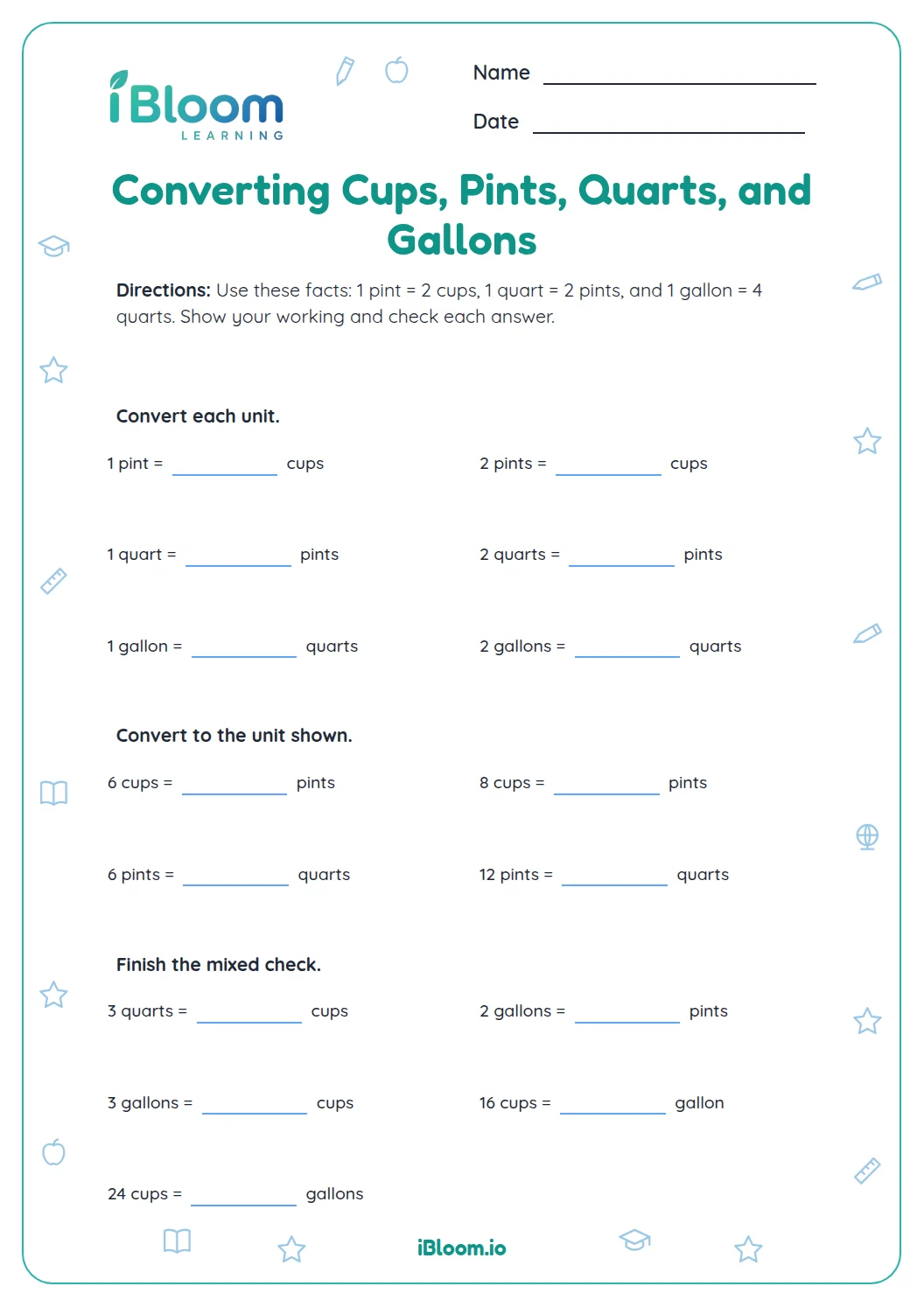
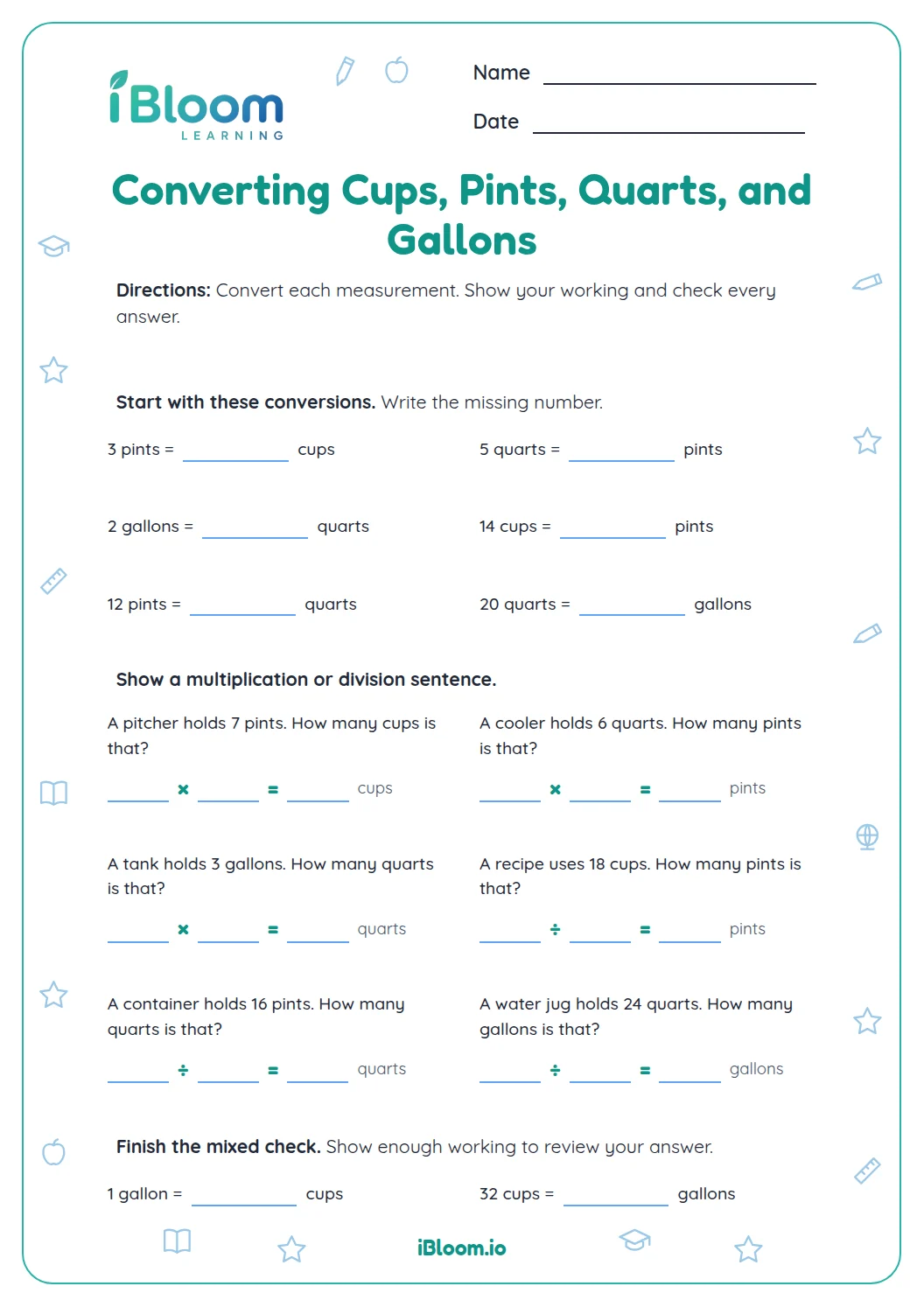
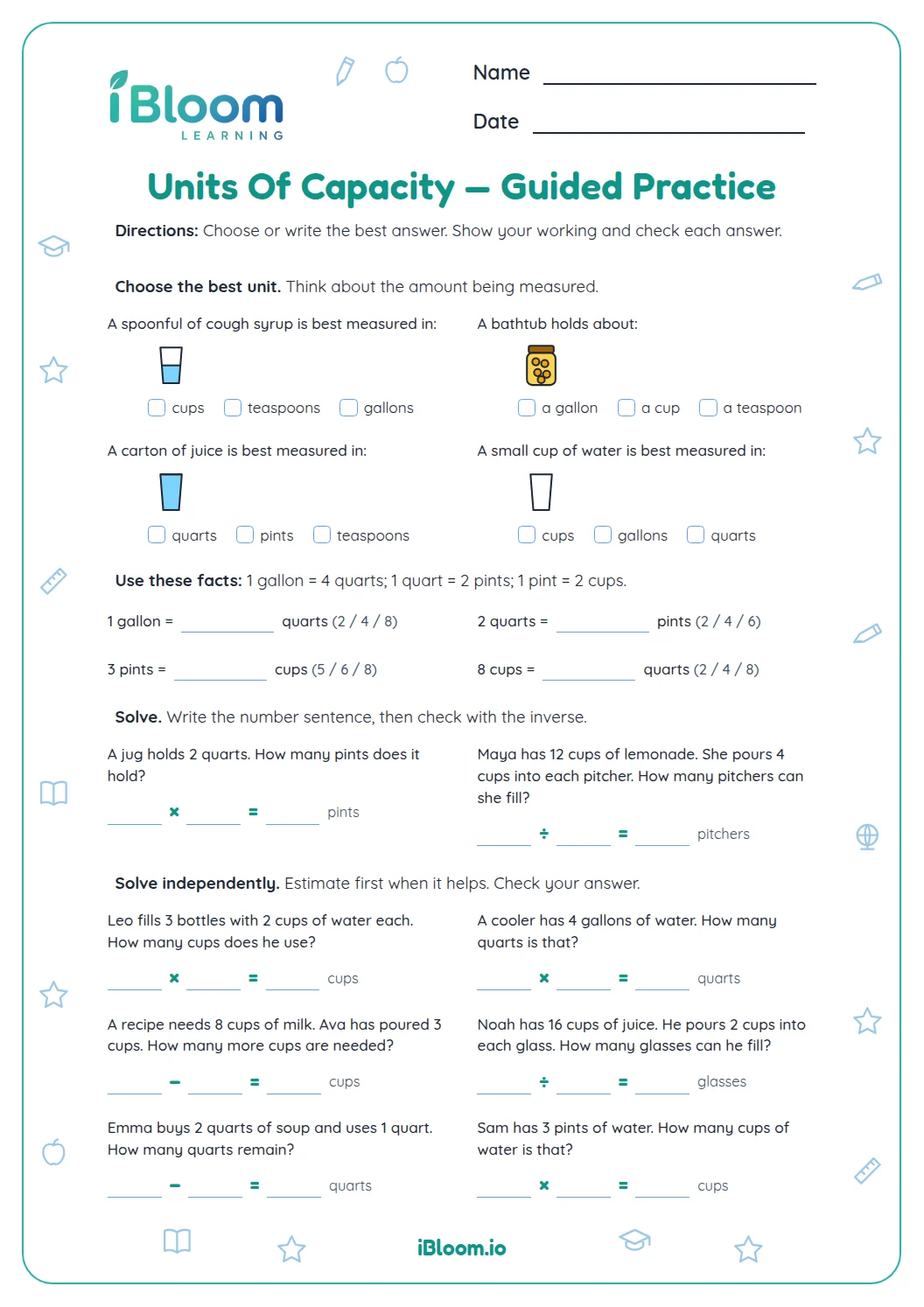
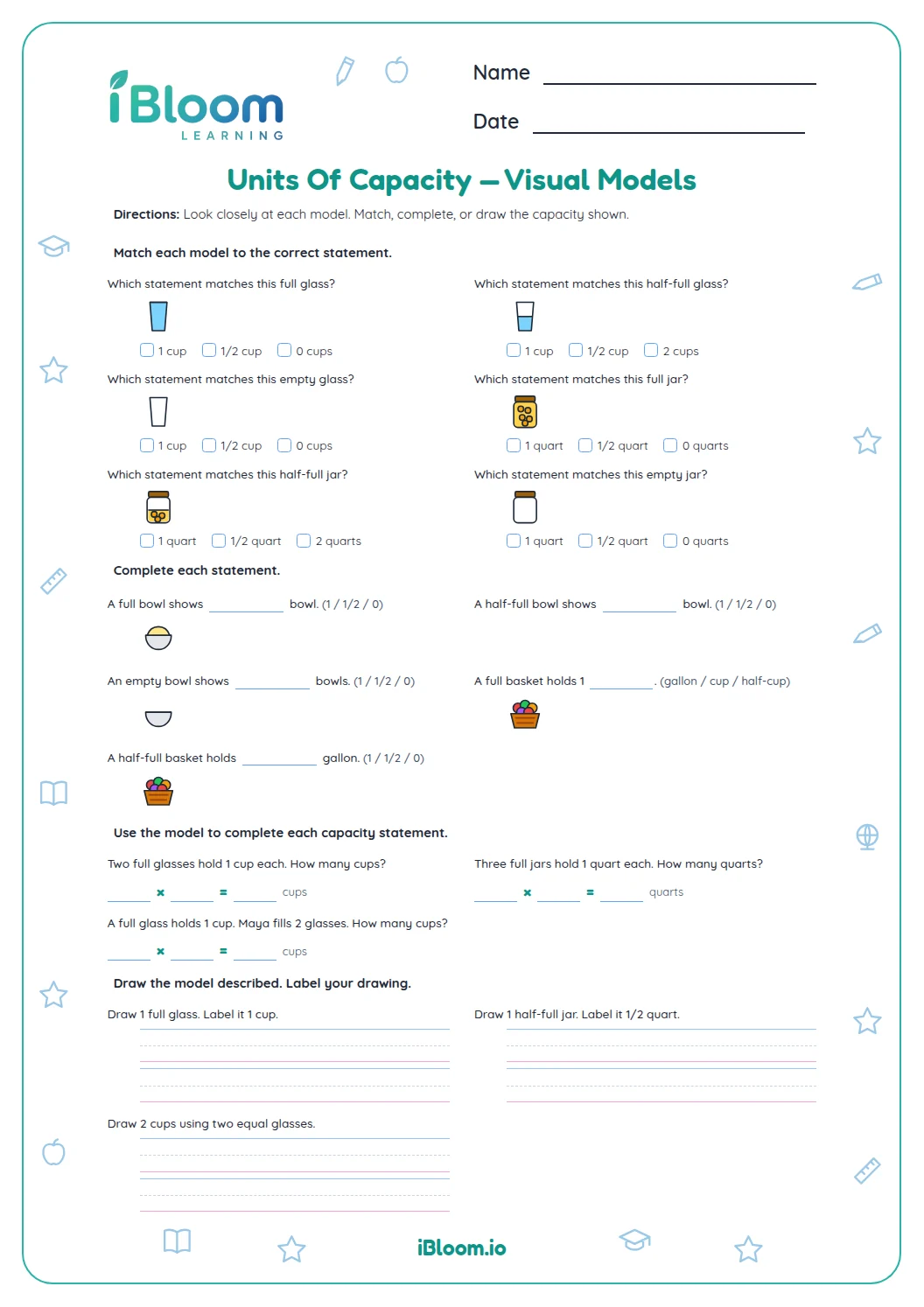
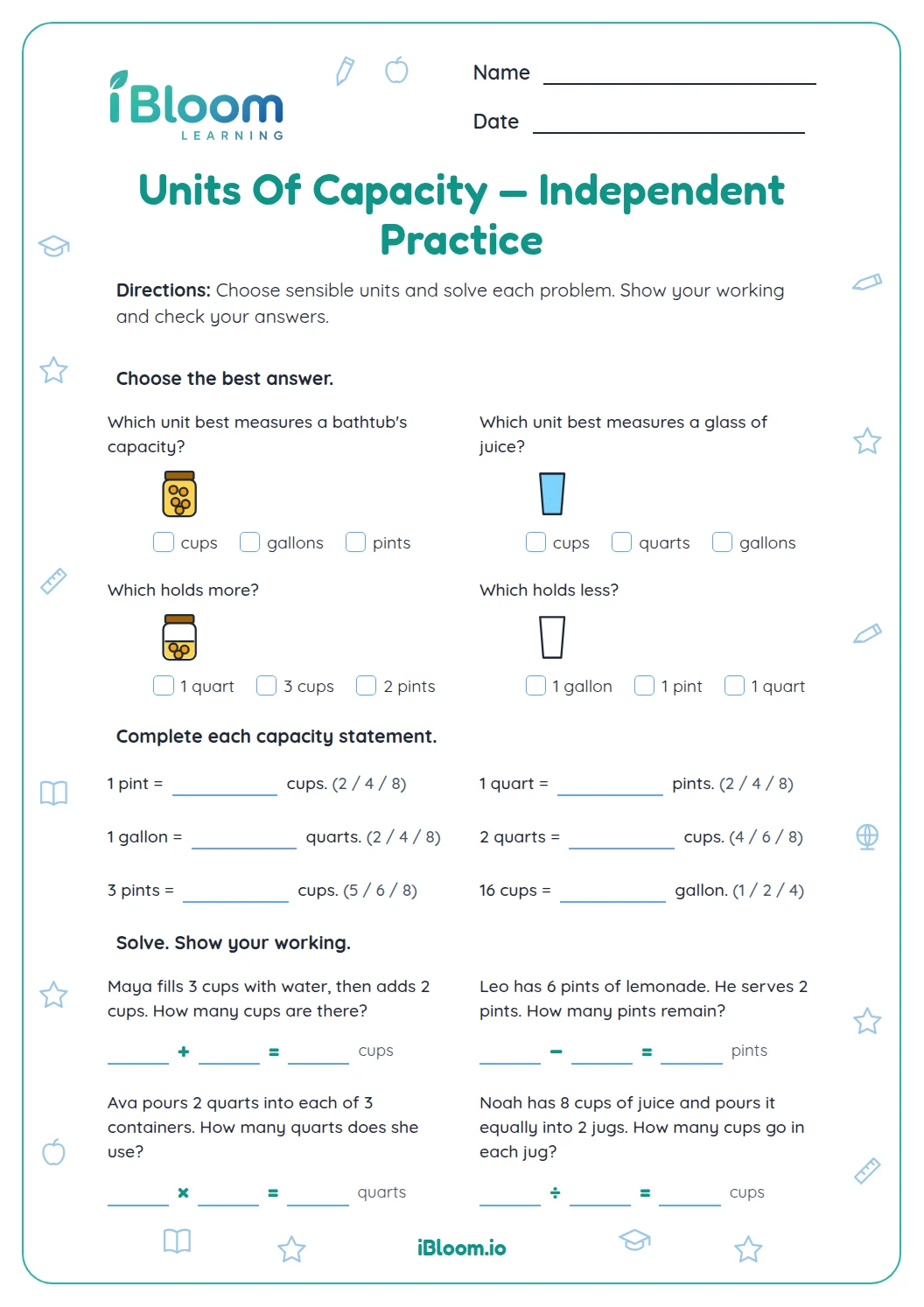
This guided-practice sheet gives Grade 3 learners 16 capacity conversions, beginning with the unit chain and moving to short situations about soup, lemonade, water, and broth. Students use 2 cups per pint, 2 pints per quart, and 4 quarts per gallon to move between units. A separate answer key lists number-only answers where the worksheet prints a unit after the blank, preventing duplicated units.
Aligned to 4.MD.A.1
What is the capacity unit chain?
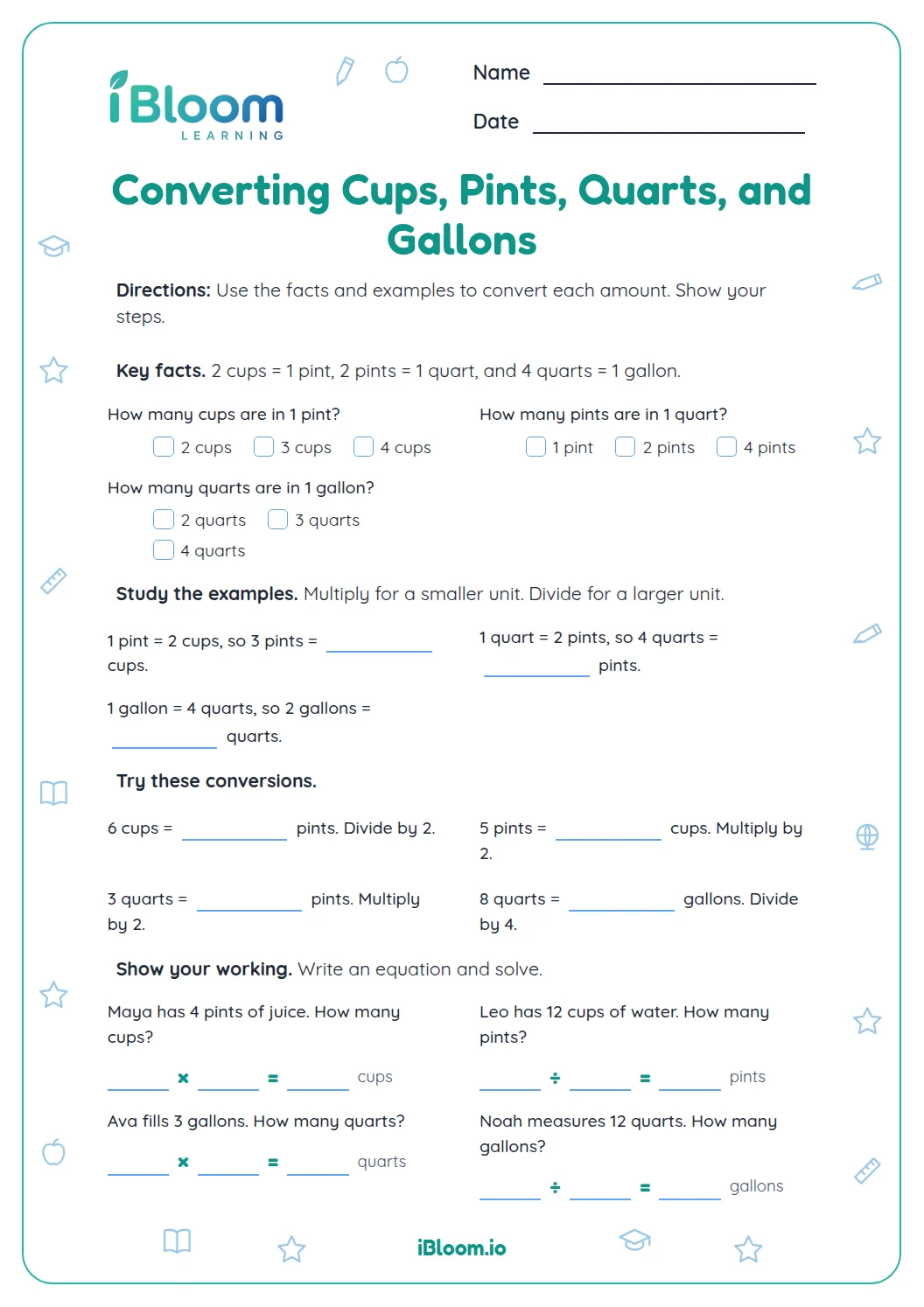
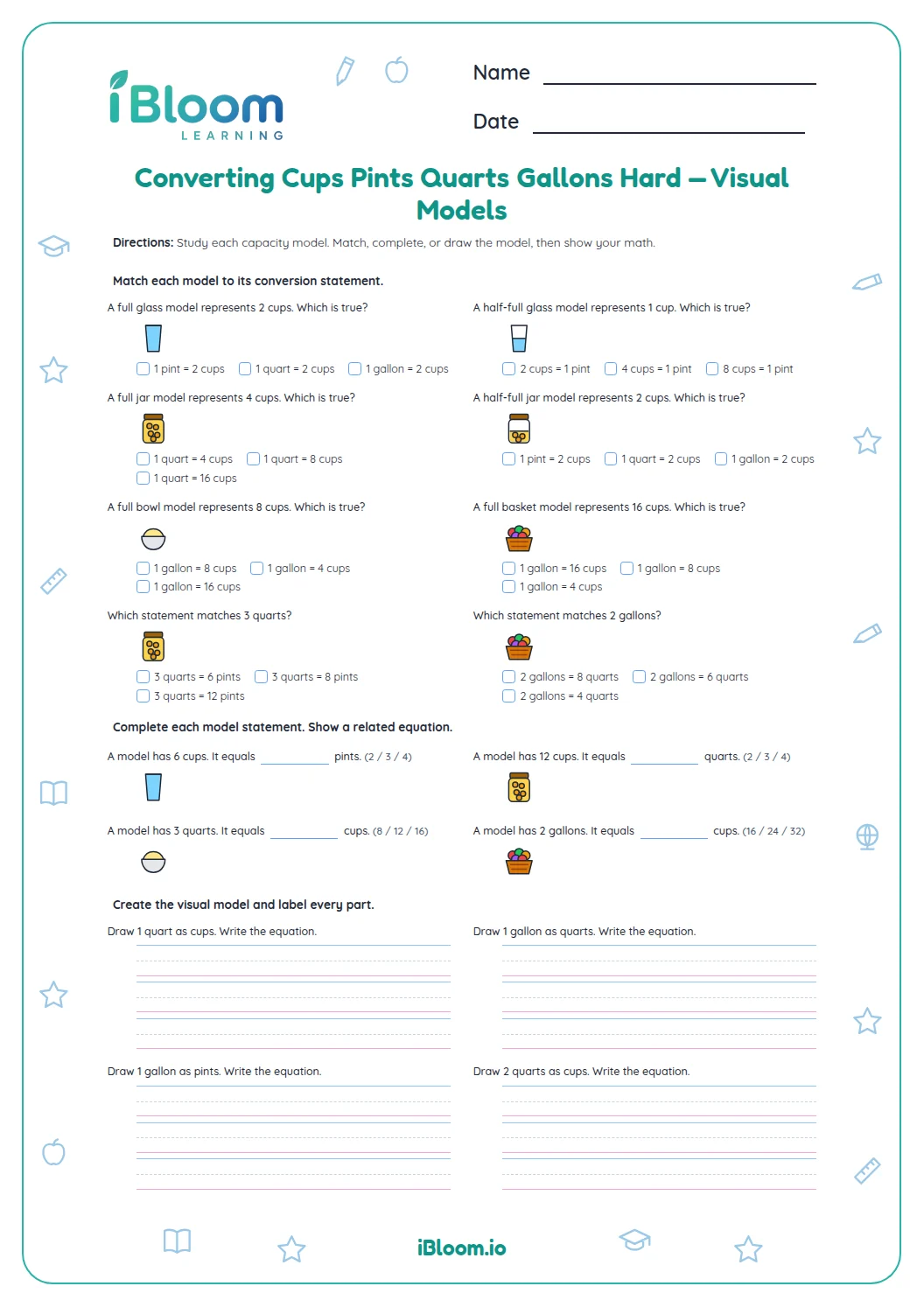
Two cups make a pint, two pints make a quart, and four quarts make a gallon. A quart is therefore 4 cups. Question 4 uses this link directly: 1 quart equals 4 cups.
- 11 quart = 2 pints
- 21 pint = 2 cups
- 32 × 2 = 4 cups
How do you choose a conversion step?
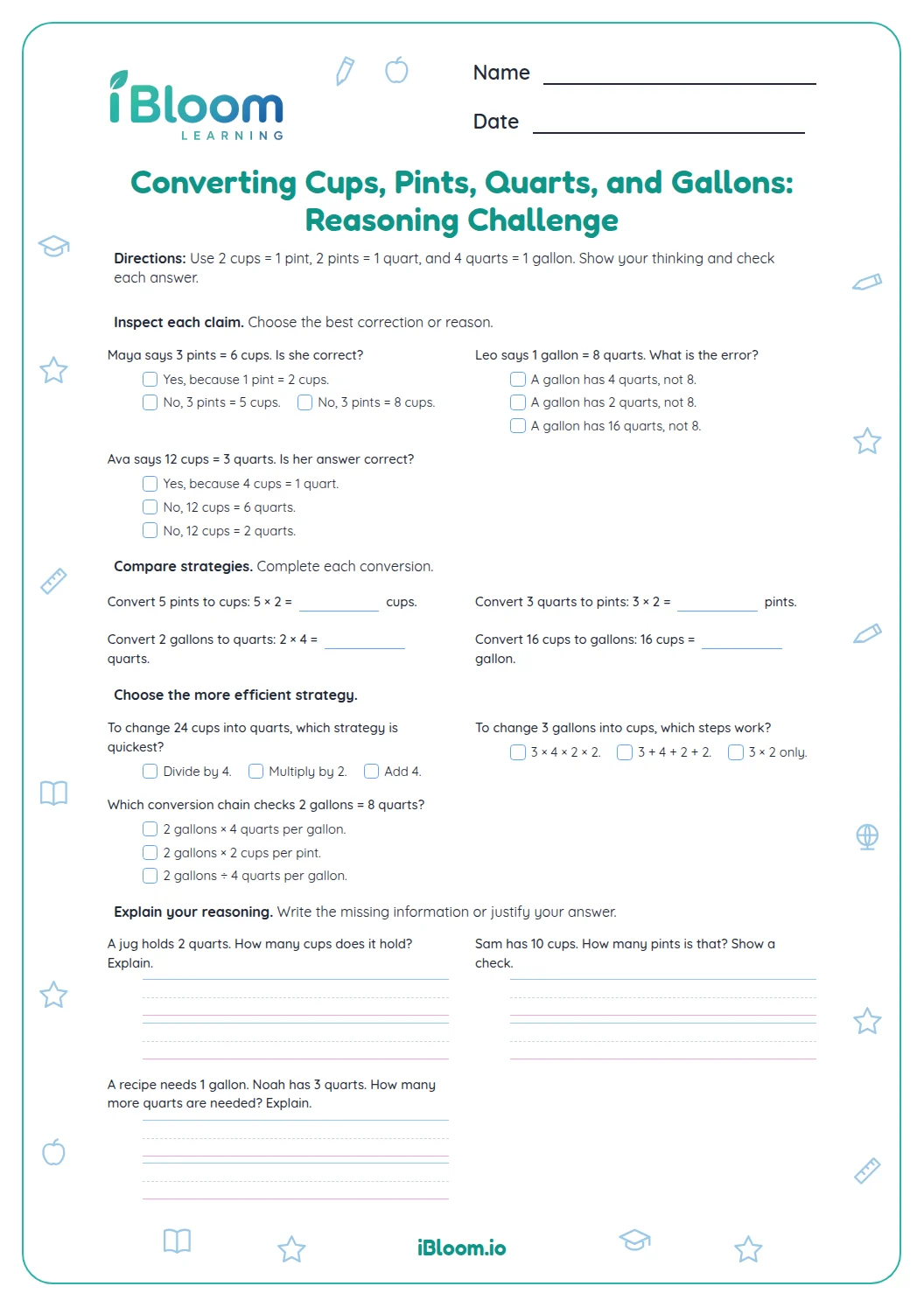
Use the relationship between the starting and target units. For a gallon-to-quart conversion, multiply by 4; for cups to quarts, group cups in sets of 4 and divide by 4. Keep the target unit in mind as you work.
How does guided practice apply the facts?
The final questions use soup, lemonade, water, and broth. Each gives one amount and asks for an equivalent amount in another unit, so students can decide whether to multiply or divide.
How to use this worksheet
- 1Write the unit fact connecting the two units.
- 2If converting to a smaller unit, multiply by the number of smaller units.
- 3If converting to a larger unit, divide into equal groups.
- 4Use a two-step chain when the units are not adjacent.
- 5Label the result with the requested unit.
- 6Check the size: smaller units should have a larger count.
Common mistakes and quick fixes
The mistake
Thinking 1 quart is 2 cups.
The fix
A quart is 2 pints, and each pint is 2 cups, so 1 quart is 4 cups.
The mistake
Using 4 quarts in one gallon but stopping at pints.
The fix
Write each link in the unit chain and continue until you reach the requested unit.
The mistake
Dividing gallons into quarts.
The fix
Quarts are smaller than gallons, so multiply gallons by 4.
Common Core alignment
This worksheet practices customary measurement conversions and related problem solving.
Use unit relationships to express liquid volumes in smaller or larger units.
On this sheet: Students apply unit relationships to convert customary capacity measures.
Show the official wordingHide the official wording
Know relative sizes of measurement units within one system of units including km, m, cm; kg, g; lb., oz.; l, ml; hr, min, sec. Within a single system of measurement, express measurements in a larger unit in terms of a smaller unit. Record measurement equivalents in a two-column table. For example, know that 1 ft is 12 times as long as 1 in. Express the length of a 4 ft snake as 48 in. Generate a conversion table for feet and inches listing the number pairs (1, 12), (2, 24), (3, 36), ...
What to practice next
Make more practice
Further reading
Questions parents and teachers ask
How many cups are in a quart?
There are 4 cups in a quart. One quart is 2 pints, and each pint is 2 cups, so 2 × 2 = 4. Question 4 asks students to recall that relationship and use the unit chain instead of memorizing a separate cups-per-quart fact.
How many quarts are in a gallon?
There are 4 quarts in 1 gallon. Multiply gallons by 4 to find quarts; the cooler problem converts 2 gallons into 8 quarts. The number gets larger because quarts are smaller units than gallons. Four equal quarts make one gallon, so two gallons contain eight quarts altogether.
How do I convert cups to pints?
There are 2 cups in each pint, so divide cups by 2. For example, 10 cups equals 5 pints in question 15. Check with the inverse fact: 5 pints times 2 cups each returns to 10 cups. Since two cups make a pint, this conversion groups the cups into pairs.
What is the purpose of the unit chain?
The chain connects cups, pints, quarts, and gallons one step at a time. It helps students avoid guessing a relationship and supports multi-step conversions, such as going from gallons to cups. Writing each relationship before calculating helps keep the units in the correct order.
Does the answer key repeat units after blanks?
No. For equation blanks with the unit already printed, the key gives only the missing number. For story questions with no printed unit after the answer space, the key includes the unit. This convention avoids showing a unit twice when one is already printed beside a blank.