



About this worksheet
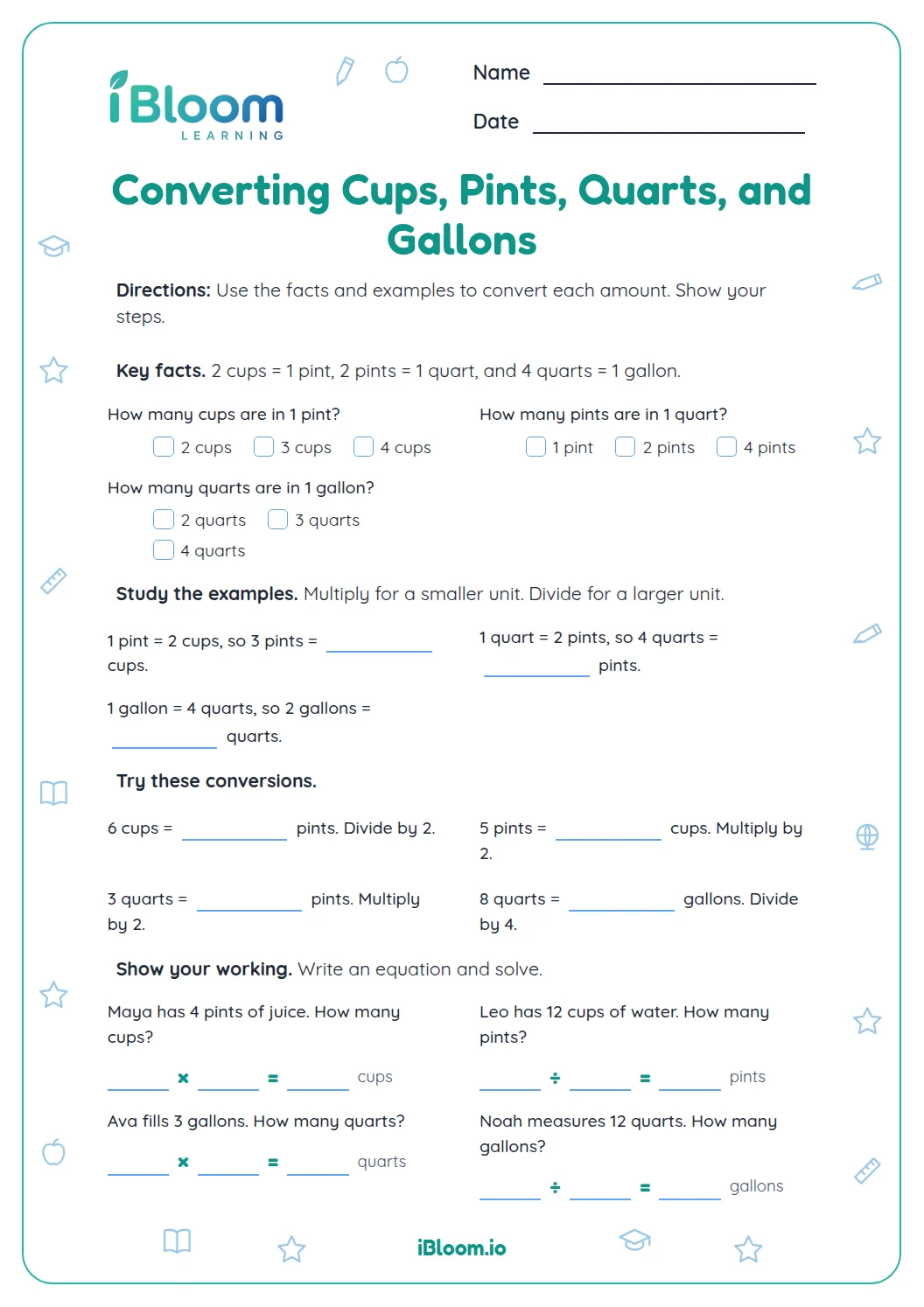
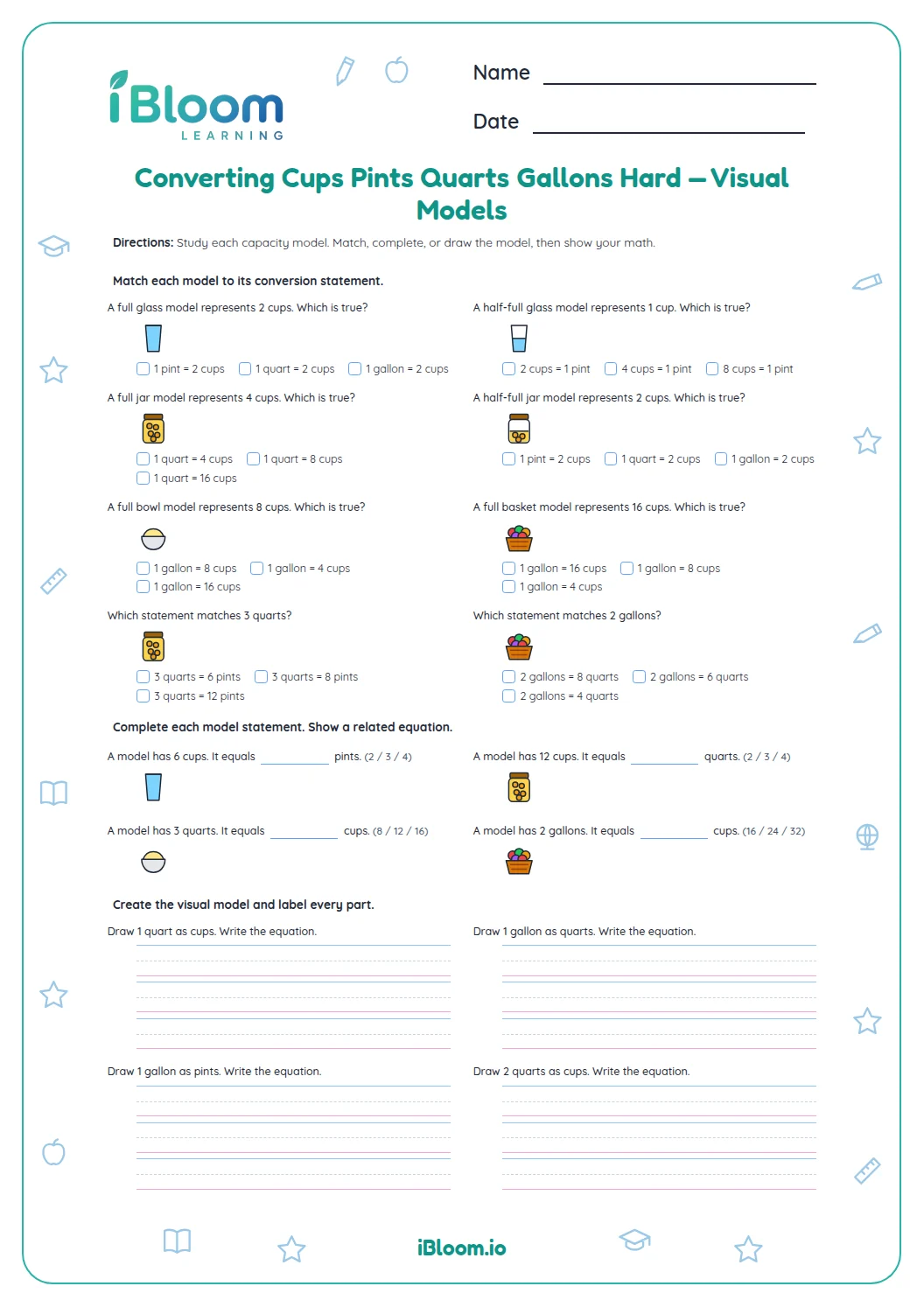
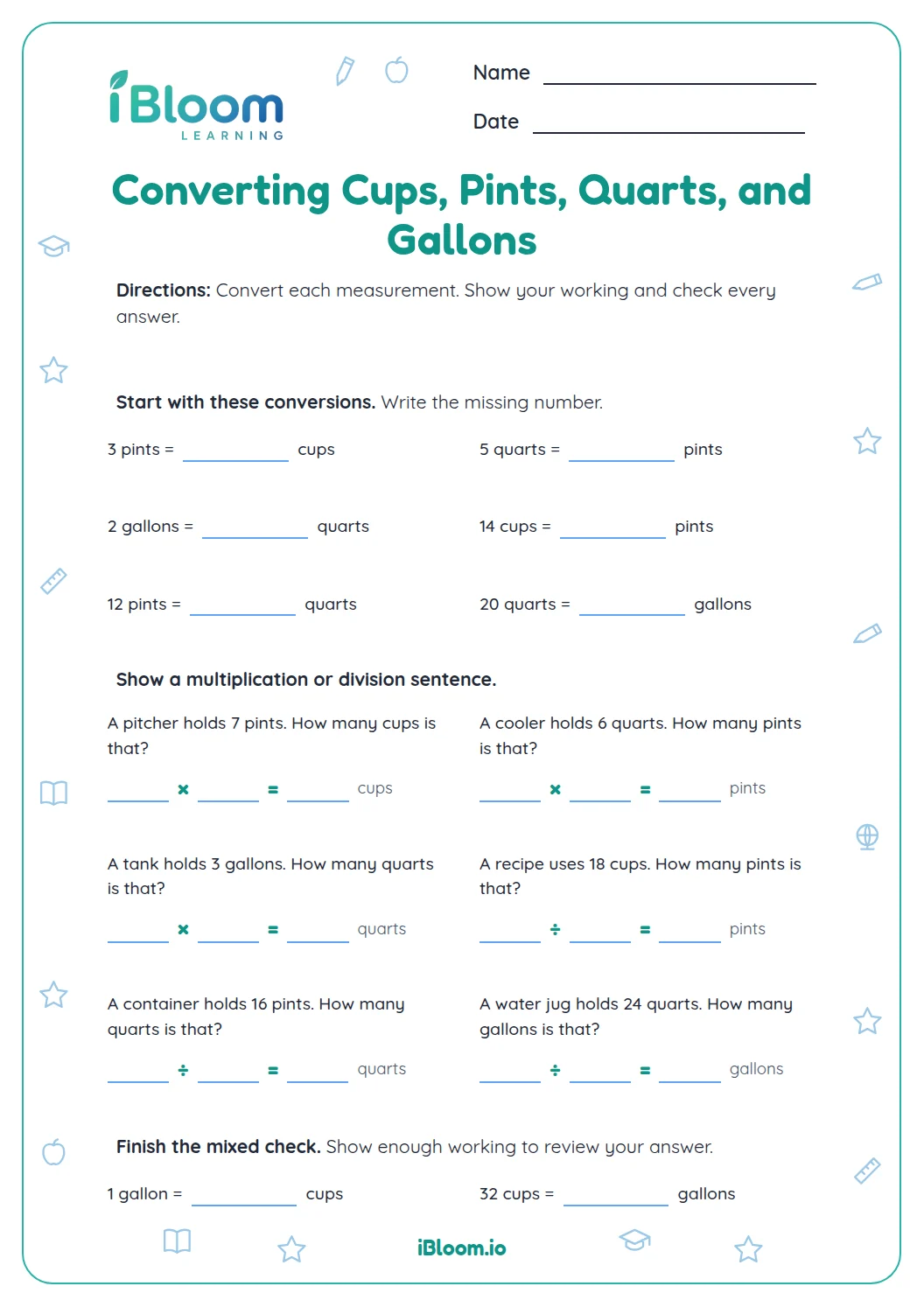
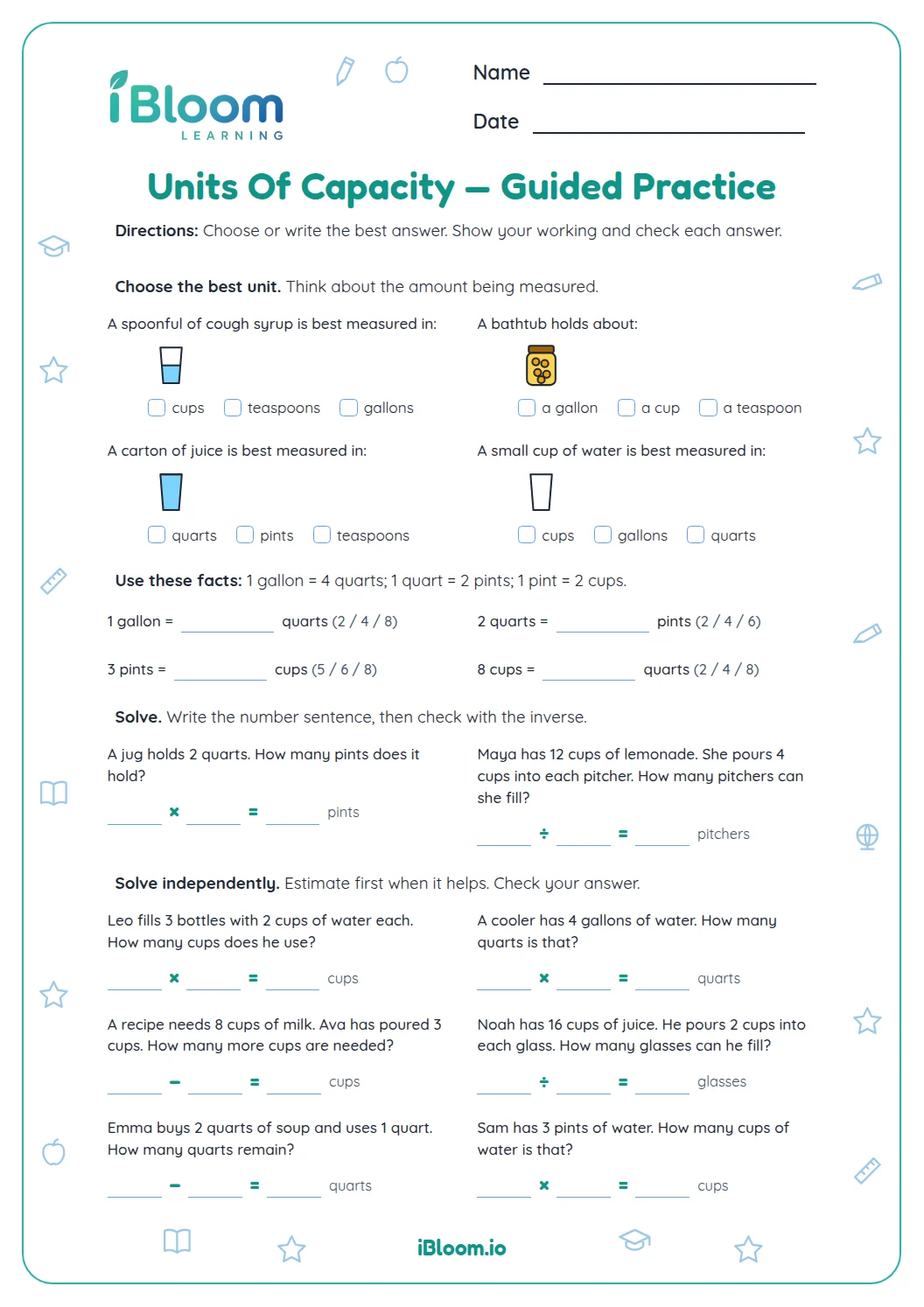
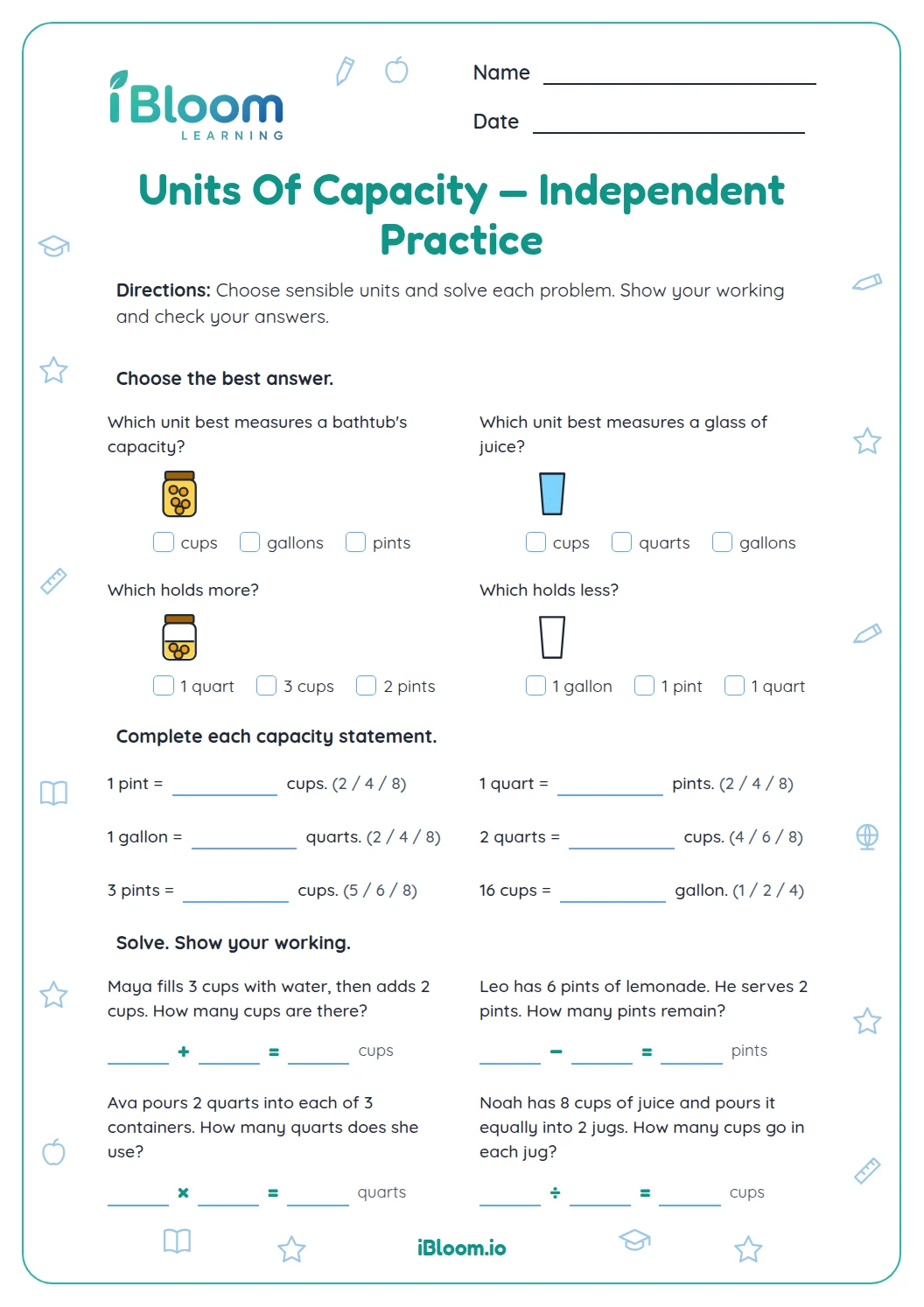
This Grade 3 practice page works with cups, pints, quarts, and gallons using the conversion facts printed in its directions. A gallon contains 4 quarts, and each quart contains 4 cups, so 1 gallon = 16 cups. The 15 questions include conversions, reasoning choices, and short capacity stories.
Aligned to 5.MD.A.1
How are the capacity units related?
Since 1 quart is 4 cups, 3 quarts are 12 cups. Each conversion uses the unit facts in the directions.
How can the facts be combined?
Convert one unit at a time using the equalities in the directions, and keep the unit with each amount.
How do the facts help in a story?
Convert one unit at a time using the equalities in the directions, and keep the unit with each amount.
How to use this worksheet
- 1Start with the equalities in the directions.
- 2Convert through one neighboring unit at a time.
- 3Keep track of the unit after each step.
- 4Check a conversion by changing the result back to the starting unit.
Common mistakes and quick fixes
The mistake
Treating a quart as 2 cups
The fix
Use 4 cups in each quart.
The mistake
Using 8 cups for a gallon
The fix
Multiply 4 cups per quart by 4 quarts.
The mistake
Changing units in the wrong direction
The fix
Check whether the new unit is larger or smaller before multiplying or dividing.
Common Core alignment
The problems apply customary capacity relationships in calculations and short real-world situations.
Use customary capacity relationships to solve conversion problems.
On this sheet: Use customary capacity relationships to solve conversion problems.
Show the official wordingHide the official wording
Convert among different-sized standard measurement units within a given measurement system (e.g., convert 5 cm to 0.05 m), and use these conversions in solving multi-step, real world problems.
What to practice next
Make more practice
Further reading
Questions parents and teachers ask
How many cups are in a gallon?
There are 16 cups in 1 gallon. A gallon contains 4 quarts and each quart contains 4 cups, so 4 groups of 4 cups make 16 cups. The worksheet prints these relationships in its directions for students to use throughout the questions.
How can 24 cups be written in gallons?
Sixteen cups make 1 gallon, leaving 8 cups. Since 8 is half of 16, 24 cups equals 1 1/2 gallons. The multiple-choice question includes this value so students can compare the amount with the unit facts. Convert back to cups to check: 1 1/2 gallons is 24 cups.
Does this worksheet include an answer key?
Yes. A separate answer key gives the results for all 15 conversion and story questions. It includes the correction that a quart contains 4 cups and the reasoning that 32 cups equals 2 gallons. Students can compare each result with the printed conversion chain.
What capacity facts are used?
The directions use 2 cups in a pint, 2 pints in a quart, and 4 quarts in a gallon. Together, these show that one gallon contains 16 cups. Students can move through neighboring units and then check by converting the result back. Each fraction model uses equal-sized pieces, so every grid dimension matches the side lengths in its prompt.
How do you decide whether to multiply or divide?
When changing to a smaller unit, multiply to count more units; when changing to a larger unit, divide. For example, gallons to cups requires multiplication, while cups to gallons requires division by 16. Follow the unit chain to keep the conversion steps clear.