


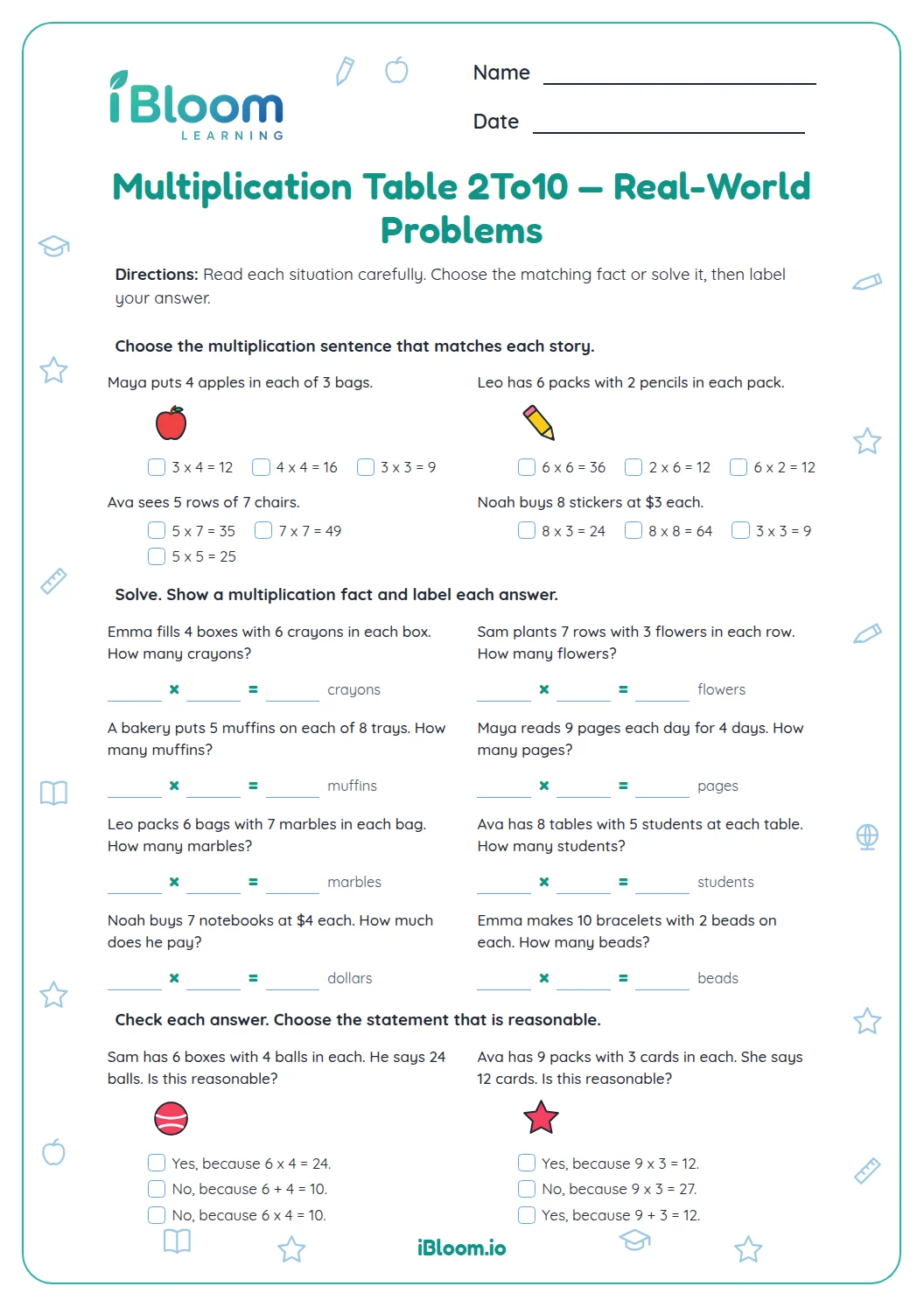
About this worksheet
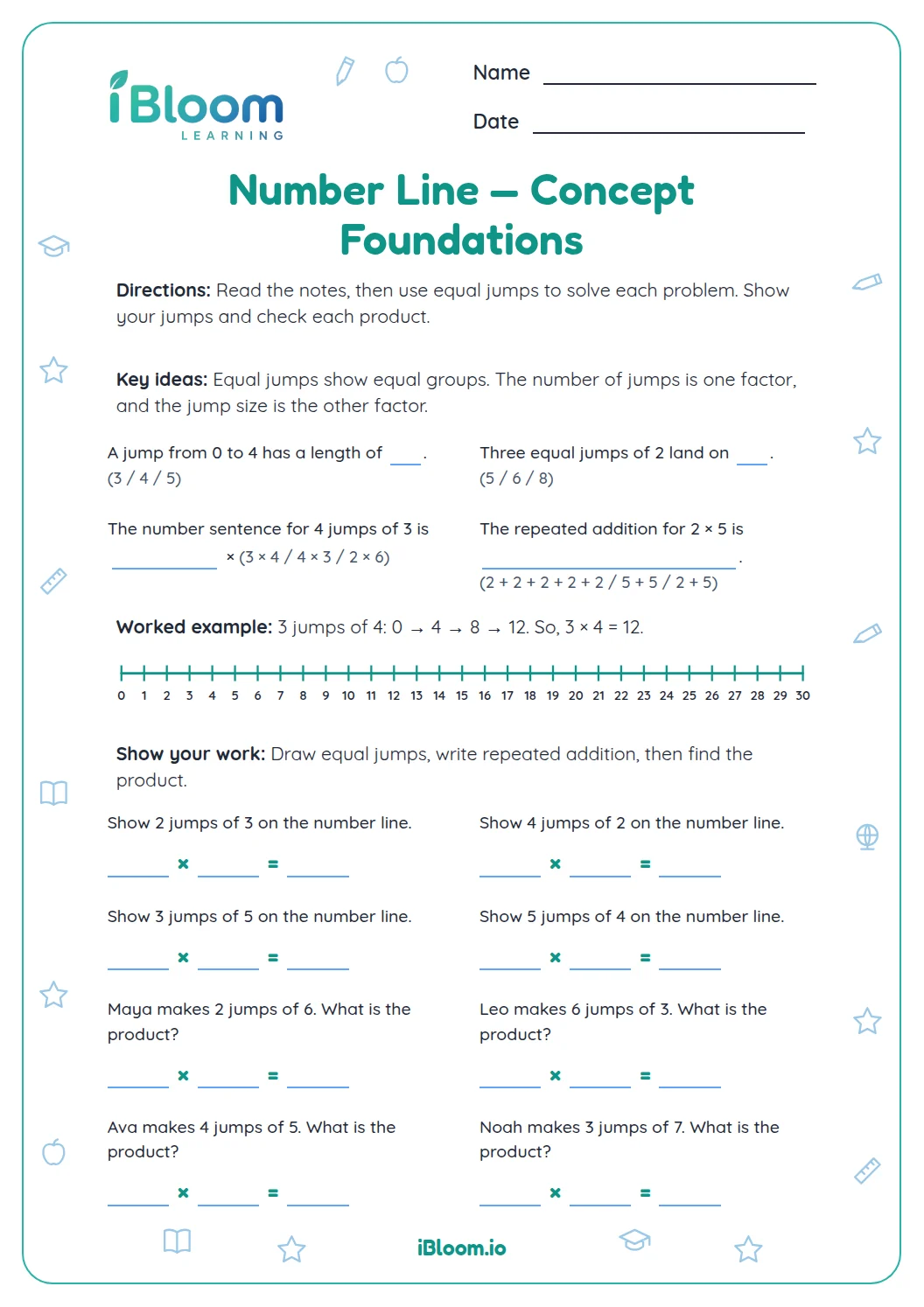
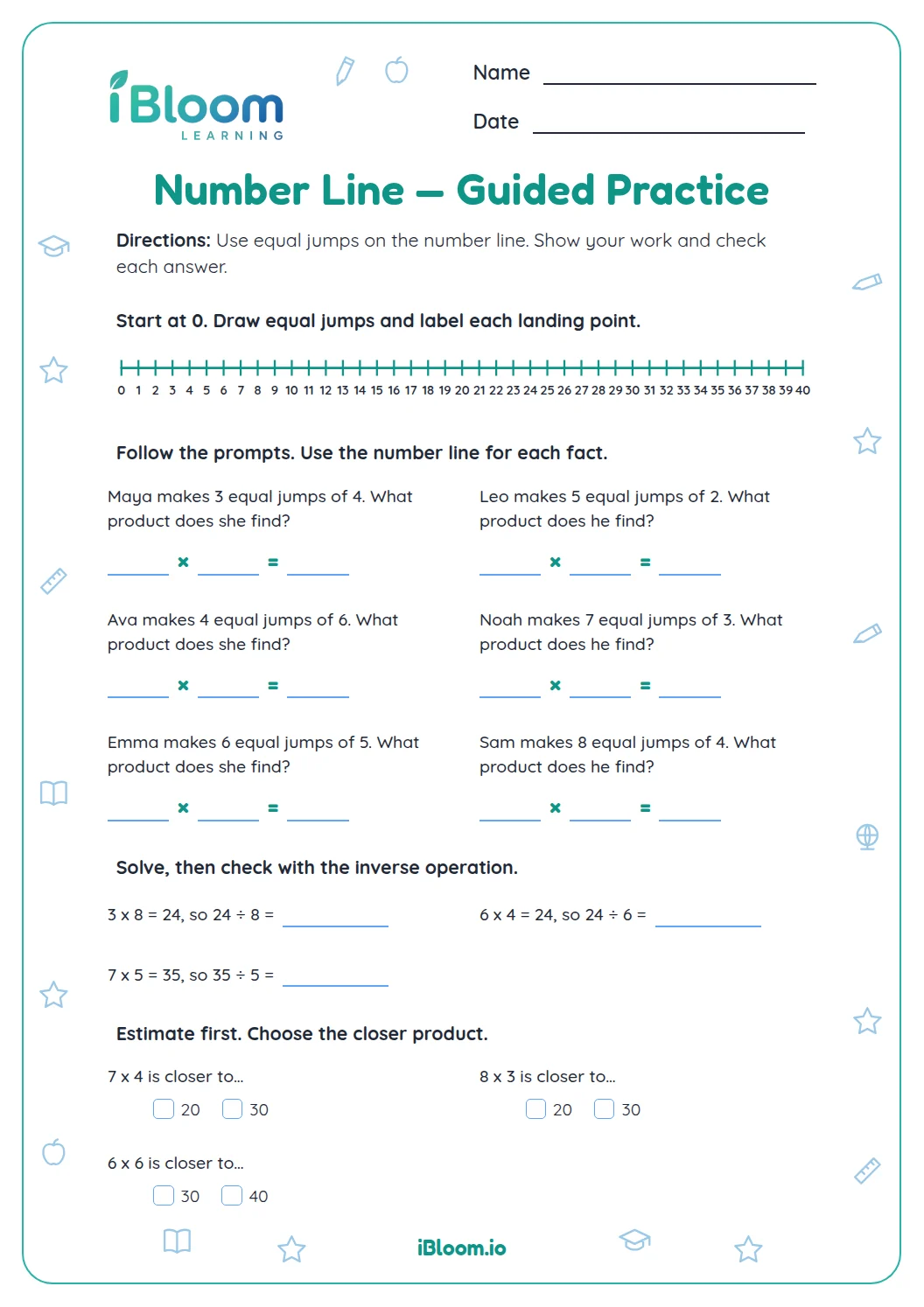
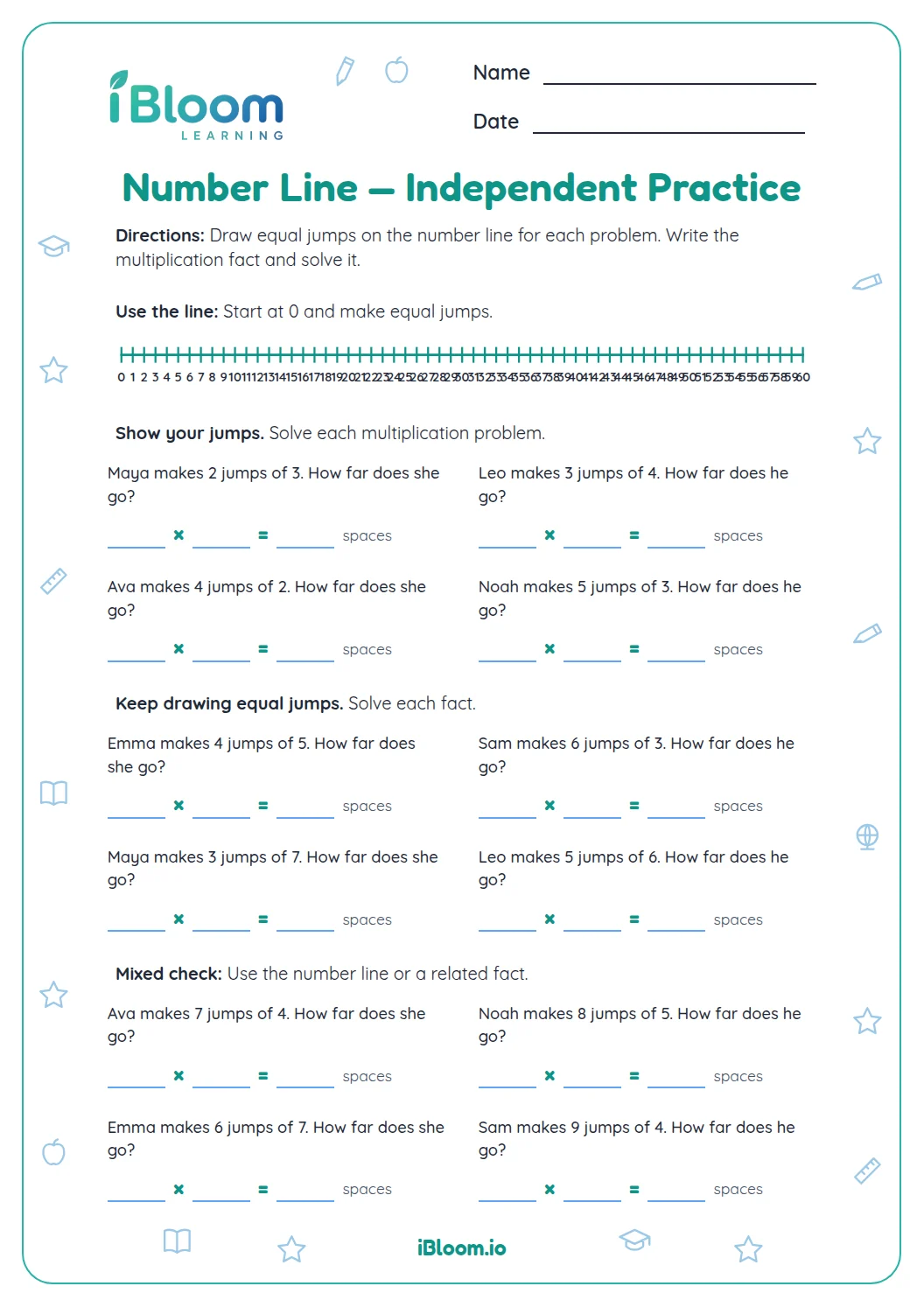
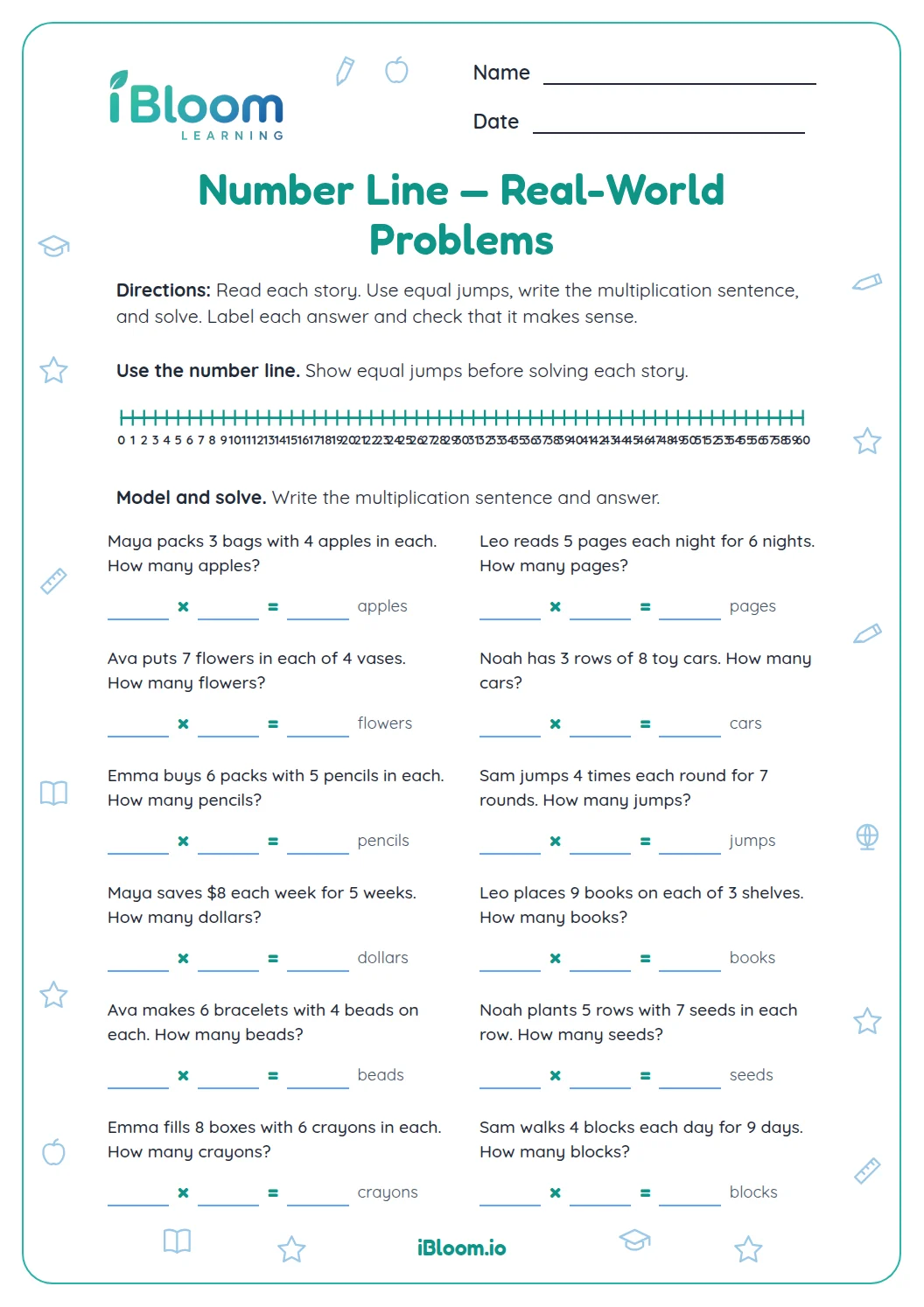
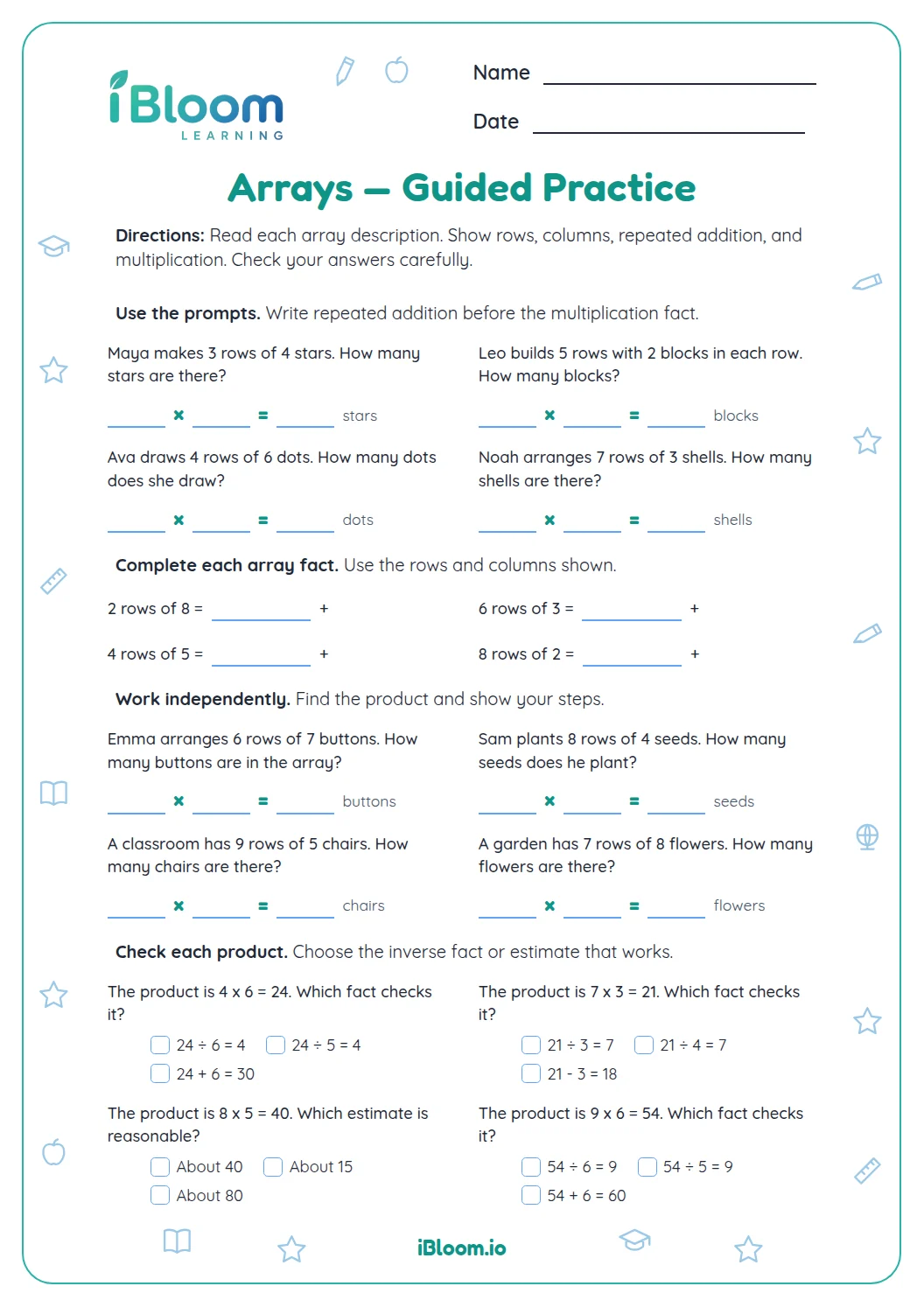
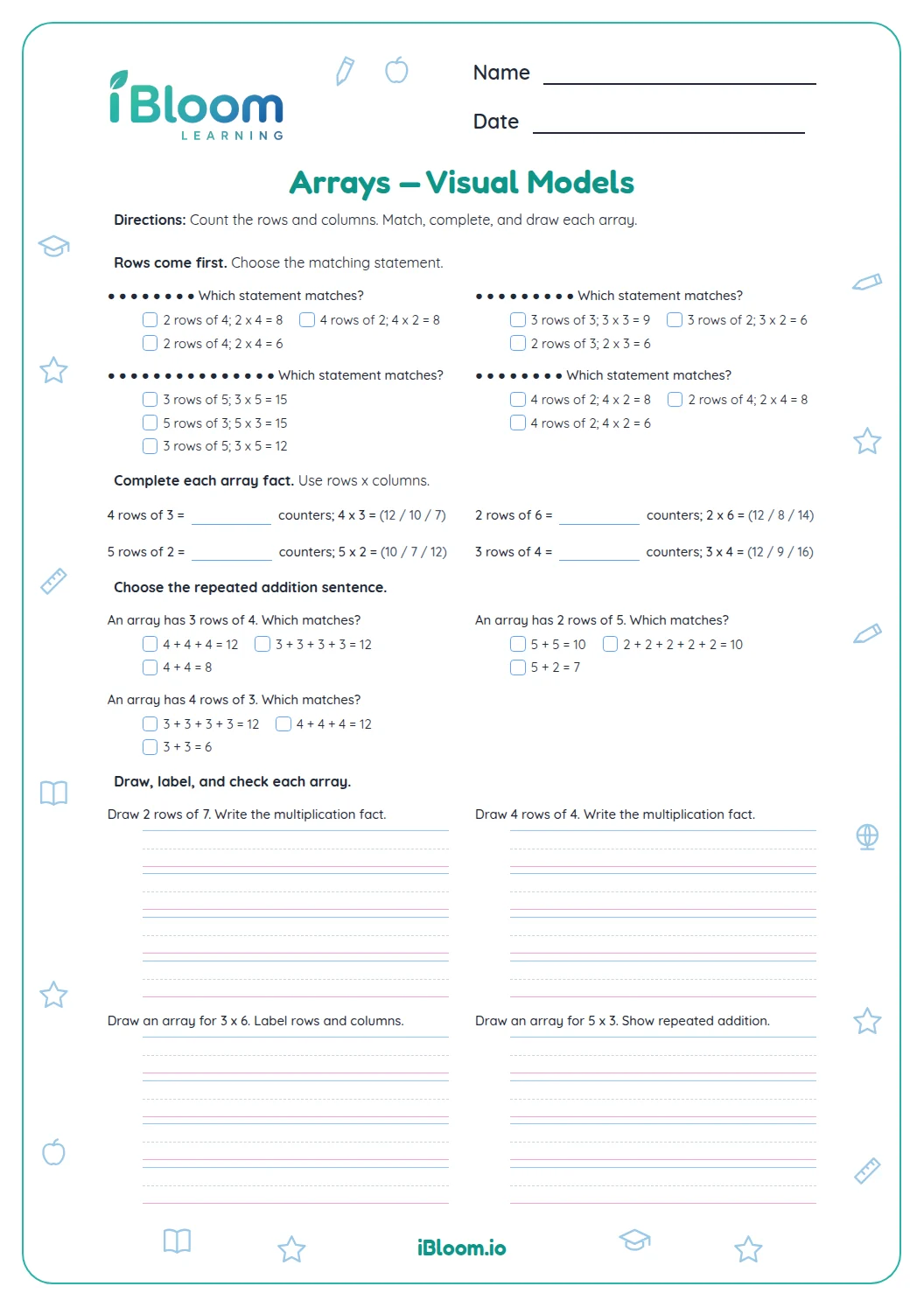
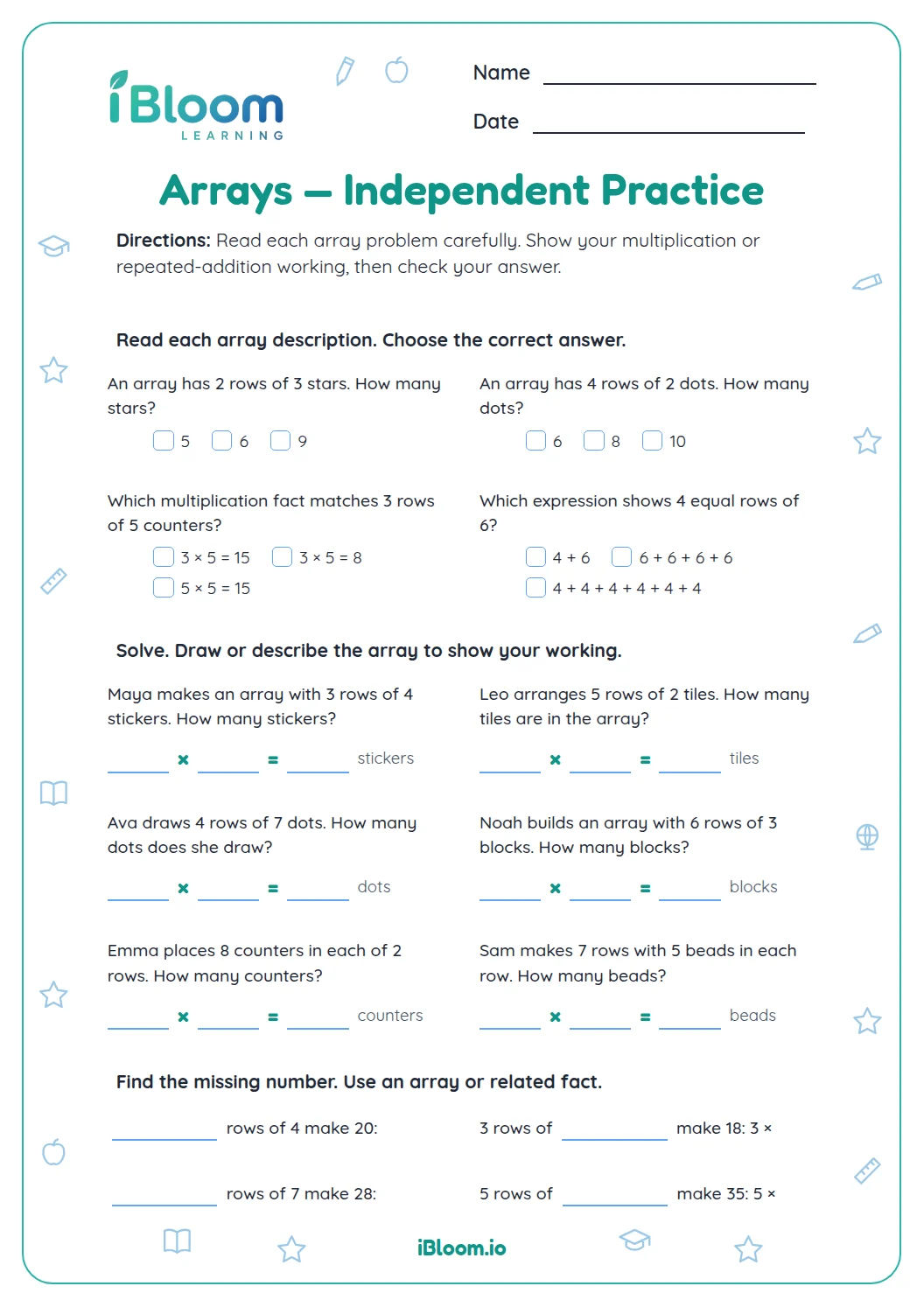
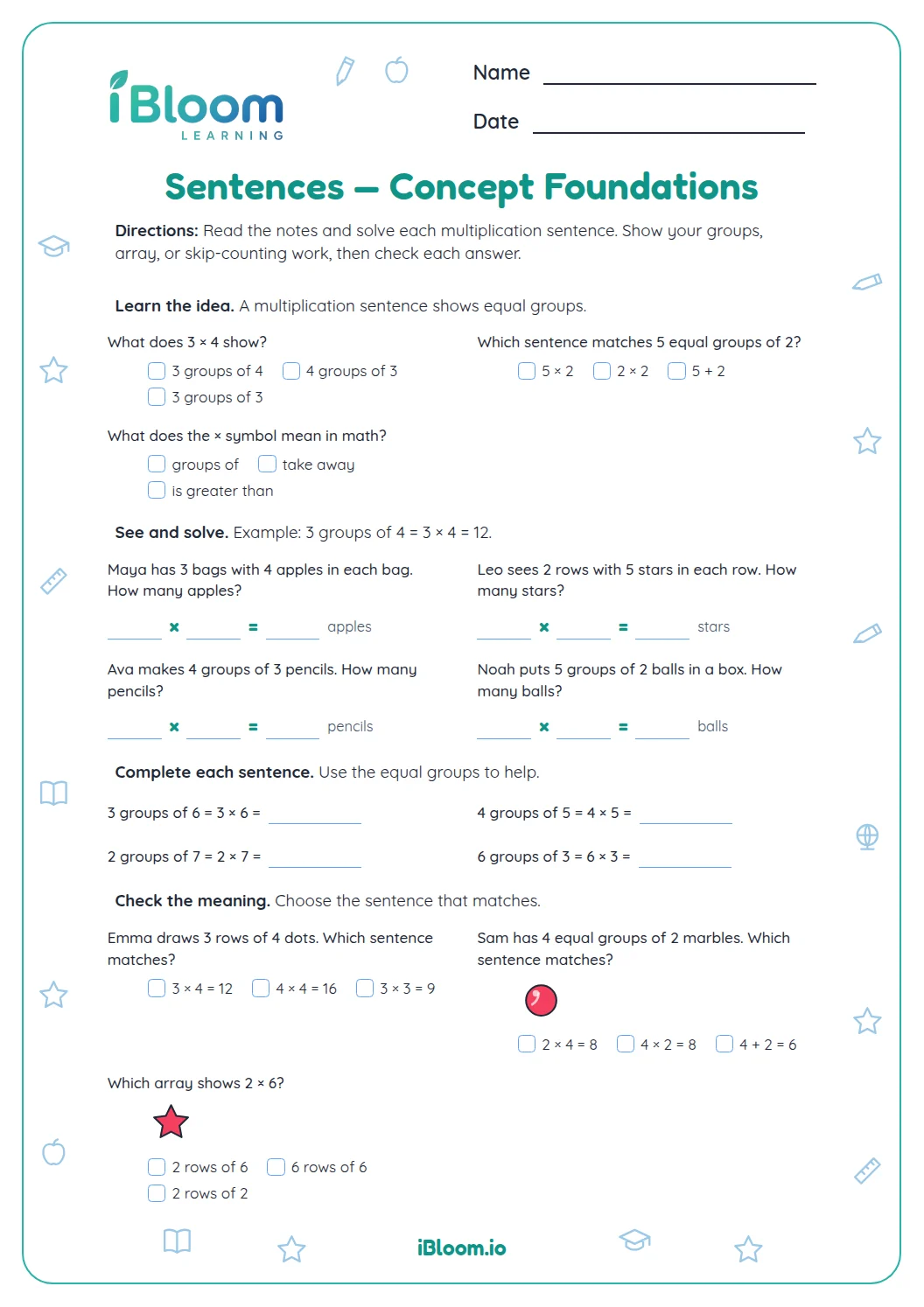
This printable gives Grade 3 learners 14 questions connecting multiplication with equal jumps. Children read a clear 0–30 number line, find products and missing jump sizes, match equations to groups, and solve short movement stories. A separate answer key lists the products and choices. The number line labels its jumps at intervals of 6 so the marks remain readable.
How do equal jumps show multiplication?
The number of jumps is one factor, and the size of each jump is the other. In question 1, five jumps of 6 reach 30, so 5 × 6 = 30.
- 10 → 6 → 12 → 18 → 24 → 30
- 25 equal jumps of 6
- 35 × 6 = 30
How can a product reveal a missing factor?
If four equal jumps end at 28, divide 28 into four equal groups: each jump is 7. Check with 4 × 7 = 28.
What is on the challenge?
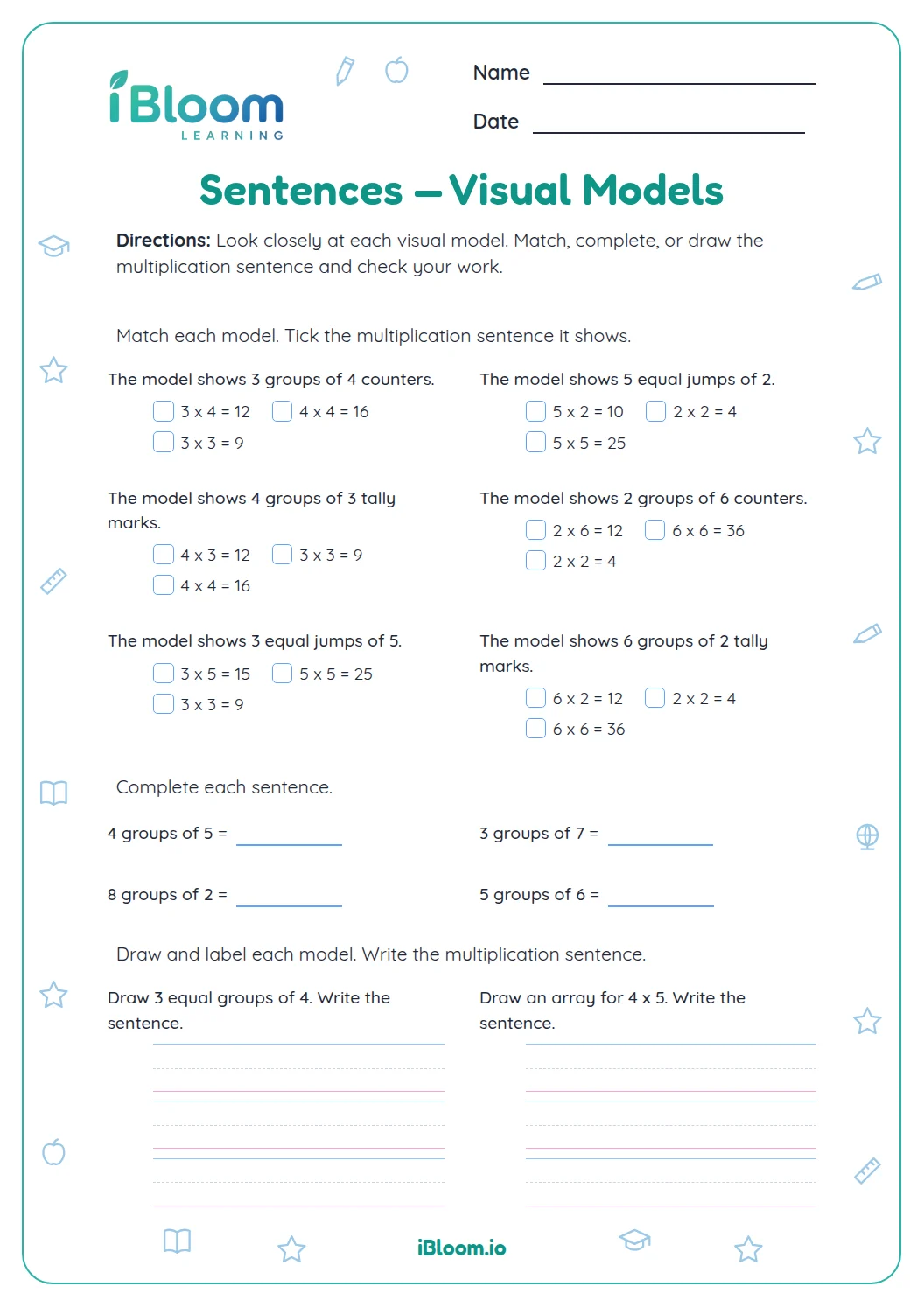
The 14 questions cover reading jumps, matching multiplication sentences, movement stories, and reasoning about equal products. A number-line drawing anchors the first section.
How to use this worksheet
- 1Identify how many equal jumps or groups there are.
- 2Identify the size of one jump or group.
- 3Multiply the factors to find the total.
- 4If a factor is missing, divide the product into equal groups.
- 5Check the answer by repeated addition or by reversing the multiplication.
Common mistakes and quick fixes
The mistake
Using jump size as the number of jumps.
The fix
Name both factors: number of jumps and size of each jump.
The mistake
Adding the factors instead of multiplying equal groups.
The fix
For equal groups, multiply; use repeated addition to check.
The mistake
Reading the last tick before the endpoint.
The fix
Count every jump and follow the line to its final landing point.
What to practice next
Make more practice
Questions parents and teachers ask
How many questions are on this worksheet?
There are 14 questions in three parts, plus a separate answer key. They include number-line reading, multiplication sentences, missing factors, and short word problems. One clearly labeled line models equal jumps. Each item asks for one result, and the key follows the same question order.
What do the jumps represent?
Each jump is one equal group. The number of jumps is one factor, and the distance or count in each jump is the other factor. Multiplying those factors gives the endpoint or total amount. A total can be checked by adding the same jump size repeatedly.
Can a child solve without drawing a number line?
Yes. The number line is a visual model for the first question. Other items can be solved with multiplication facts, repeated addition, or division to find a missing factor. No drawing is required for those questions. The number line supports the core idea; other questions give their groups directly in words.
What is the answer to five jumps of four?
Five jumps of four reach 20 because 4 + 4 + 4 + 4 + 4 = 20, or 5 × 4 = 20. The worksheet asks this in question 2, with a single blank for the endpoint. Multiplication records equal groups more compactly than repeated addition.
Is an answer key included?
Yes. A separate key gives answers for all 14 questions, including the number-line jump count and multiplication choices. Learners can use it after completing the student pages to check each response. The key gives the jump count, factor, or product needed for each item.