



About this worksheet
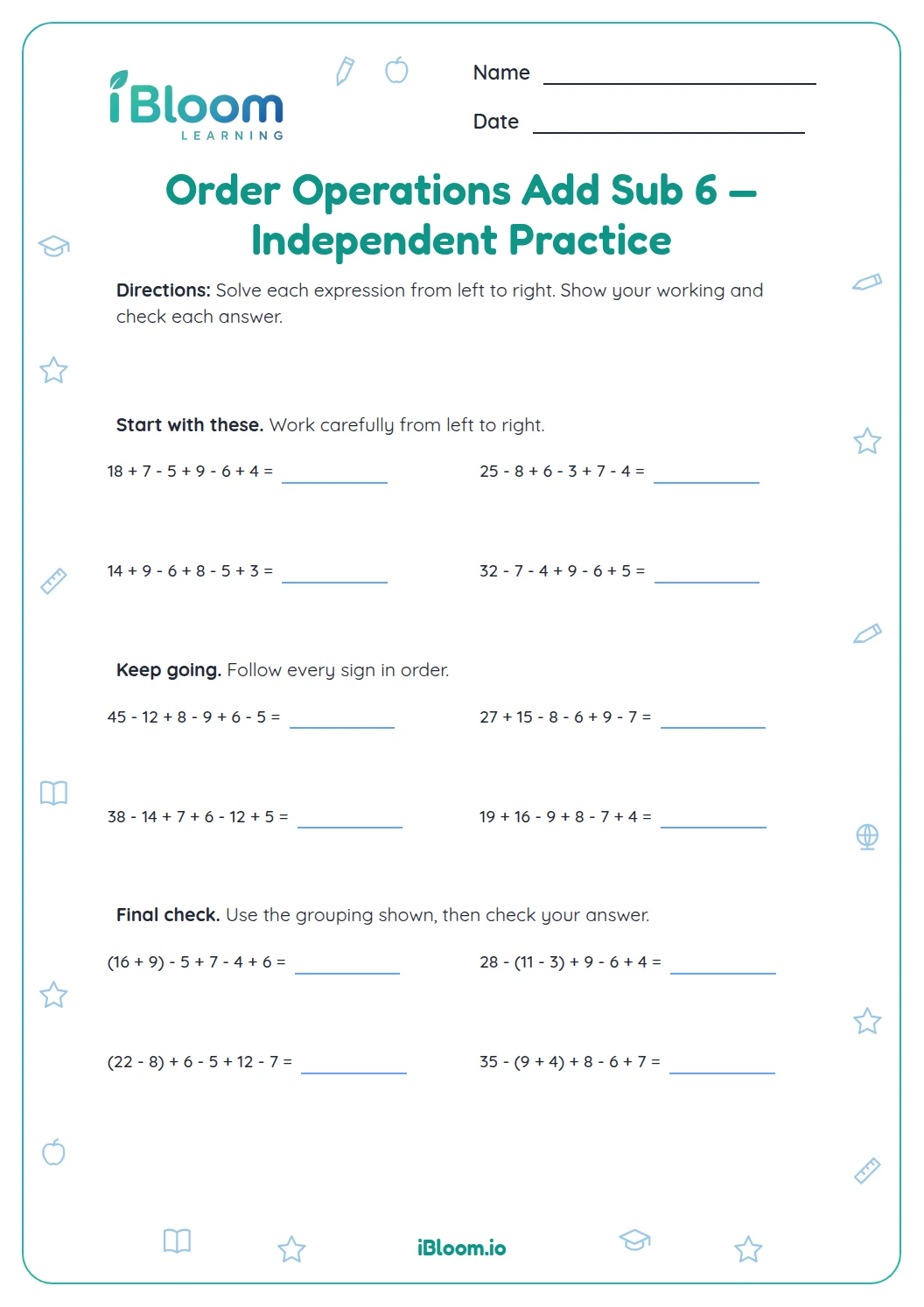
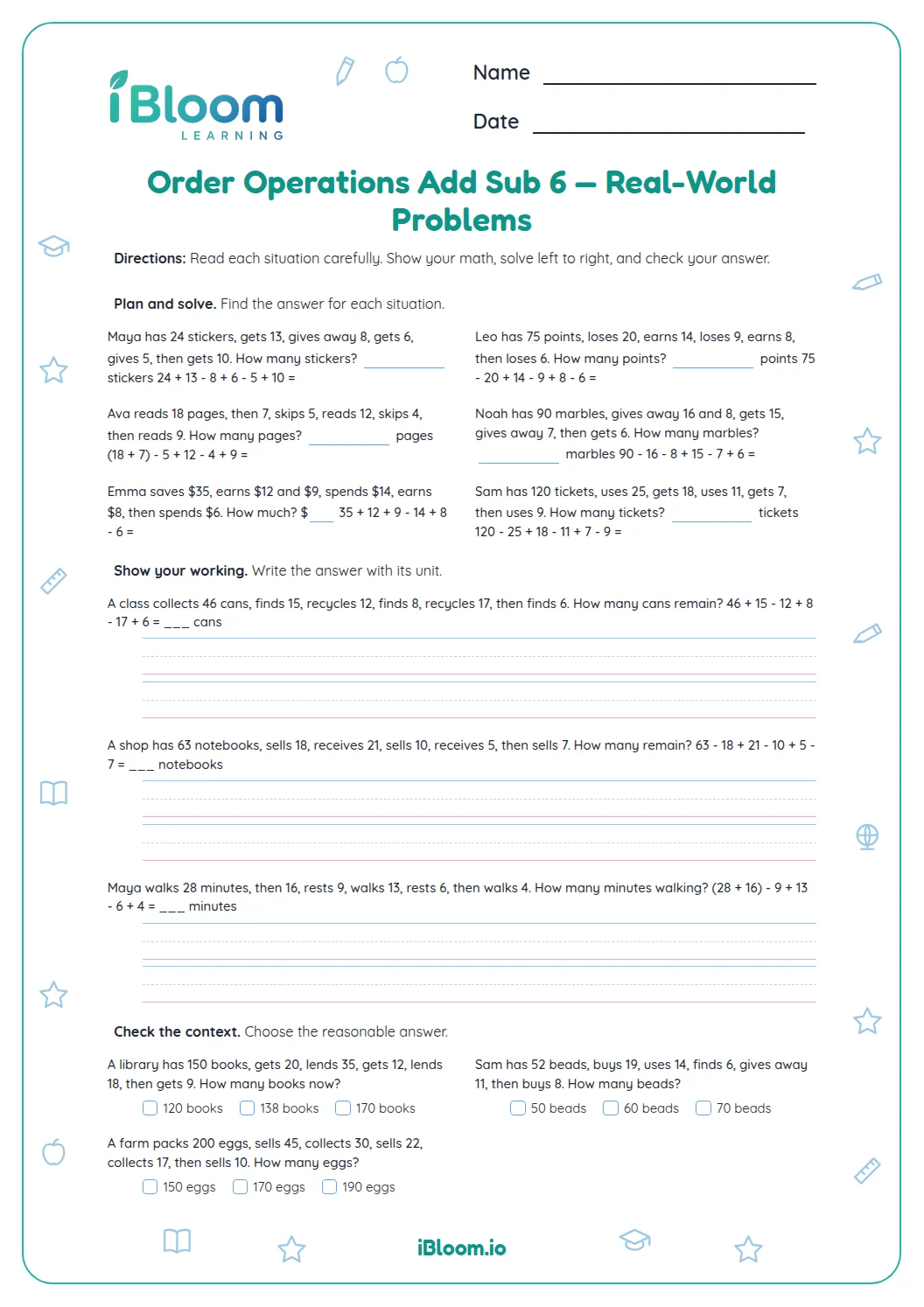
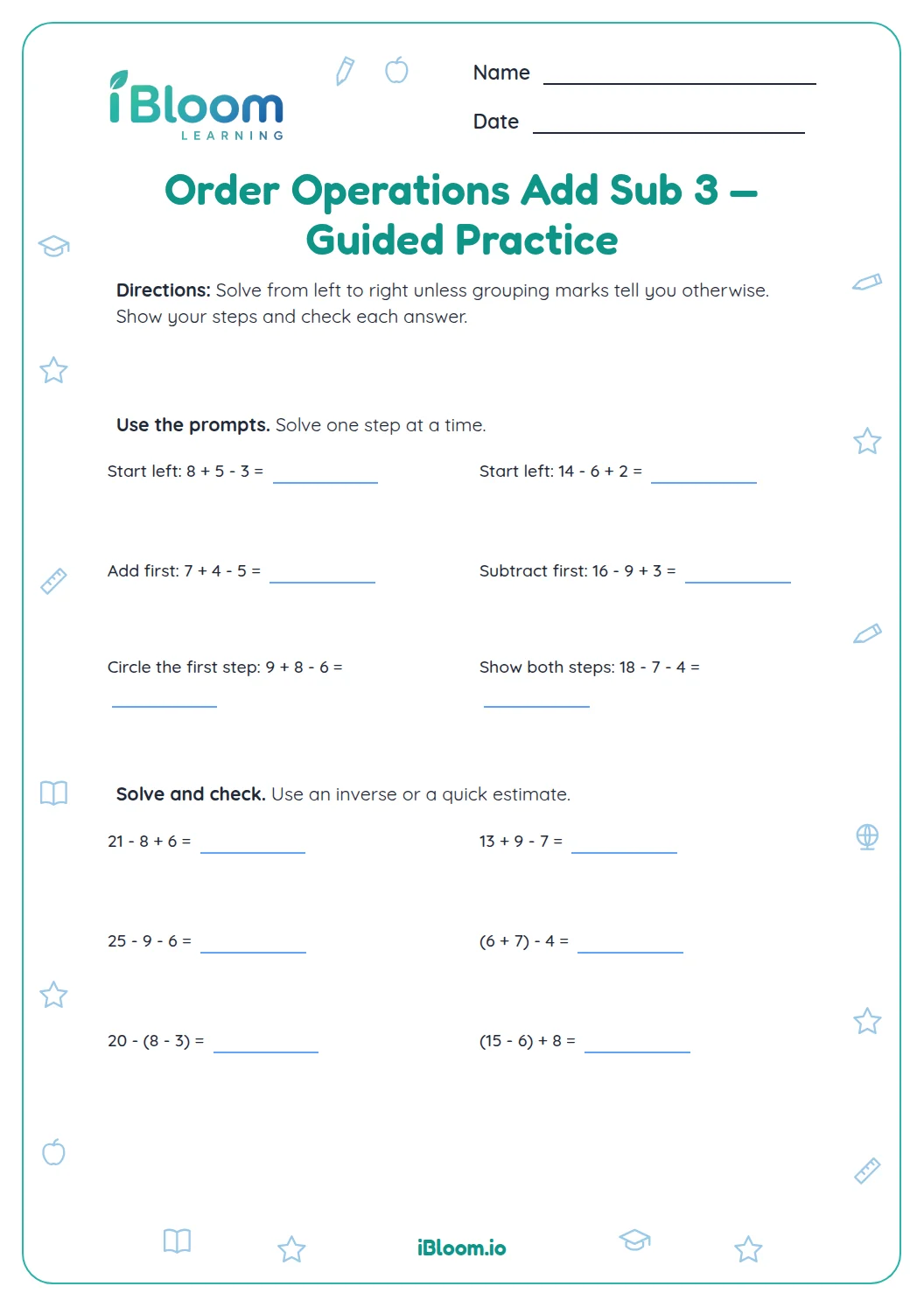
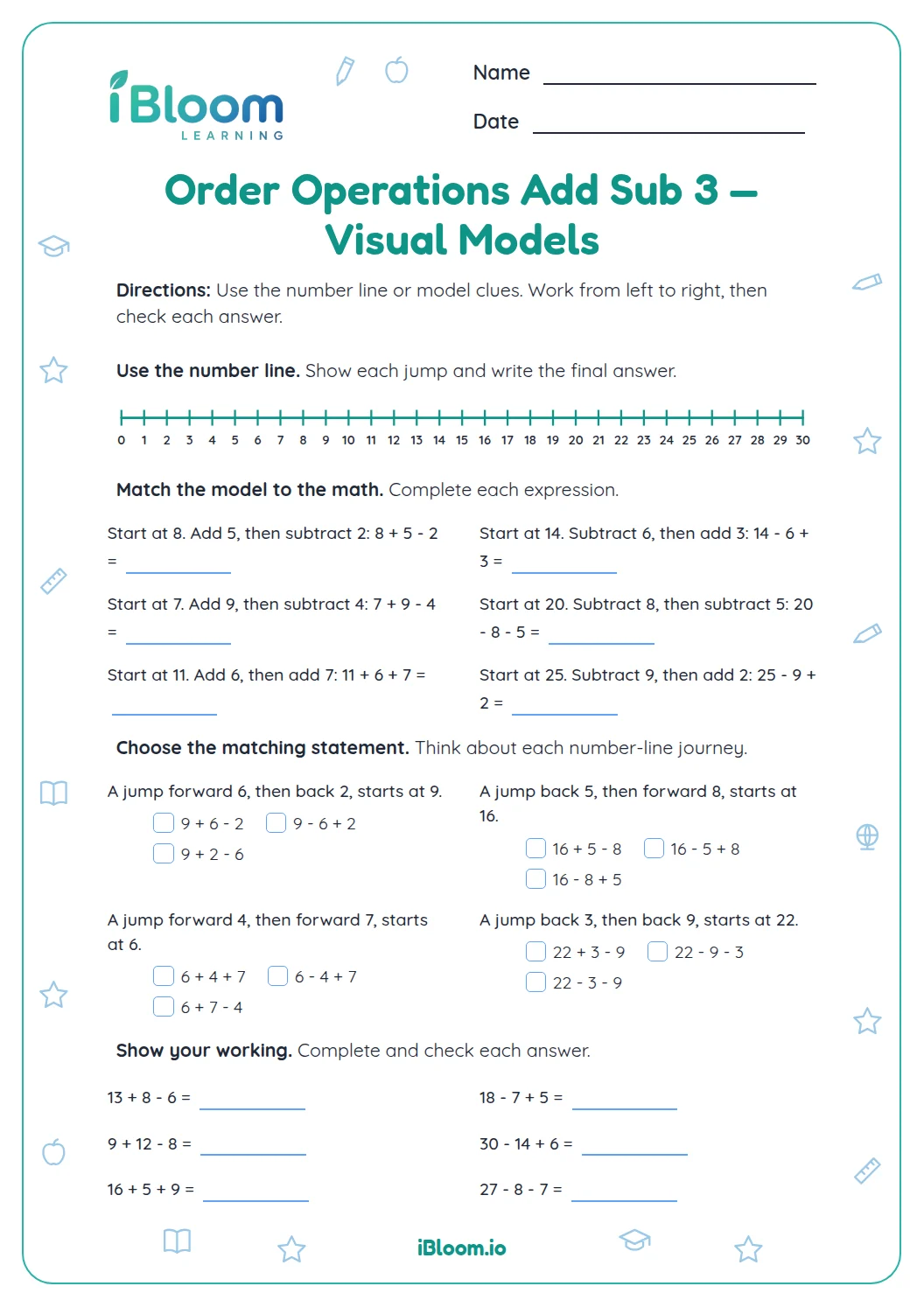
This Grade 3 worksheet makes addition and subtraction steps visible as running totals. Students complete eight chains with one missing value, then match six more arrow models to the expression that records each move. Each total changes by the operation shown in the sequence, so students can check the path one step at a time. The two student pages are followed by a separate answer key.
How do running totals work?
Start at the first number and follow each arrow. For example, 21 → 17 → 24 → 21 → 23 → 29 means subtract 4, add 7, subtract 3, add 2, then add 6. Write the value at each step before moving on.
What is on the two student pages?
Part A has eight chains with one missing total. Part B has six complete arrow models; students choose the expression that records the changes. The key repeats all 14 question numbers.
How can a student check a model?
Use the change between adjacent totals to identify each operation. Then substitute the selected expression and calculate from left to right.
- 112 → 9 → 17 shows subtract 3, then add 8. The matching expression is 12 − 3 + 8.
What can an adult listen for?
Ask the student to name the change at each arrow: “12 to 9 is minus 3; 9 to 17 is plus 8.” That explanation checks both the model and the signs in the expression.
How to use this worksheet
- 1Begin at the first total in the chain.
- 2Compare each pair of neighboring values.
- 3Use the direction and size of the change to identify + or −.
- 4For a missing value, calculate the chain in order.
- 5For a match, compare both the starting value and every change.
Common mistakes and quick fixes
The mistake
Treating each arrow as a new starting value.
The fix
Carry the latest total forward to the next arrow.
The mistake
Changing a subtraction into addition.
The fix
Check whether the next total is smaller or larger.
The mistake
Matching only the first operation.
The fix
Check every arrow against the selected expression.
What to practice next
Make more practice
Questions parents and teachers ask
How many questions are on this worksheet?
There are 14 numbered questions on the student pages. They are grouped into 2 sections, and the answer key uses the same question numbers. The practice moves from missing totals to expression matching, so an adult can check progress without searching through a separate list.
How should students work through the questions?
Start at the first value in each arrow chain and compare neighboring totals to see how the number changes. In Part A, calculate the missing total in order. In Part B, choose the expression that records every move, not just the first one.
What does the answer key include?
The key gives the missing total for each chain and the matching expression for every model. Students can compare the signs and values in an expression with the changes between adjacent arrows. If the selected expression does not end at the final total, revisit the first arrow where the model changes.
How long should this practice take?
Plan for about 20 minutes, with more time if students write every step. The grade 3 running totals worksheet questions are short enough to pause after each section, compare one result with the key, and then return to any item that needs another calculation.
Can I use this for homework?
Yes. Print the student pages separately from the key if students should work independently. Ask them to keep the current total and each change visible; that gives you a useful way to discuss a missed answer and lets students correct their own work after checking the key.