

About this worksheet
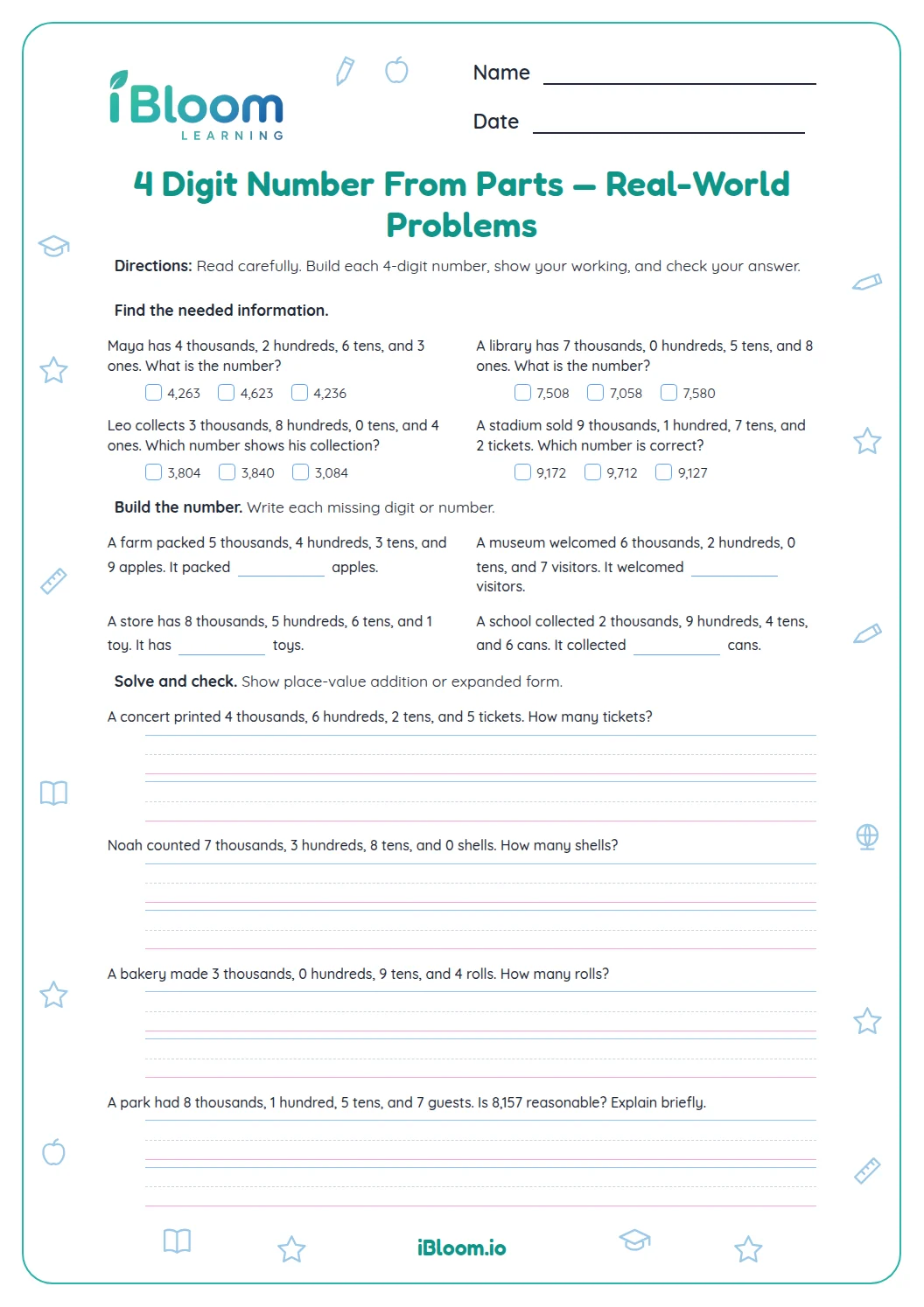
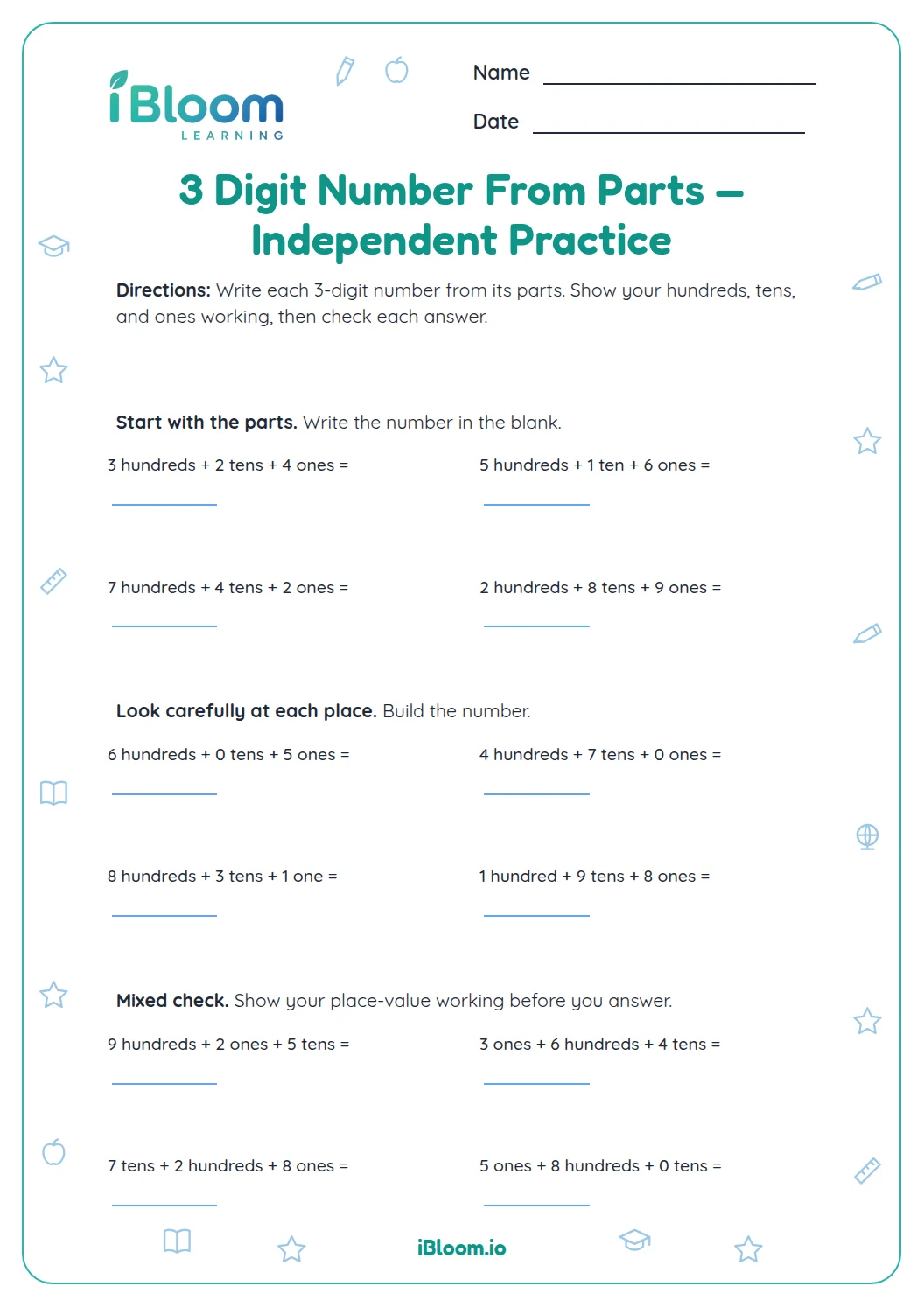
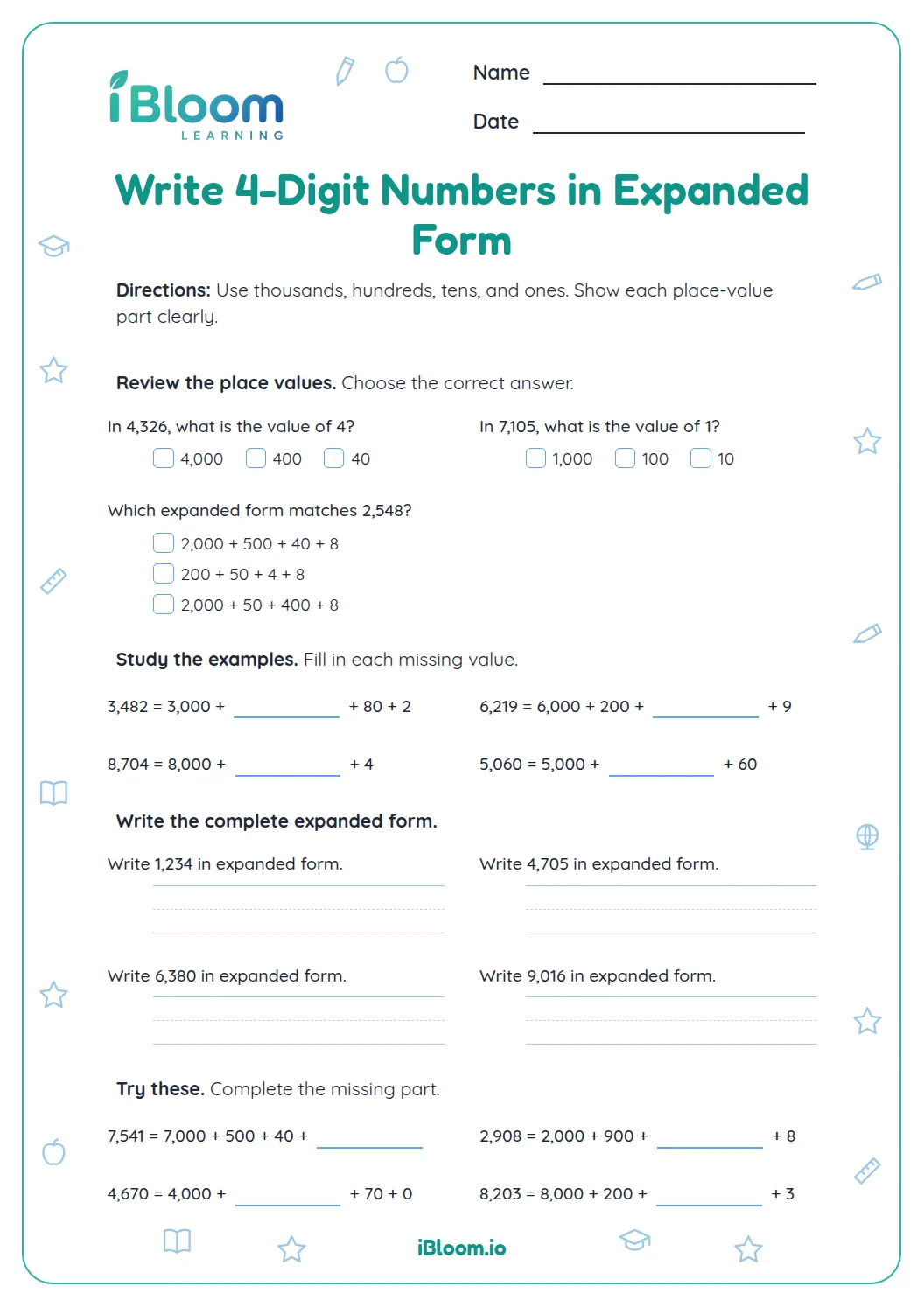
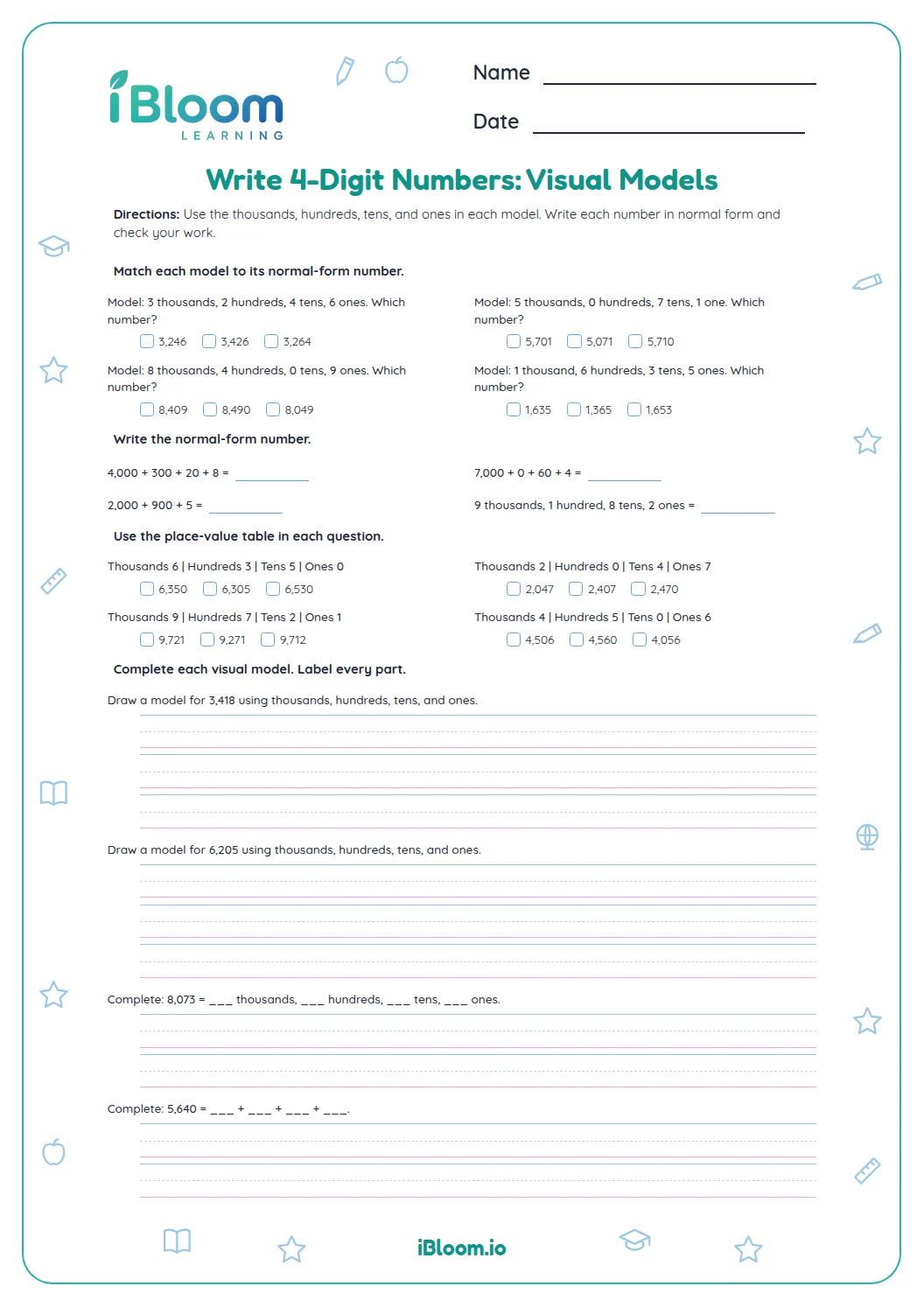
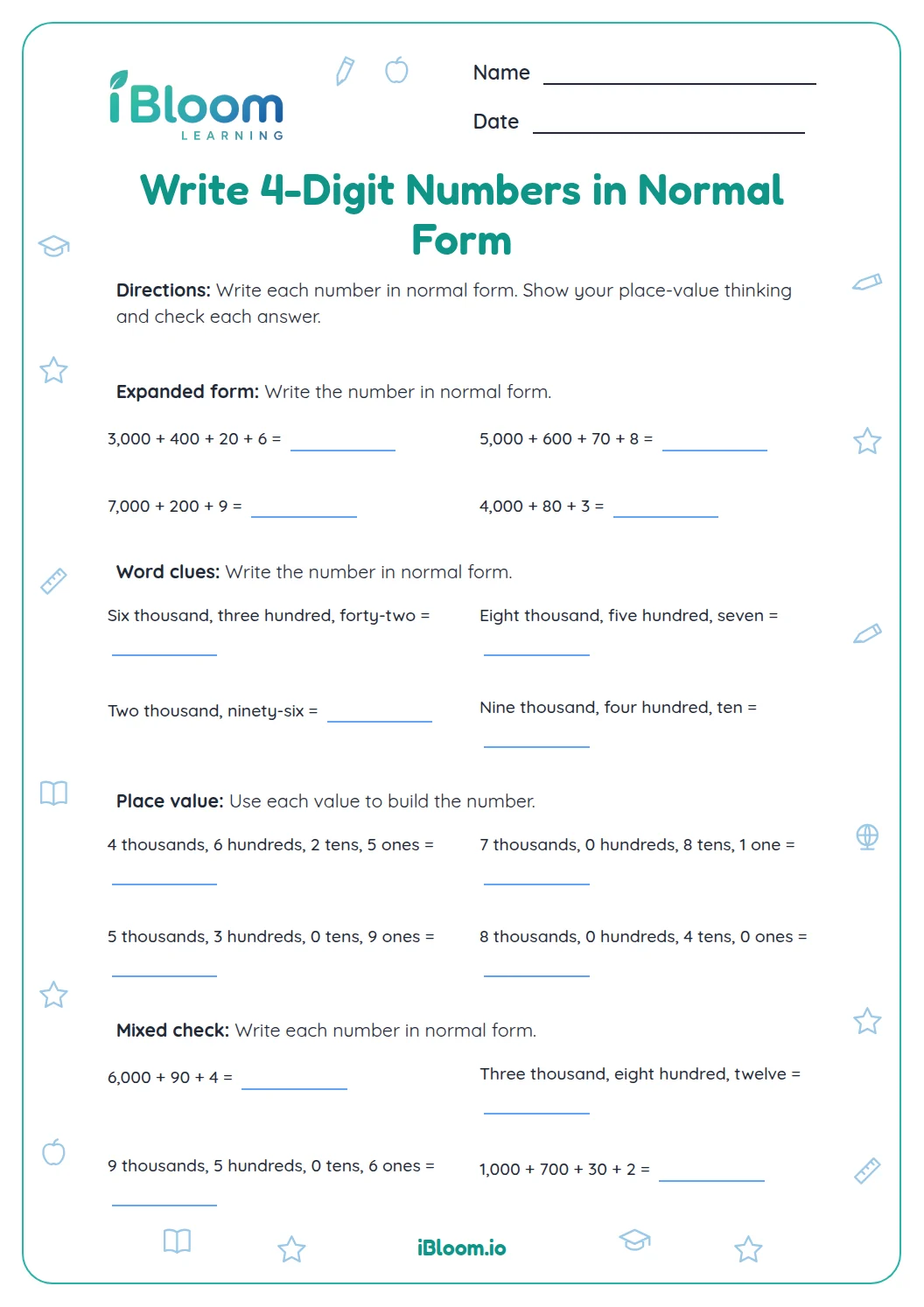
This printable Grade 3 worksheet presents 16 four-digit numbers as place-value tables. Students read thousands, hundreds, tens, and ones, match four models to numerals, and write expanded forms. Every question includes a table with real digit values, including zeros in some places. A separate answer key is included. The work practices reading and writing numbers with place-value parts.
Aligned to 4.NBT.A.2
How do you read the place-value table?
Read the columns in order: thousands, hundreds, tens, then ones. Each column supplies one digit for the numeral.
Question 1 shows 2 thousands, 3 hundreds, 4 tens, and 6 ones, so the number is 2,346.
- 1Thousands: 2
- 2Hundreds: 3; tens: 4; ones: 6
- 3Numeral: 2,346
What does a zero show in a place?
A zero means there are none of that place's units. Keep it in the numeral to preserve the other digits' positions. In question 2, 5 thousands, 0 hundreds, 7 tens, and 2 ones make 5,072.
Do not slide the tens or ones digits into the empty hundreds place.
How do you write expanded form?
Multiply each digit by its place value, then add the parts. For 2,346, write 2,000 + 300 + 40 + 6.
A zero-valued place adds zero and may be left out of the sum.
How to use this worksheet
- 1Read the table headings from left to right.
- 2Copy each digit into its matching place.
- 3Keep a zero when a place is empty.
- 4For expanded form, write each nonzero place value as an addend.
- 5Check that the numeral still has four digits.
Common mistakes and quick fixes
The mistake
Dropping a zero from the numeral
The fix
Keep the zero as a placeholder in its column.
The mistake
Reading columns from ones to thousands
The fix
Read the table left to right.
The mistake
Writing the digit instead of its value in expanded form
The fix
Multiply each digit by its place value.
Common Core alignment
This worksheet practices the math standard below.
Read and write four-digit whole numbers in standard and expanded form.
On this sheet: The questions read four-digit numerals and express them in expanded form.
Show the official wordingHide the official wording
Read and write multi-digit whole numbers using base-ten numerals, number names, and expanded form. Compare two multi-digit numbers based on meanings of the digits in each place, using >, =, and < symbols to record the results of comparisons.
What to practice next
Make more practice
Further reading
Questions parents and teachers ask
How does the place-value table show a four-digit number?
Read the columns from left to right: thousands, hundreds, tens, and ones. The digit in each column gives the number of that unit. For example, 2 thousands, 3 hundreds, 4 tens, and 6 ones make 2,346. Say each place aloud as you read the row.
What if a place-value column shows zero?
Keep the zero in its place when writing the numeral. In 5,072, the zero shows there are no hundreds; the 5 still means 5 thousands, the 7 means 7 tens, and the 2 means 2 ones. The zero keeps the tens and ones in their correct columns.
How do I write a number in expanded form?
Multiply each digit by its place value and add the parts. For 2,346, expanded form is 2,000 + 300 + 40 + 6. A zero-valued place contributes zero, so it can be omitted from a sum. Check that the addends rebuild the original numeral.
What is on the answer key?
The answer key lists each numeral or expanded form and gives the correct choice for the multiple-choice models. It follows the same question numbers as the two practice sections, so students can review a specific place-value model. Use the matching number to find an answer.
Do the models use four-digit numbers throughout?
Yes. Every table has thousands, hundreds, tens, and ones columns, and all values represent four-digit numbers. Several models include a zero in one place so students practice keeping that zero in the correct position. No table uses an empty or unspecified place.