








About this worksheet
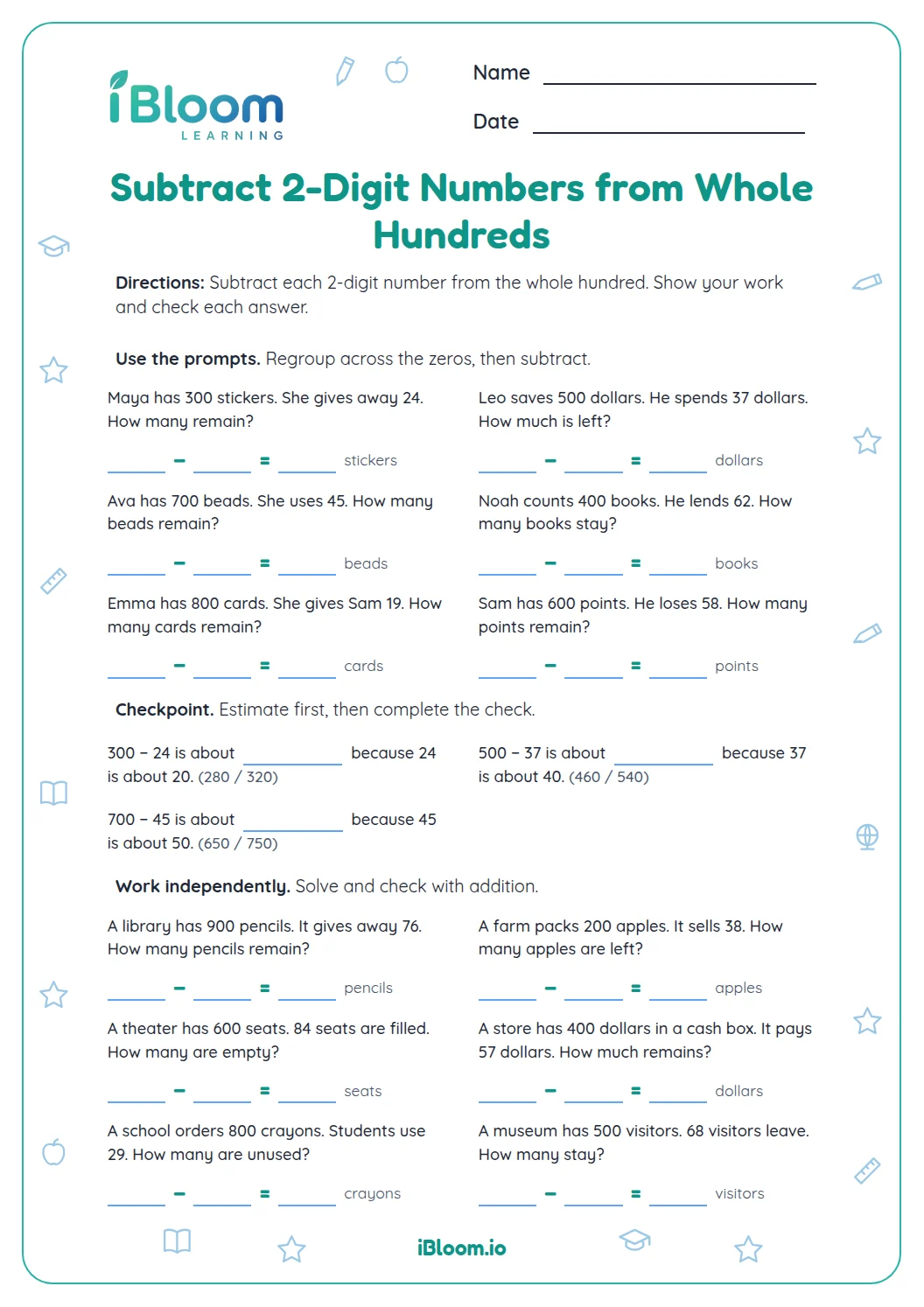
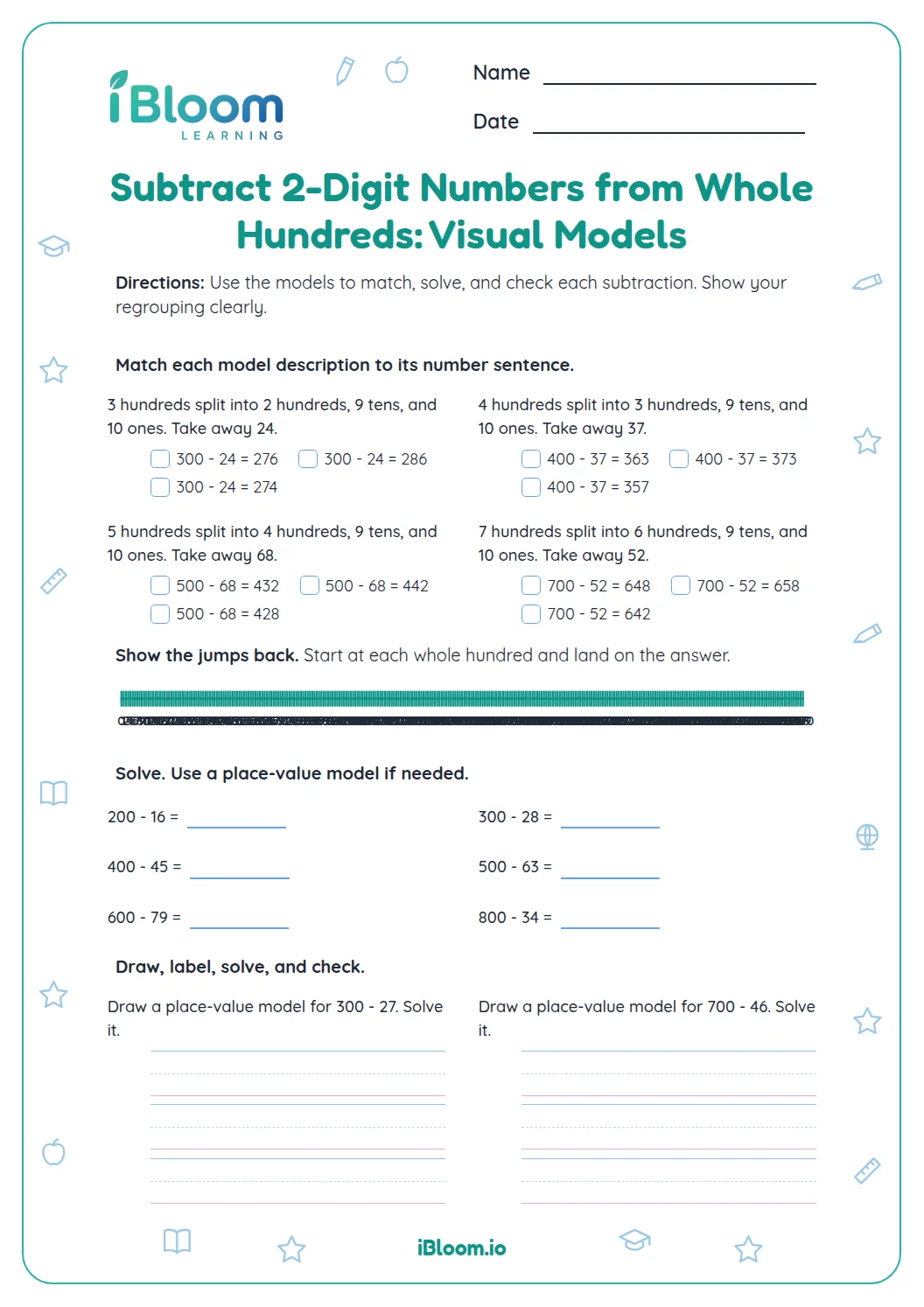
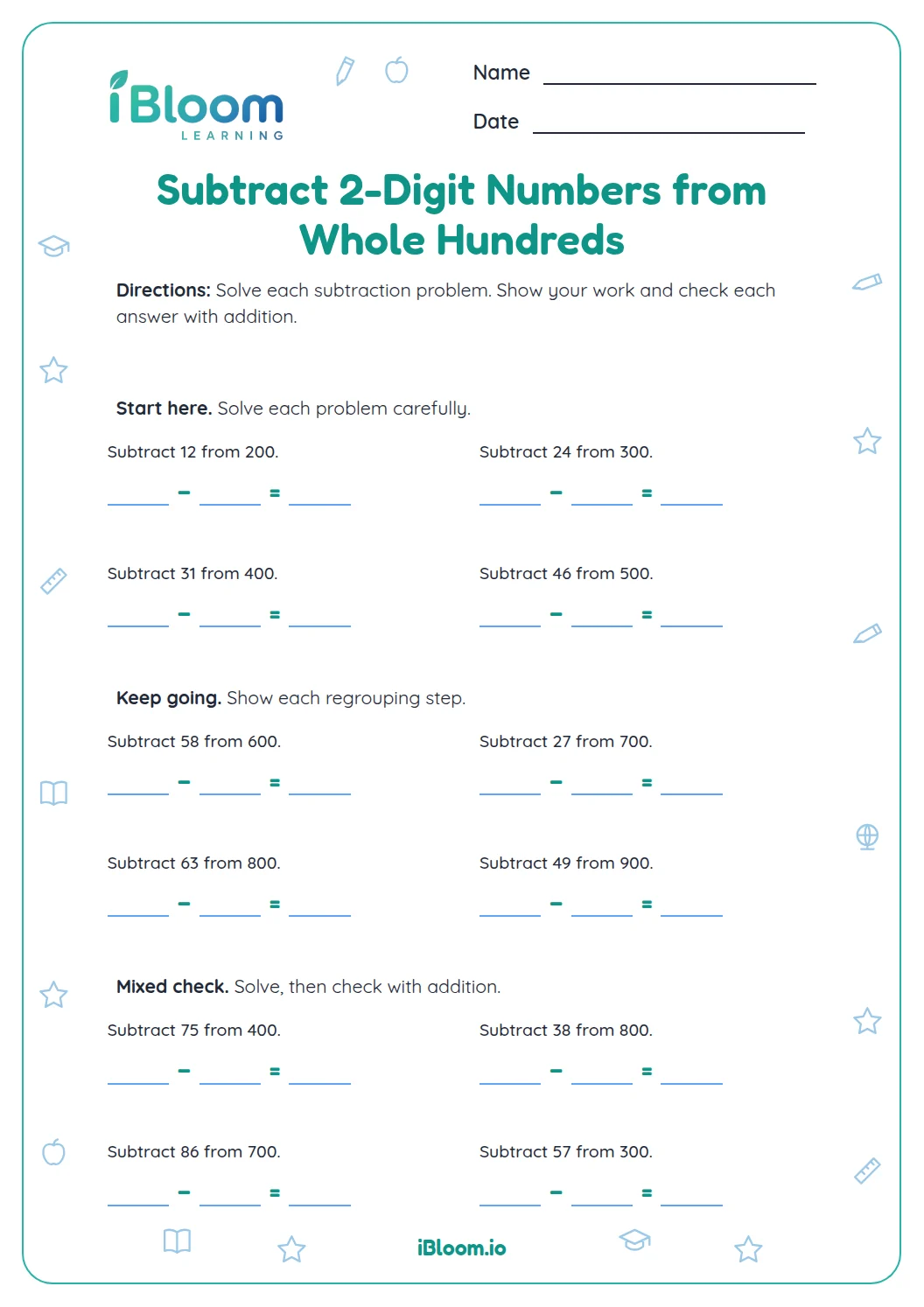
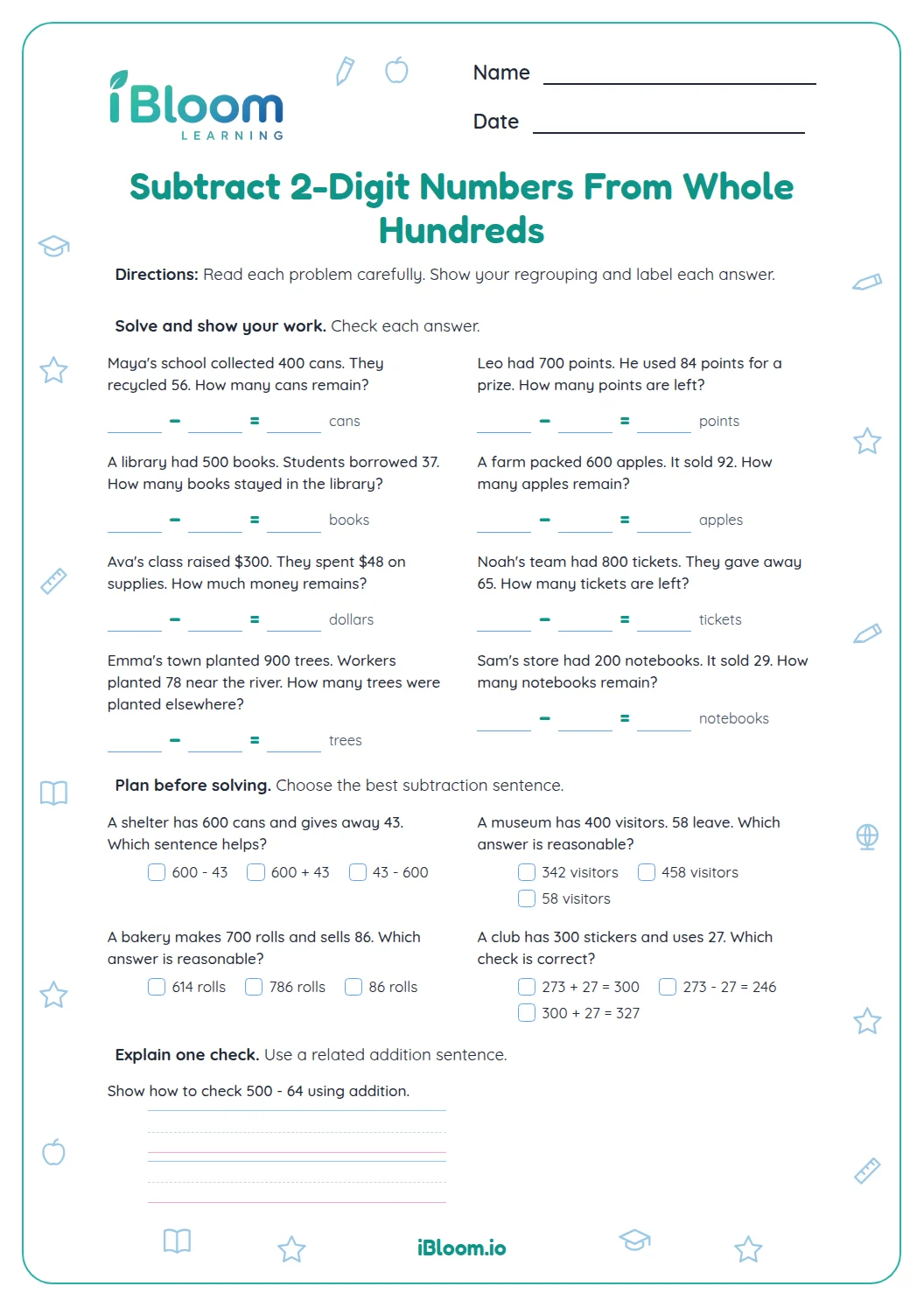
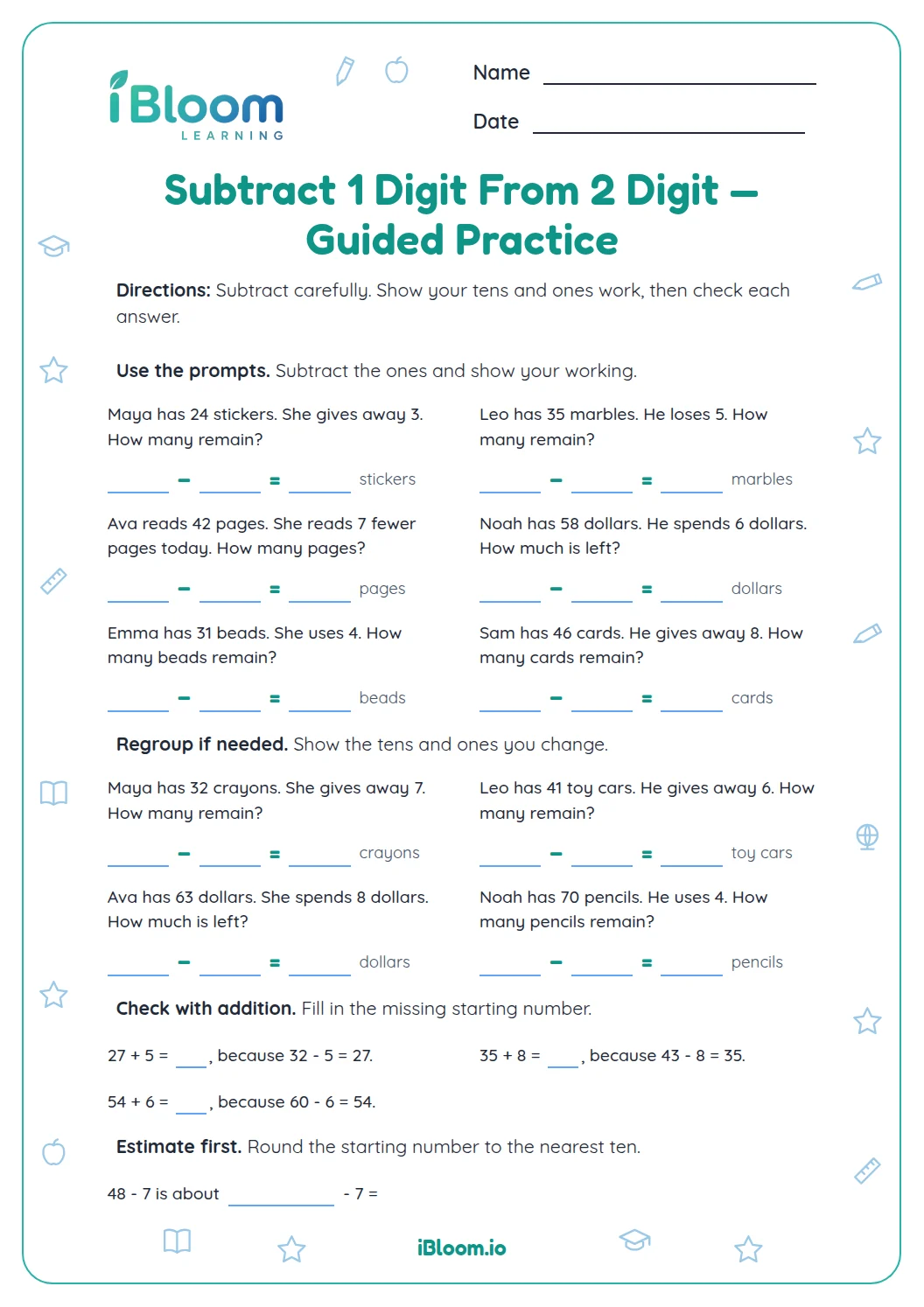
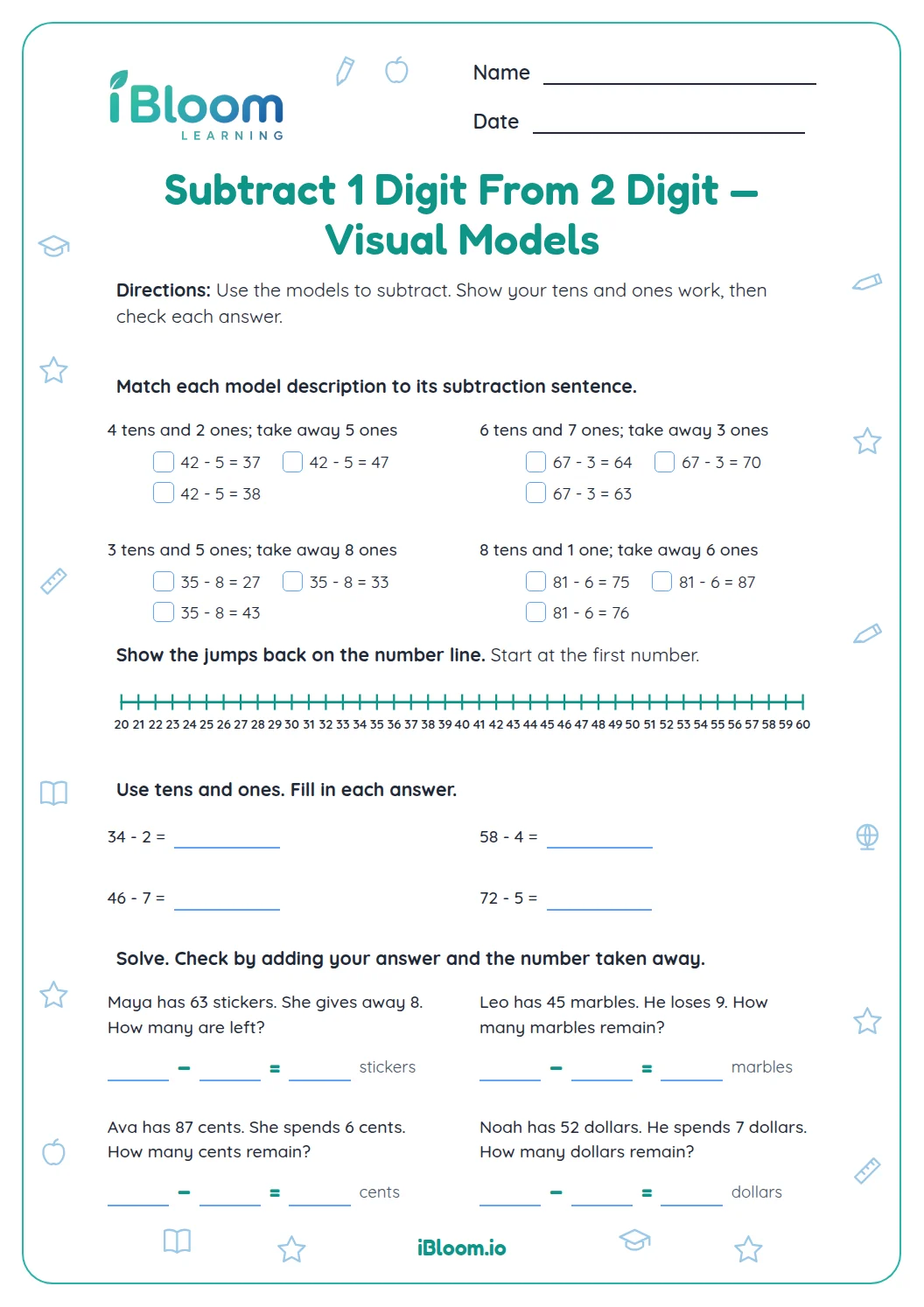
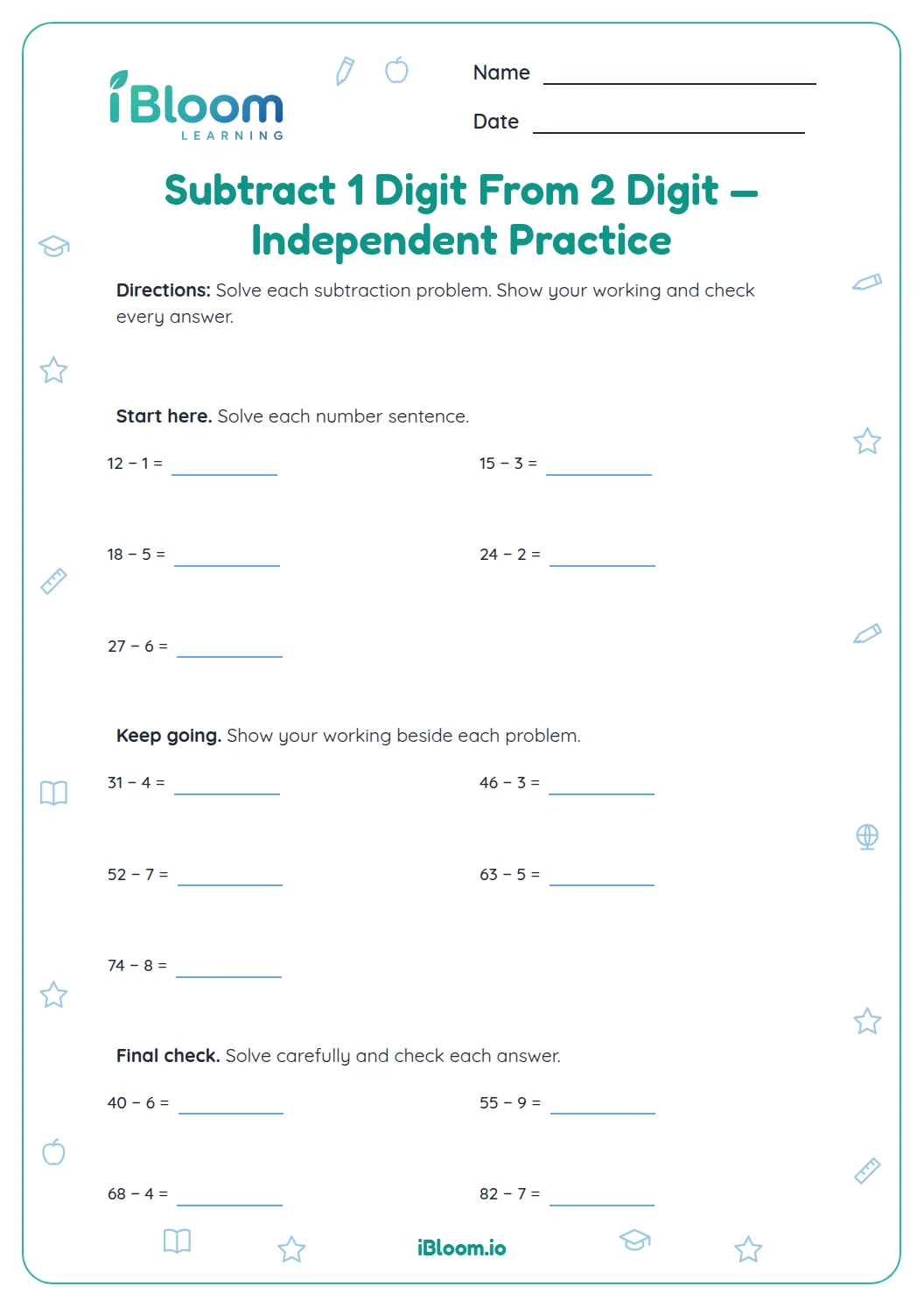
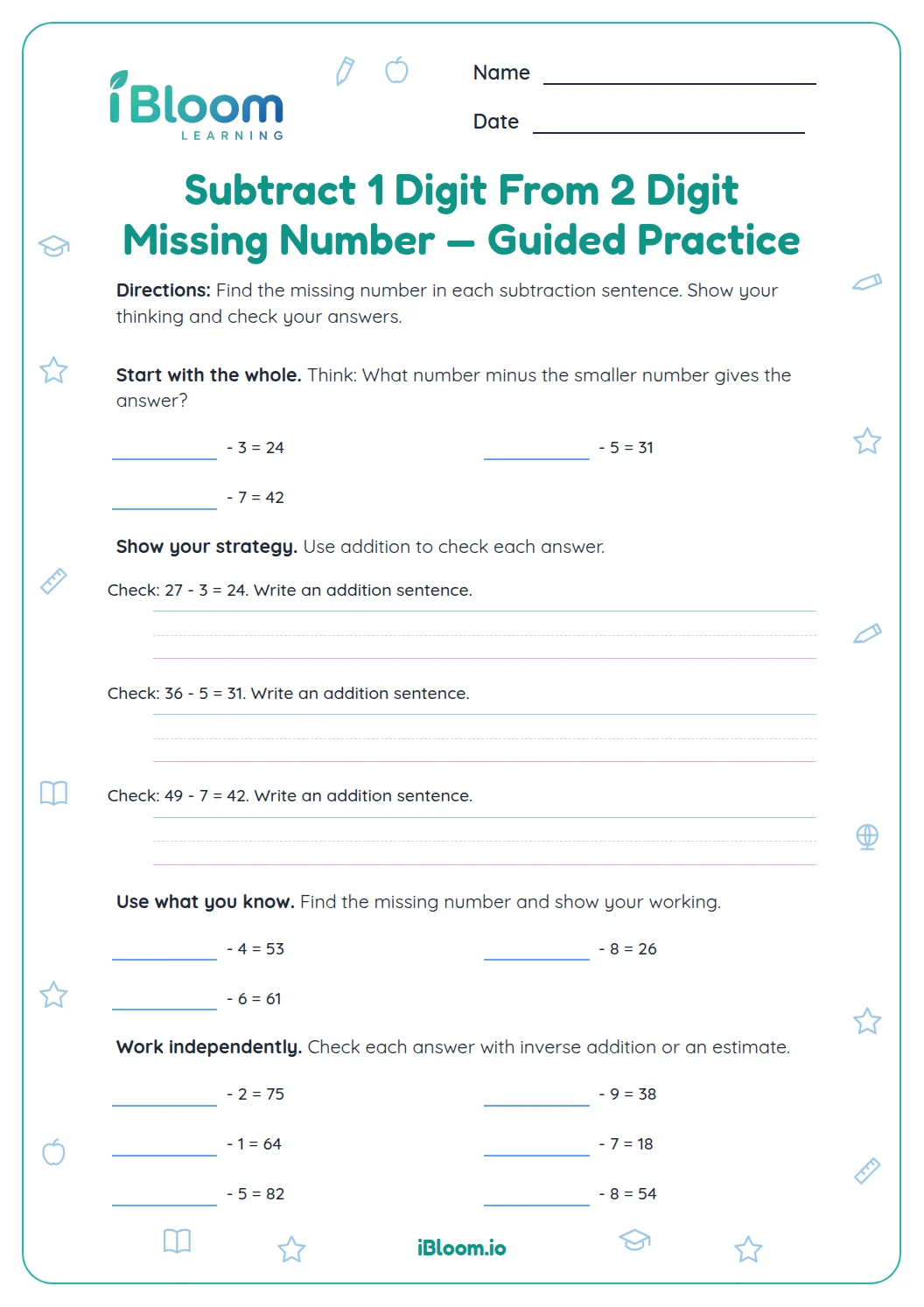
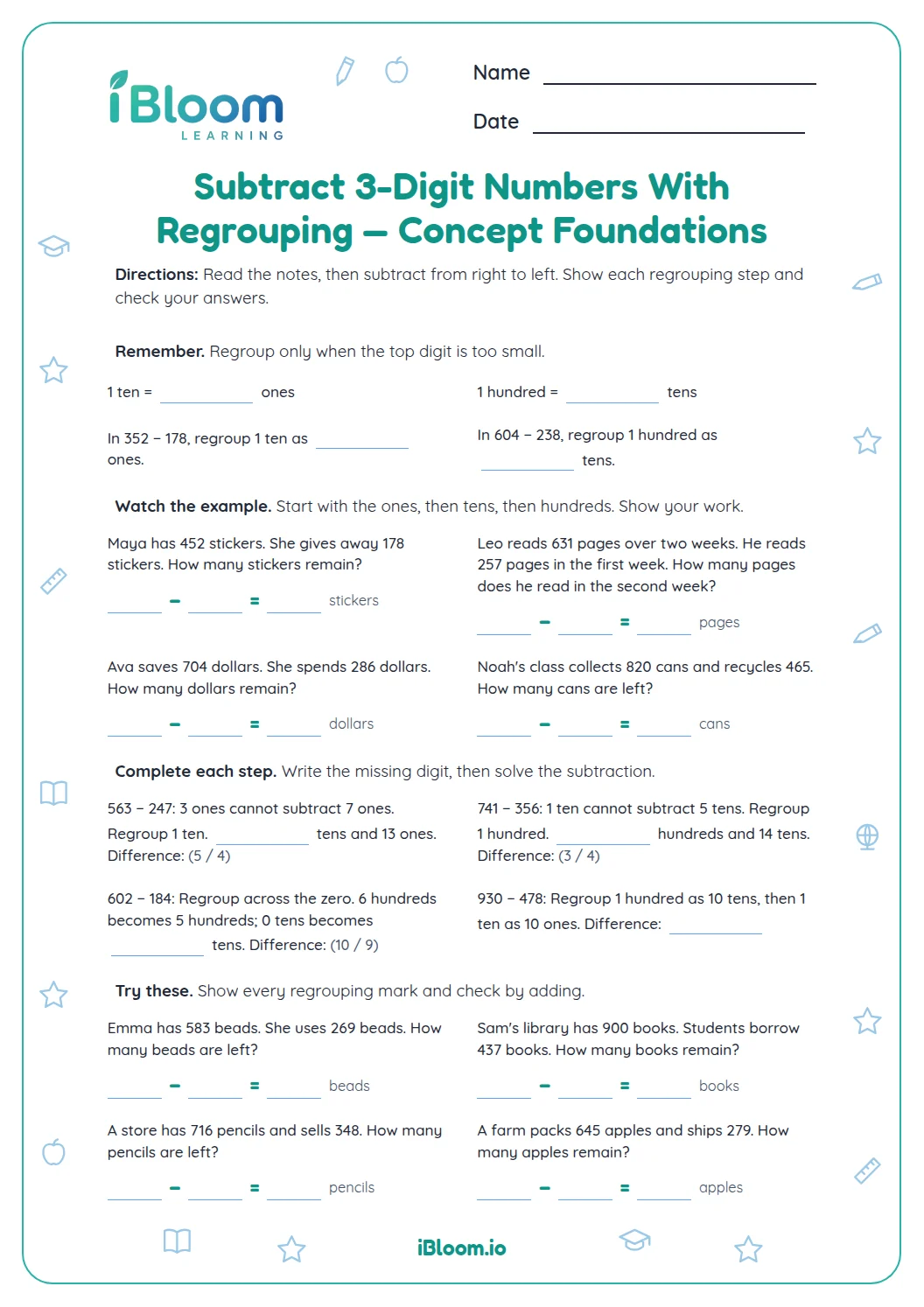
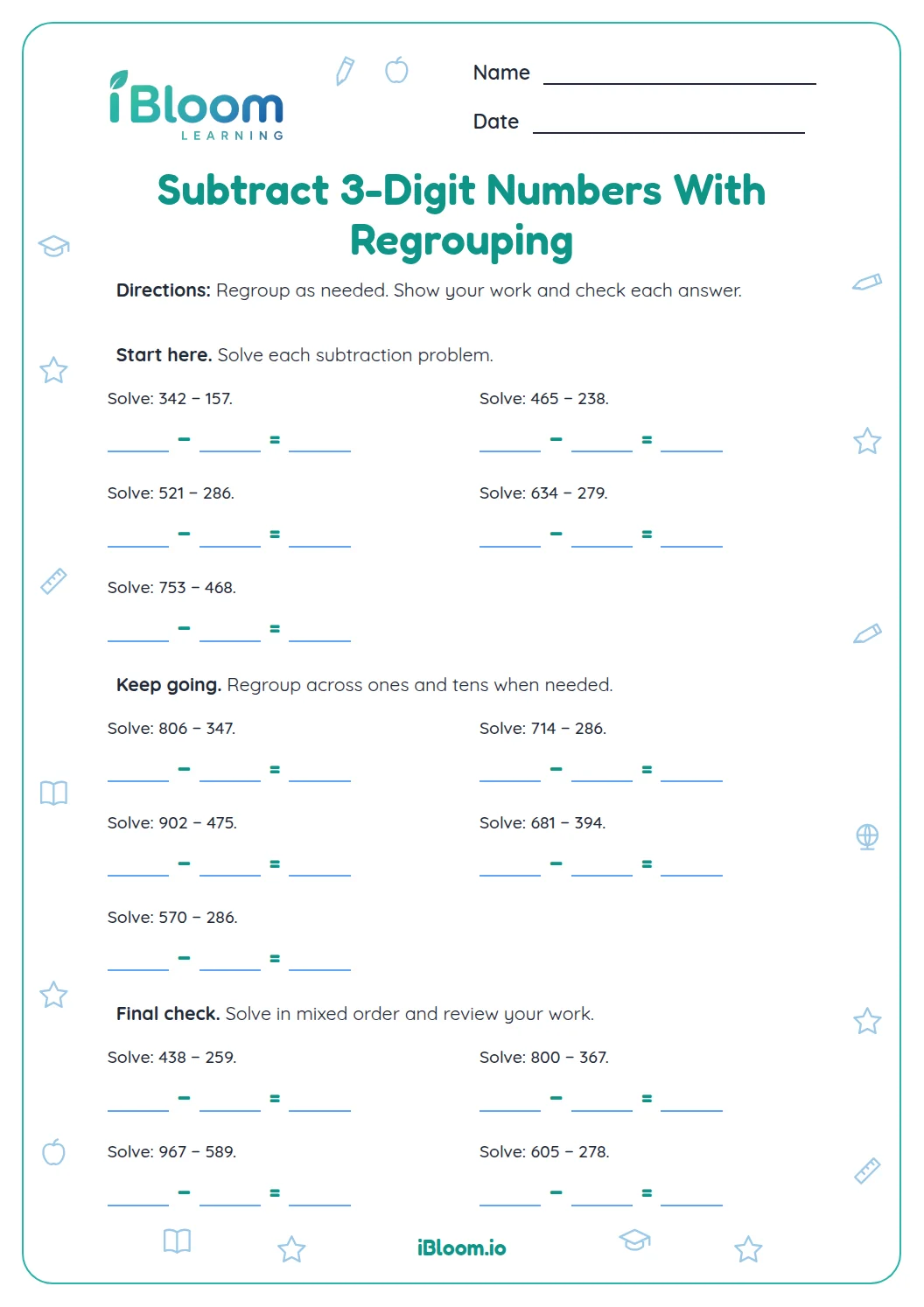
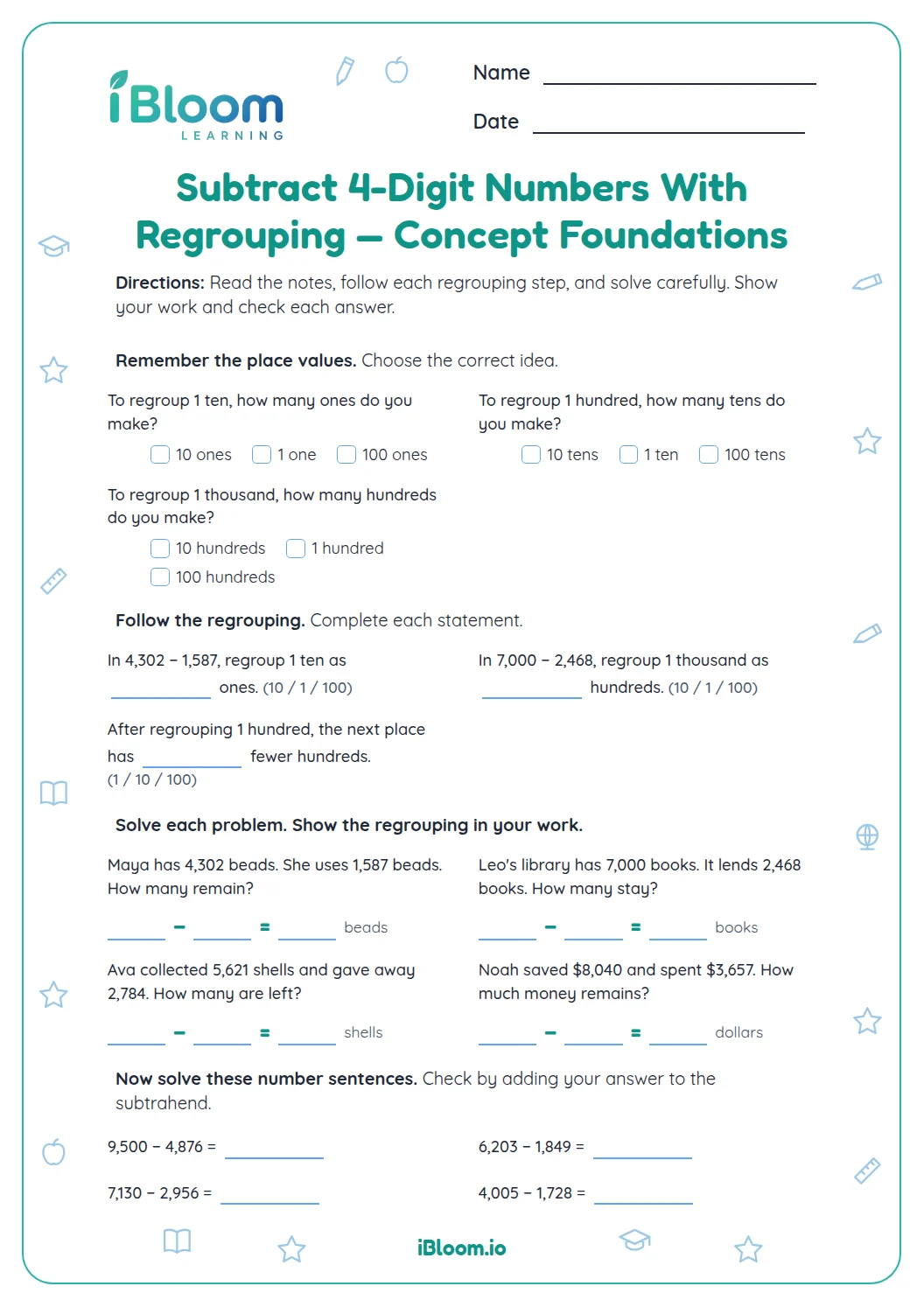
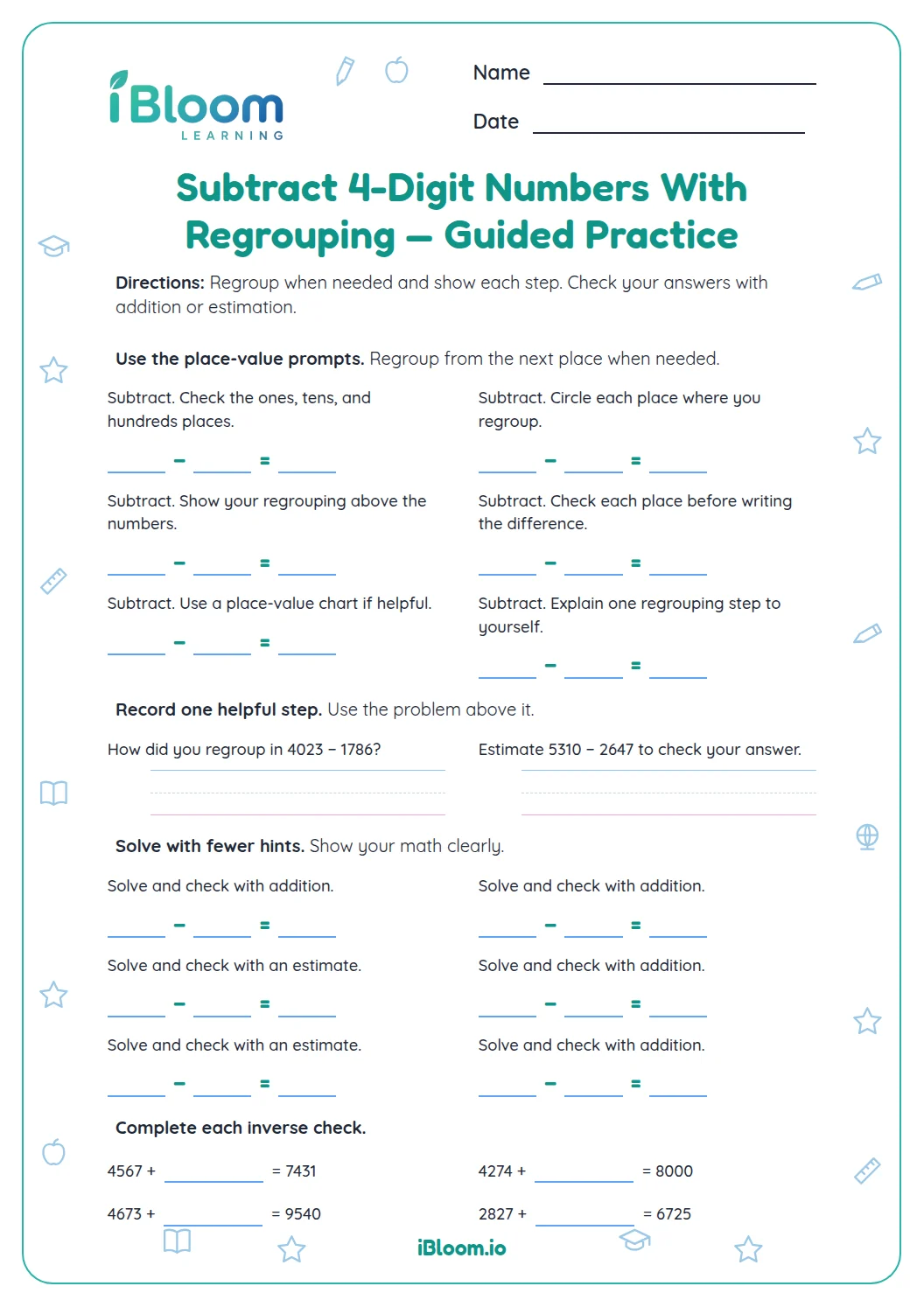
This free printable worksheet gives Grade 3 students 16 questions on subtracting a two-digit number from a whole hundred. The student sheet prints every value needed for its calculations, missing-number items, and short situations. Students solve, compare, and check their reasoning across three parts; a separate answer key supports review.
Aligned to 3.NBT.A.2
How does the sheet build practice?
Part A starts with six direct problems. Later parts use the same skill in short situations and reasoning checks, with the needed values printed in each prompt.
For example, question 1 asks 300 − 45 = ___. The answer is 255; students can use a a known fact and place value to check it.
- 1300 − 45 = ___
- 2Answer: 255.
- 3Check that the operation and place value match the printed numbers.
How can students check their work?
For subtracting a two-digit number from a whole hundred, keep the printed quantities in view and use a known fact or place-value strategy. For a story problem, name the groups or quantities before writing the number sentence.
For a comparison, solve both expressions before deciding which is greater; do not judge by one number alone.
When should families use the answer key?
Have the student finish a part before checking its answers. If a result differs, point to the original numbers and redo the calculation; the key is for checking, not for supplying missing problem values.
How to use this worksheet
- 1Read the directions for each of the three parts.
- 2Solve the six direct problems in Part A, keeping each printed value in the calculation.
- 3In Part B, write or select an answer that fits the operation and quantities.
- 4Finish Part C and check both expressions when a comparison is asked.
- 5Use the separate key after solving to review and correct your work.
Common mistakes and quick fixes
The mistake
Dropping a zero or changing a digit’s place value.
The fix
Say the value of each digit before writing the result.
The mistake
Using only one quantity from a situation.
The fix
Underline all the amounts or group sizes, then write a complete number sentence.
The mistake
Comparing expressions before solving them.
The fix
Find each total or difference first, then compare the results.
Common Core alignment
This sheet practices the Common Core mathematics standard listed here.
Subtracting a two-digit number from a whole hundred.
On this sheet: Every question uses the printed numbers to practice this skill.
Show the official wordingHide the official wording
Fluently add and subtract within 1000 using strategies and algorithms based on place value, properties of operations, and/or the relationship between addition and subtraction.
What to practice next
Make more practice
Further reading
Questions parents and teachers ask
What does this worksheet practice?
It practices subtracting a two-digit number from a whole hundred with 16 questions across three parts. Students see the numbers on the worksheet, solve direct problems, and apply the skill in reasoning items. A separate answer key lists the answers for checking after the work is complete.
Are all the numbers printed on the student sheet?
Yes. Each calculation, situation, or choice shows the values students need; only the answer spaces are left blank. Students can work from the student pages without using the key to discover the numbers. The key confirms the result only; it does not add the missing factors, addends, or starting amounts.
How many questions and pages are included?
The worksheet has 16 questions arranged in three parts over two student pages. The separate answer key takes two pages as well. The parts move from direct practice to application or reasoning so students can use the same skill in more than one format.
How long might this worksheet take?
Plan for about 20 minutes, with time to read each prompt and show a strategy where space is provided. Some students may prefer to complete one page at a time. The time is a practical estimate and can vary with the student.
When should the answer key be used?
Use the key after the student has attempted the questions. Compare each result with the matching problem, then redo any missed calculation using the values printed in that prompt. This keeps the student’s work focused on solving rather than copying.
What can a student do after a missed answer?
Have the student read the problem again, name the operation, and copy every value before solving. For a story, identify how many groups there are and how many are in each group. Then compare the revised answer with the key.