




About this worksheet
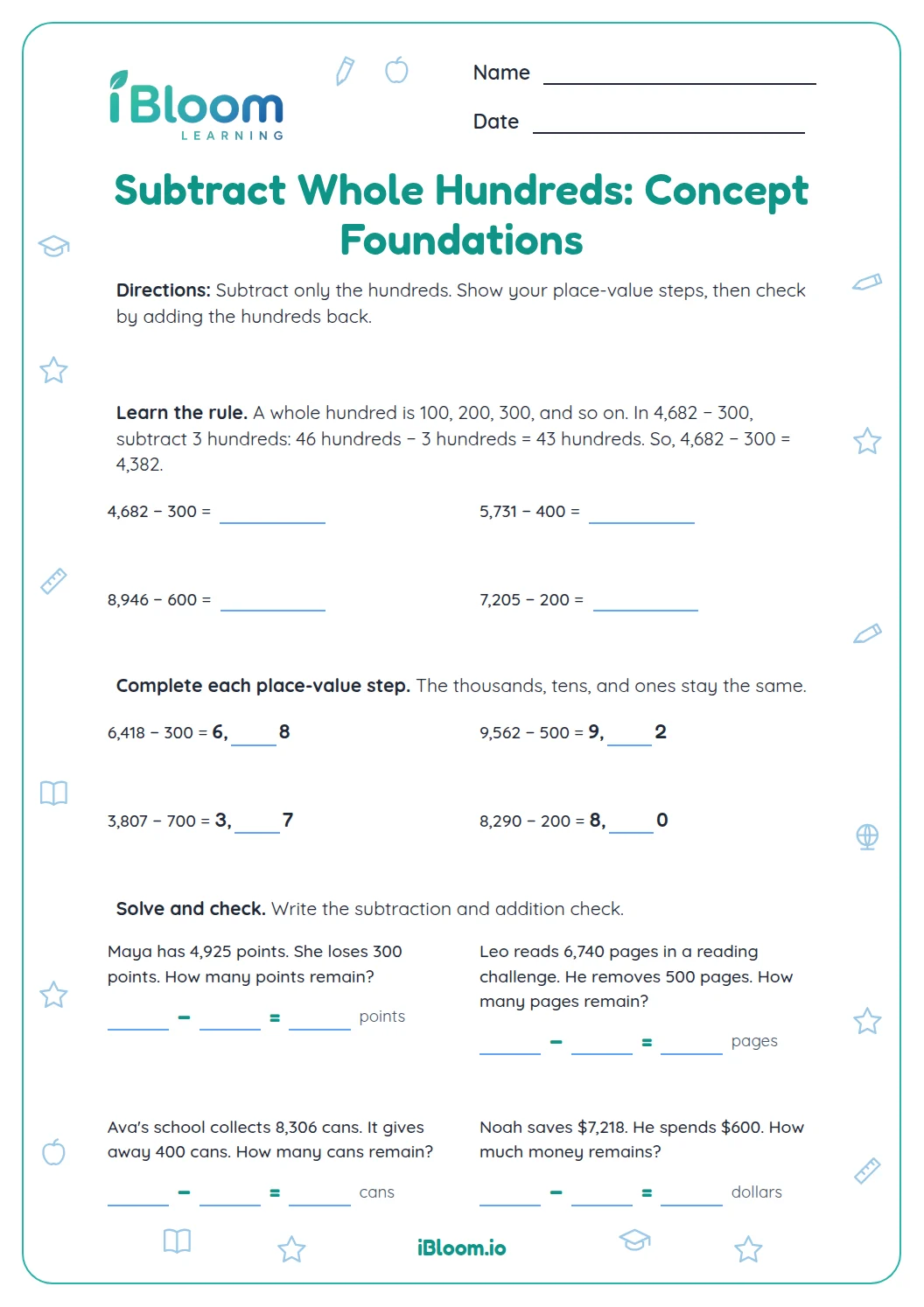
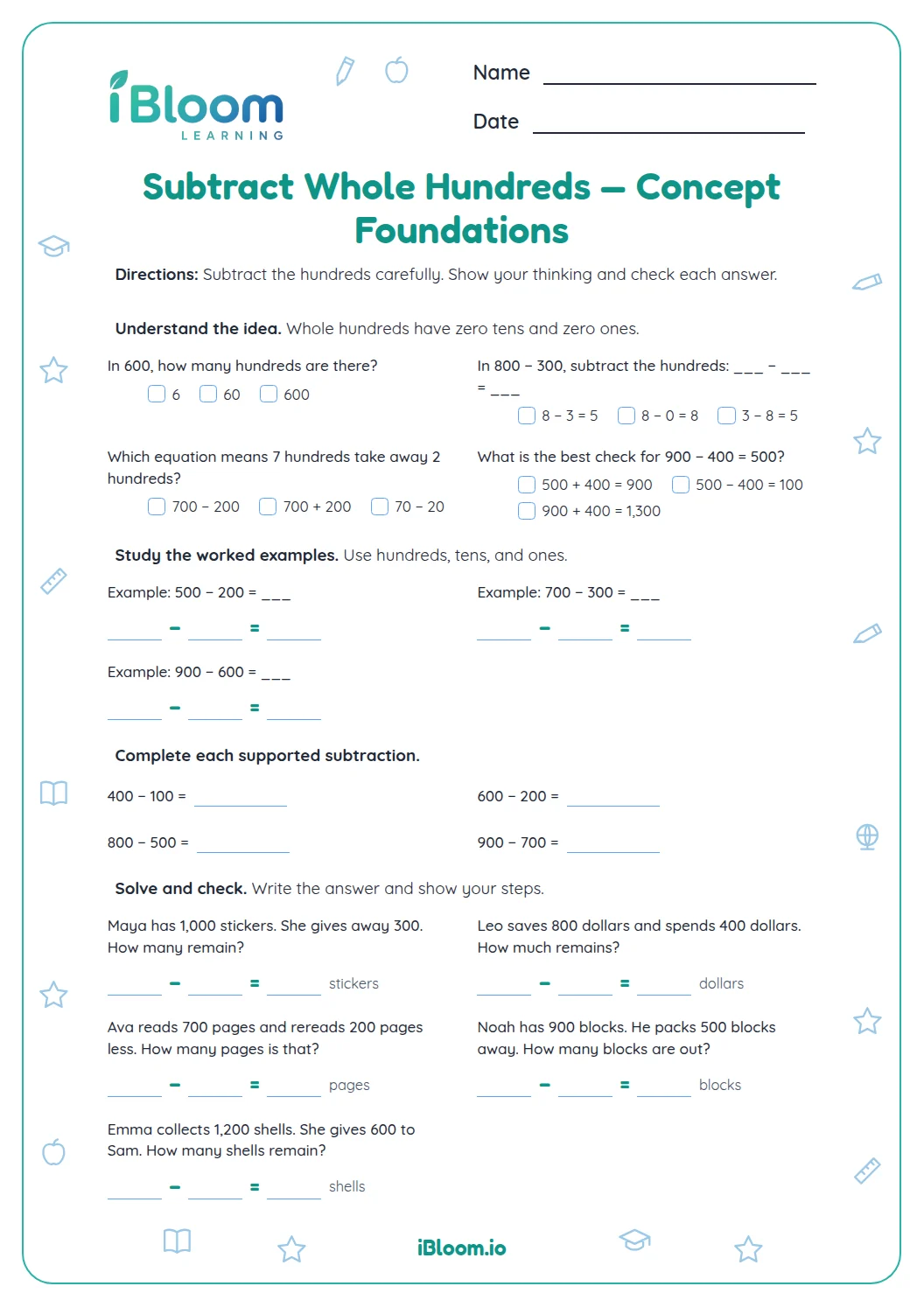
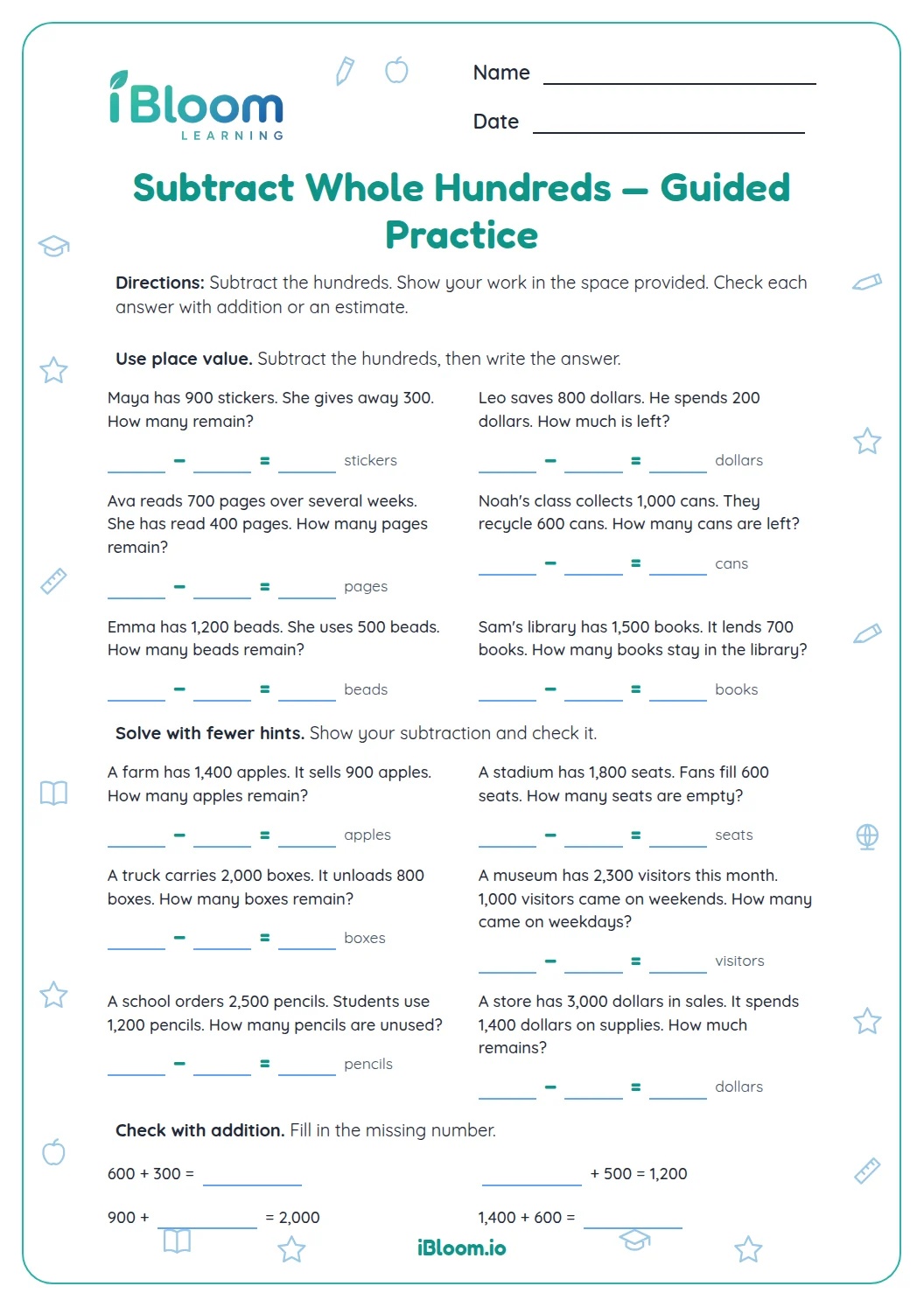
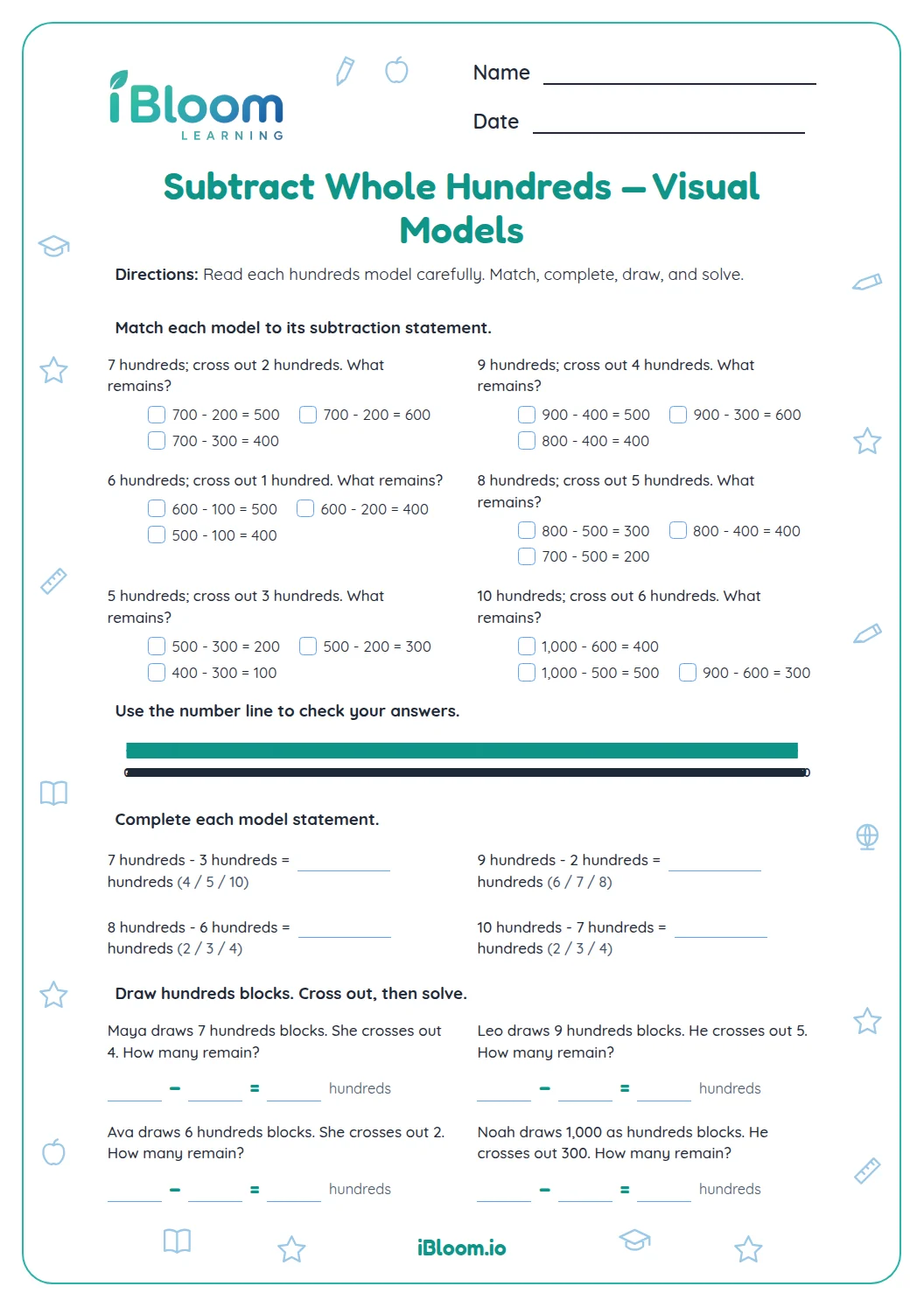
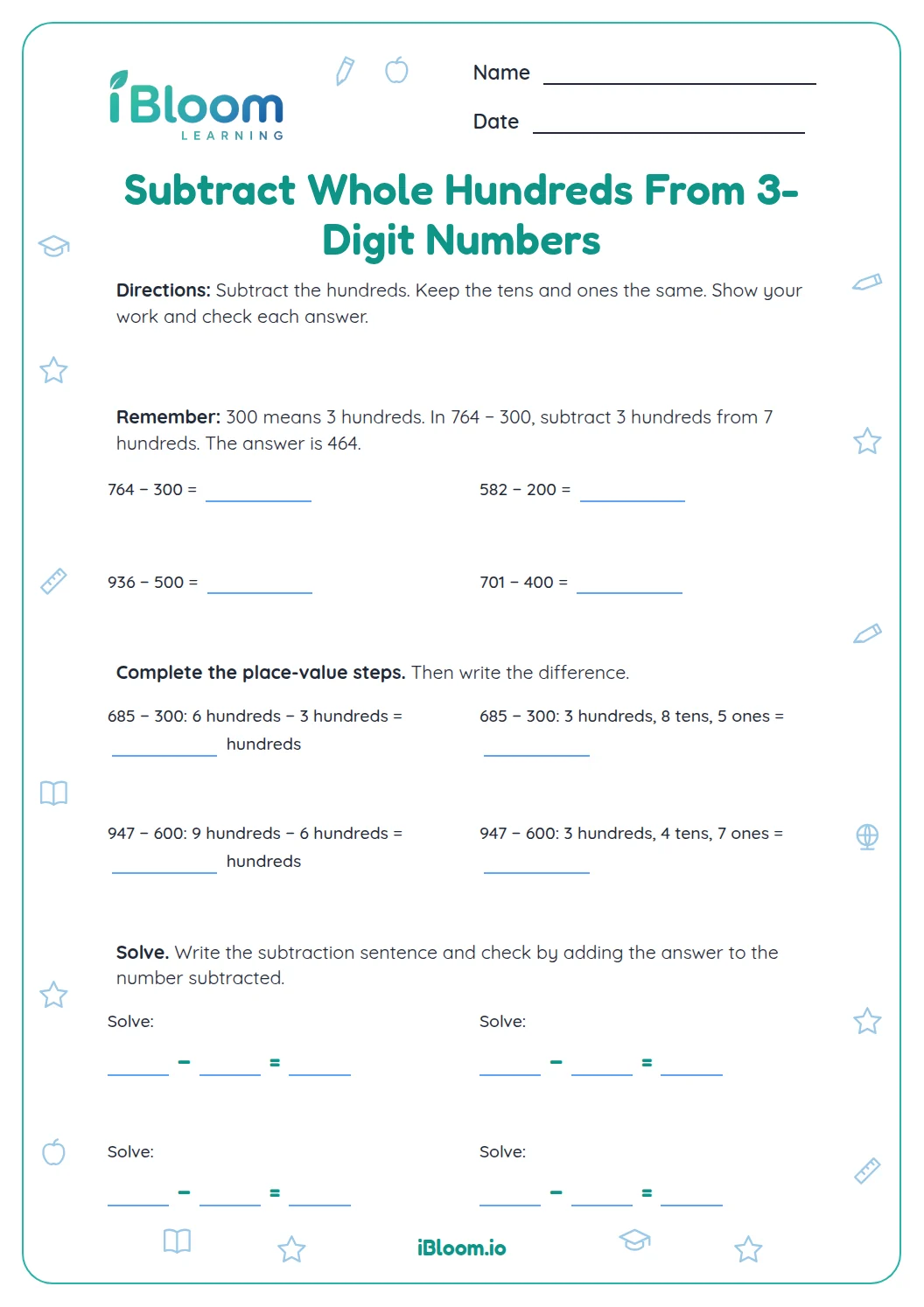
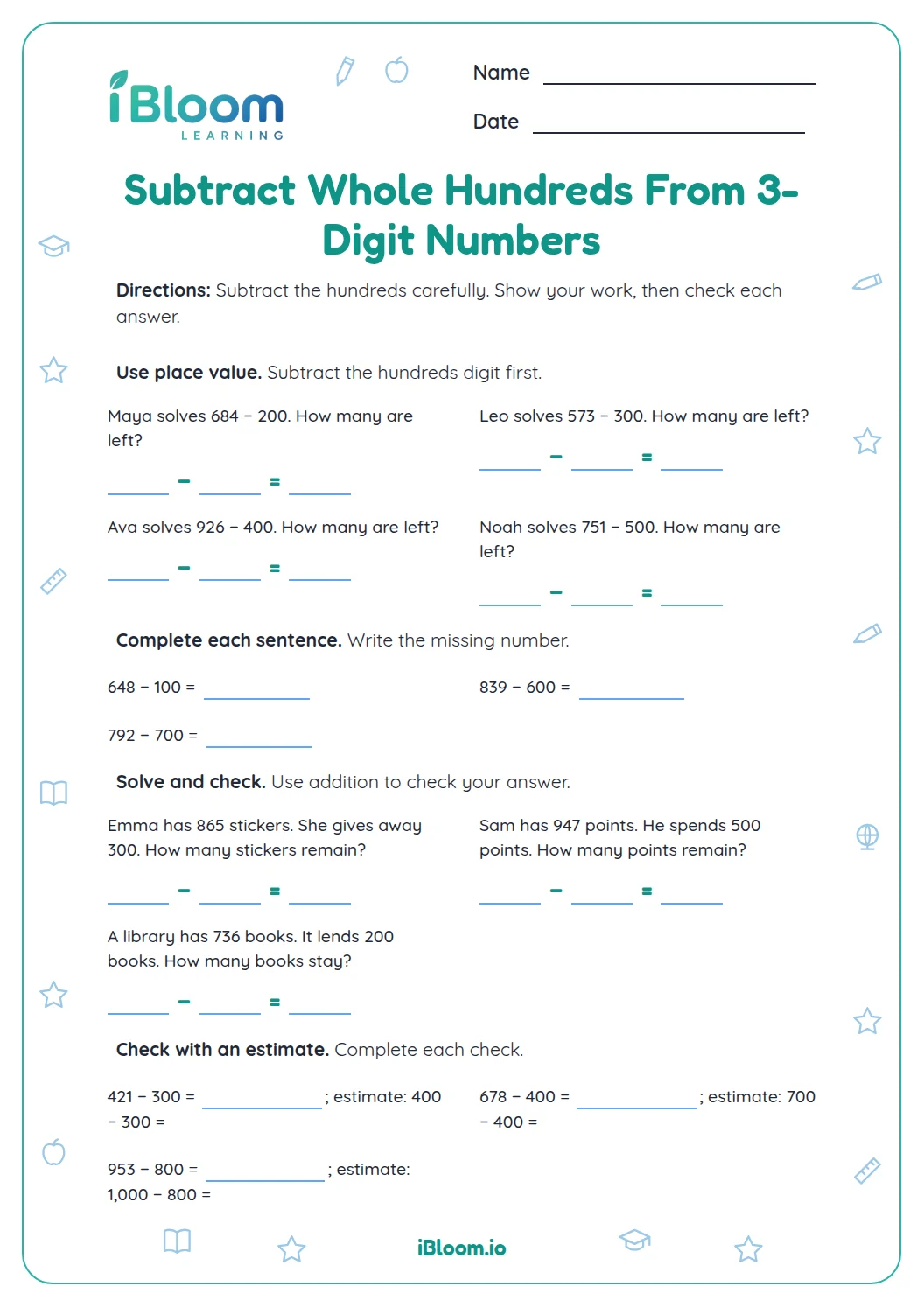
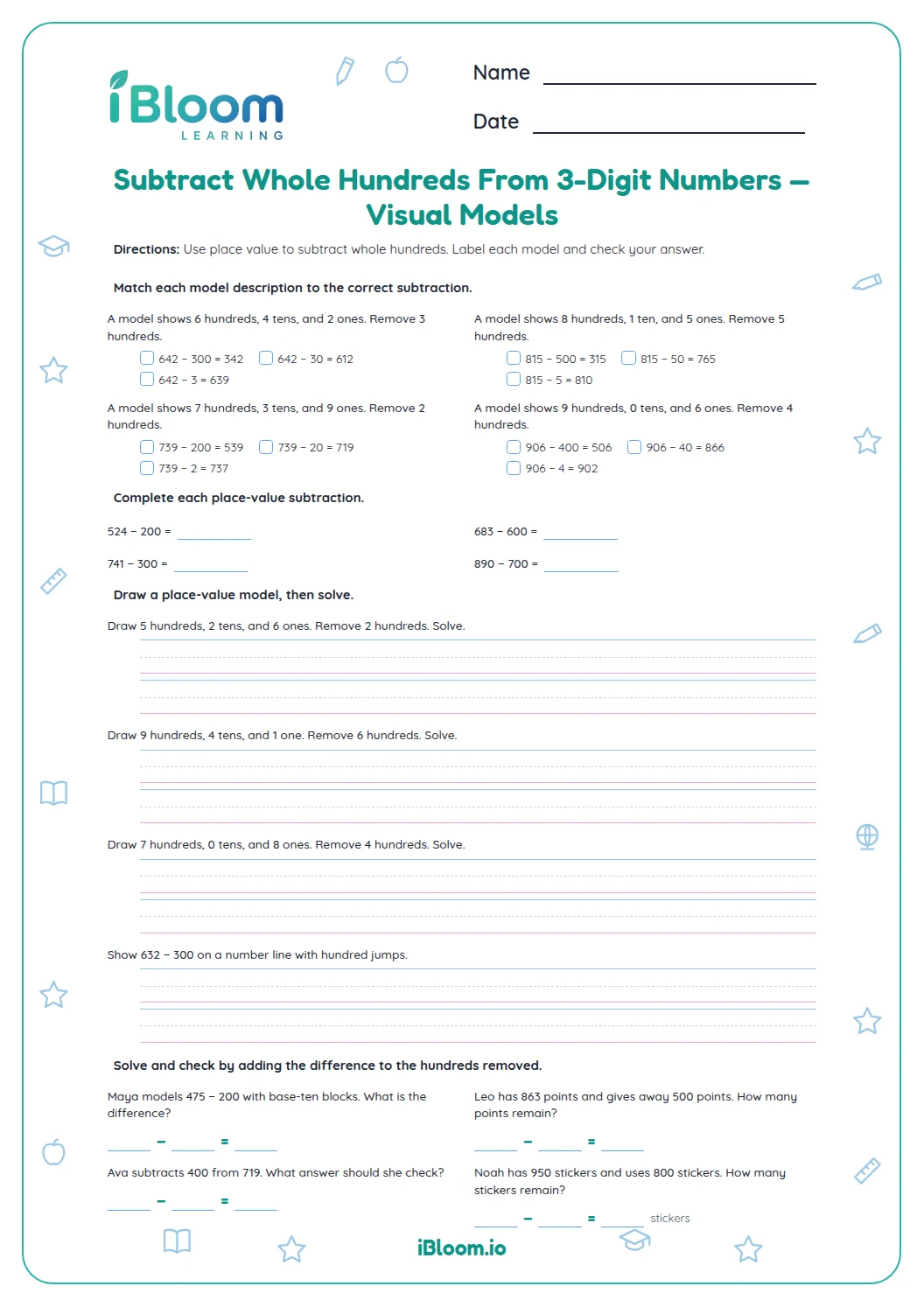
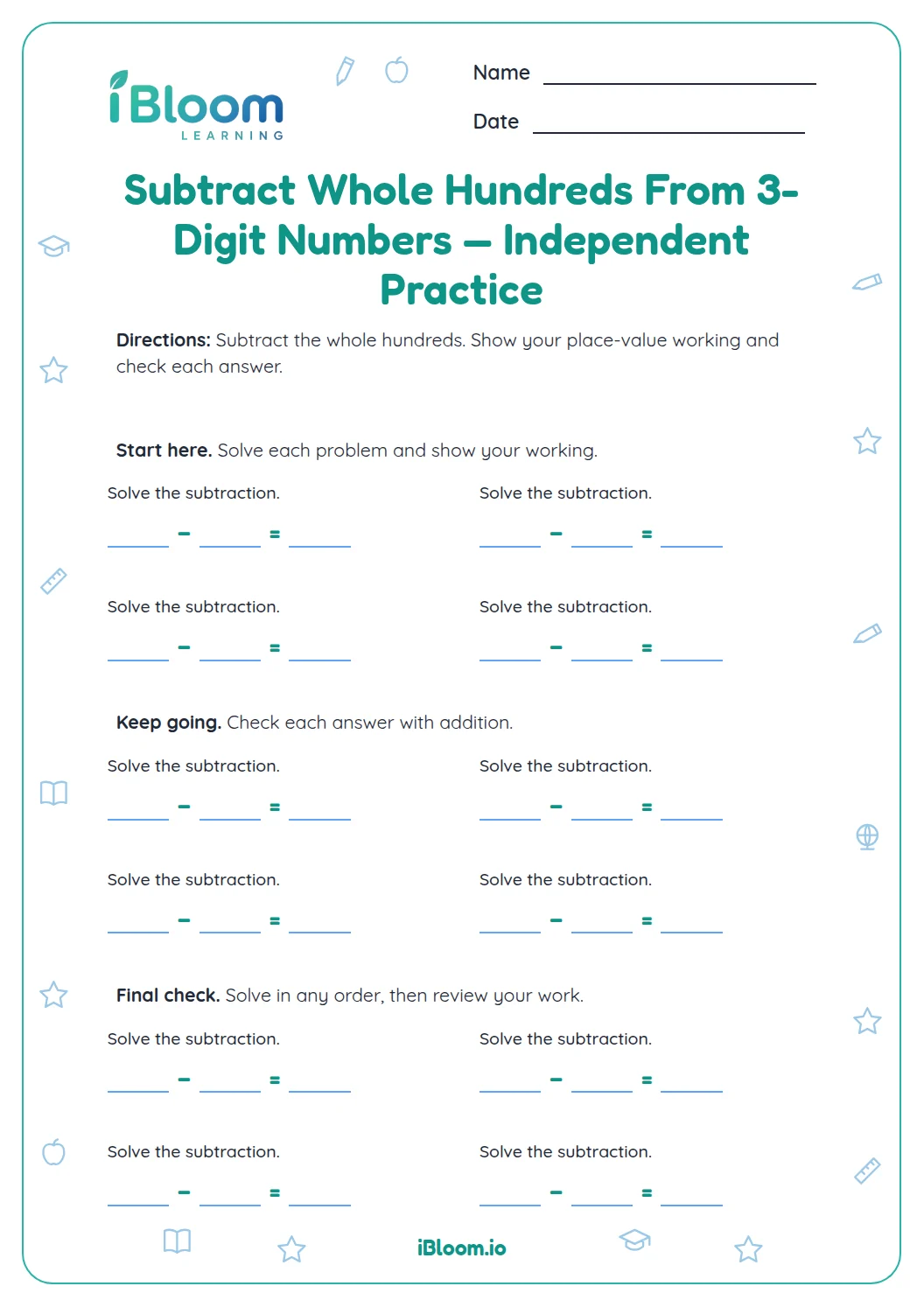
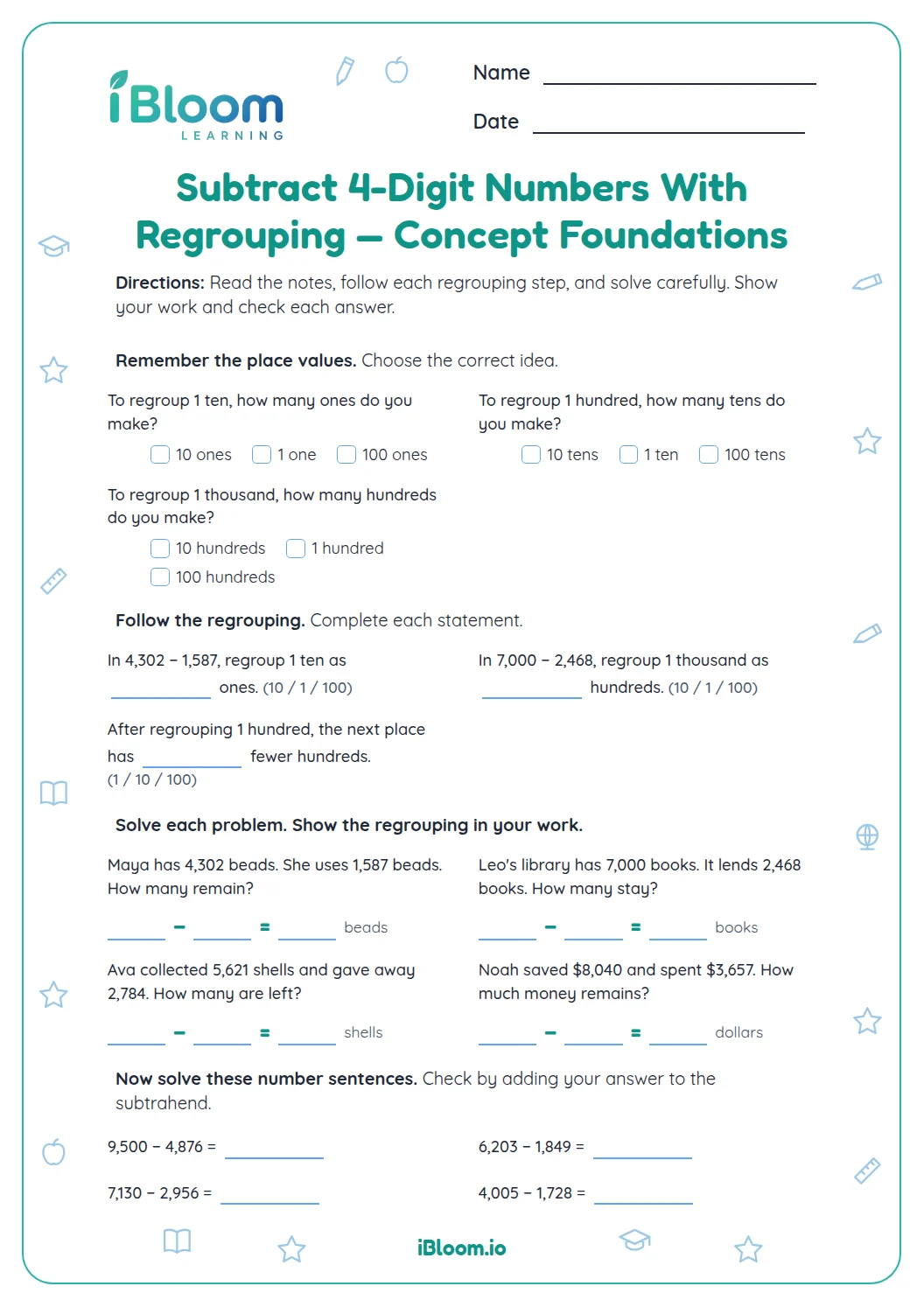
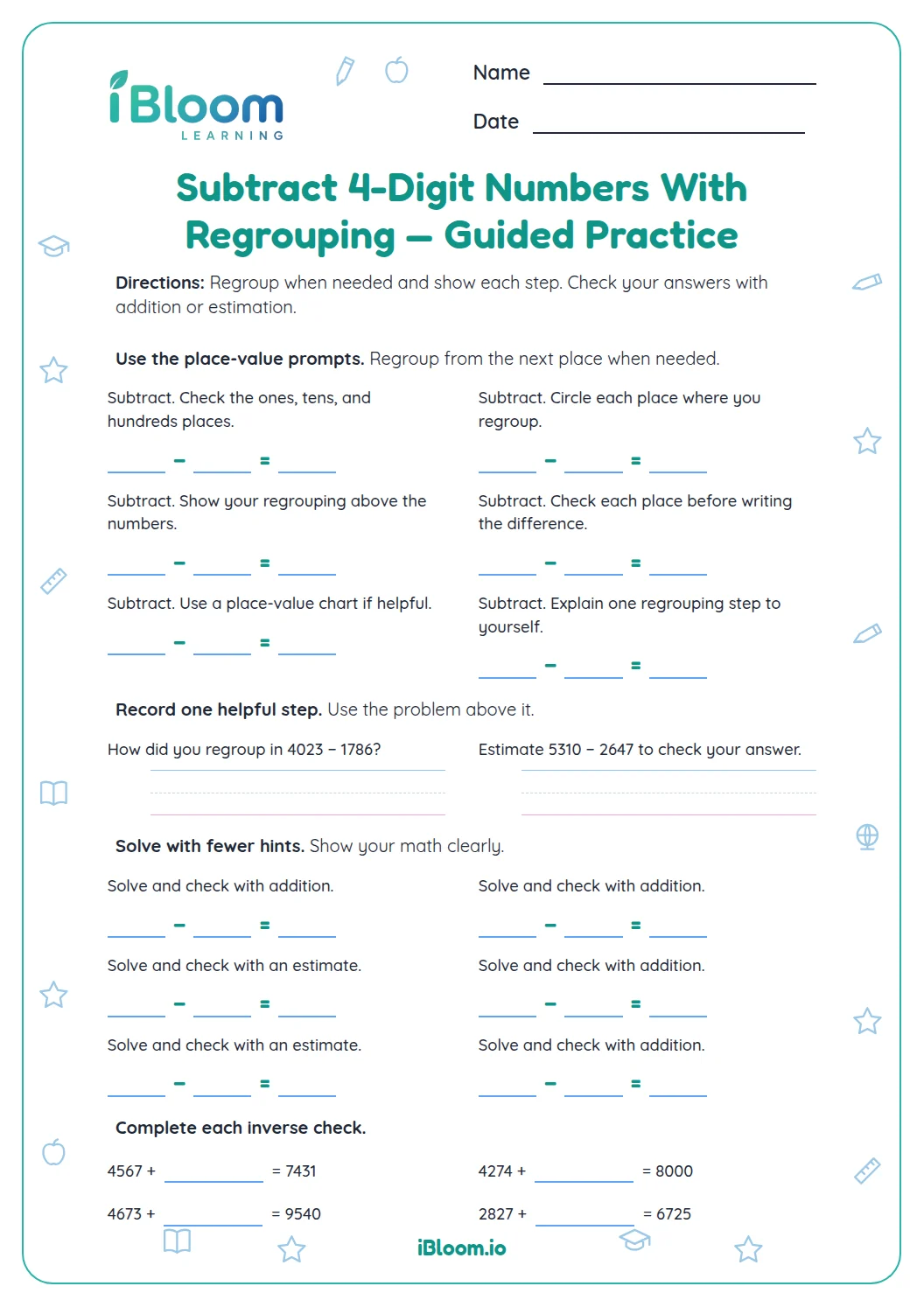
This Grade 3 worksheet gives 16 guided subtraction problems with four-digit starting numbers and whole hundreds subtracted. Students practice preserving place value and use addition to check selected differences, such as 4,682 − 300 = 4,382. A separate two-page answer key lists each difference. It aligns with CCSS 3.NBT.A.2, which calls for fluent addition and subtraction using place-value strategies and the relationship between the operations.
Aligned to 3.NBT.A.2
How do you subtract whole hundreds?
Subtract the hundreds while keeping the tens and ones in place. For example, 4,682 − 300 means 46 hundreds and 82 ones minus 3 hundreds, so the difference is 4,382.
The first eight questions build fluency with four-digit minuends. In question 1, 4,682 − 300 = 4,382; adding 300 back returns 4,682.
- 14,682 − 300
- 246 hundreds − 3 hundreds = 43 hundreds
- 34,382
- 4Check: 4,382 + 300 = 4,682
What does the second set ask students to do?
The second set mixes straightforward subtraction with a check by addition. Each item still uses a four-digit starting number and subtracts a whole number of hundreds.
For question 9, subtract 600 from 8,004 to get 7,404, then add 600 to confirm the starting number.
How can a student check a subtraction answer?
Add the number taken away to the difference. The sum should match the original four-digit number. This inverse-operation check is useful when zeros appear in the tens or ones places.
How to use this worksheet
- 1Read the hundreds being subtracted and line up place values.
- 2Subtract the hundreds from the starting number.
- 3Keep tens and ones in their places, regrouping only when needed.
- 4For check items, add the hundreds back to the difference.
- 5Compare the check sum with the original number.
Common mistakes and quick fixes
The mistake
Subtracting from a zero hundreds digit without regrouping correctly.
The fix
Think in hundreds and regroup one thousand as ten hundreds when necessary.
The mistake
Changing a tens or ones digit that is not part of the subtraction.
The fix
Keep each place value aligned and check that the amount removed is a multiple of 100.
The mistake
Writing the check sum as a second answer in the subtraction blank.
The fix
Use the answer blank for the difference; write any addition check in the provided working area.
Common Core alignment
This worksheet practices the following Common Core mathematics standard.
Subtract the hundreds while preserving the other place values.
On this sheet: The questions directly practice the stated skill.
Show the official wordingHide the official wording
Fluently add and subtract within 1000 using strategies and algorithms based on place value, properties of operations, and/or the relationship between addition and subtraction.
What to practice next
Make more practice
Further reading
Questions parents and teachers ask
How do you subtract hundreds from a four-digit number?
Subtract the hundreds digit value while keeping the other place values aligned. For example, 4,682 − 300 removes three hundreds from 46 hundreds, leaving 43 hundreds and 82 ones, or 4,382. Add 300 to the difference to check. Use the printed question and the separate answer key to check the result carefully.
Why does subtracting hundreds change only the hundreds place?
A whole hundred is made of 100, so subtracting 300 removes three hundreds. Depending on the digits, regrouping may be needed, but the tens and ones still represent the same amounts unless regrouping rewrites them. Use the printed question and the separate answer key to check the result carefully.
How can addition check subtraction?
Use the relationship between subtraction and addition: difference plus amount subtracted equals the starting number. For 8,004 − 600 = 7,404, check 7,404 + 600 = 8,004. Use the printed question and the separate answer key to check the result carefully.
Are there four-digit numbers throughout the practice?
Yes. Each of the 16 questions starts with a four-digit number and subtracts a whole number of hundreds. The set includes zeros in different places so students practice keeping place value organized. Use the printed question and the separate answer key to check the result carefully.
Does the page include worked space?
Yes. Selected questions provide space for computation, and the directions invite students to show place-value work and check selected differences. The answer key is printed separately. Use the printed question and the separate answer key to check the result carefully.
Is there an answer key?
Yes. A separate answer key lists all 16 differences. For the designated check questions, students can verify each result by adding the subtracted hundreds back. Use the printed question and the separate answer key to check the result carefully. Use the printed question and the separate answer key to check the result carefully.