


About this worksheet
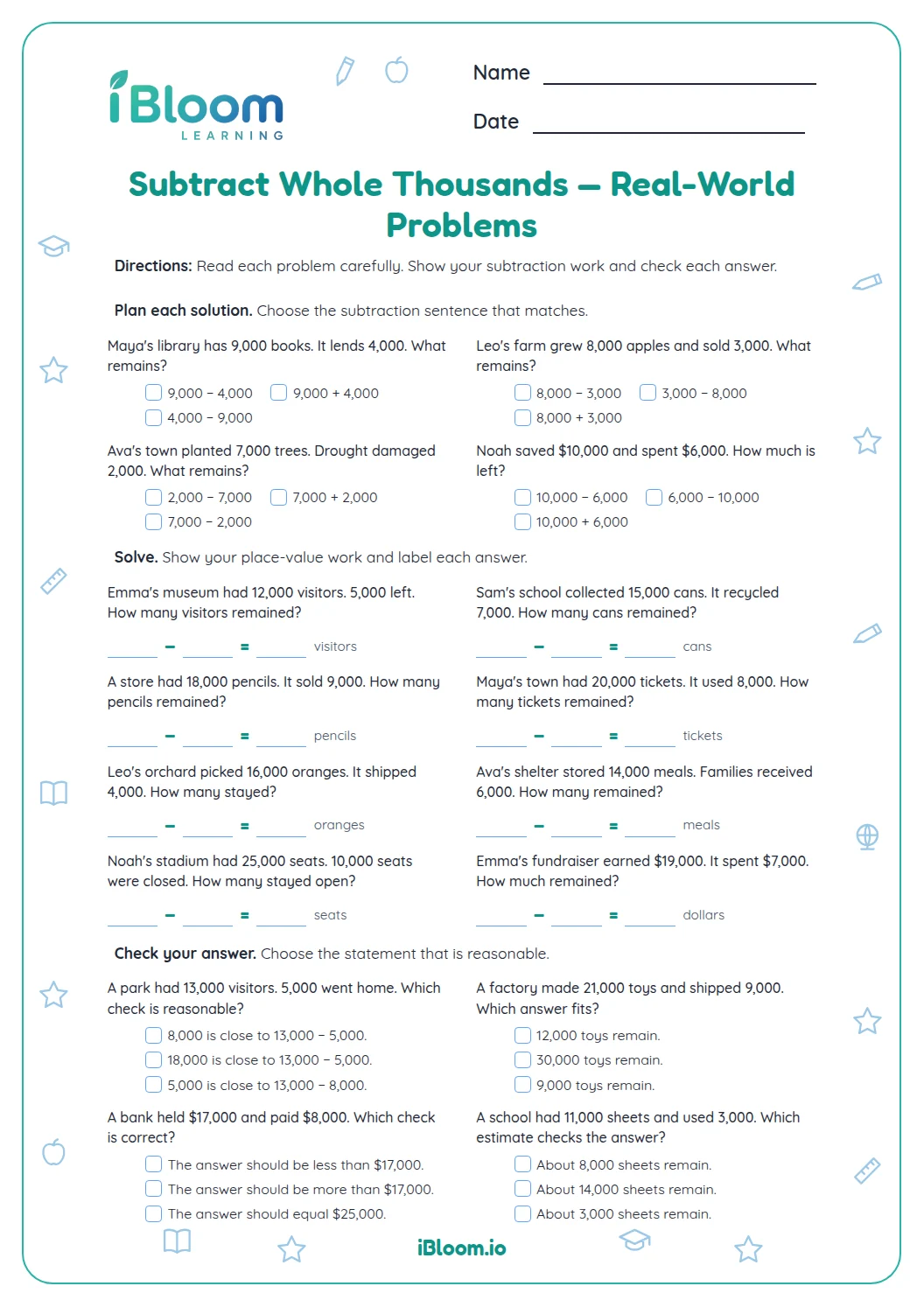
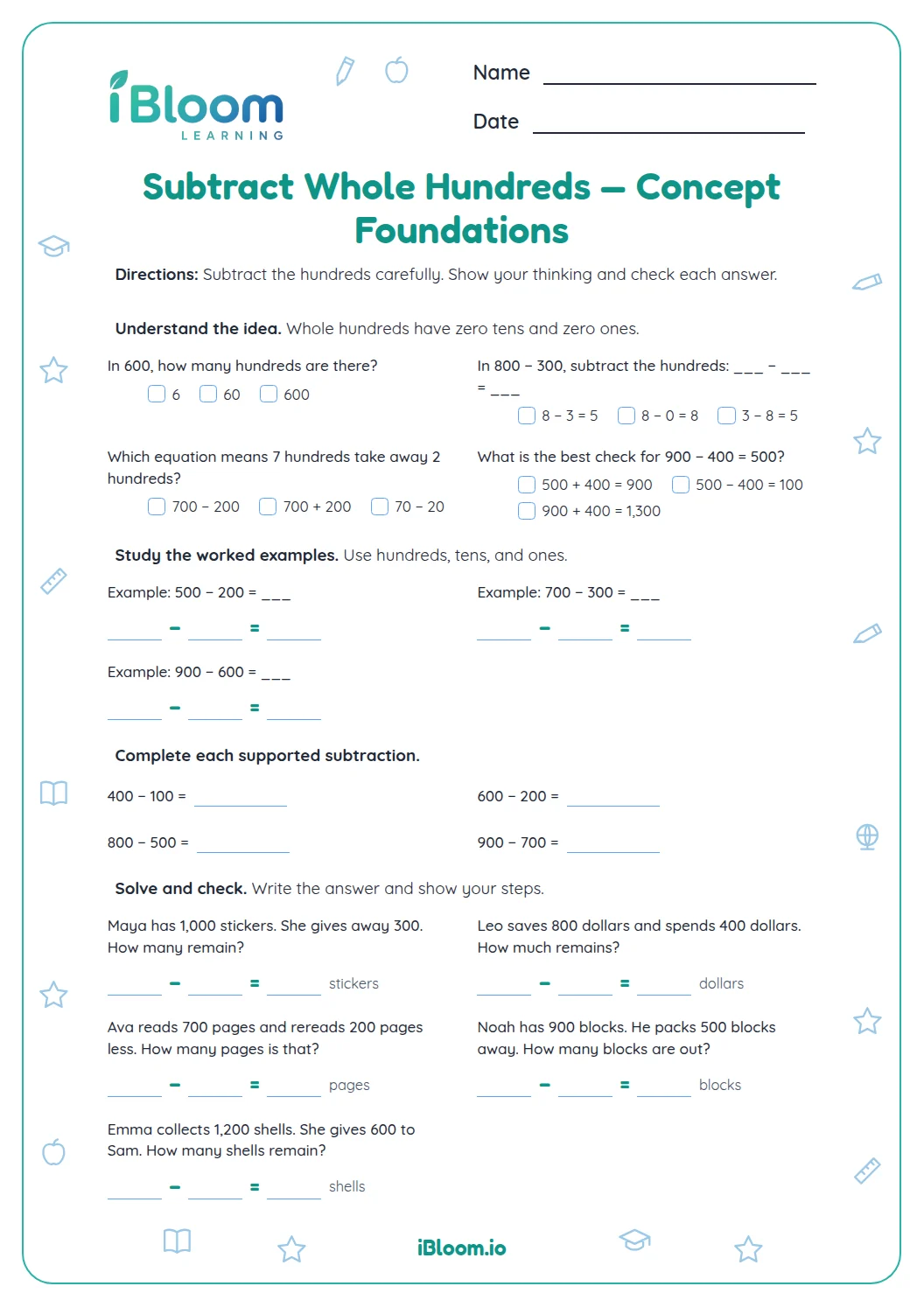
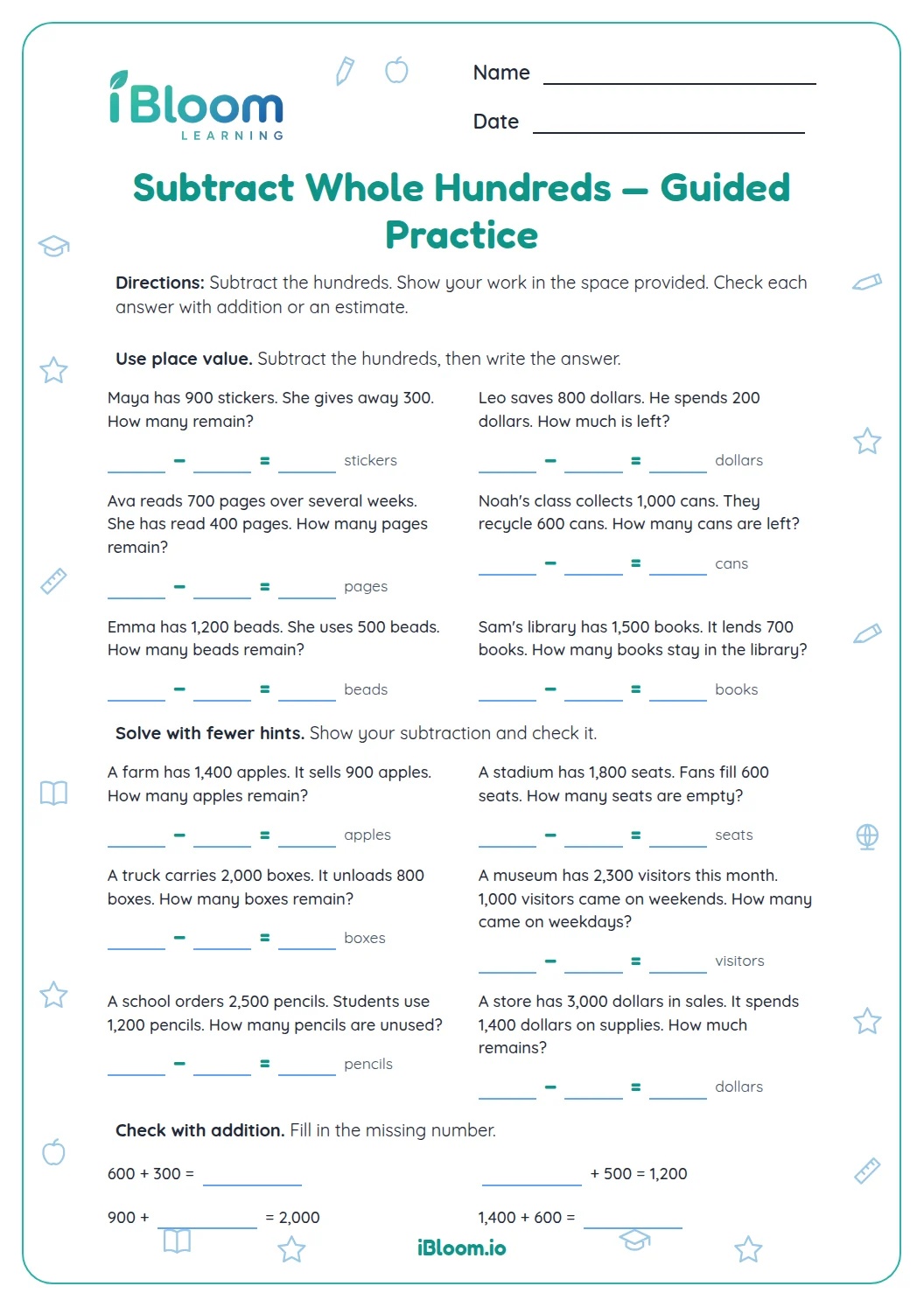
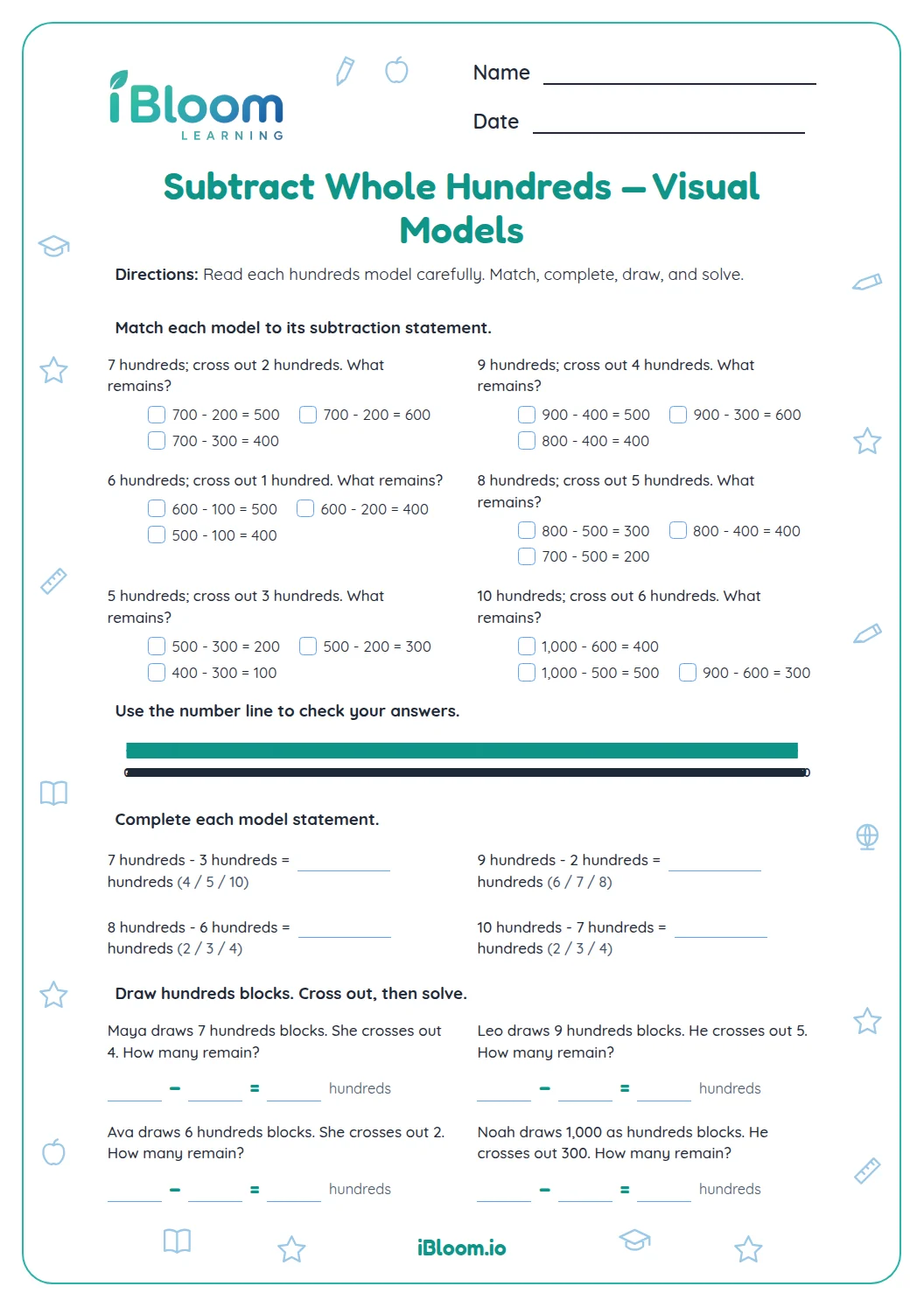
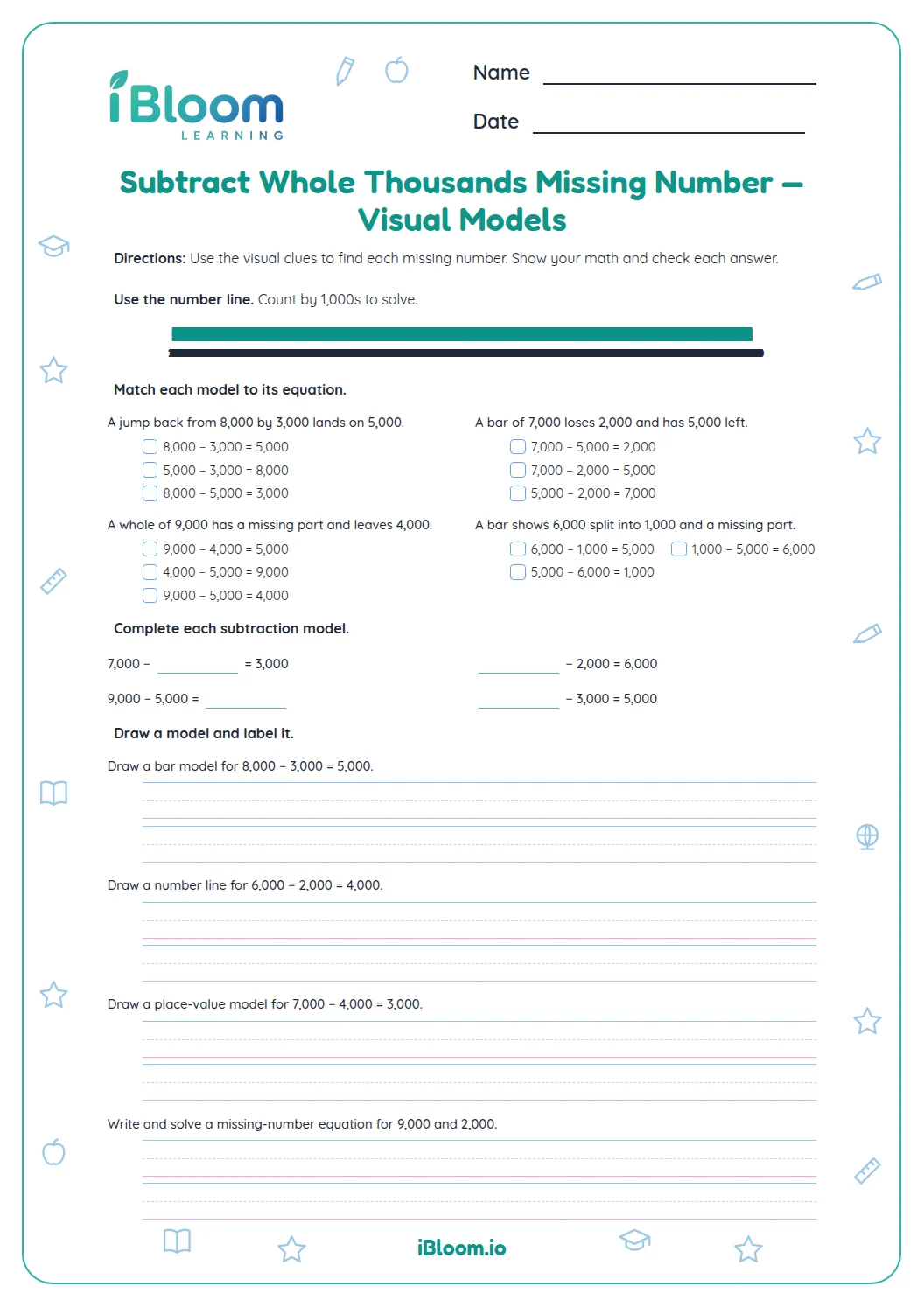
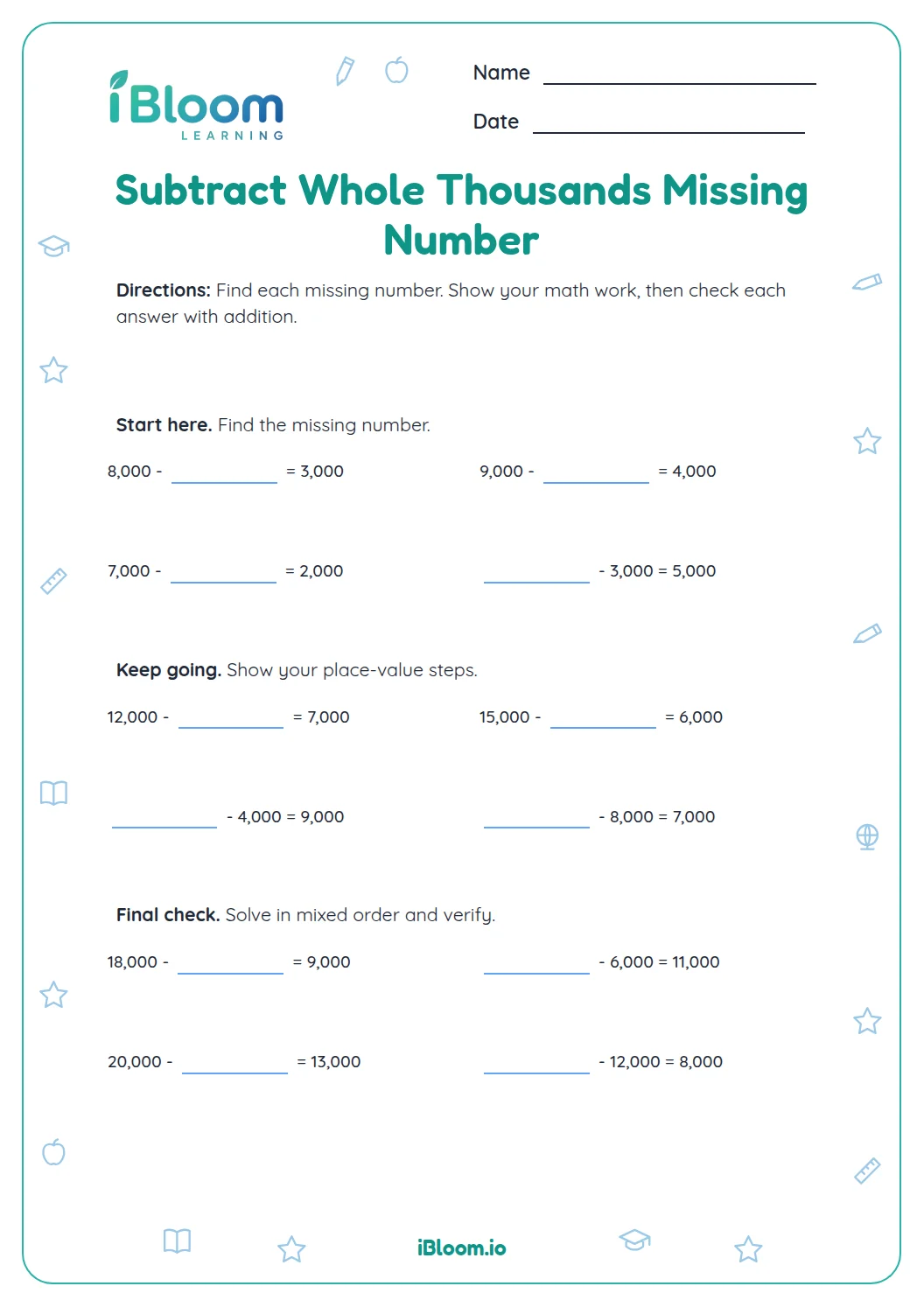
This free printable gives Grade 3 students focused practice in how to subtract whole thousands. The student pages show every number sentence, arranged in three parts for a clear progression. A complete answer key is included.
What will students solve?
The worksheet has 16 printed number sentences in three parts. In Part A, solve 8,000 − 3,000 by subtracting 8 thousands − 3 thousands.
Which strategy supports mental work?
Think in thousands: 8 thousands − 3 thousands = 5 thousands, so 8,000 − 3,000 = 5,000. Keep the thousands place when writing the result.
How can a student check?
Use the related operation to check the result. For subtraction, add the difference to the amount taken away; for addition, split the addends and recombine; for division, multiply the quotient by the divisor.
How to use this worksheet
- 1Read the operation sign and both numbers.
- 2Choose a place-value or related-fact strategy.
- 3Solve each number sentence and record the answer.
- 4Check with the inverse operation or a second strategy.
Common mistakes and quick fixes
The mistake
Writing 5 instead of 5,000 after subtracting 8 − 3.
The fix
Say the answer in thousands, then write the matching number of zeros.
The mistake
Copying one of the numbers incorrectly.
The fix
Read both numbers once more before solving.
The mistake
Stopping without checking the result.
The fix
Use the related operation to confirm the answer.
What to practice next
Make more practice
Questions parents and teachers ask
How many problems are included?
There are 16 problems in three parts. Each number sentence is printed on the student pages, so students can begin solving without copying operands from the key. The answer key follows the practice pages and lists the correct result for each item.
What grade is this worksheet for?
This worksheet is labeled Grade 3 and focuses on subtract whole thousands. The problems use direct computation so a student can concentrate on the place-value or fact relationship behind each answer. An adult can review one example, then let the student continue independently.
What strategy can students use?
Think in thousands: 8 thousands − 3 thousands = 5 thousands, so 8,000 − 3,000 = 5,000. Keep the thousands place when writing the result. Students may also write a quick note on scratch paper if they want to keep track of their thinking.
How should I use the answer key?
Have the student complete a part before checking it. For any missed item, compare the written number sentence with the key, then use the related operation to locate the error. This keeps the key useful for checking rather than copying answers.
What should students practice next?
The links below lead to related skills, including another way to work with this place value. Choose a page that matches the next classroom goal, and use its directions and answer key to continue practice. For a smooth next step, review one worked example before starting the new page.