


About this worksheet
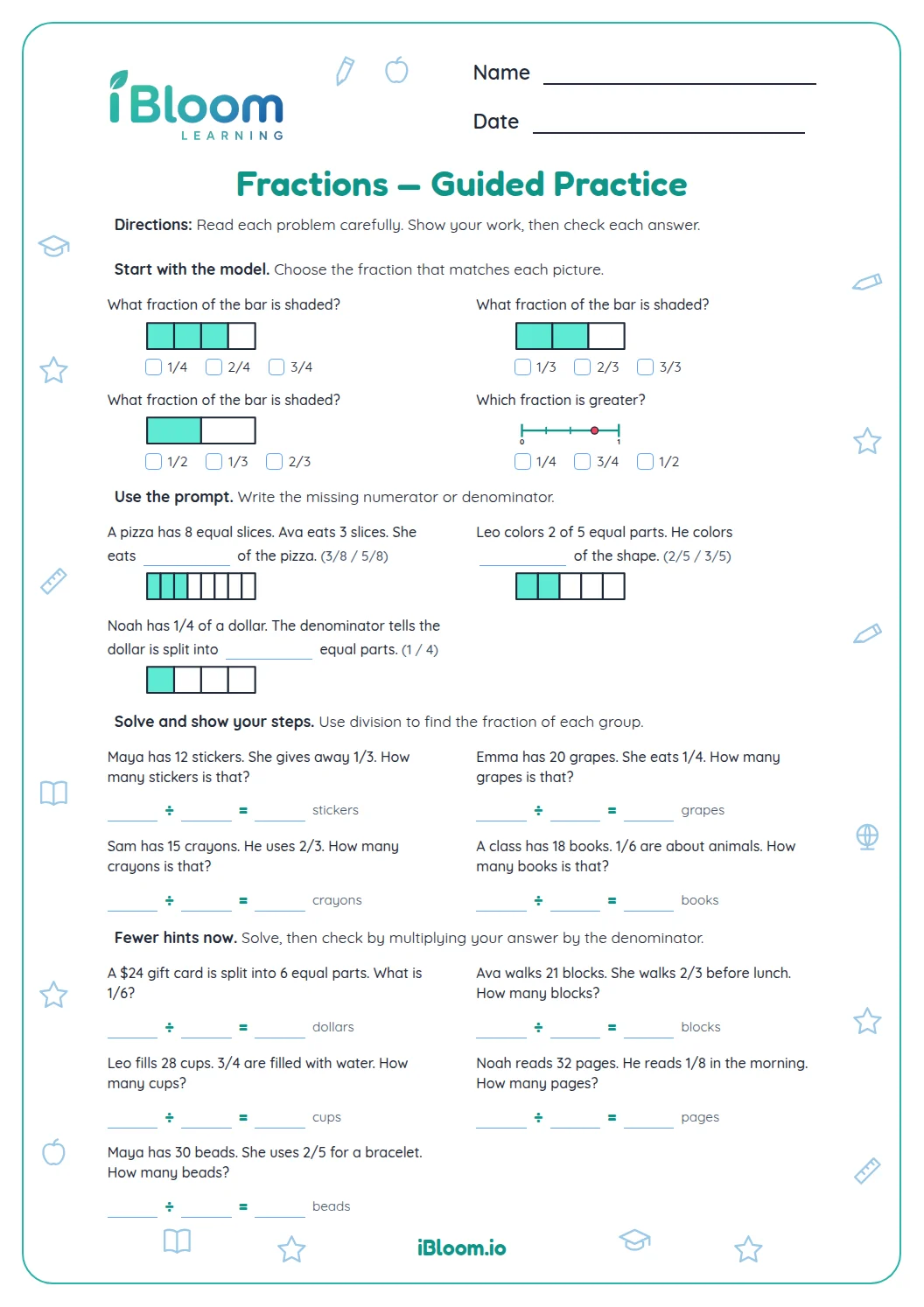
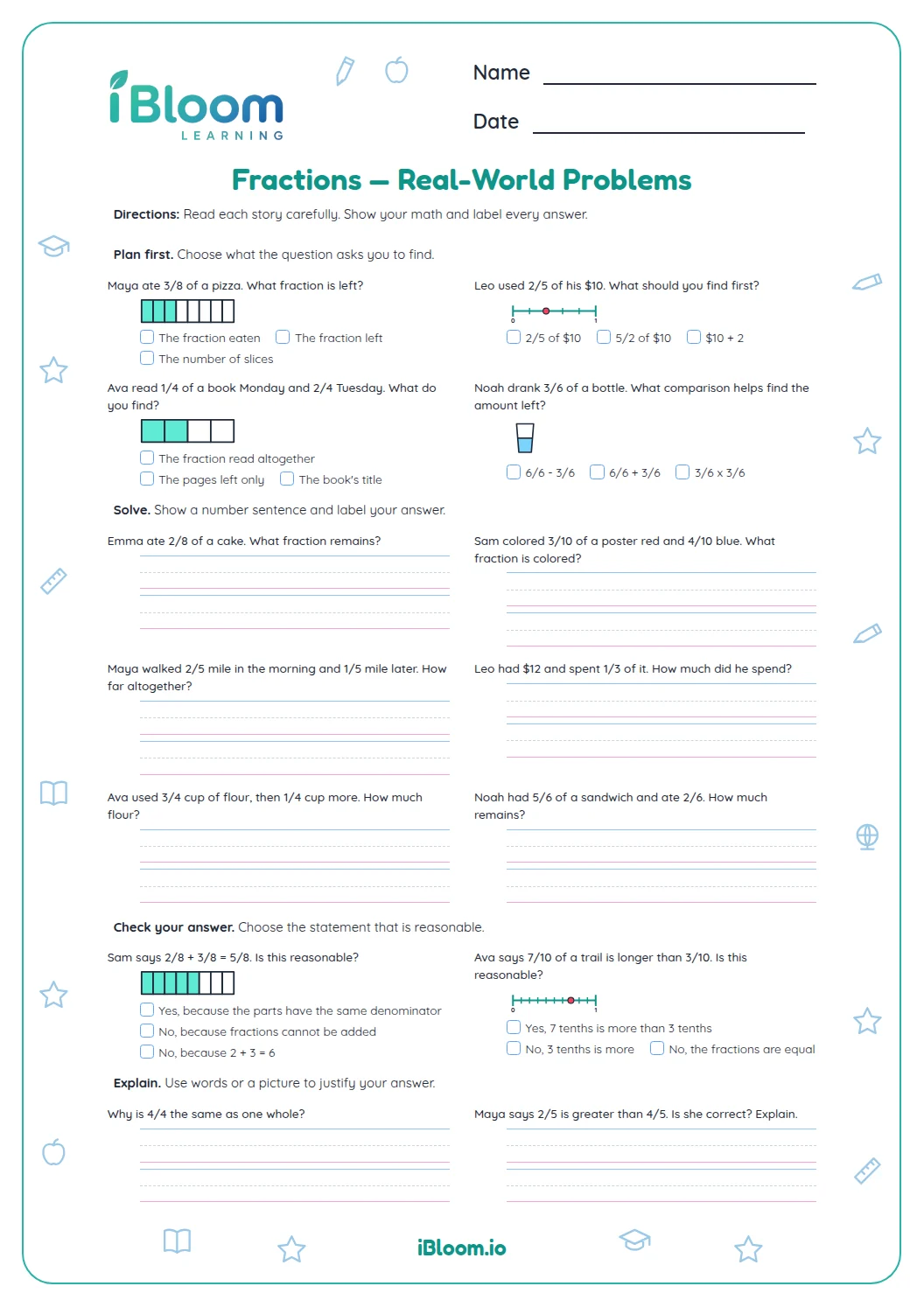
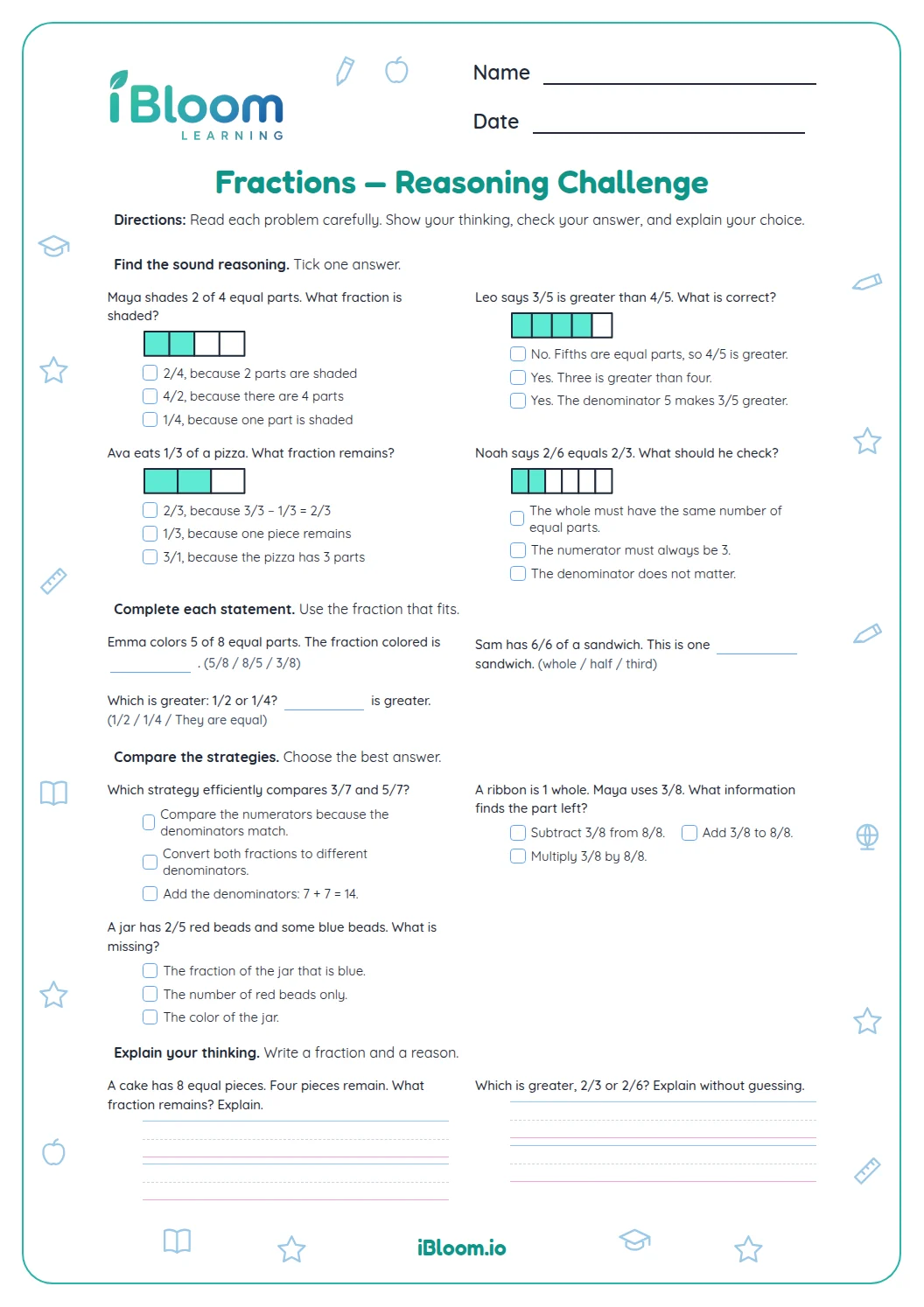
This Grade 3 printable pairs fraction stories with a real shaded model on every question. Students read equal-part bars, circles, and squares while solving stories about food, a trail, a book, a garden, and a ribbon. The denominators stay within Grade 3 fraction work, and the key lists one numerical fraction per answer.
Aligned to 3.NF.A.1
How does a shaded model show a fraction?
Count all equal pieces to find the denominator. Count the shaded pieces to find the numerator. In question 1, one of four parts is eaten, so three of the four equal parts remain.
- 14 equal parts make the whole
- 21 part eaten leaves 3 parts
- 33/4 of the pan remains
How do you combine or remove equal-size parts?
When parts have the same denominator, keep the size of the parts and add or subtract the numerators. In question 5, three eighths plus two eighths is five eighths.
How to use this worksheet
- 1Count the equal parts in the whole to identify the denominator.
- 2Use the story to decide whether parts are added, removed, or named.
- 3Count the shaded or selected parts for the numerator.
- 4For equal denominators, keep the denominator while adding or subtracting numerators.
- 5Compare your answer with both the story and the drawing.
Common mistakes and fixes
The mistake
Using the shaded count as the denominator.
The fix
Count all equal pieces for the denominator and shaded pieces for the numerator.
The mistake
Adding denominators when the part sizes match.
The fix
Keep the denominator and combine only the numerators.
The mistake
Forgetting that the remaining part is the unshaded part.
The fix
Subtract the used parts from all parts in the whole.
Common Core alignment
This worksheet gives students practice with the fraction skills described below.
Understand a fraction as equal parts of one whole.
On this sheet: Students read numerator and denominator values from shaded equal-part models and connect them to story amounts.
Show the official wordingHide the official wording
Understand a fraction 1/b as the quantity formed by 1 part when a whole is partitioned into b equal parts; understand a fraction a/b as the quantity formed by a parts of size 1/b.
What to practice next
Make more practice
Further reading
Questions parents and teachers ask
What does the bottom number in a fraction tell us?
The denominator tells how many equal parts make one whole. For example, a pan split into four equal pieces has denominator 4, whether one, two, or three pieces are shaded. Students can check that the calculation matches the values and directions printed in this worksheet before using the separate key to review the result.
How do students find the fraction left?
Count all the parts, then remove the parts described as eaten or used. In question 1, four parts make the pan and one was eaten, leaving three of the four parts, or 3/4. Students can check that the calculation matches the values and directions printed in this worksheet before using the separate key to review the result.
Why do some answer choices show fractions instead of models?
The drawings show the quantities in the stories, and the choices ask students to name those quantities as fractions. Each option is printed as a fraction so it can be read clearly. Students can check that the calculation matches the values and directions printed in this worksheet before using the separate key to review the result.
Does each question include a drawing?
Yes. Every question has a bar, circle, or square divided into equal parts. Students can use the model alongside the words in the story. Students can check that the calculation matches the values and directions printed in this worksheet before using the separate key to review the result.
How can a child check an addition story?
Check that the total shaded parts match the two amounts in the story. For three eighths and two eighths, the model has five shaded eighths. Students can check that the calculation matches the values and directions printed in this worksheet before using the separate key to review the result.